



















1.The working principle of dried bagasse biomass pellet processing equipment
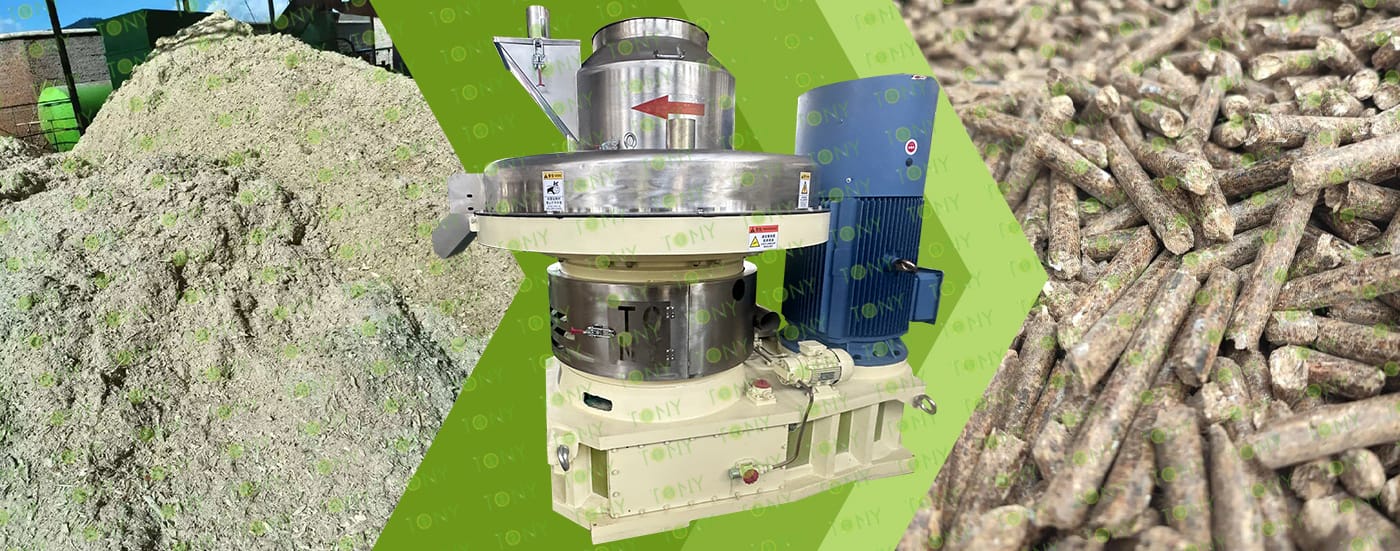
The most critical step is completed by the biomass pellet machine.
The raw material falls vertically into the pellet machine and is evenly distributed across the inner surface of the ring die through the rotational motion between the rollers and the die.
Under high mechanical pressure, the rollers exert tremendous pressure on the material, forcing the powdered bamboo through the circular channels of the ring die.
During the extrusion process, friction between the materials and between them and the die generates high temperatures (up to 80°C to 120°C), softening the natural lignin in the sugarcane and causing it to self-adhere, eliminating the need for additional adhesives.
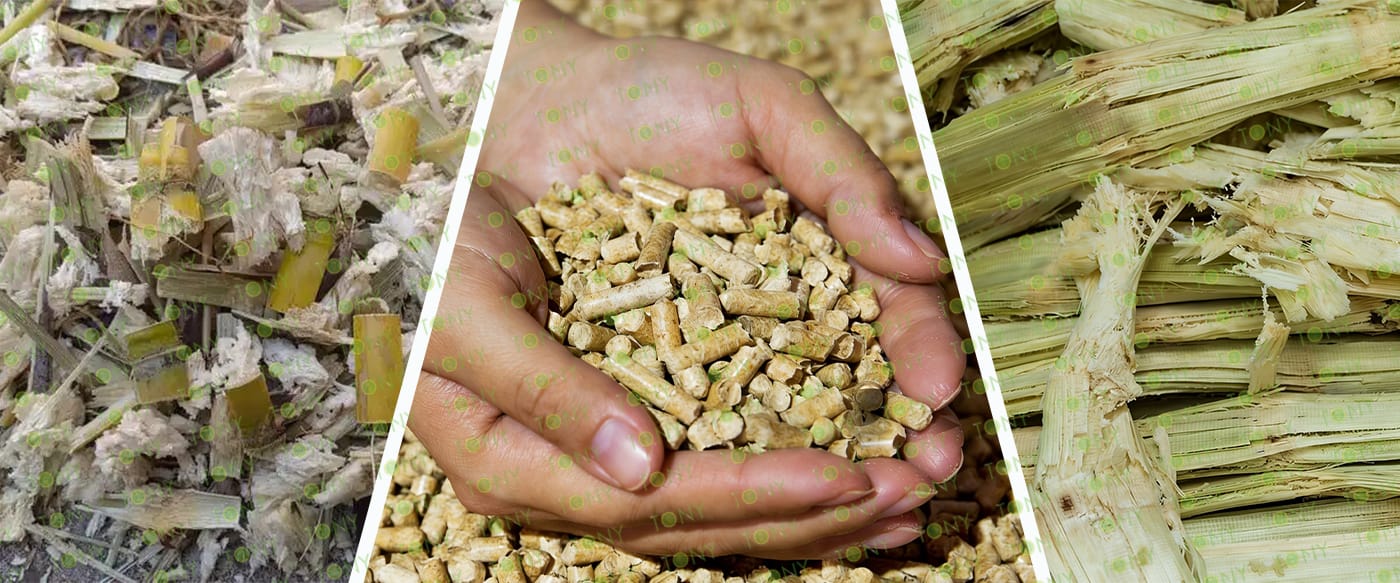
The resulting long pellets are cut by a cutter, forming cylindrical fuel pellets approximately 10 to 30 mm in length.
This process leverages the properties of sugarcane as a wood fiber material—its rich lignin content and excellent thermoplasticity under high temperature and pressure—making it a key to achieving glue-free molding.
2.Characteristics of dried bagasse biomass pellet processing equipment
(1)Economic benefits: low cost and high return
Low raw material cost: Bagasse is a waste product of the sugar industry. The acquisition cost is extremely low, or even free, which significantly reduces the input of raw materials.
Low equipment investment: The equipment of small and medium-sized production lines is simple to operate and can be used by ordinary people after training. The labor cost is low and the overall return on investment is high.
Potential for policy support: As a renewable energy project, it may enjoy local subsidies or tax incentives.
(2)Environmental protection and sustainability
Carbon neutrality: The carbon dioxide absorbed during the growth process of bagasse is balanced with the amount released during combustion. There is no additional carbon emission and no harmful gases such as sulfur dioxide are produced.
Renewable: Sugarcane can be planted every year, the raw material supply is stable, and it replaces fossil fuels to reduce resource consumption.
Turning waste into treasure: Solve the pollution problem of bagasse accumulation, increase farmers' income, and form a circular economy.
(3)Wide range of application scenarios
Bagasse pellets can be used for home heating, industrial boilers, biomass power plants, etc., covering multiple scenarios such as homes, enterprises, and power plants. The combustion efficiency is over 98%, meeting different heat energy needs.
(4)Efficient and stable equipment performance
High molding rate: The patented mold design enables a pellet molding rate of over 99.5%, reducing raw material waste.
Automation and durability: The equipment has a reasonable structure and the pressing wheel can be automatically adjusted to avoid machine jams, extend service life, and support continuous production.
3.Application scenarios of dried bagasse biomass pellet processing equipment
(1)Industrial sector:It can replace coal for boiler heating and steam production in sugar mills, paper mills, food factories and other enterprises, realizing the "slag-to-energy" cycle model;
(2)Civil sector:It can be used as a clean fuel for home heating and cooking, replacing liquefied gas and loose coal;
(3)Power generation sector:It can be used as fuel for biomass power plants and participate in grid-connected power generation;
(4)Animal husbandry sector:It can be used as feed for animal husbandry, taking advantage of its "high crude fiber" characteristics, as a roughage supplement for ruminants such as cattle and sheep.
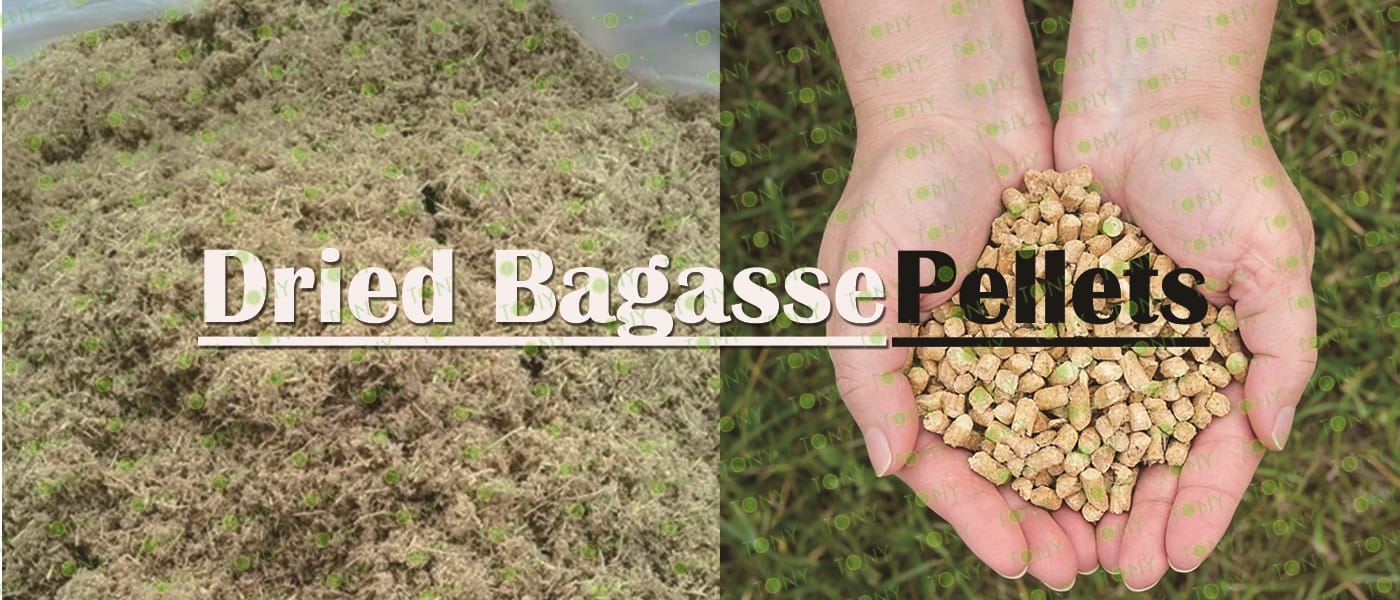
TONY Brand 24-30Ton/Hour Dried Bagasse Pellet Manufacturing Plant can take dried bagasse as the main raw material. After pretreatment and processing, it is solidified into high - density Bagasse pellet fuel. This fuel is an ideal substitute for coal and oil and plays a role in energy conservation and emission reduction. At present, it has been widely used in regions rich in bagasse resources.
1. Capacity: 24-30Ton/Hour
2. Raw materials: Dried bagasse
3. Moisture: dried type, about 10-15%.
4. Application: All kinds of bagasse materials suitable for pellet production.
Suitable customers: Sugarcane processing factories are the direct output of bagasse, such as sugar mills, sugarcane ethanol factories, sugarcane pulping factories, etc.; centralized storage and transit places, such as sugar mills, ethanol factories, agricultural product processing parks, where multiple sugarcane processing factories often gather to form a park. The storage and transit areas of bagasse are uniformly planned within the park, and the resource concentration is extremely high.and other places where bagasse raw materials have advantages
5. Finished Pellets Markets: Large power plants, domestic heating, industrial heating, combustion heat, heating systems, boiler rooms, school canteens, foundry heat sources.
1. Project Name: Dried Bagasse Pellet Production Line
2. Raw Material: All kinds of dried bagasse
3. Moisture Content of Raw Material: 10-15%
4. Capacity: 24-30 tons per hour
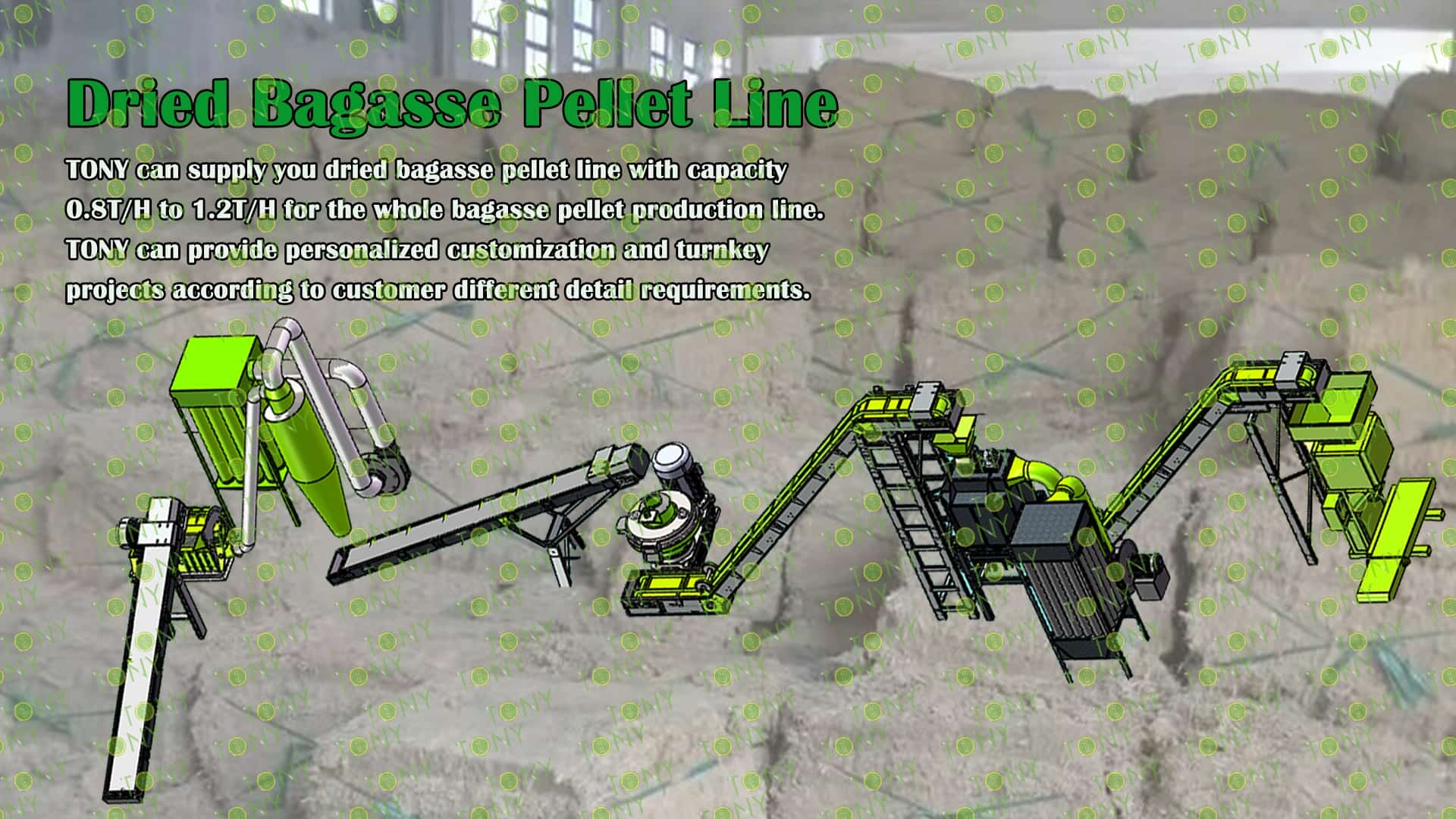
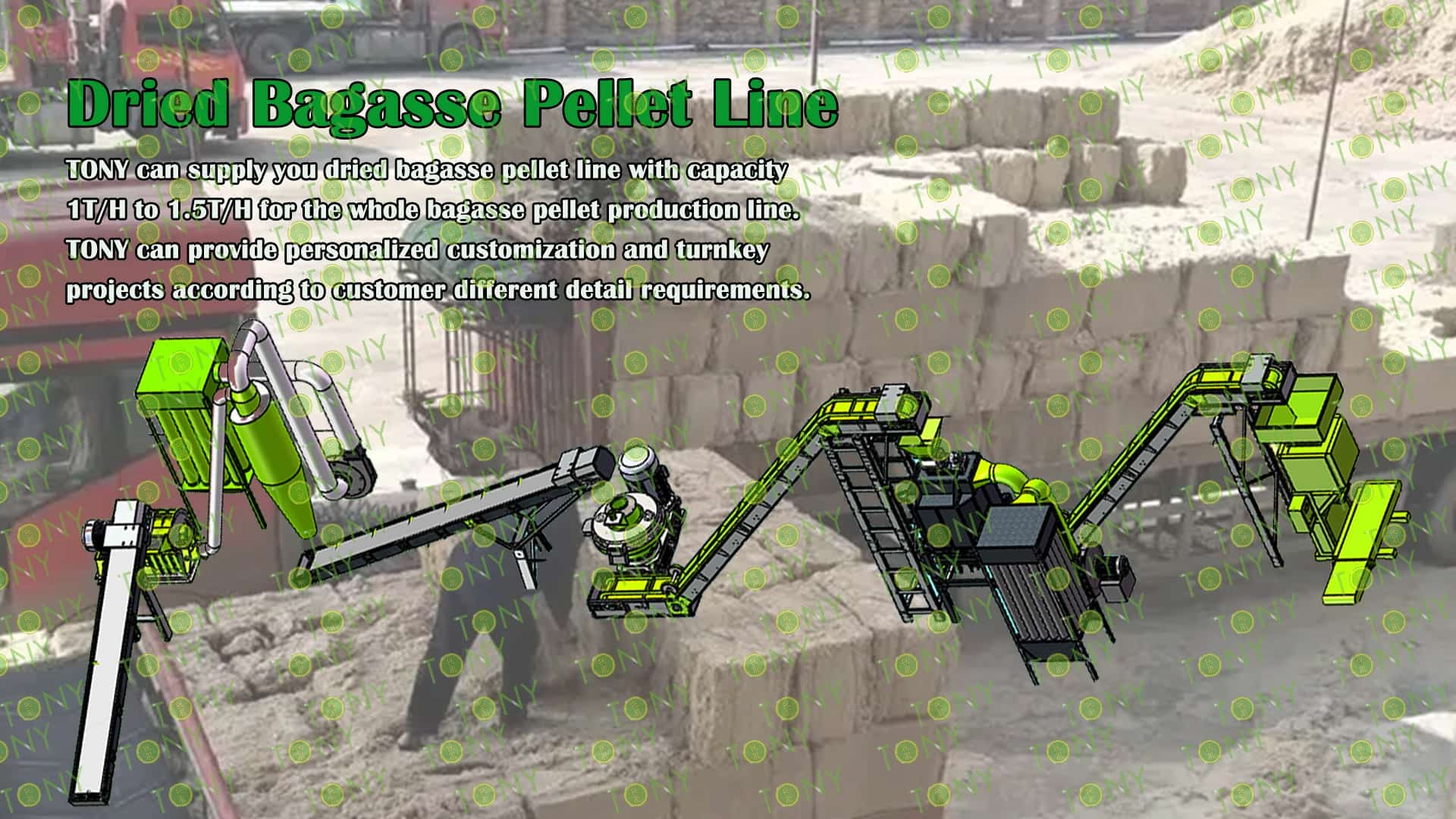
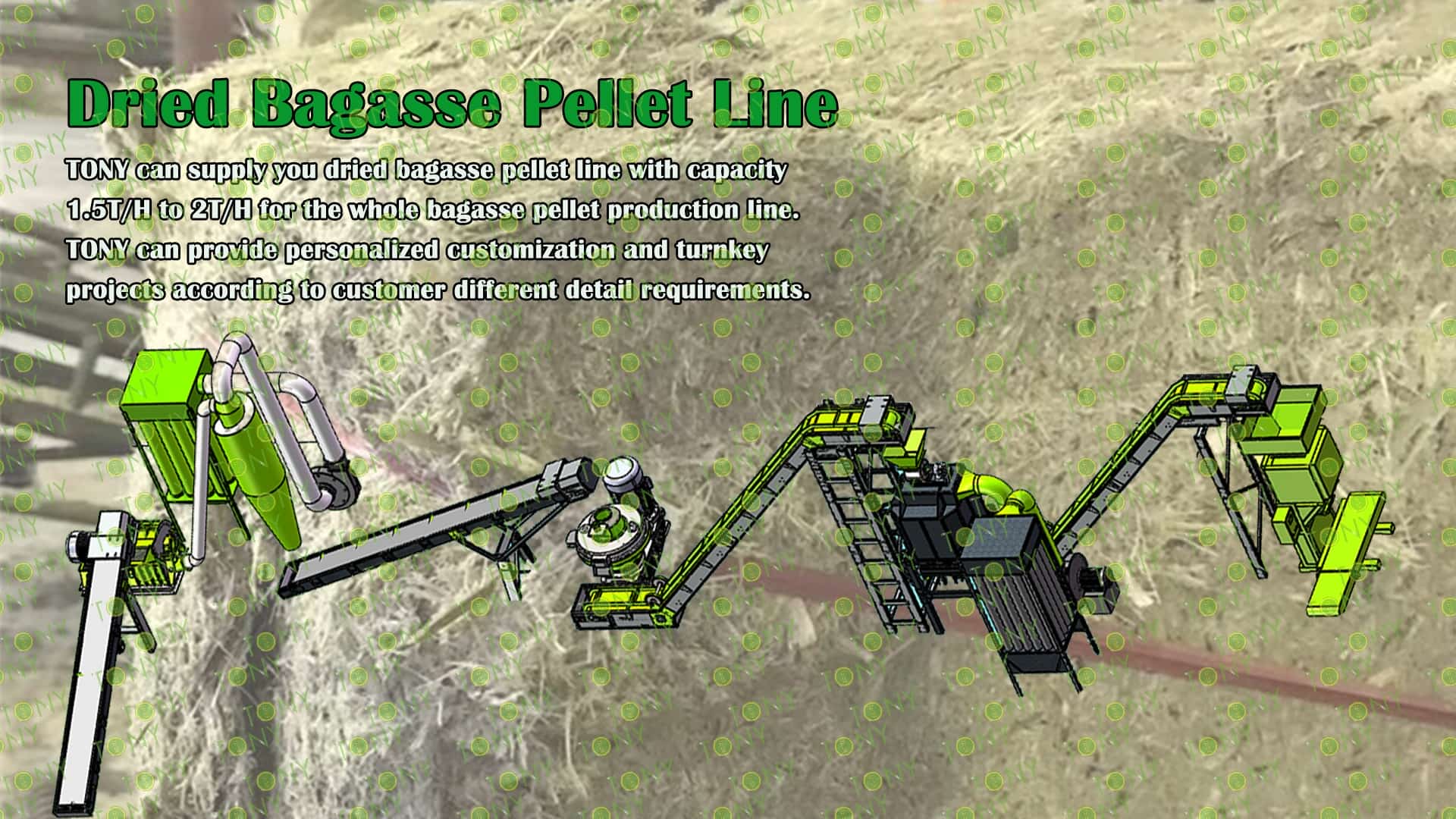
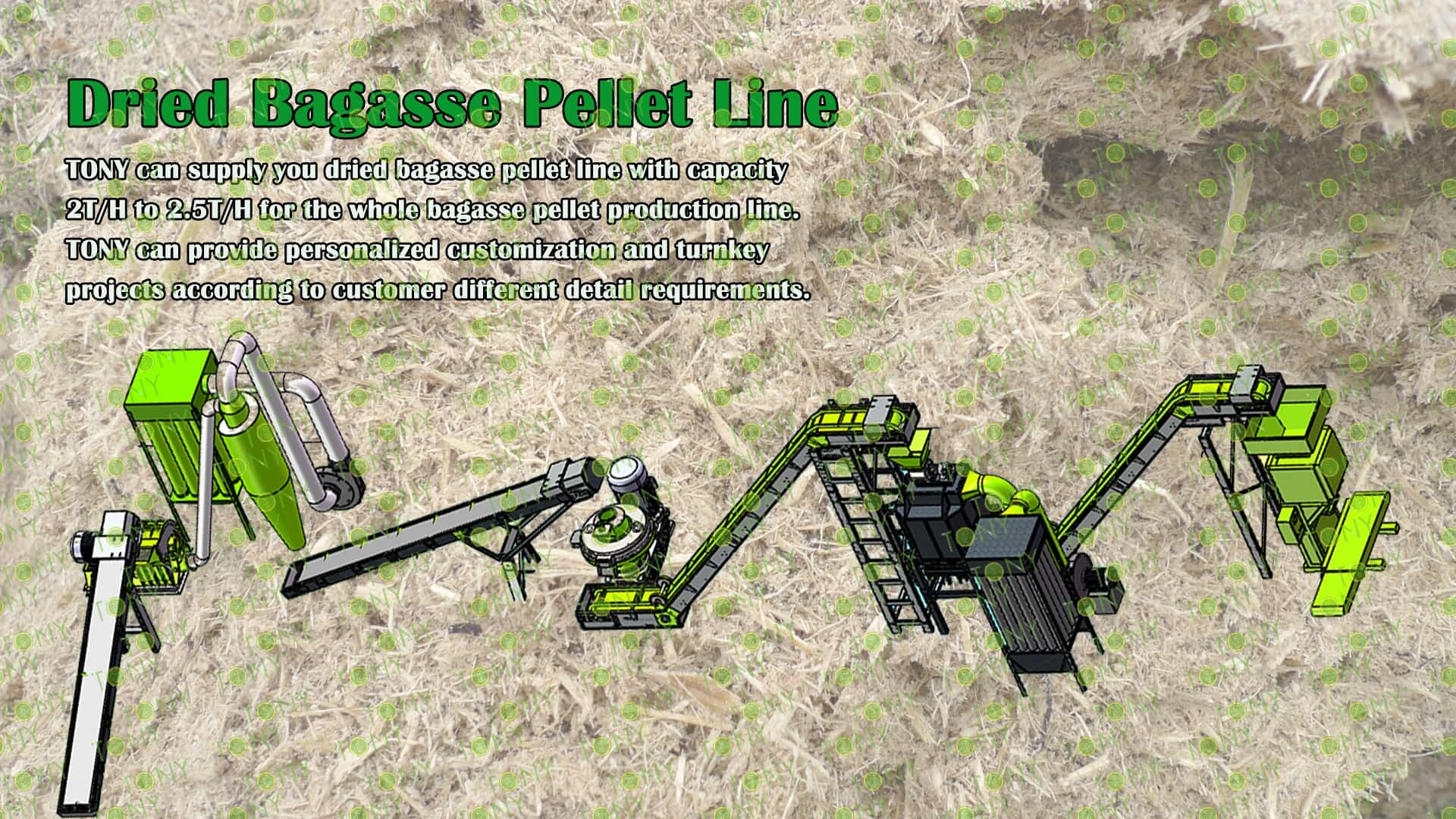
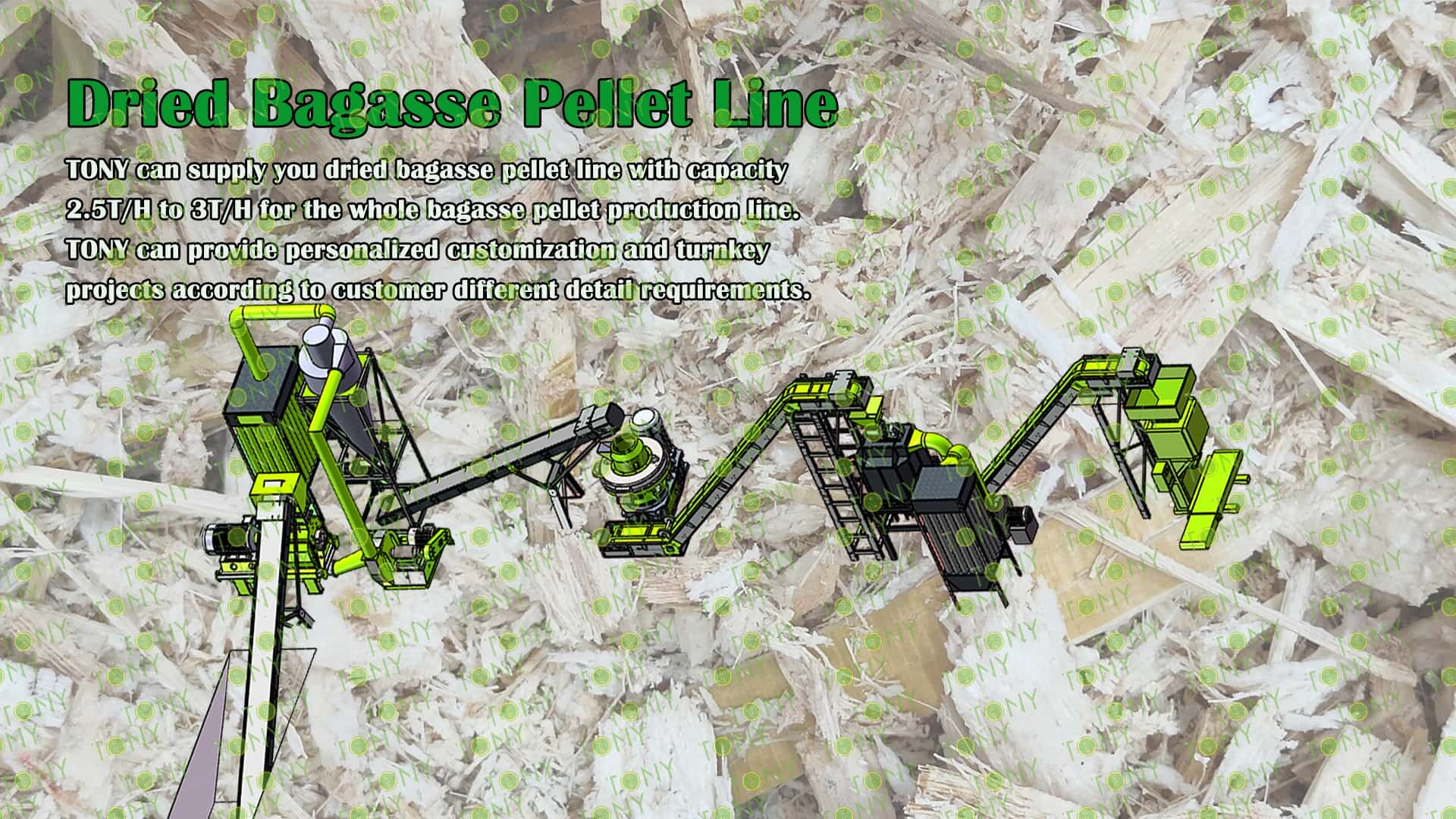
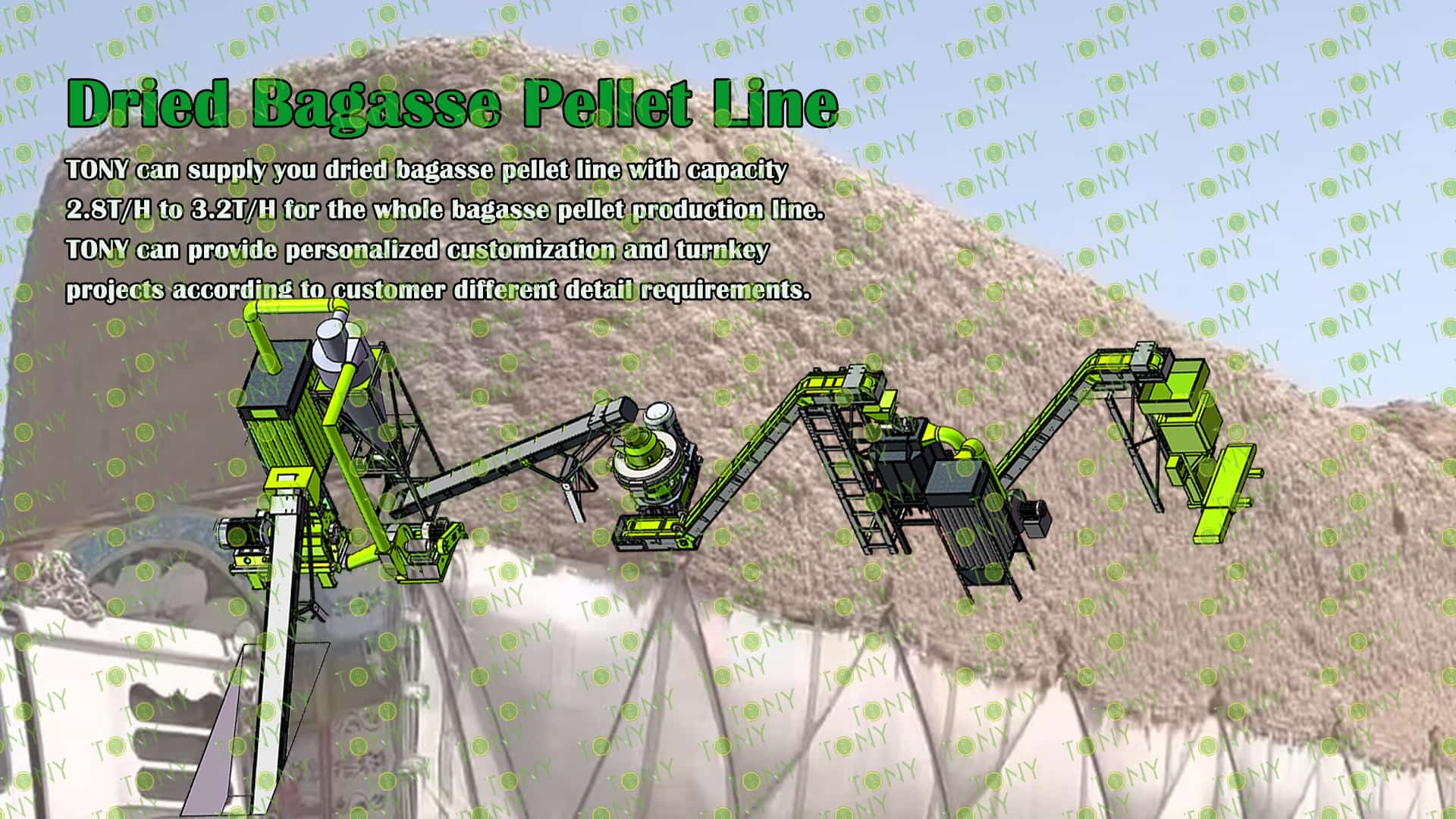
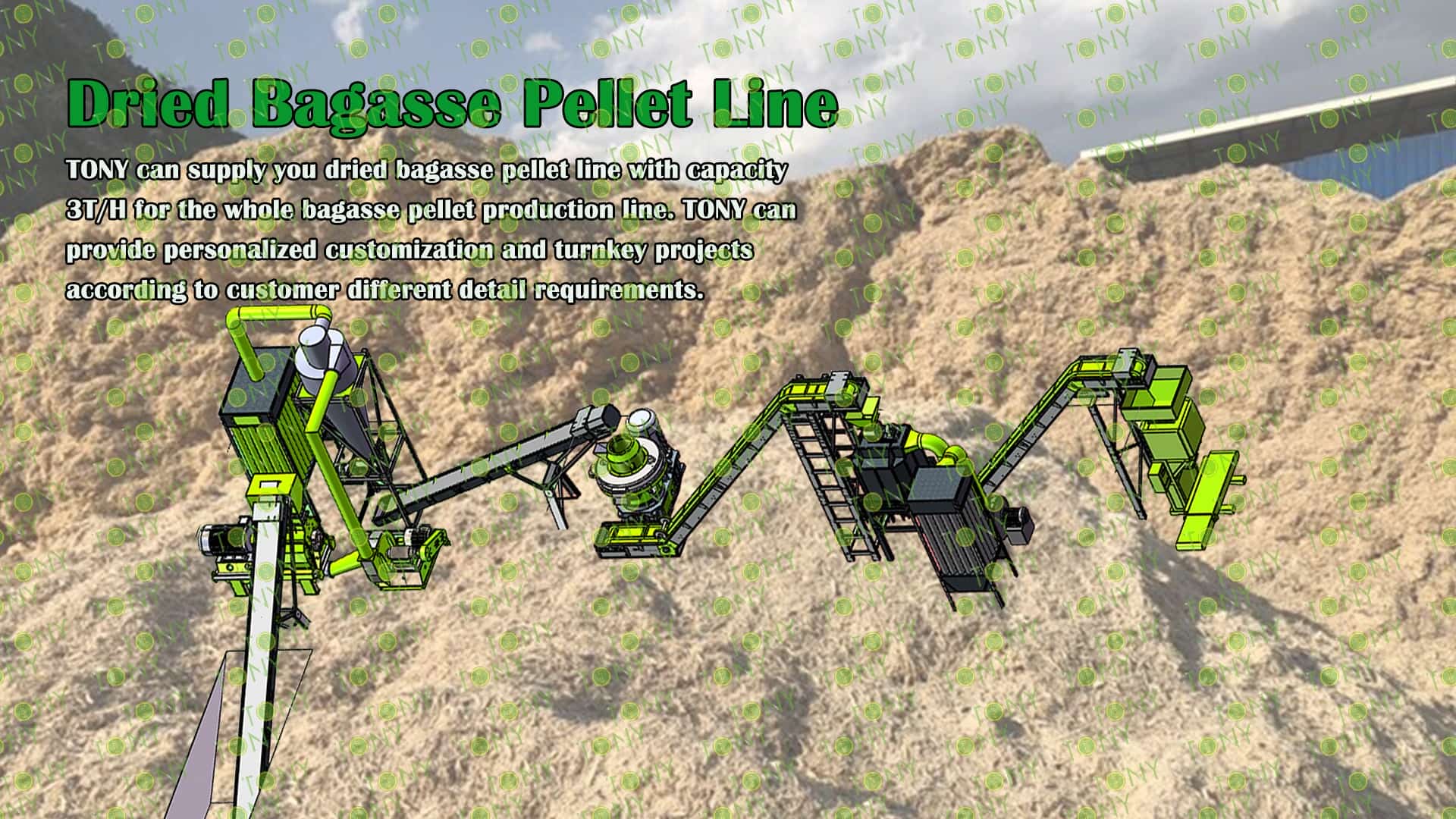
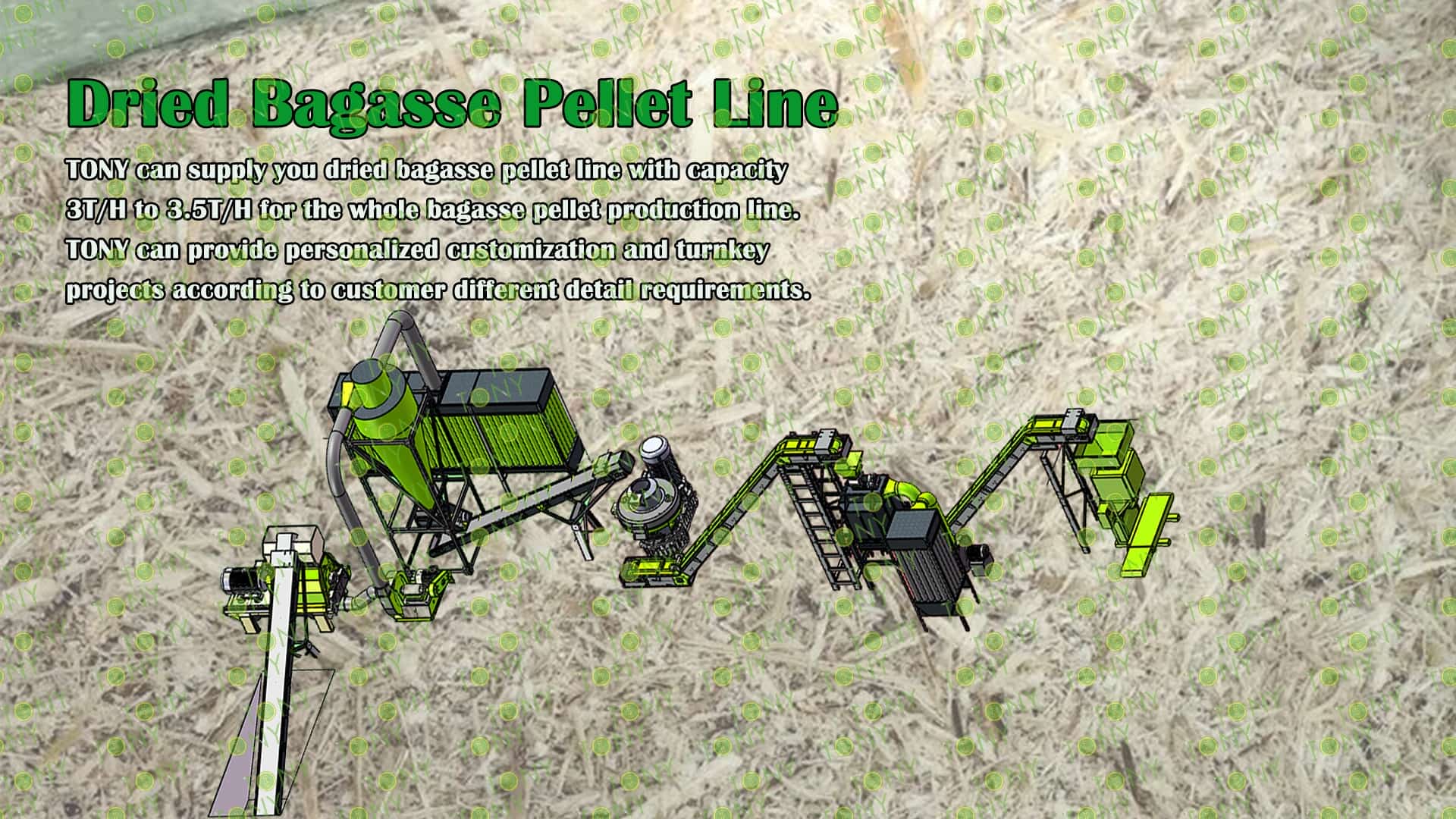
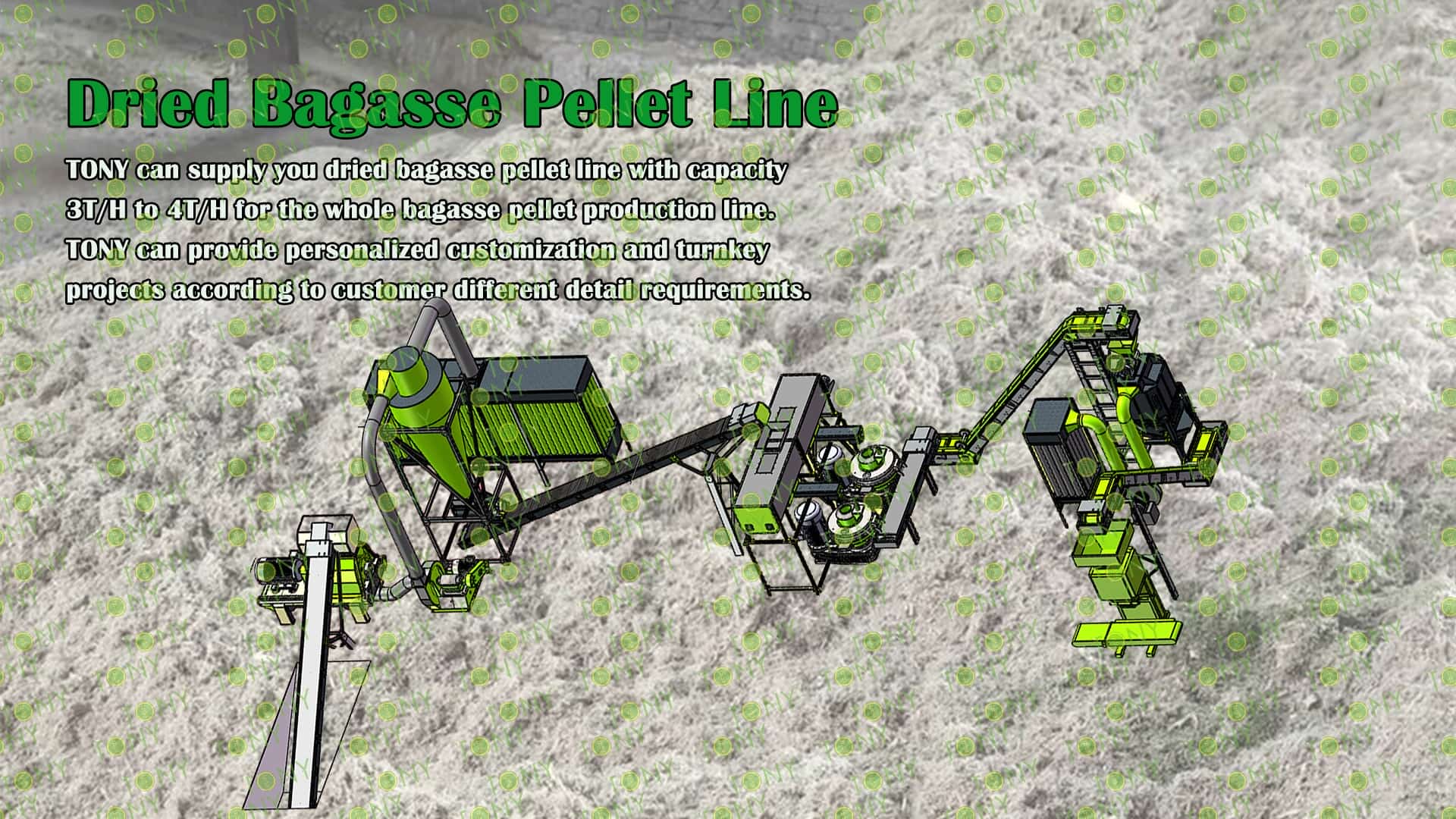
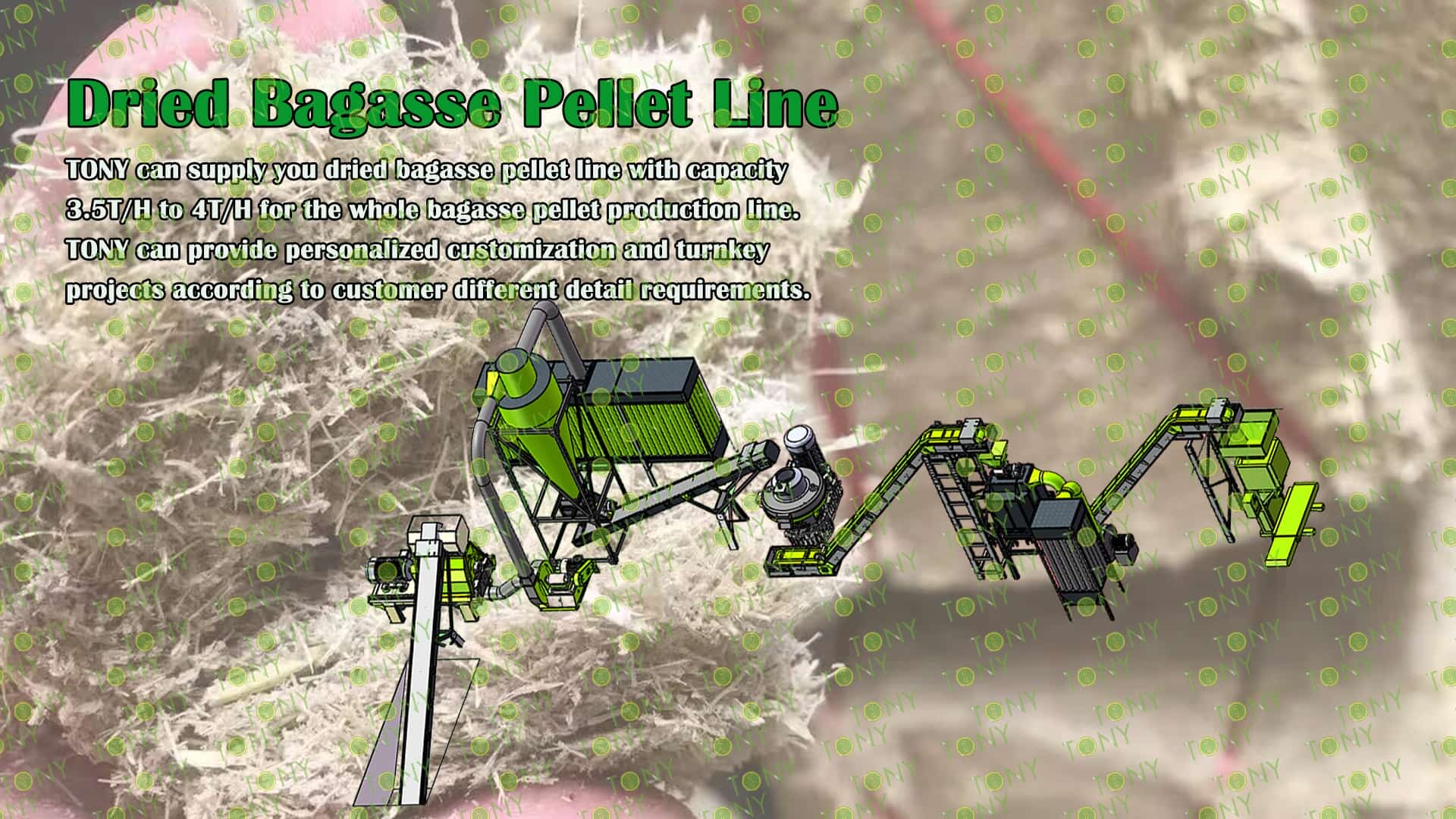
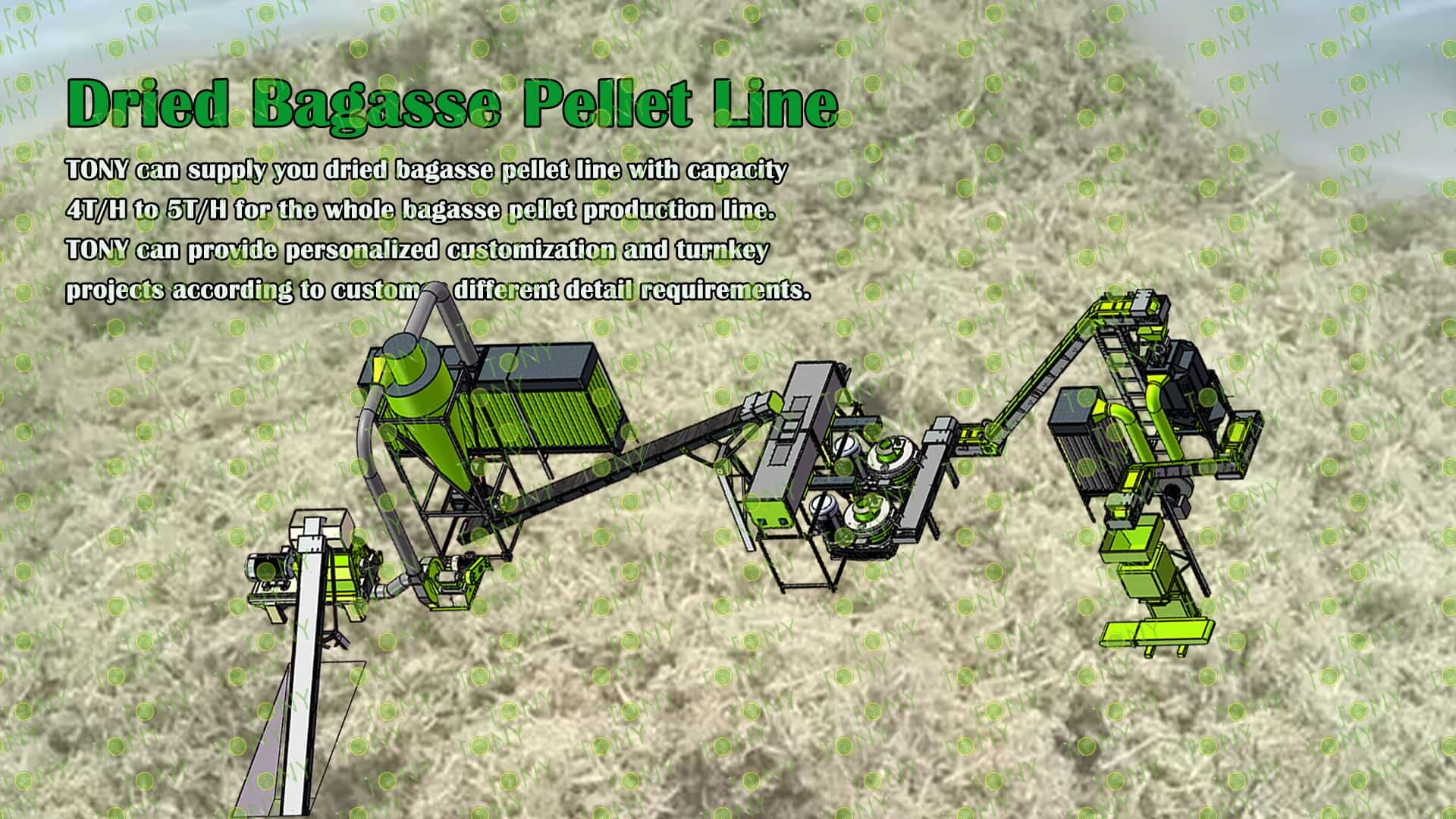
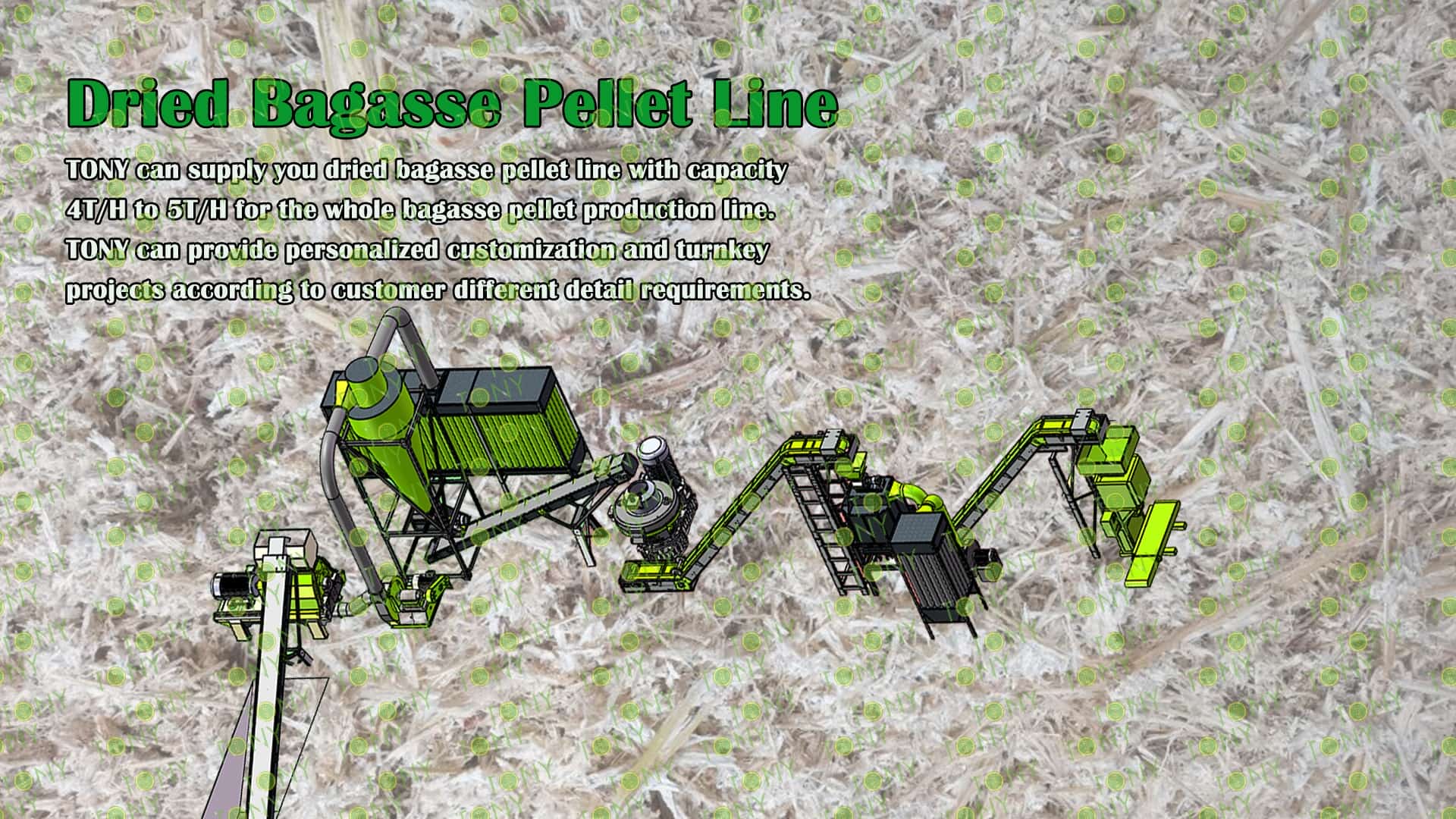
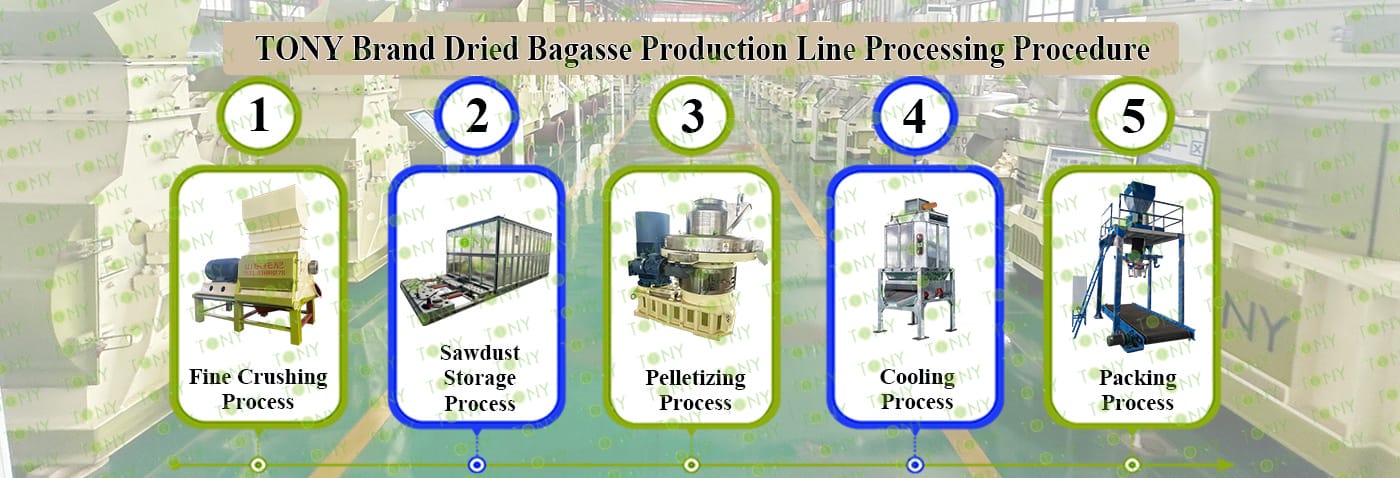
5. Process: Fine Crushing Process -- Bagasse Storage Process- Pelletizing Process - Cooling Process - Packing Process
6. Main Equipment: Effective Hammer Mill-TFD85-220-220KW,TONY Large Hydraulic Storage Silo,TONY Pellet Machine- TYJ860-Ⅲ-280KW, Galvanized Pellets Cooler, Ton Packing Machine and Belt Conveyors

|
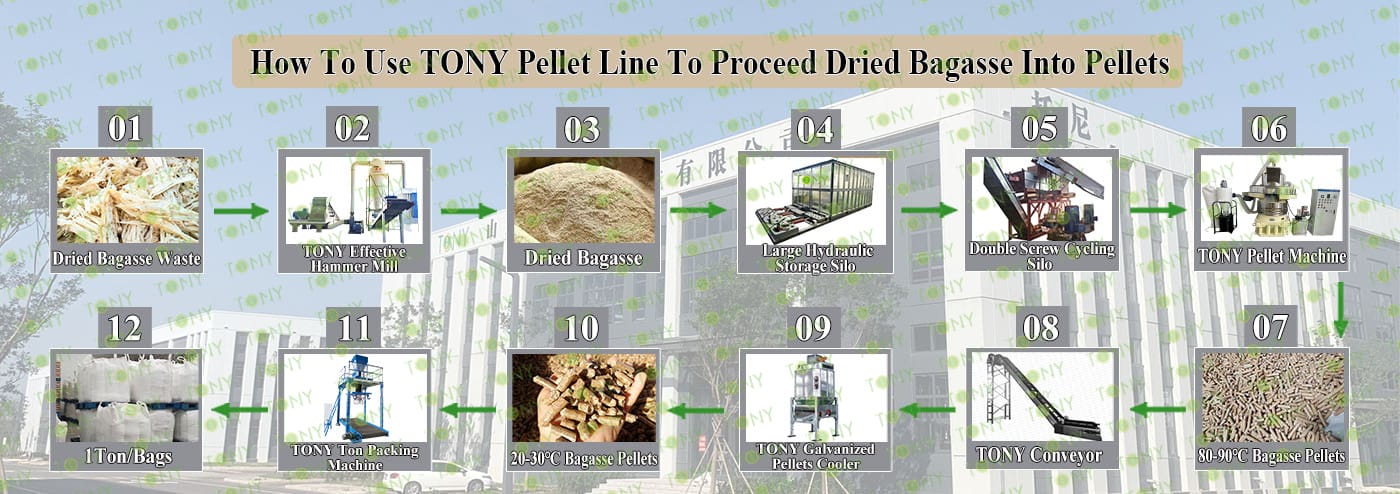
How to use the TONY pellet production line to make pellets from dried bagasse? The process mainly includes the following steps and equipment: 1. Use TONY effective hammer mill to crush the slightly larger bagasse into 8-14 mm bagasse.If customer has enough Investment budget,he can also chose TONY Special Cutting Machine for bagasse which will be more expensive than the hammer mill. 2.Use TONY large hydraulic storage silo to storage 8-14 mm bagasse. 3. Use TONY vertical ring die pellet machine to produce pellets with a diameter of 6-8 mm. 4. Use TONY galvanized pellets cooler to cool the pellets from 80-90°C to 20-30°C. 5. Use TONY ton packing machine to pack the pellets into bags, each weighing 1 ton. For more detailed information and quotations, you can contact TONY. TONY can provide all the above - mentioned products at highly competitive prices and with excellent quality. |
|
|||||||||||||||||||||||||||||||||||||||||||||
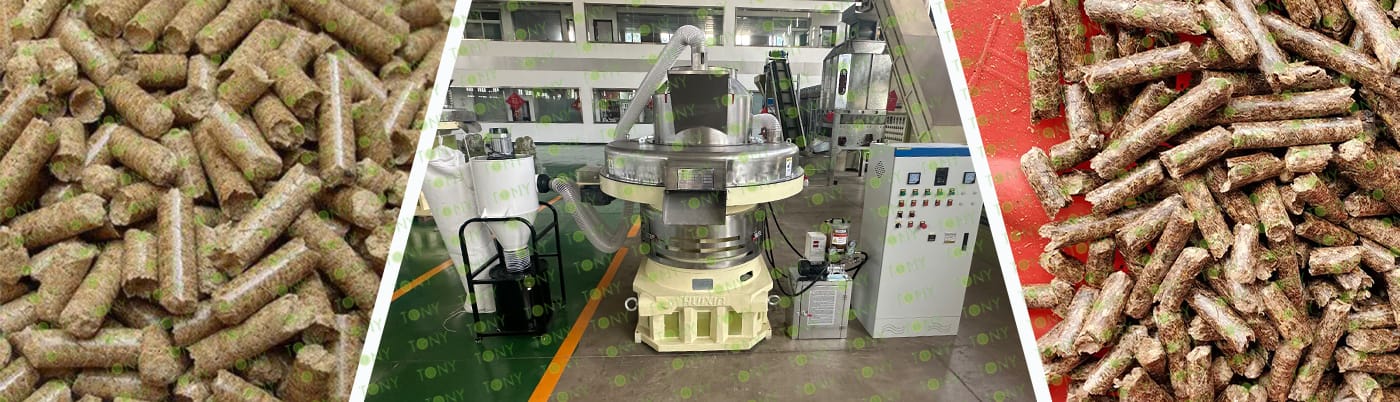
| Next, TONY Will Introduce To You All The Necessary Machinery That Will Be Used For The Whole Pellet Production Line. Some Machines Can Be Custom - Made By Customers According To Different Customers' Detailed Demands. Contact TONY For More Details, Including Quotation And Layout. | ||
 |
 |
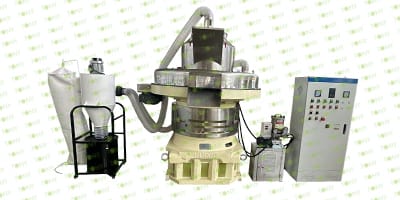 |
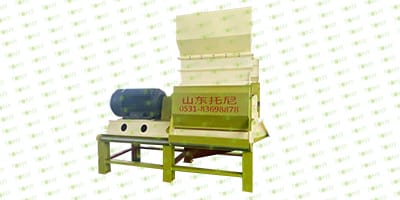
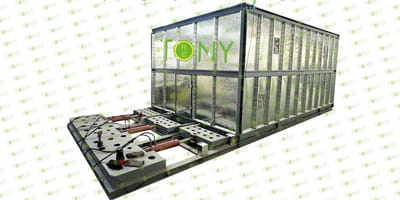
| Effective Hammer Mill | Large Hydraulic Storage Silo | Vertical Ring Die Pellet Machine |
| 1.To Crush Larger Bagasse Into 8-14mm Baggase. 2.Model: TFD85-220-220KW*4sets 3.Capacity: 7-8Ton/Hour/Set |
1.To Storage Bagasse Before Dryer Control Bagasse Flow Entering The Dryer Model: TCY-40*2sets 2.TONY Uses Galvanized Material |
1.To Press Dry Bagasse Into 6-8mm Biomass Pellets 2.Model: TYJ860-III-280KW*6sets 3.Capacity:4-5Ton/Hour/Set 4.New 304SS Type |
 |
 |
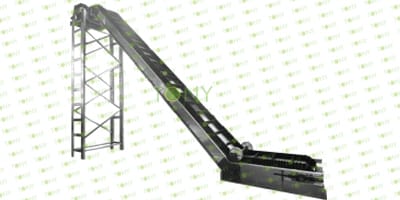 |
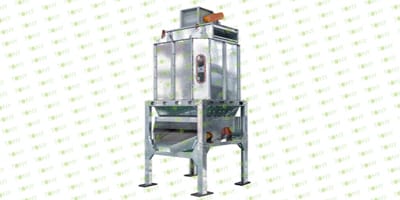
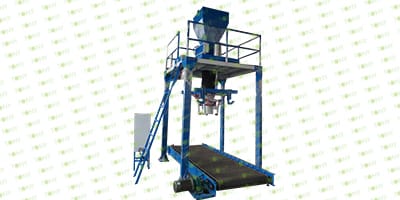
| Galvanized Pellets Cooler | Ton Packing Machine | Belt Conveyor |
| 1.To Cool Pellets From 80-90℃ Into 20-30℃ 2.Model: TCN-10*2sets 3.Capacity:24-30Ton/Hour |
1.To Pack Pellets Into 1Ton/Bags 2.Model: TBD*2sets 3.Capacity: 24-30Ton/Hour |
1.Transport Bagasse,Pellets. 2.Width: 80cm*18sets 3.Capacity:Designed With The Whole Line |
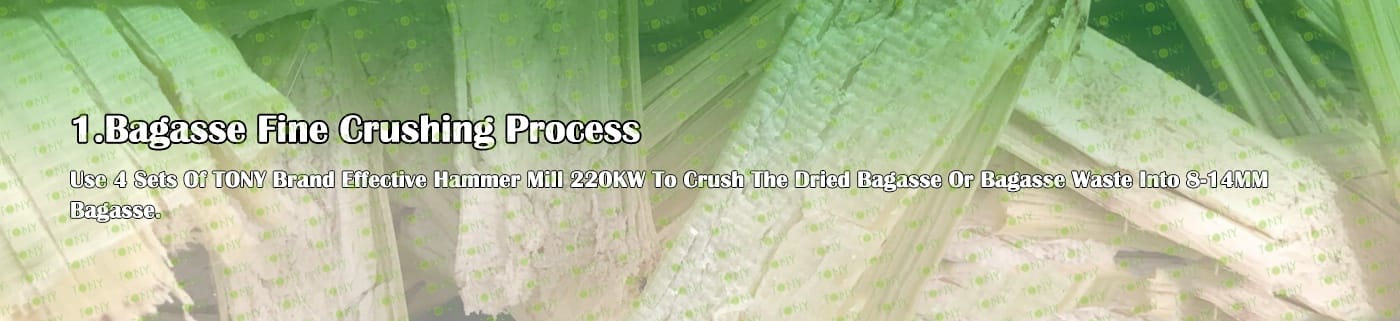
1.Bagasse Fine Crushing Process:
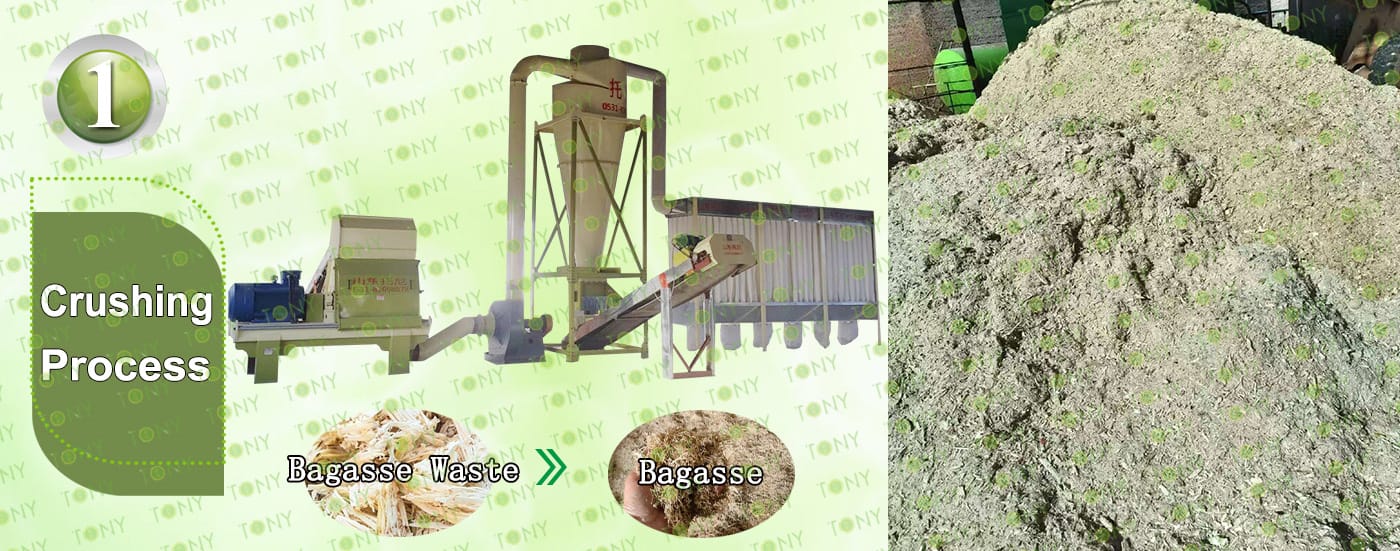
A.This process is mainly used to crush larger bagasse into 8-14mm bagasse.
B.Capacity:24-30Ton/Hour.
C.TONY brand effective hammer mill TFD85-220-220KW*4sets
Main Parts:
(1)TONY Effective Hammer Mill.
(2)Galvanized Dust Collector.
(3)Sawdust Transportation Fan Blower.
(4)Cyclone With Airlock.
(5)Electrical Cabinets.
2.Bagasse Storage Process:
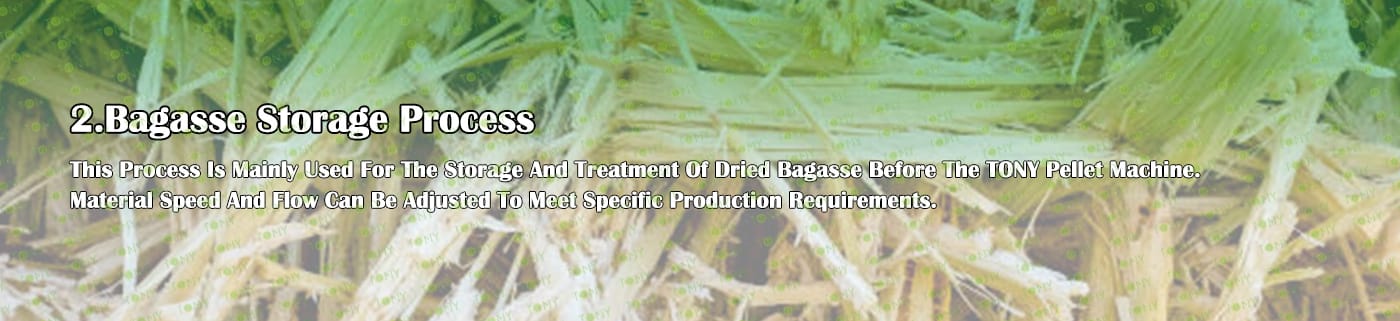
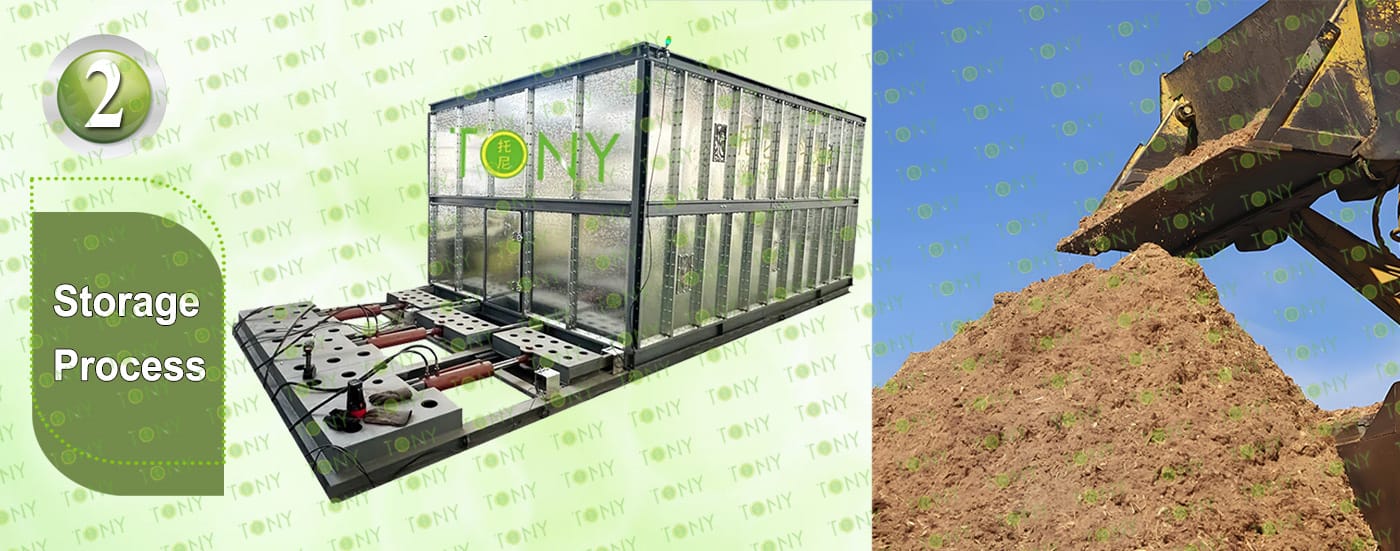
A. This process is mainly used to storage the bagasse that comes out of the hammer mill.It is hydraulic galvanized storage bin which is more stalbe and Bagasse in it is not easy to be blocked.
B. TONY Brand Large Hydraulic Storage Silo to storage the bagasse that comes out of the hammer mill.This process can be optional by customer.If customer do not chose the storage bin,he can storage the Bagasse on the ground directly which may need some labour.
Main Parts:
(1)TONY's New Large Hydraulic Storage Silo.
(2)With Screws Inside The Storage Bin To Prevent Bagasse Blocked.
3.Pelletizing Process:
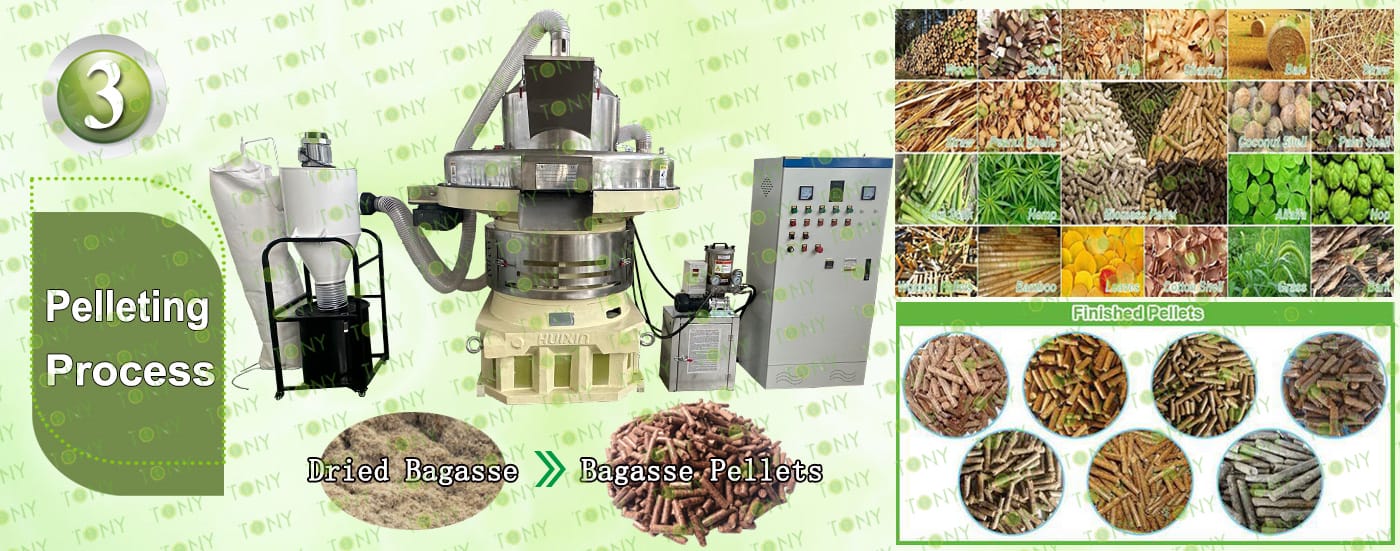
A.This process is mainly used to to product pellets into φ6-8mm.
B.Capacity:24-30Ton/Hour.
C.TONY brand vertical ring die pellet machine TYJ860-III-280KW*6sets
D.Double Screw Cycling Silo is added above the pellet machine, which has the advantages of saving space, saving labor, intelligently controlling the feeding speed, not easy to block the material, and improving production efficiency.
Main Parts:
(1)TONY's new Vertical Ring Die Pellet Machine.
(2)Cyclone And Bags Dust Collectors.
(3)Automatic Lubrication System.
(4)Electrical Cabinets.
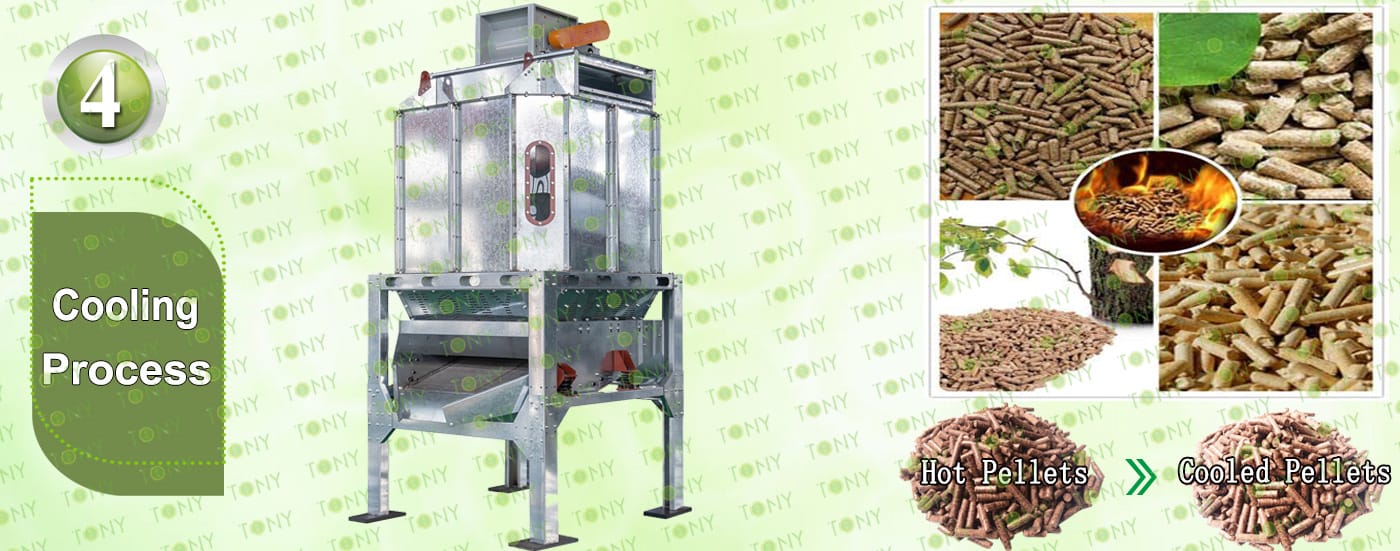
4.Cooling Process:
A.This process is mainly used to cool pellets from 80-90℃ to 20-30℃
B.Capacity:24-30Ton/Hour.
C.TONY brand galvanized pellets cooler *2sets
Main Parts:
(1)TONY's new Galvanized Pellets Cooler With Vibrating Screen.
(2)Cyclone And Bags Dust Collectors.
(3)Fan Blower.
(4)Connect Pipes.
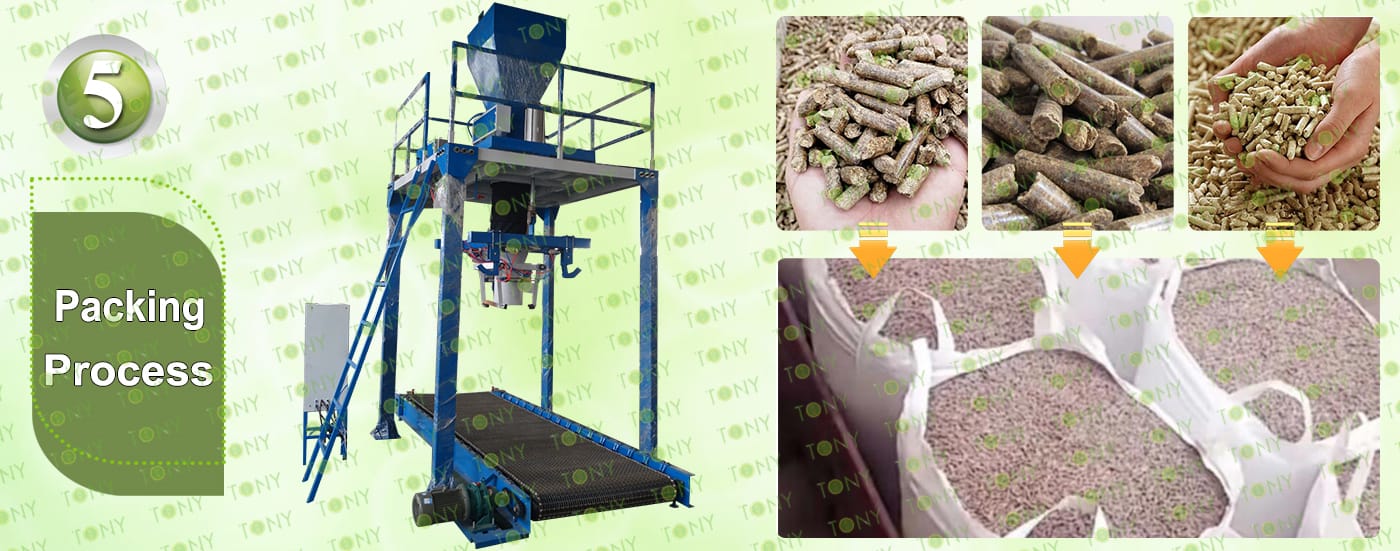
5.Packing Process:
A.This process is mainly used to pack pellets into 1Ton/Bags.
B.Capacity:24-30Ton/Hour.
C.TONY brand ton packing machine*2sets
Main Parts:
(1)TONY Ton Packing Machine
(2)Electronic Platform Scale Metering System
(3)Automatic Tare, Zero, and Drop Correction Functions
(4)Feeding System Features Fast, Medium, and Slow Feeding Speeds to Ensure Measuring Accuracy

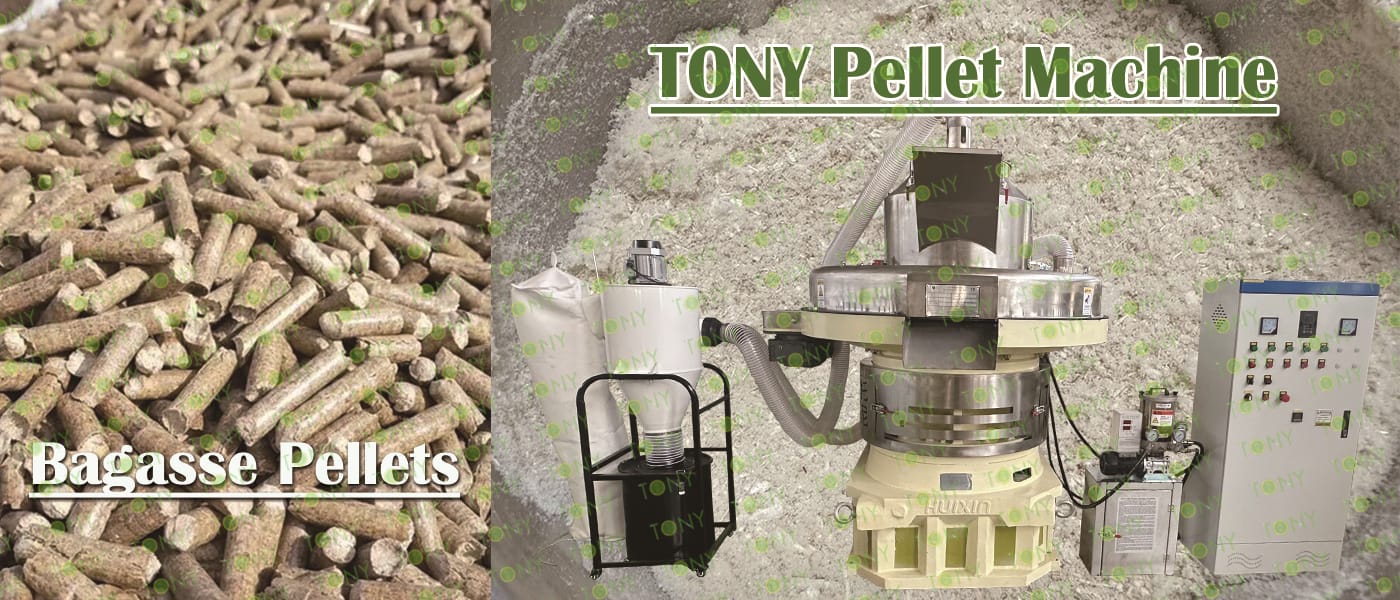
One of the core advantages of the dry bagasse biomass pellet processing project lies in its simplified production process.
1.Eliminating the core drying step:
The moisture content of dry bagasse has been reduced to the optimal molding range of 10%-15%, eliminating the need for costly drum dryers. This not only reduces equipment investment by 30%-40%, but also completely eliminates energy consumption in the drying process. The per-ton processing cost is 20%-25% lower than that of wet bagasse projects.
2.Easier equipment maintenance:
Dry bagasse is non-sticky and less likely to clog the feed inlets and die holes of pulverizers and pelletizers. This reduces equipment cleaning frequency by over 50%, reducing downtime for maintenance (to just 3-5 hours per month). Furthermore, dry bagasse causes less wear on equipment components (such as blades and ring dies), extending replacement intervals by 30%, significantly reducing maintenance costs.
3.Greater production flexibility:
No longer relying on proximity to sugar refineries (where dry residue transportation costs are low and deterioration is less likely), projects can be sited in areas close to downstream markets (such as heating zones and industrial clusters), reducing finished product transportation costs and expanding market reach.
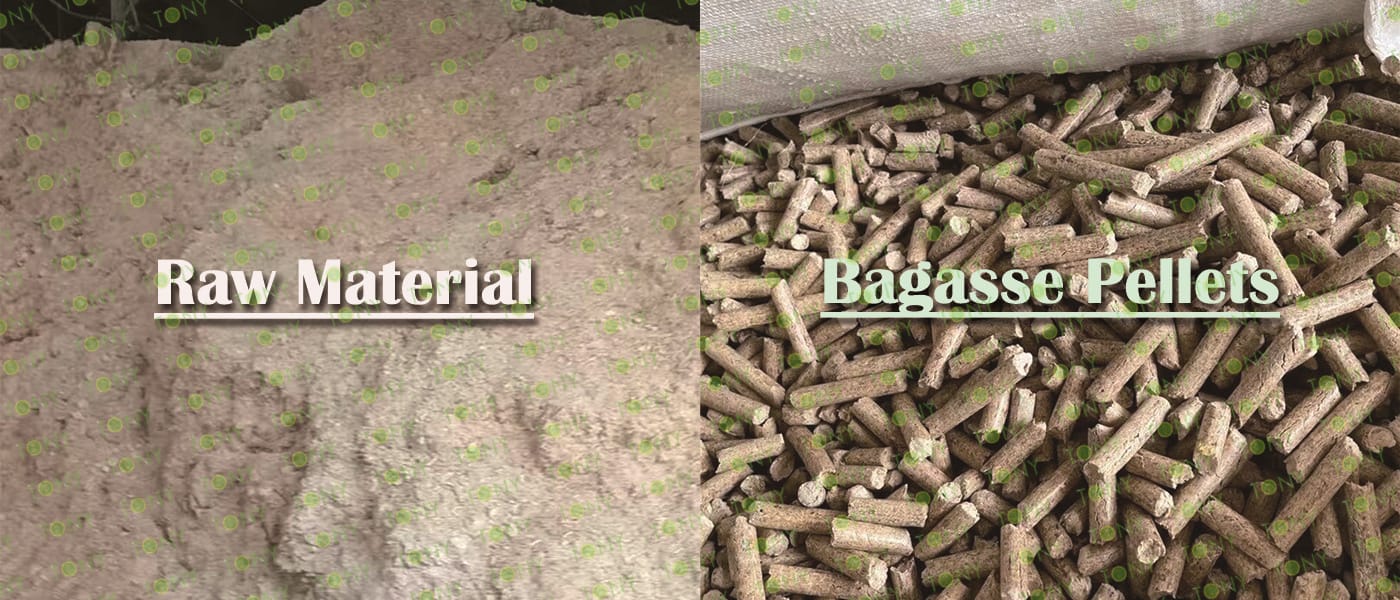
1.Nearly "zero net" carbon emissions:
Sugarcane absorbs carbon dioxide (CO₂) through photosynthesis during its growth. The CO₂ released when the sugarcane pellets are burned is essentially balanced by the amount absorbed during the growth phase, forming a closed carbon cycle. This significantly reduces carbon emissions compared to coal (approximately 2400g/kg) and natural gas (approximately 1600g/kg), making it a typical "low-carbon energy source" and helping to mitigate the greenhouse effect.
2.Low pollutant emissions:
Sugarcane bagasse itself contains extremely low levels of sulfur (S) and nitrogen (N) (typically <0.1% sulfur and <0.5% nitrogen). Combustion produces minimal sulfur dioxide (SO₂) and nitrogen oxides (NOₓ), eliminating the need for complex desulfurization and denitrification equipment and significantly reducing air pollution.
3.Low ash content (typically 3%-5%):
This is significantly lower than coal (10%-30%), resulting in minimal ash residue after combustion. The ash residue can be reused as organic fertilizer or as a building material, reducing solid waste pollution.
4.Reduce waste incineration pollution:
Traditionally, sugarcane bagasse is mostly burned in the open air, which produces a large amount of smoke, dust, dioxins and other pollutants. After being made into pellets, centralized clean combustion can completely avoid the local air pollution caused by such dispersed incineration.
2025 Tony Machinery - All Rights Reserved. Map