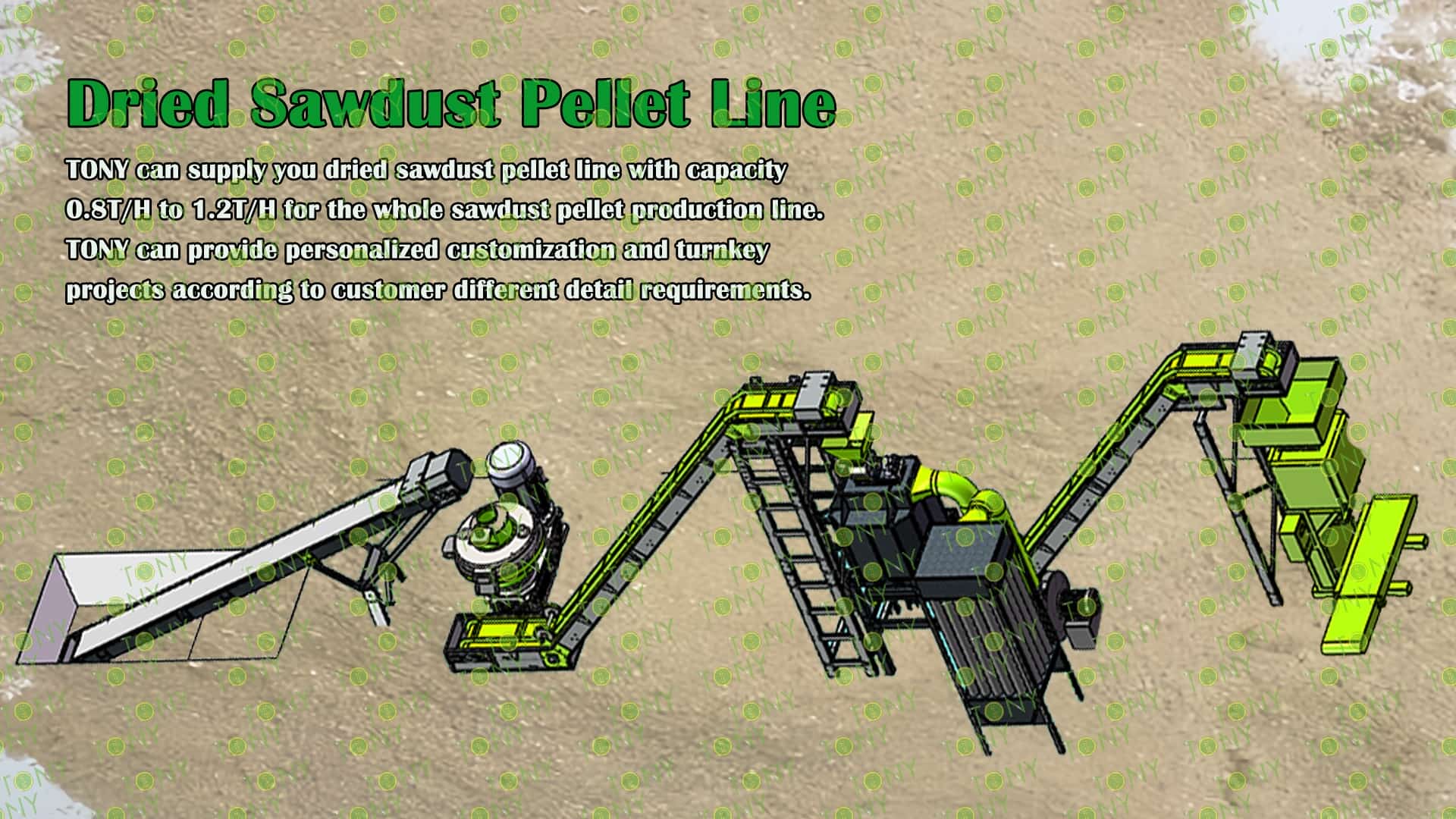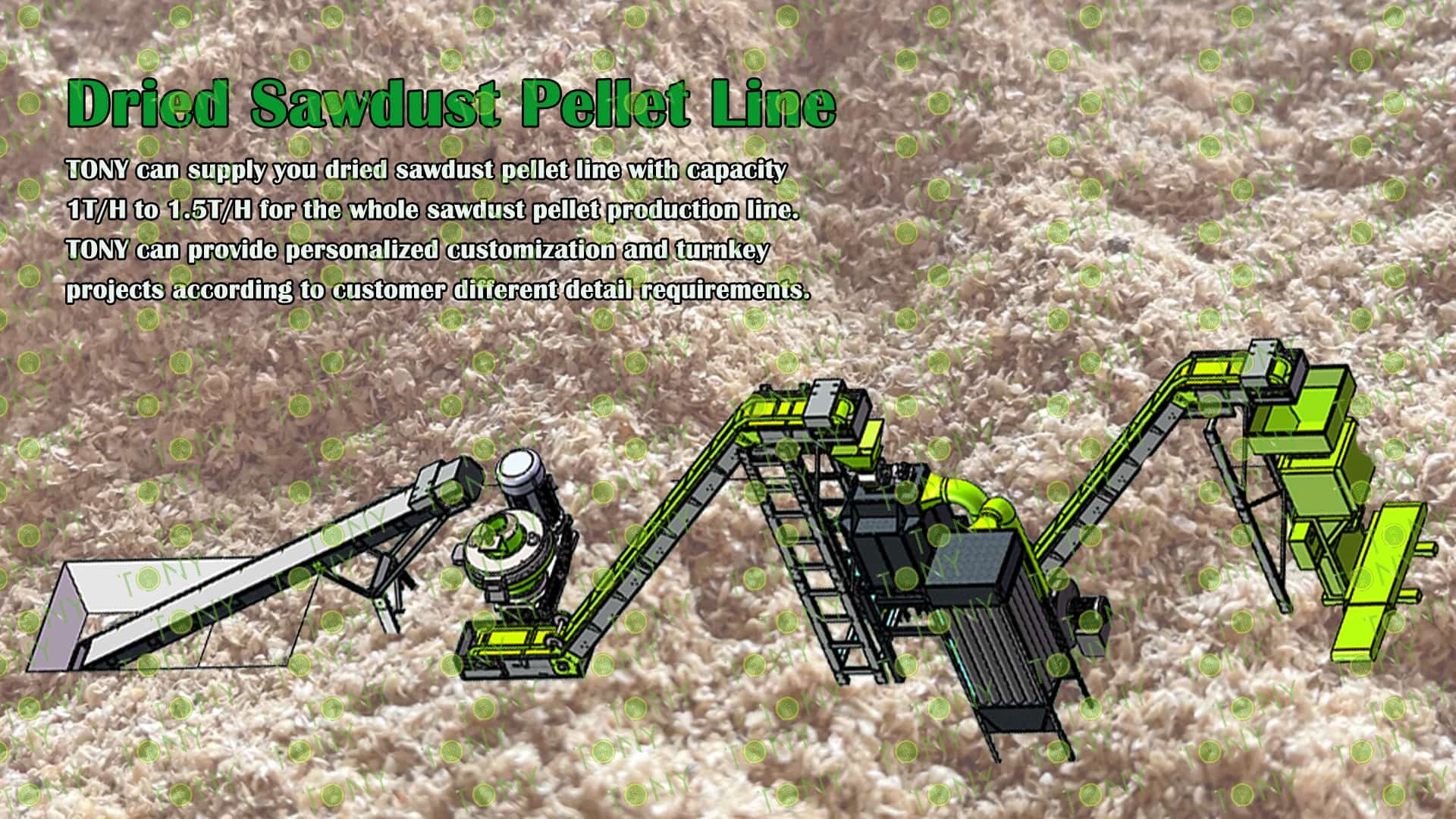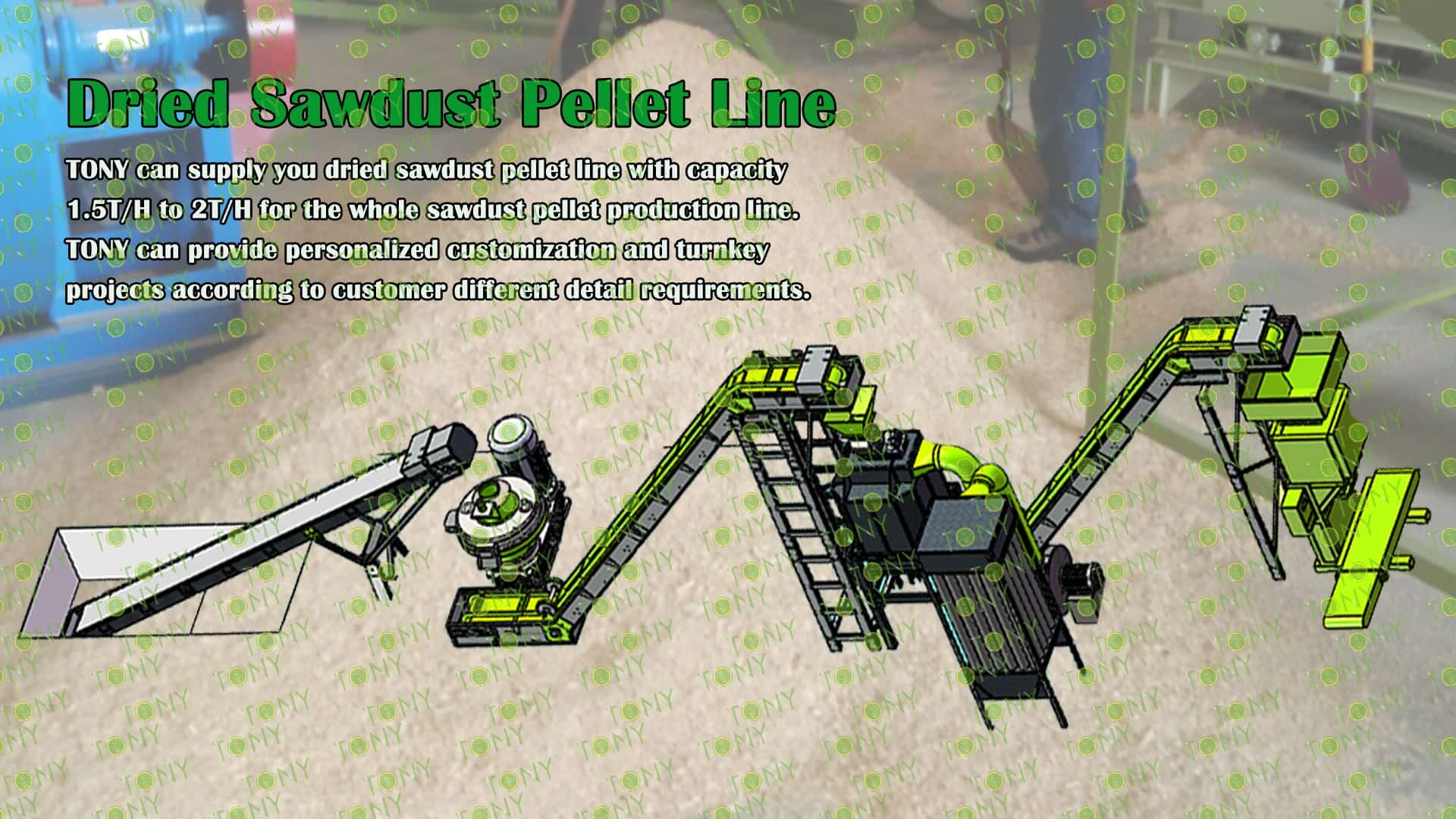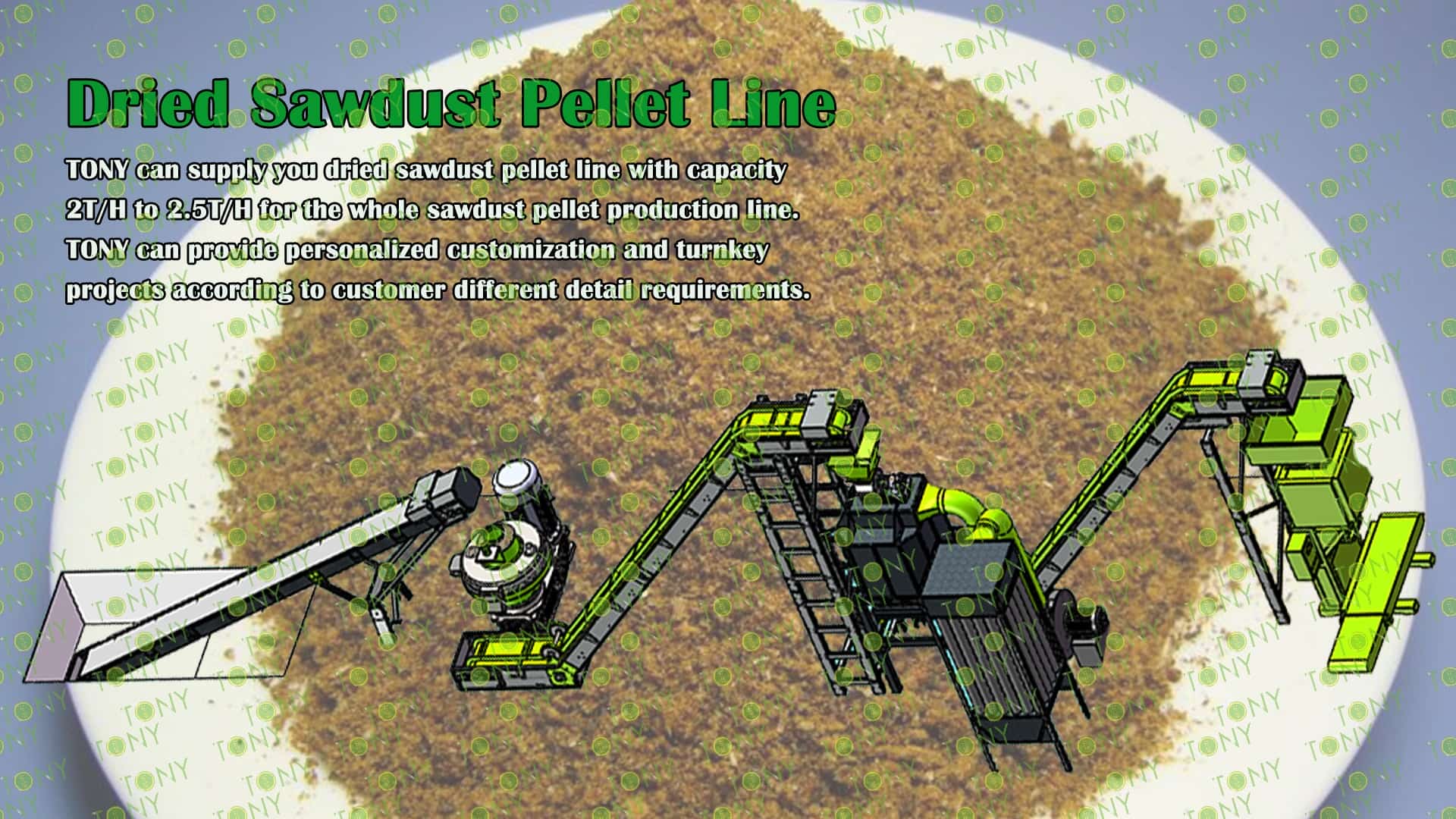




















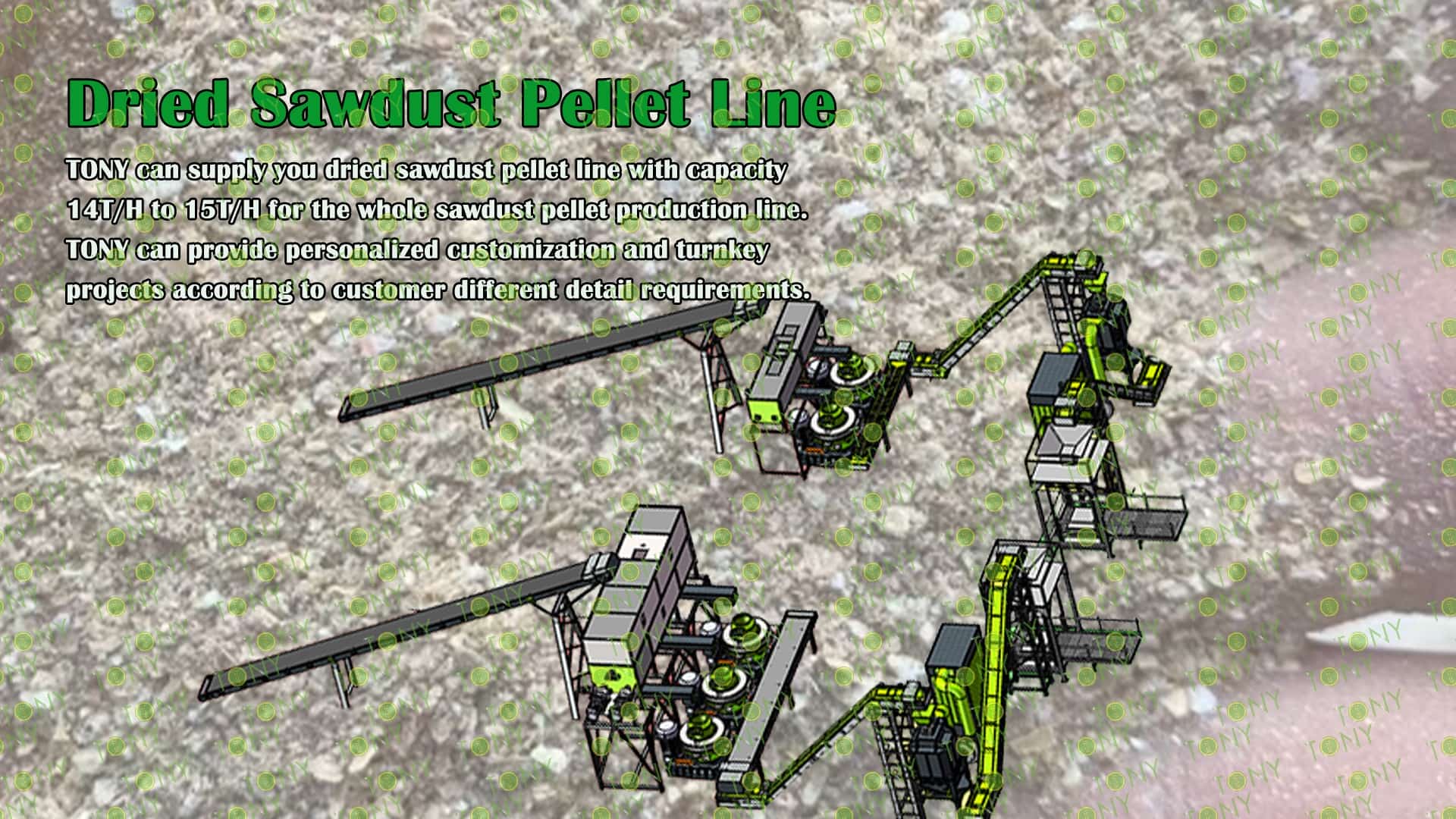

Project Brief Introduction:
1.Product:Dried Sawdust Pellet Line
2.Capacity: 14-15T/Hour
3.TONY Brand 14-15Ton /Hour Dried Sawdust Pellet Line Project Process
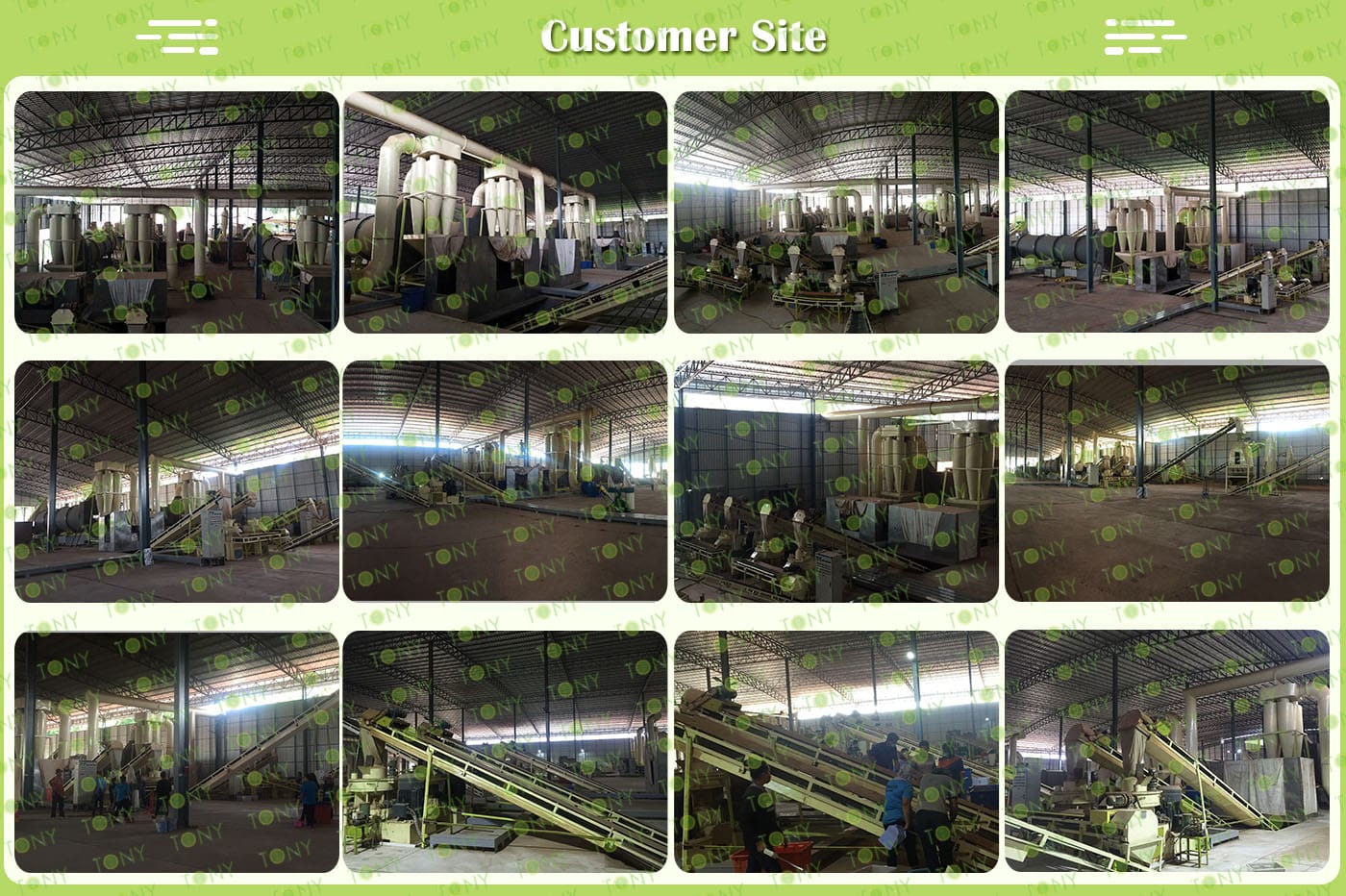
4.Main Machine:TONY Pellet MachineTYJ760-III-185KW,Pellets Cooler,Packing Machine And Belt Conveyors
5.Total Power: About 1000KW
6.Need Area: About ㎡ L: M W: M H: M
Project Layout For Customer:
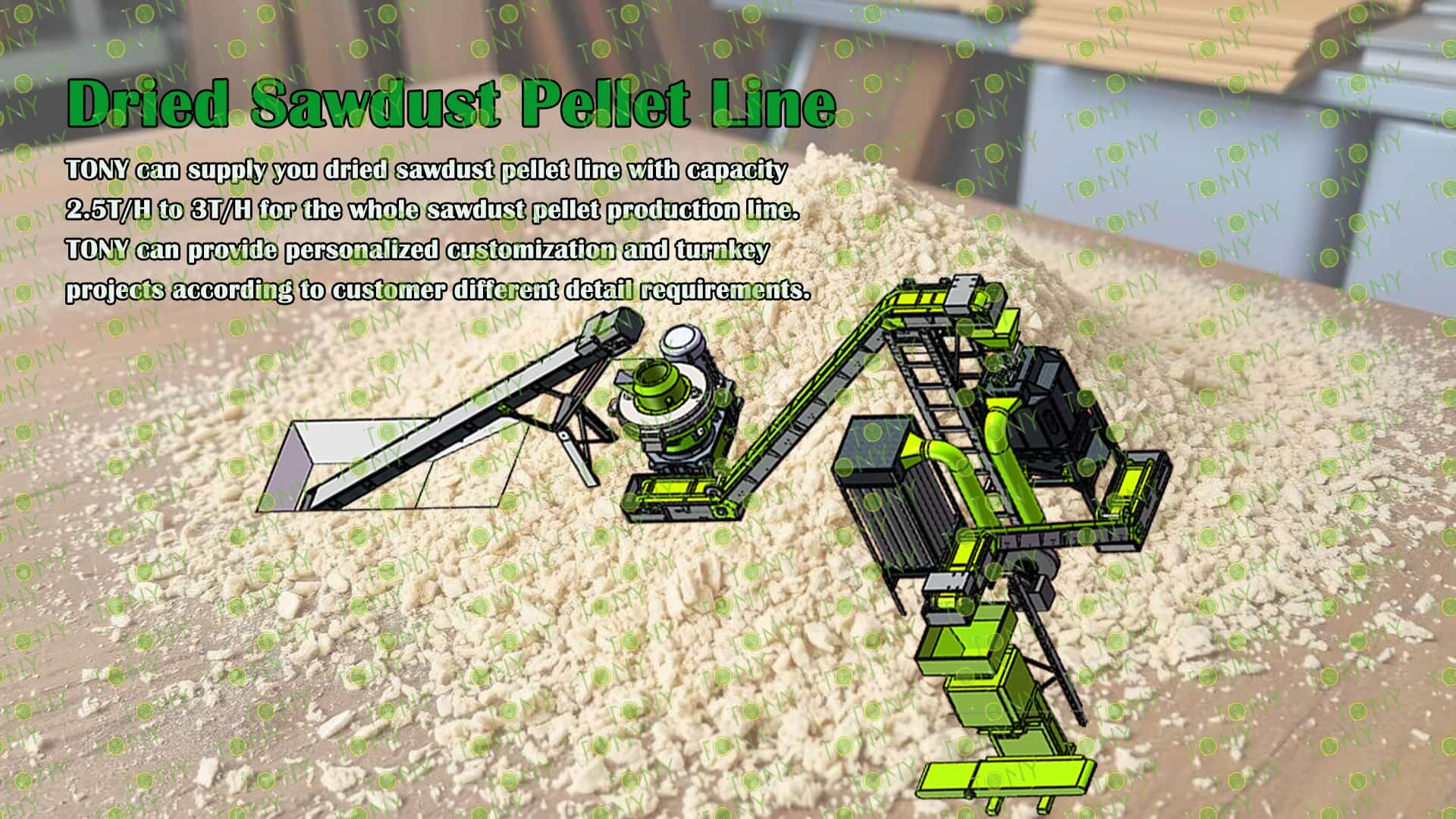
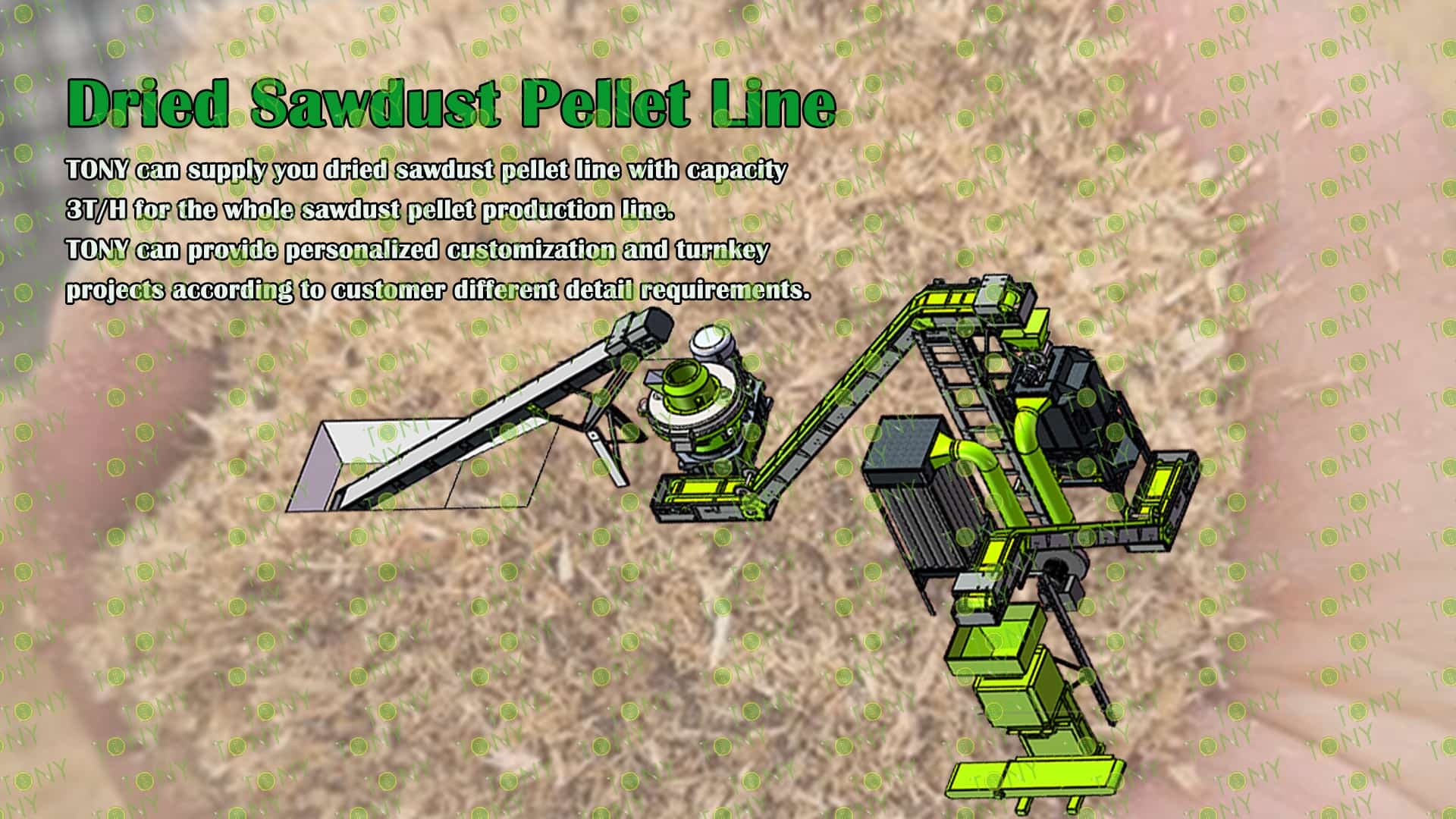
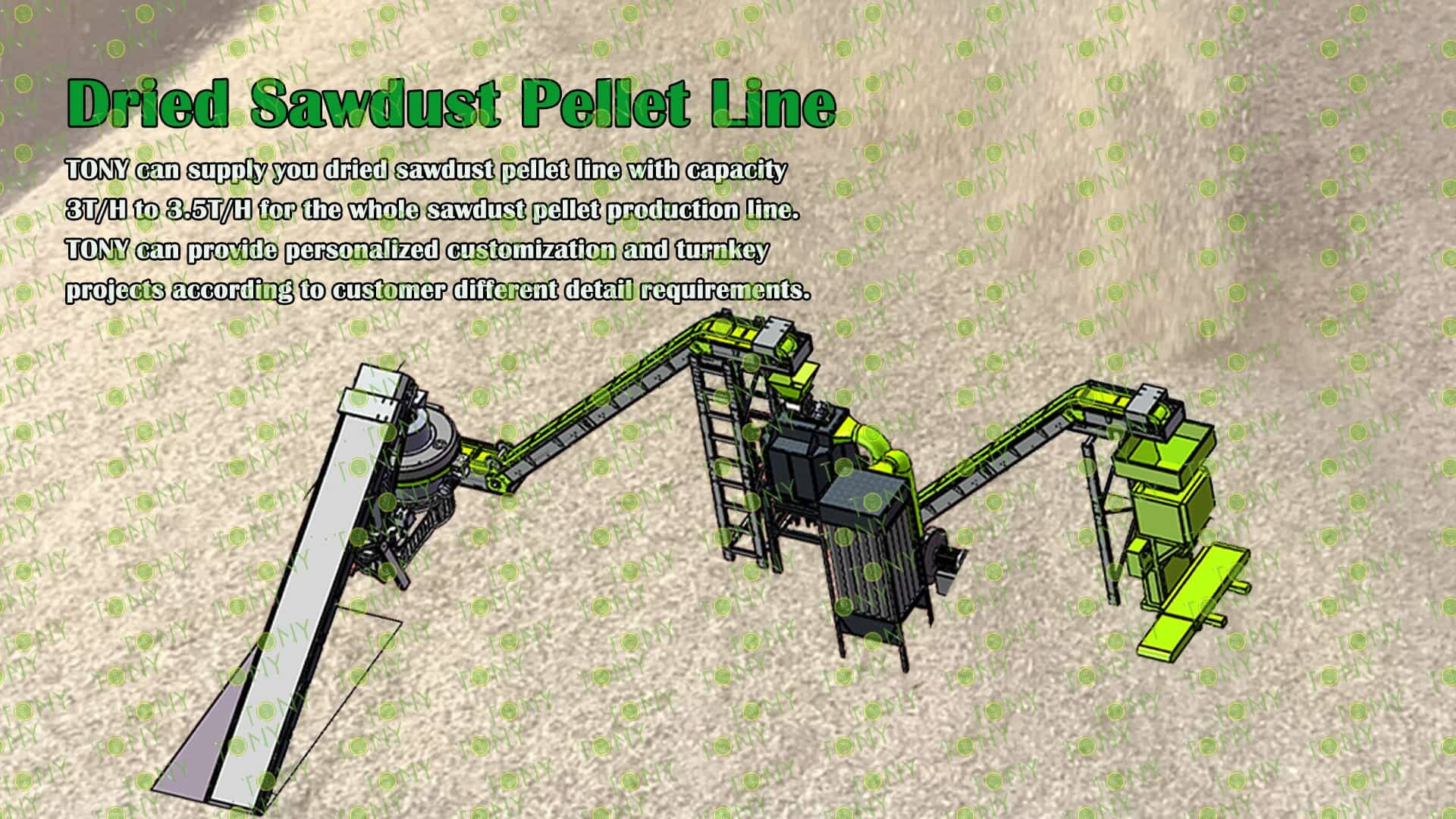
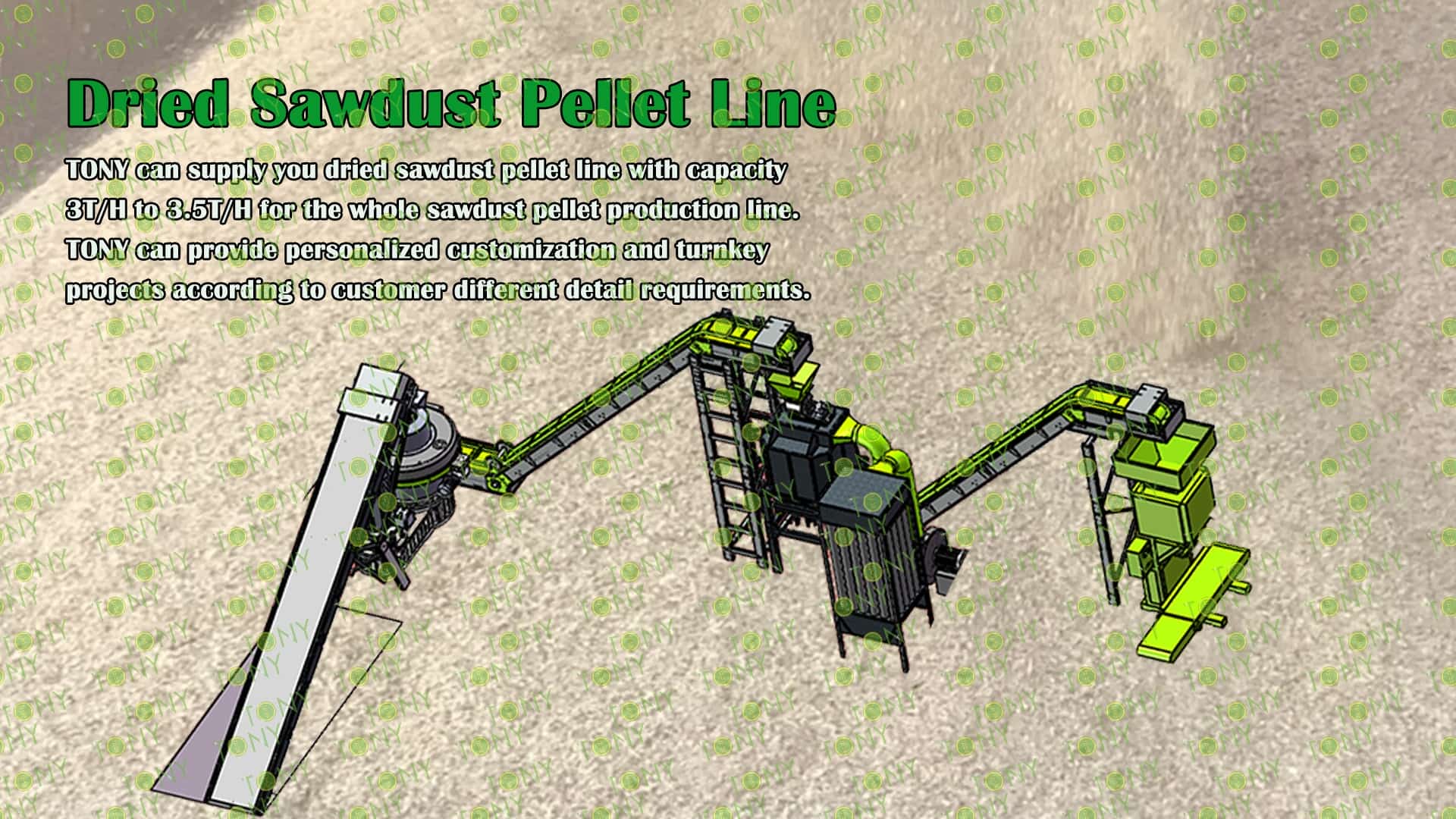
3D
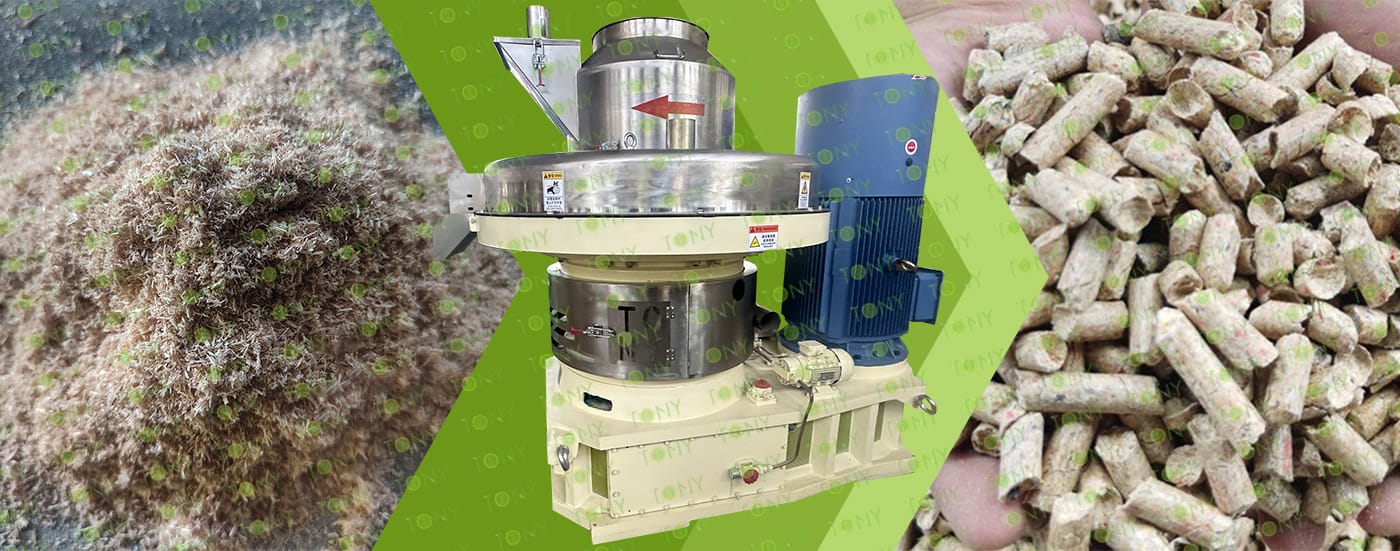
1.The working principle of dried sawdust biomass pellet processing equipment
(1)Sawdust is fed to the "distributor" through a feeder, which evenly distributes the material to the gap between the ring die and the pressure wheel.
(2)The high-speed rotating ring die generates centrifugal force, pushing the sawdust toward the pressure wheel. The pressure wheel rotates synchronously with the ring die under the reaction force of the material, and at the same time "presses" the sawdust into the forming hole of the ring die. The sawdust is subjected to high-intensity compression in the forming hole (pressure can reach 100-200MPa), and frictional heat causes the lignin to fully soften. After tightly bonding, it is "extruded" from the hole on the outer wall of the ring die to form long strips of material.
(3)The "fixed cutter" on the outside of the ring die cuts the long strips of material (the cutting length can be controlled by adjusting the cutter position) to form standard pellets, which then enter the cooling system (pellet cooler) to cool to room temperature (to prevent the pellets from getting damp due to residual heat when they accumulate).
2.Characteristics of dried sawdust biomass pellet processing equipment
(1)Raw material adaptability: Precisely match the characteristics of dry sawdust. The equipment's feeding system and extrusion system are optimized for "10%-15% moisture content dry sawdust", and the core components have a long service life.
(2)Core molding characteristics: Relying on physical action to achieve efficient bonding. Dry sawdust does not have excess moisture to assist in bonding. The equipment needs to enhance the "physical extrusion + lignin melting" effect through structural design to ensure stable pellet molding.
(3)Operation and operation characteristics: Stable, convenient, and low maintenance. The equipment design focuses on "reducing manual intervention and reducing downtime" and is suitable for long-term continuous operation. For example, the "variable frequency screw feeder" is used to automatically adjust the feeding speed according to the raw material inventory in the extrusion chamber. The core components (ring die, pressure roller) adopt a "quick-release design" and can be replaced without disassembling the entire machine. The medium and large equipment integrates a "PLC control system" to monitor parameters such as feeding volume, extrusion temperature, and pellet output speed in real time.
(4)Finished product guarantee characteristics: Ensure that the pellets meet the use requirements. The equipment solves the "high temperature and broken pellets" after the dry sawdust pellets are formed through the subsequent processing module. Problems are solved to ensure the quality of the finished product. The standard "counter-current cooler" quickly cools the pellets to room temperature (±5°C) and removes trace amounts of residual heat to prevent moisture and agglomeration during pellet storage. After cooling, it is equipped with a "double-layer vibrating screen" to ensure that the qualified rate of finished pellets can reach over 98%.
3.Application scenarios of dried sawdust biomass pellet processing equipment
(1)Wood processing park: zero-emission waste treatment
Applicable scenarios: large furniture industrial parks, man-made board factories, and wood processing plant clusters.
Application logic: Such parks produce hundreds of tons of dry sawdust every day. If randomly piled up, it is easy to breed mold, cause fires, or be illegally dumped and cause environmental pollution. After matching dry sawdust pellet equipment, all sawdust can be "turned into treasure". The pellets produced can not only supply the park's own heat, but also be sold to the outside world, achieving "zero waste discharge + additional income", which meets the park's "circular economy" construction requirements.
(2)Forestry waste treatment: utilization of forest/logging waste
Applicable scenarios: forest farms, forestry logging areas (the branches and stumps left after logging are crushed to form dry sawdust).
Application logic: If branches and wood chips generated by forestry logging are burned on site, it will cause air pollution; if they are transported out of the mountains for processing, the cost is extremely high. A small dry sawdust pellet processing station is temporarily built near the logging area to process the crushed dry sawdust into pellets, which are then transported out of the mountains for sale (the pellets have high density and the transportation cost is only 1/5 of loose sawdust). This not only solves the problem of forestry solid waste pollution, but also creates additional economic benefits for the forest farm.

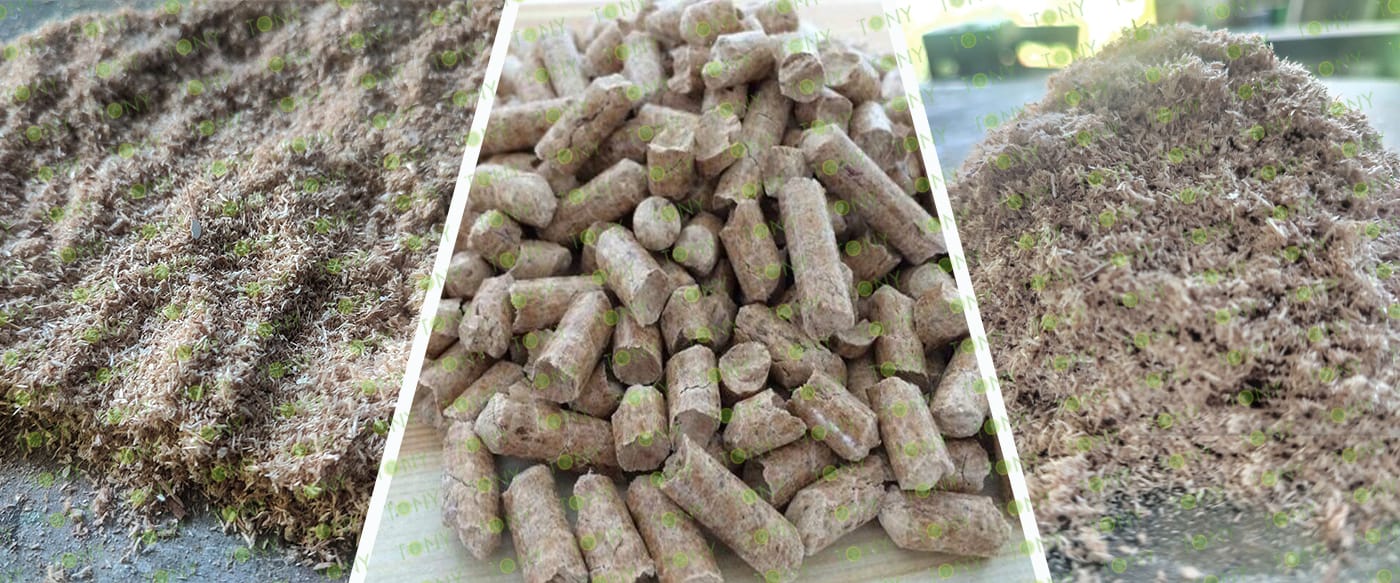
TONY Brand 14-15Ton/Hour Dried Sawdust Pellet Manufacturing Plant can take dried sawdust,wood chips, various types of wood - related biomass materials, such as wood pallets ,branches, wood logs, and wood shavings. After pretreatment and processing, dried sawdust is solidified into high - density wood pellet fuel. This fuel is an ideal substitute for coal and oil and plays a role in energy conservation and emission reduction.
1. Capacity: 14-15Ton/Hour
2. Raw materials: Dried sawdust
3. Moisture: Dry type, about 10%-15%.
4. Application: All kinds of wood sawdust or more waste wood raw materials
Suitable customers:Wood processing plants, furniture manufacturing plants, construction sites, landscaping companies and other places with advantageous sawdust resources
5. Finished Pellets Markets: Large power plants ,domestic heating, industrial heating, combustion heat, heating systems, boiler rooms, school canteens, foundry heat sources.


1. Project Name: Dried Sawdust Pellet Production Line
2. Raw Material: All kinds of dried sawdust
3. Moisture Content of Raw Material: 10%-15%
4. Capacity: 14-15 tons per hour
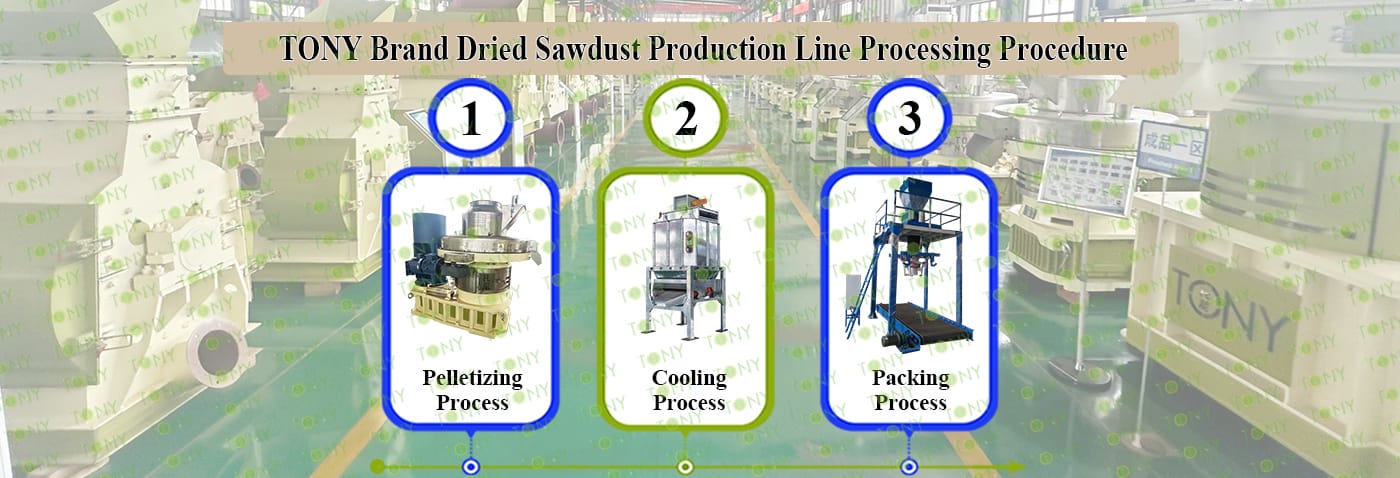
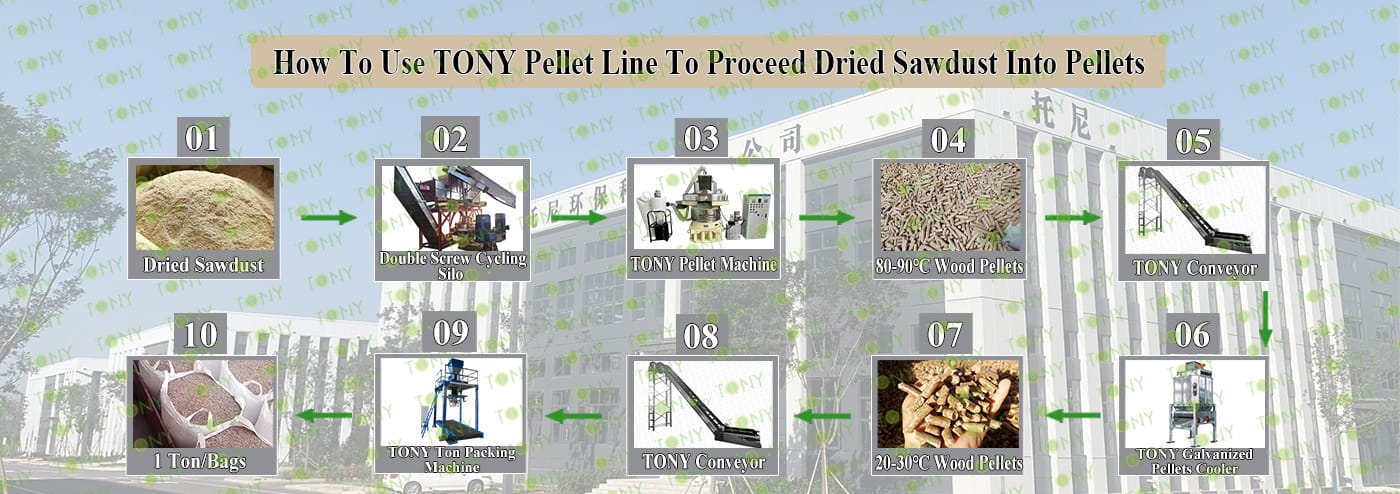
5. Process: Pelletizing Process - Cooling Process - Packing Process
6. Main Equipment: TONY Pellet Machine TYJ760-Ⅲ-185KW, Galvanized Pellets Cooler, Ton Packing Machine and Belt Conveyors

|
How to use the TONY pellet production line to make pellets from dried sawdust? The process mainly includes the following steps and equipment: 1. Use TONY vertical ring die pellet machine to produce pellets with a diameter of 6-8 mm. 2. Use TONY galvanized pellets cooler to cool the pellets from 80-90°C to 20-30°C. 3. Use TONY ton packing machine to pack the pellets into bags, each weighing 1 ton. For more detailed information and quotations, you can contact TONY. TONY can provide all the above - mentioned products at highly competitive prices and with excellent quality. |
|
|||||||||||||||||||||||||||||||||||
三维图
三维图
| Next, TONY Will Introduce To You All The Necessary Machinery That Will Be Used For The Whole Pellet Production Line. Some Machines Can Be Custom - Made By Customers According To Different Customers' Detailed Demands. Contact TONY For More Details, Including Quotation And Layout. | |||
 |
 |
 |
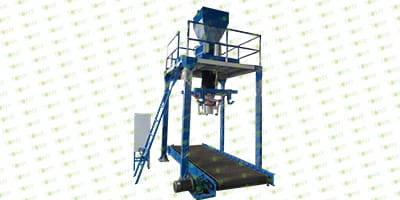 |
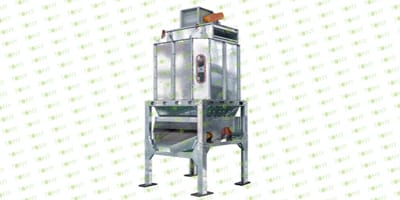
| Double Screw Cycling Silo | Vertical Ring Die Pellet Machine | Galvanized Pellets Cooler | Ton Packing Machine |
| 1.To Stroage Sawdust Before Pellet Machine; Adjust The Speed Of Sawdust Entering The Pellet Machine 2.Model: TLC-15*1set 3.Capacity:14-15Ton/Hour/Set |
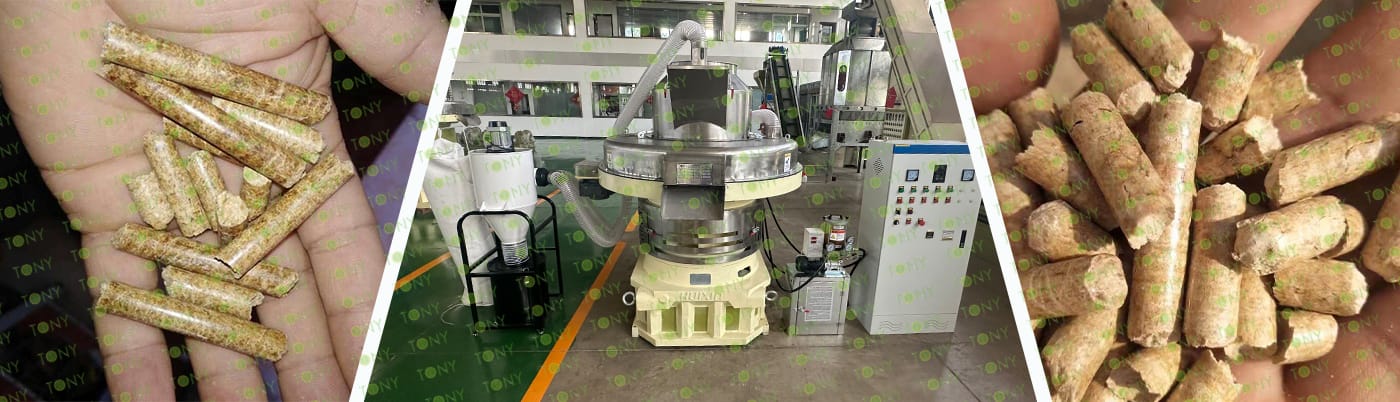
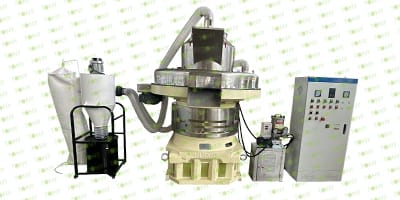
1.To Press Dry Sawdust Into 6-8mm Biomass Pellets 2.Model: TYJ760-III-185KW*5sets 3.Capacity:2.8-3.3Ton/Hour/Set 4.New 304SS Type |
1.To Cool Pellets From 80-90℃ Into 20-30℃ 2.Model: TCN-10*1set 3.Capacity:14-15Ton/Hour |
1.To Pack Pellets Into 1 Ton/Bags. 2.Model: TBD* 1set 3.Capacity:14-15Ton/Hour |
三维图

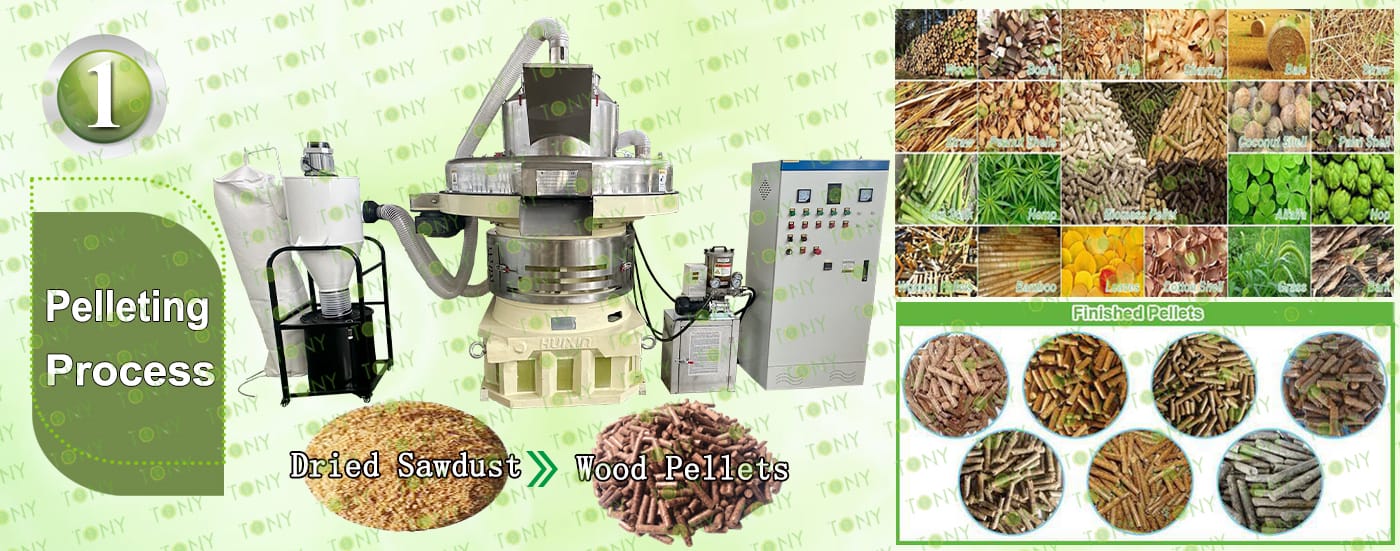
1.Pelletizing Process:
A.This process is mainly used to to product pellets into φ6-8mm.
B.Capacity:14-15Ton/Hour.
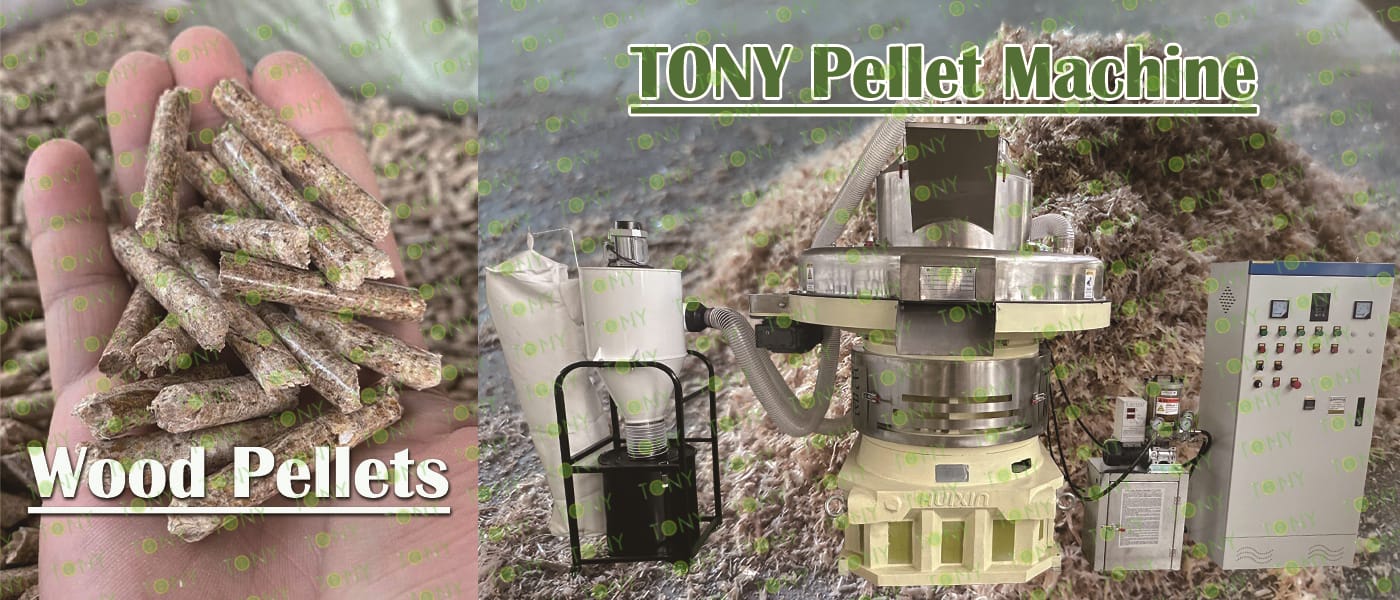
C.TONY brand vertical ring die pellet machine TYJ760-Ⅲ-185KW*5sets
D.Double screw cycling silo is added above the pellet machine, which has the advantages of saving space, saving labor, intelligently controlling the feeding speed, not easy to block the material, and improving production efficiency.
Main Parts:
(1)TONY's New Vertical Ring Die Pellet Machine.
(2)Cyclone And Bags Dust Collectors.
(3)Automatic Lubrication System.
(4)Electrical Cabinets.
You can chose TONY new type SS304 pellet machine

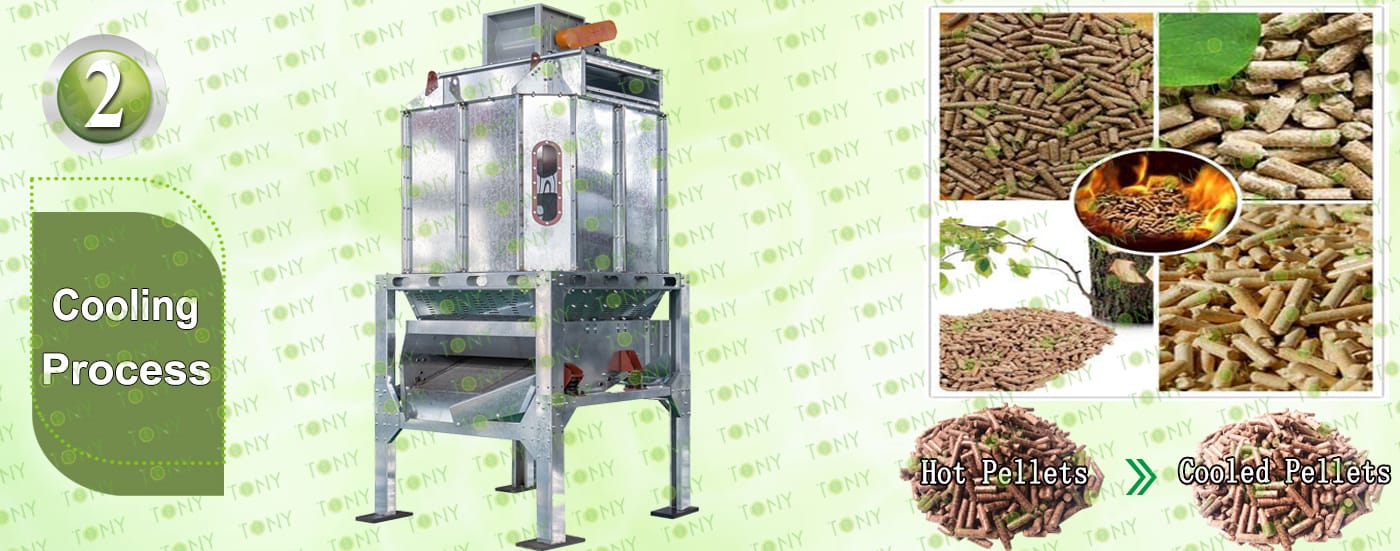
2.Cooling Process:
A.This process is mainly used to cool pellets from 80-90℃ to 20-30℃
B.Capacity:14-15Ton/Hour.
C.TONY brand galvanized pellets cooler *1set
Main Parts:
(1)TONY's Galvanized Pellets Cooler With Vibrating Screen.
(2)Cyclone And Bags Dust Collectors.
(3)Fan Blower.
(4)Connect Pipes.

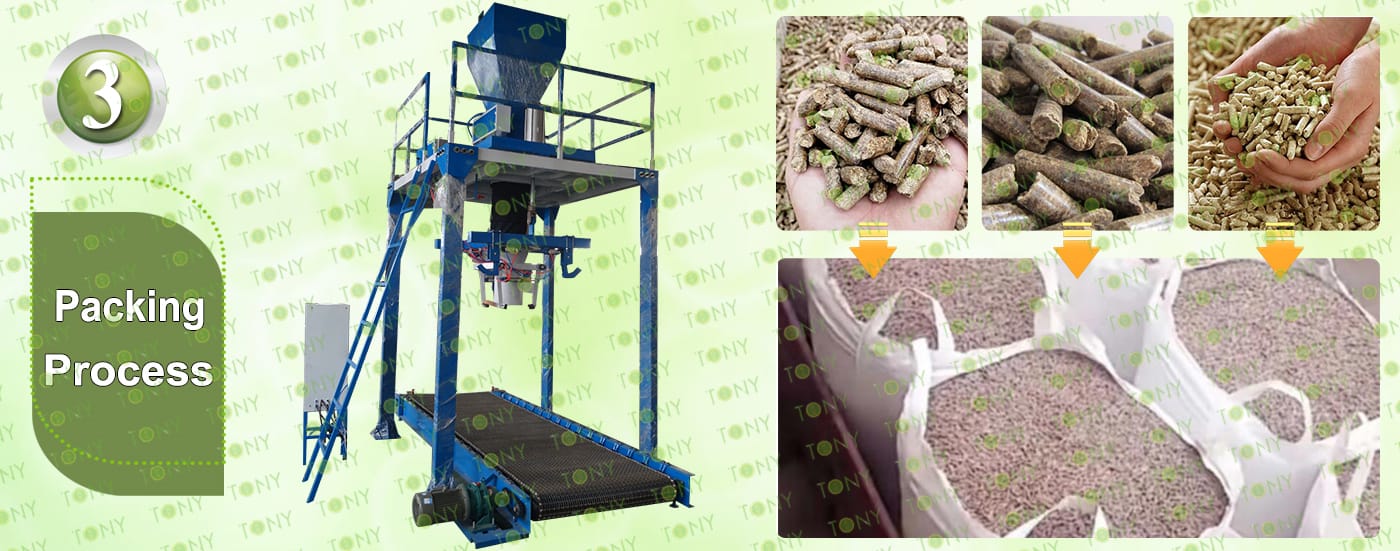
3.Packing Process:
A.This process is mainly used to pack pellets into 1Ton/Bags.
B.Capacity:14-15Ton/Hour.
C.TONY band ton packing machine*1set
Main Parts:
(1)TONY Ton Packing Machine
(2)Electronic Platform Scale Metering System
(3)Automatic Tare, Zero, and Drop Correction Functions
(4)Feeding System Features Fast, Medium, and Slow Feeding Speeds to Ensure Measuring Accuracy


Demand continues to grow, and the application scenarios are diverse. As a "clean alternative fuel," biomass pellets can directly replace traditional energy sources such as coal, natural gas, and heavy oil. Market demand spans three core sectors: industry, civil use, and power generation, and the market has enormous growth potential:
Market Advantages of Sawdust Processing Biomass Pellets
1.Industrial Sector (Core Demand):
Small and medium-sized boilers (under 10 tons) in industries such as food processing, textiles, and chemicals are the preferred choice for "coal-to-biomass" because the cost of switching from coal to biomass is lower than switching from coal to gas (the unit price of biomass pellets is only 1/2-2/3 that of natural gas). Industrial boiler conversions alone generate over 5 million tons of annual demand.
2.Civilian Sector (Incremental Demand):
Biomass pellets are used for clean heating in rural areas and fireplace heating in homes. Biomass pellets are smokeless and odorless, have a low ash content (only 2%-5%, far lower than the 10%-20% of coal), and are easy to store (bagged pellets can be stored for long periods). The civil market is experiencing an annual growth rate exceeding 15%.
3.Power generation (stable demand):
Biomass power plants use pellets as fuel and sign long-term supply agreements (usually 1-3 years) with power plants to ensure "stable orders" for the project and avoid the risk of market price fluctuations.


Compared to traditional fuels like coal and firewood, sawdust pellets offer a superior user experience and require no major modifications to existing equipment:
1.Easy to ignite and stable combustion:
The pellets have a regular shape (typically 6-10mm in diameter and 20-30mm in length) and a controllable moisture content (10%-15%). Ignition requires only a small amount of combustion aid (such as paper or wood chips). Once ignited, the flame is stable and the calorific value is uniform (lower calorific value is approximately 4200-4800 kcal/kg, close to Class II bituminous coal). There are no problems with coal "coking and flameout" or firewood "smoking and fluctuating flames."
2.Compatible with existing equipment, low modification cost:
Industrial boilers, residential heating stoves, biomass burners, and other equipment require only a simple adjustment of the feed port (e.g., replacing the coal feed port with a pellet-specific feeder). The modification cost is typically only 5%-10% of the total equipment price, significantly lower than the cost of switching from coal to gas (which requires replacing the entire gas combustion system).
3.Strong adaptability to automated operations:
The particles have good fluidity and can be fed automatically and controlled automatically through pipes and screw conveyors. When combined with a temperature control system, unattended combustion can be achieved (such as 24-hour continuous operation of an industrial boiler), reducing manual operation costs.






2025 Tony Machinery - All Rights Reserved. Map