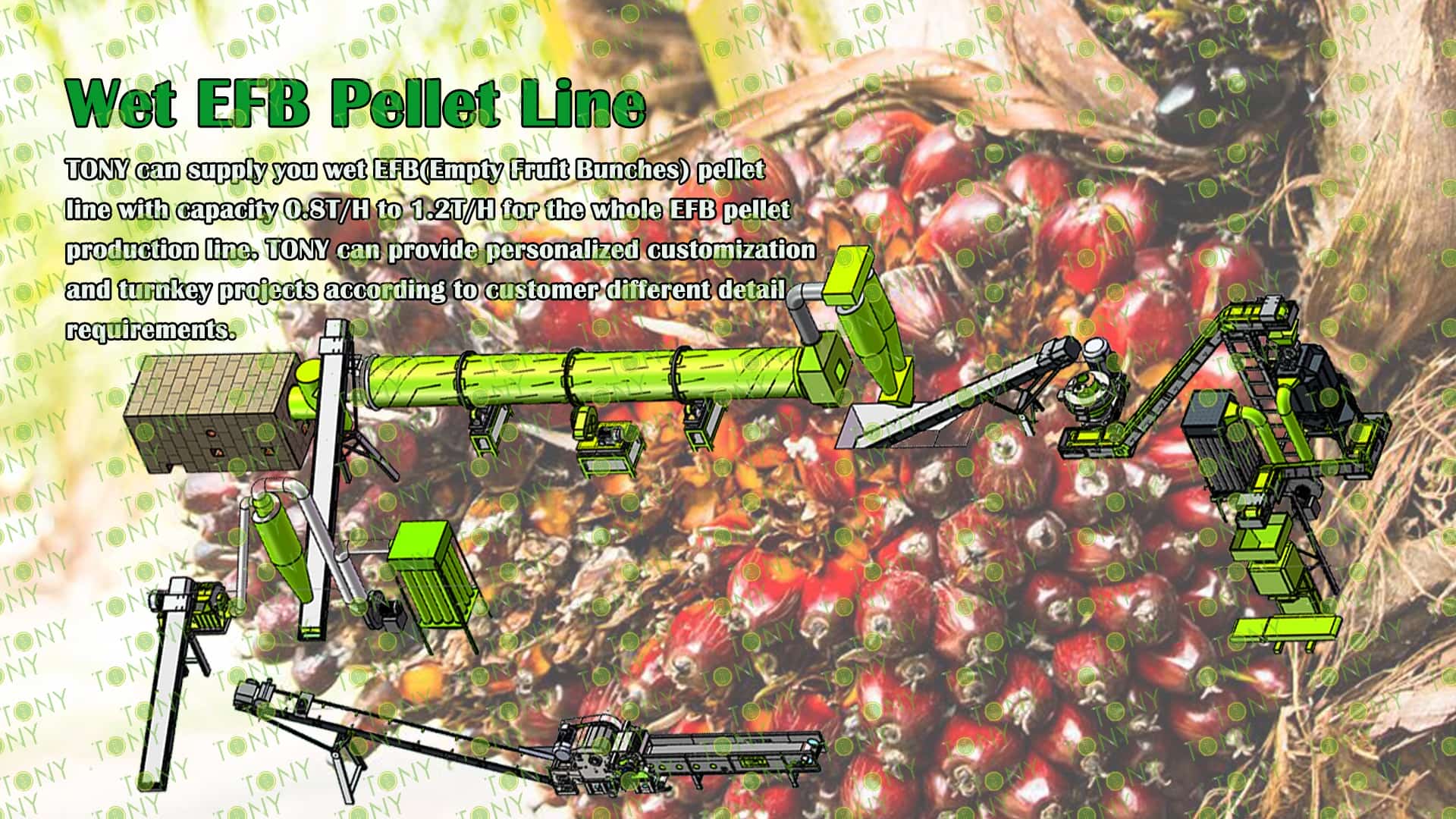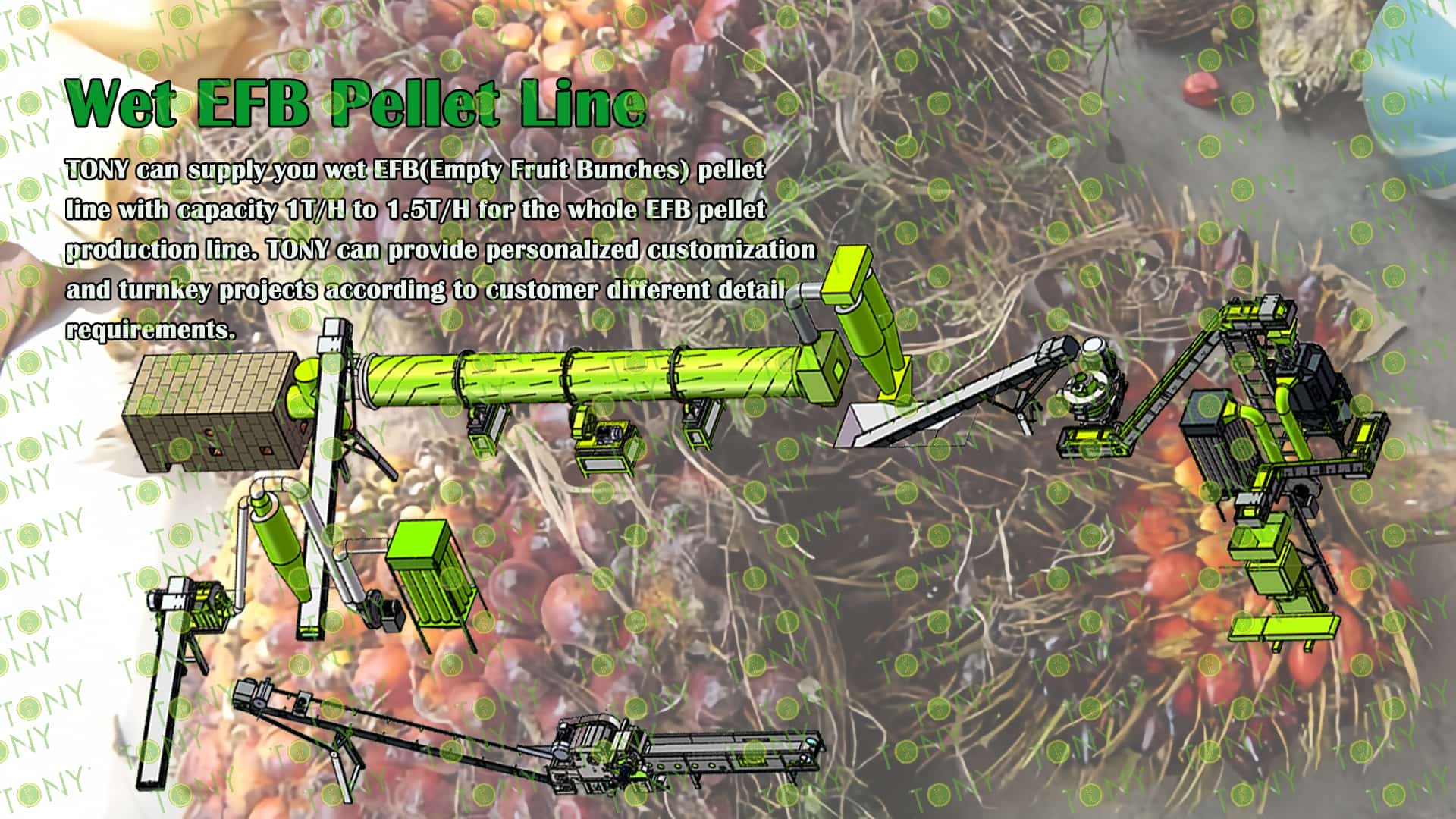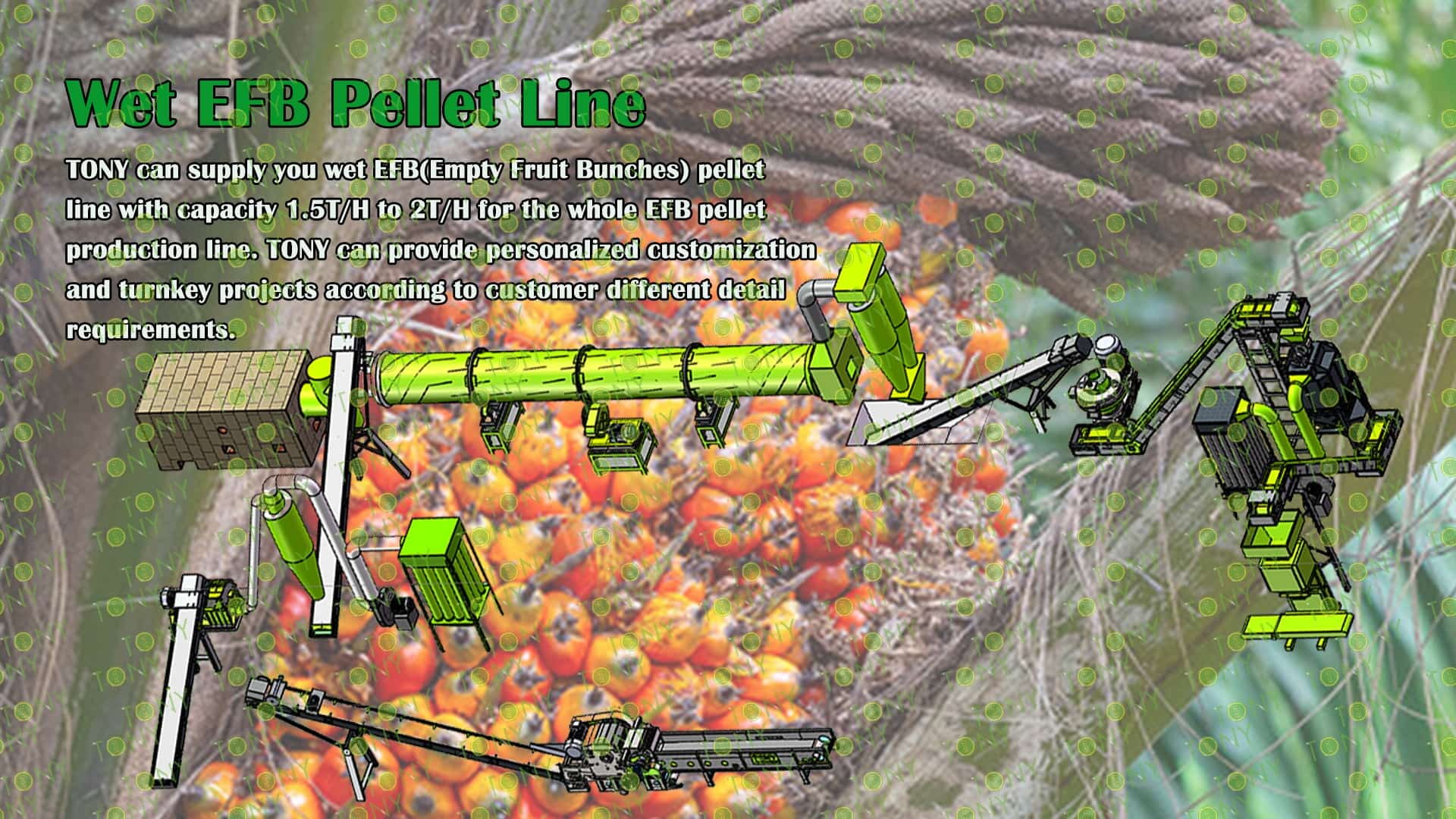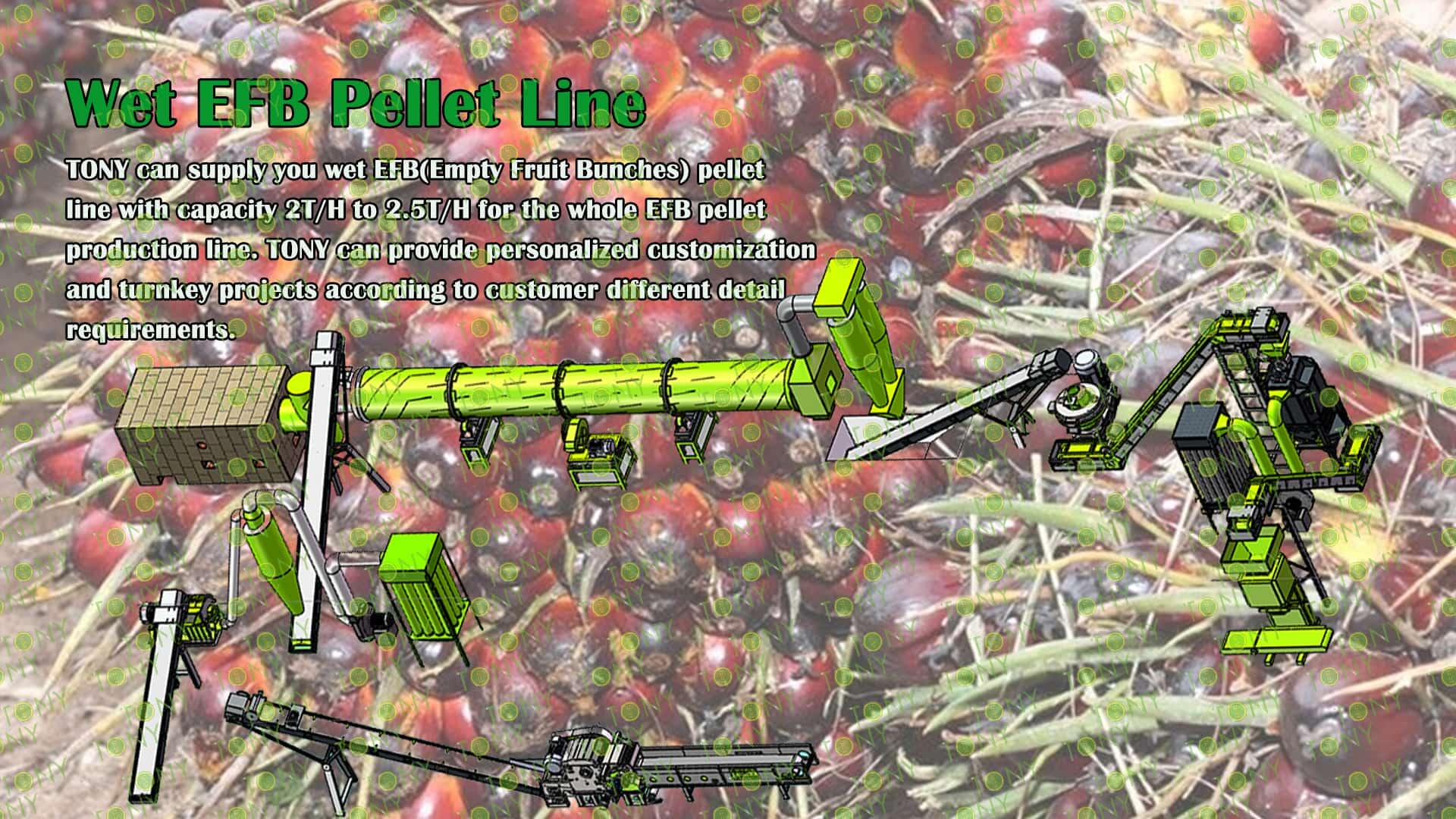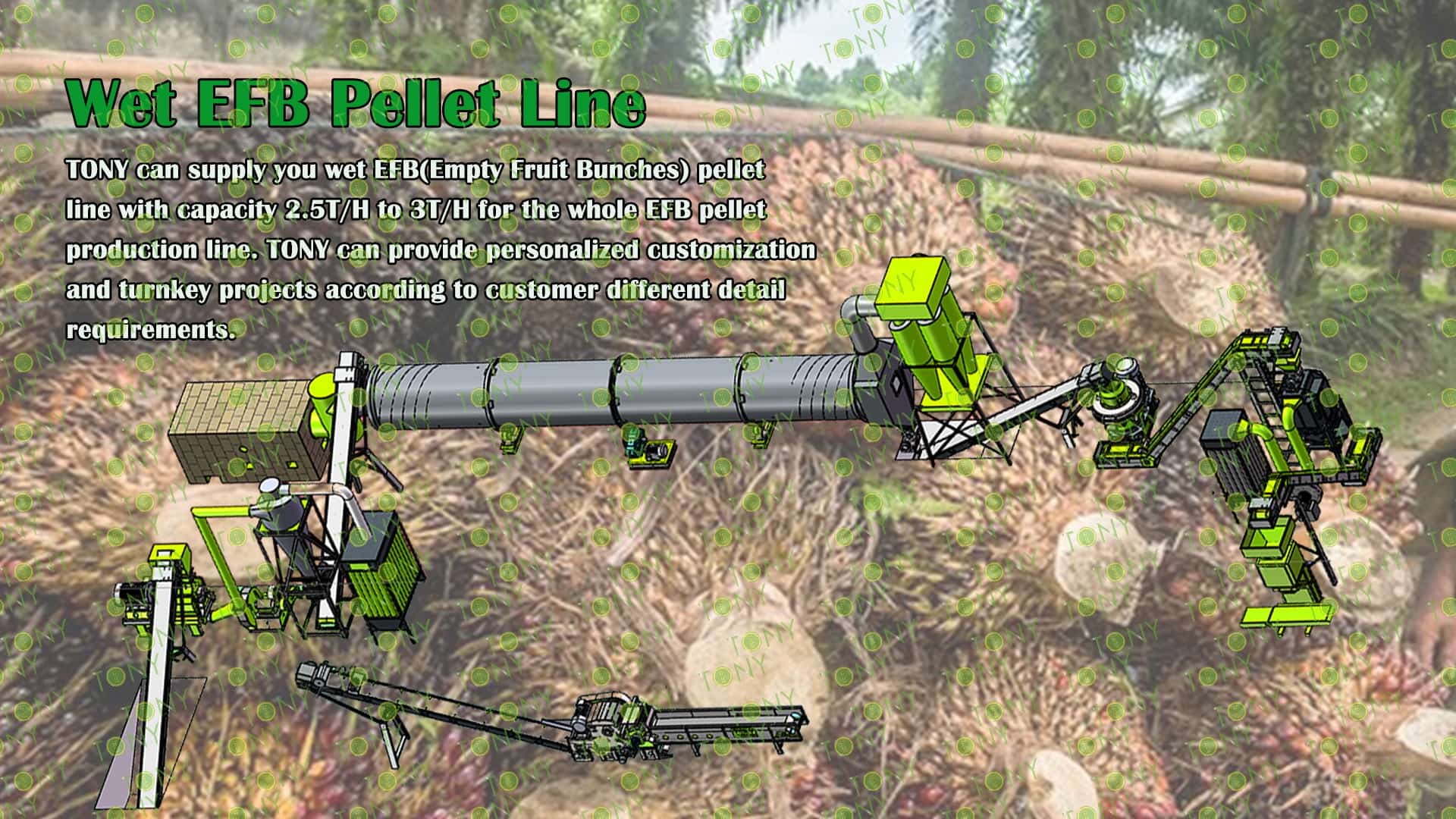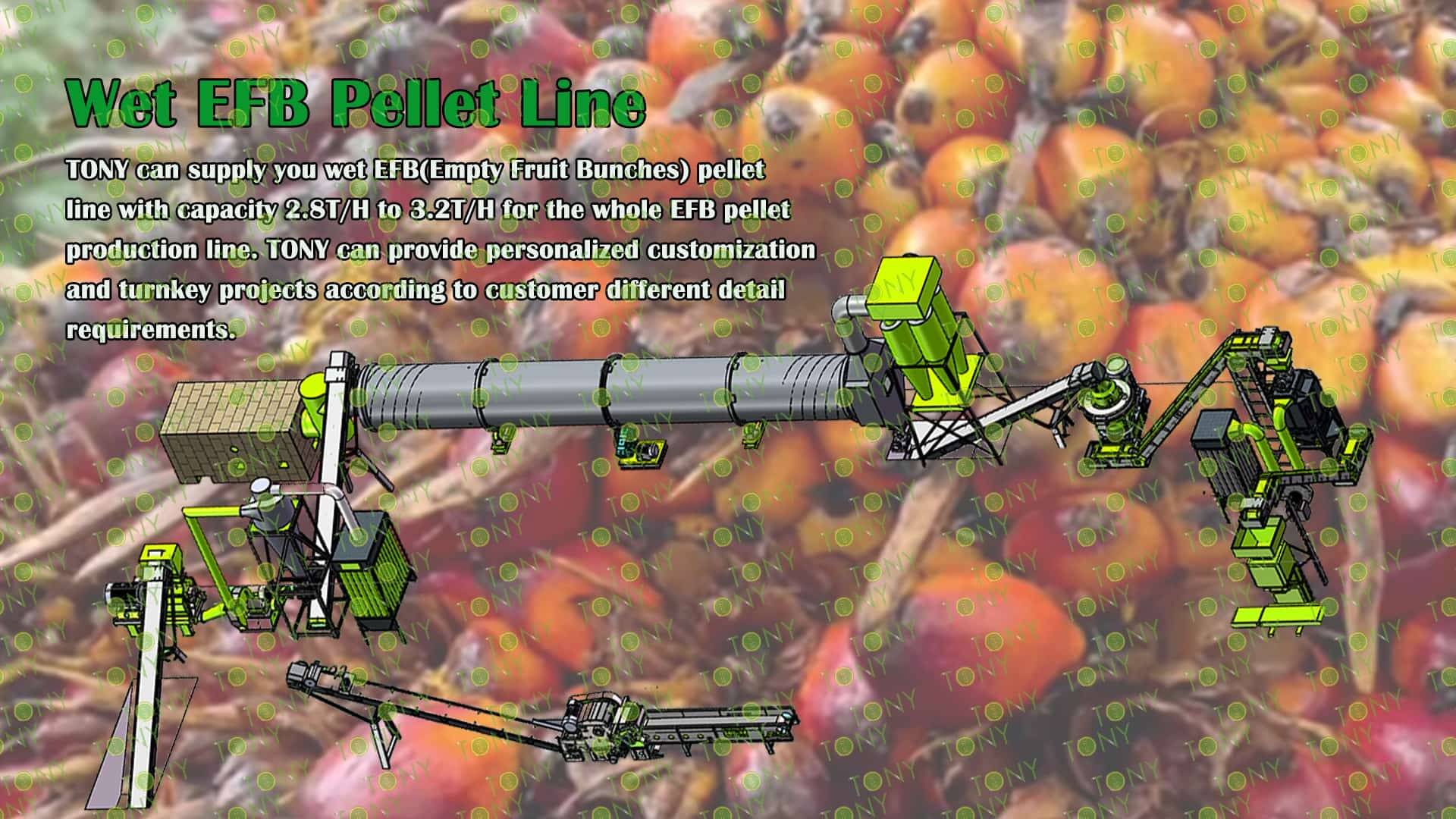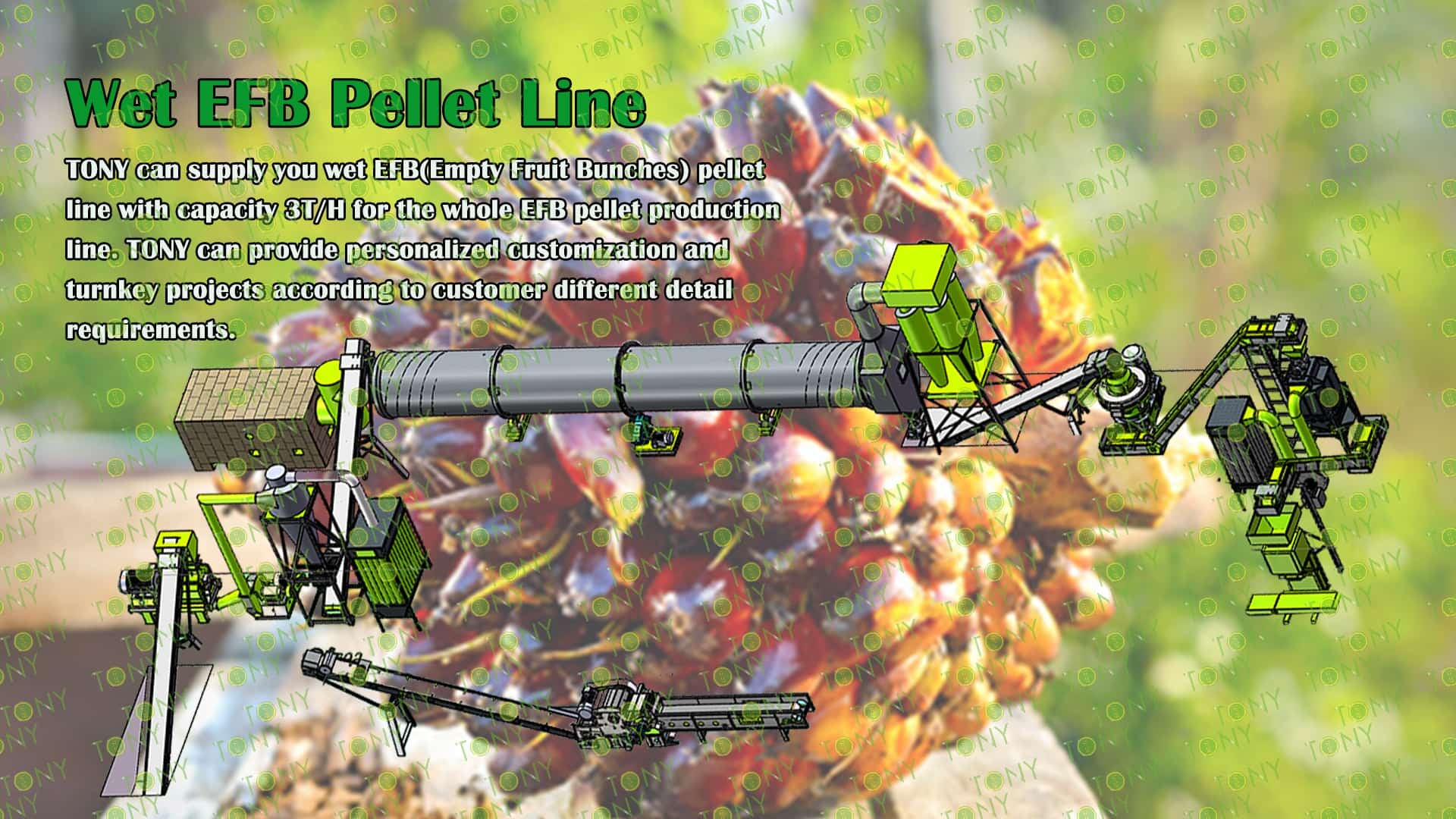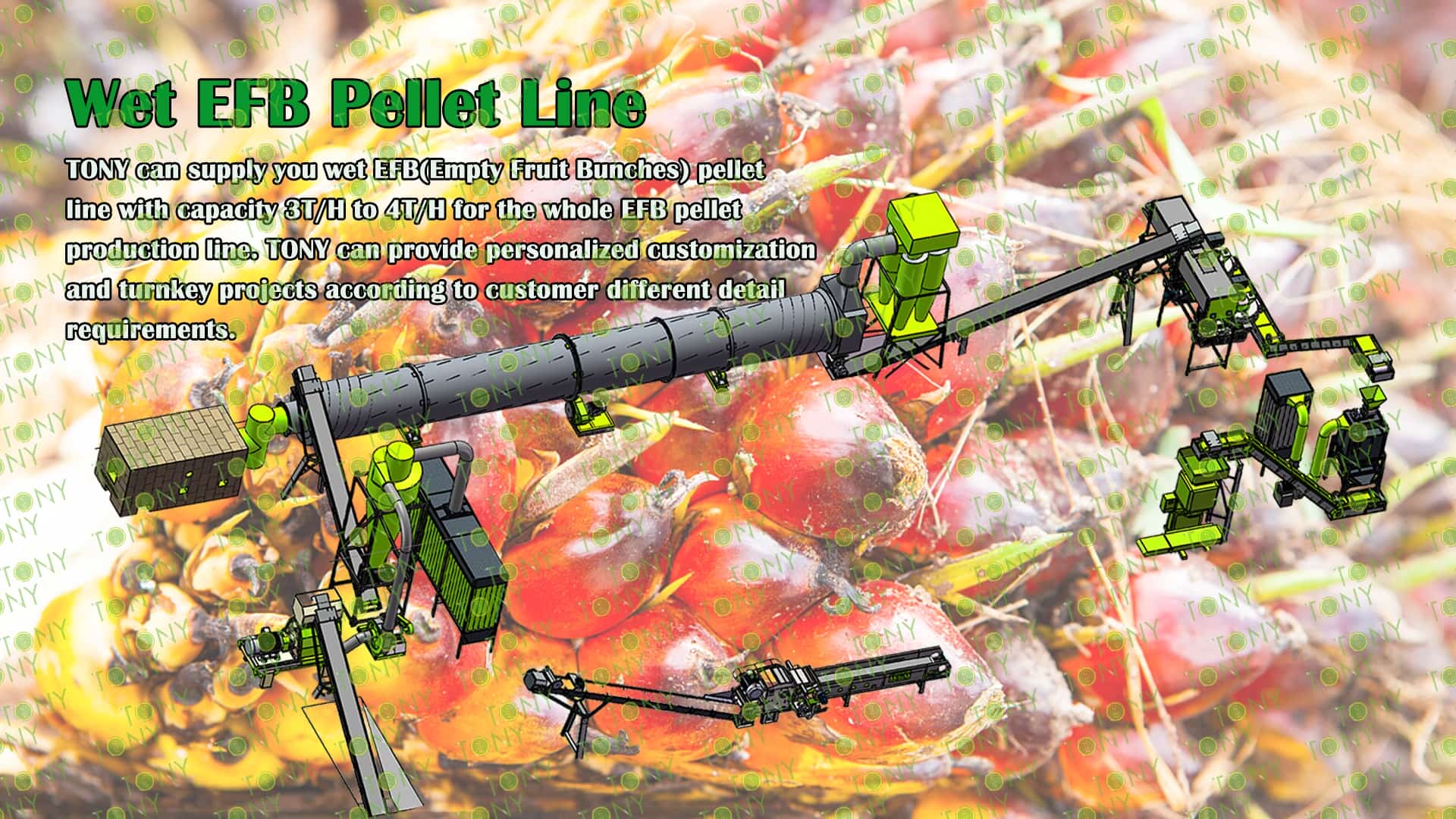




















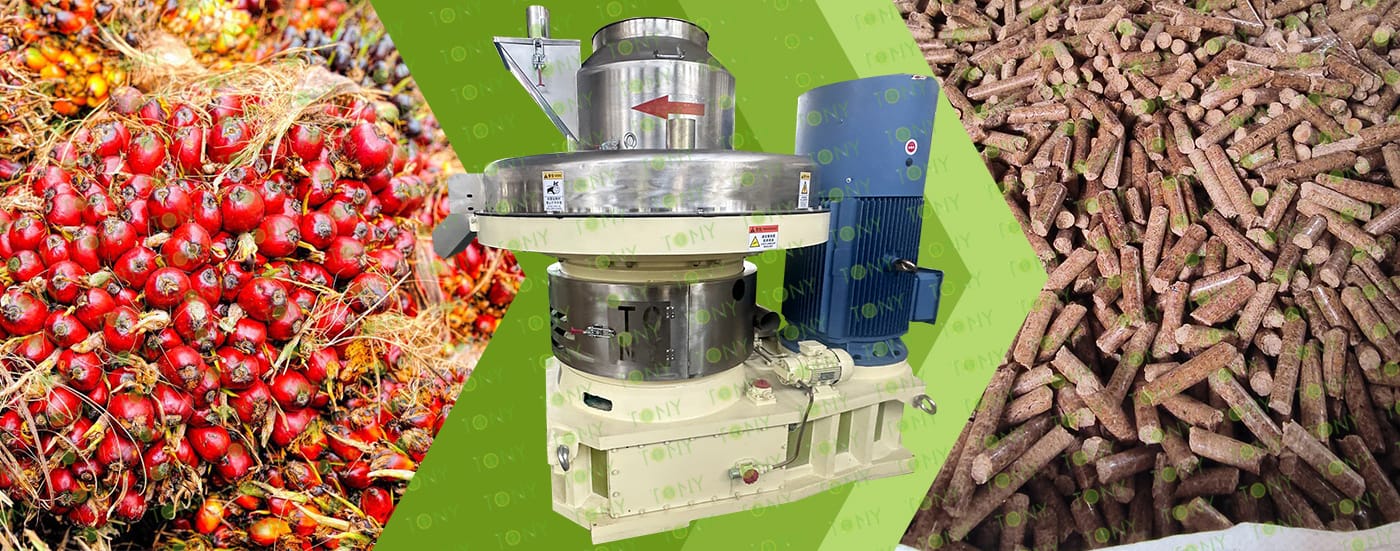
1.The working principle of wet EFB biomass pellet processing equipment
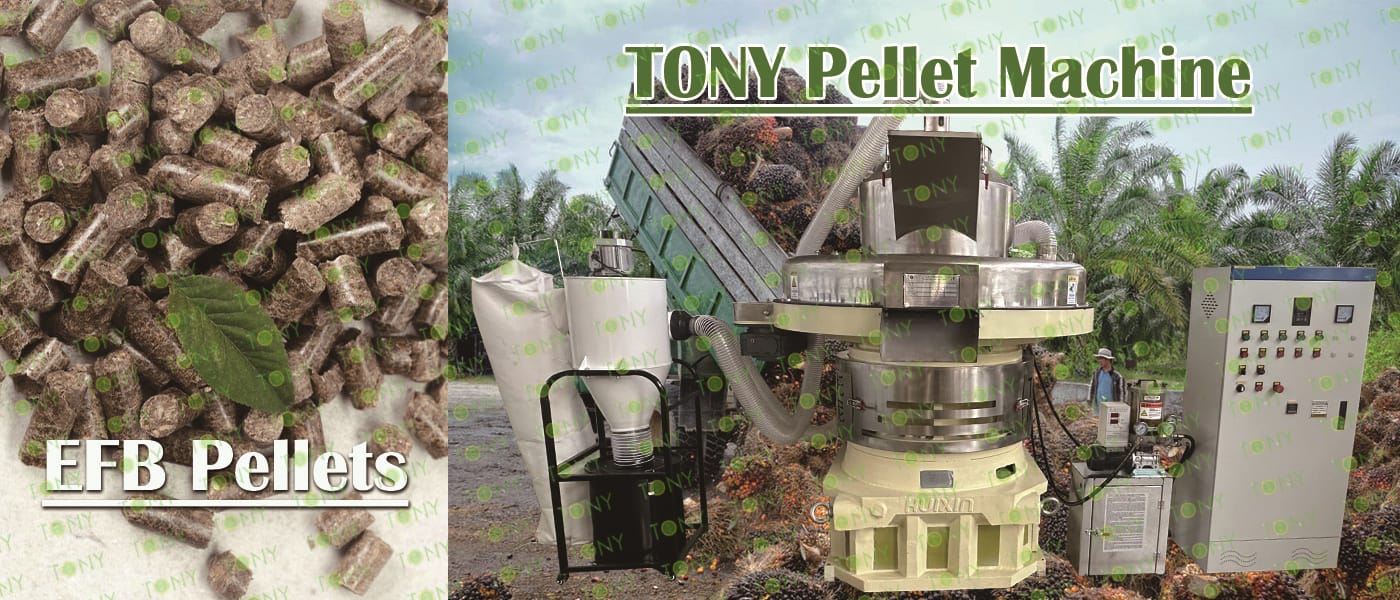
Pelletizing is the key step in converting EFB into pellets. The core equipment is a ring-type pellet machine (suitable for crude fiber materials). The principle is "extrusion friction heat + lignin softening and bonding." EFB has a high lignin content and does not require the addition of artificial binders. It can be formed by extrusion friction heat. The ring-type structure has a high pellet density (1.1-1.3g/cm³), which is suitable for crude fiber materials.
2.Characteristics of wet EFB biomass pellet processing equipment
(1)High adaptability:Compatible with EFB with different moisture and impurity content. The equipment can process EFB raw materials with a moisture content of 45%-75% and an impurity content of ≤10% (ordinary biomass equipment can only process raw materials with a moisture content of ≤60% and an impurity content of ≤5%).
(2)Continuous operation:Reduce downtime and increase production capacity. Key equipment (such as drum dryers and ring die pelletizers) adopt a continuous feeding + automatic discharge design with no intermittent time, and the daily operation time can reach 16-20 hours (ordinary intermittent equipment runs 8-12 hours a day). Wearing parts (such as hammers, blades, and ring dies) are easy to replace and are equipped with a quick disassembly and assembly structure (for example, the ring die adopts hydraulic clamping, and the replacement time is shortened from the normal 2 hours to 30 minutes), reducing downtime and maintenance time.
(3)Low energy consumption:Adapt to the fuel characteristics of EFB itself to reduce costs. The hot air furnace in the drying process can directly use EFB. Crushed or substandard pellets can be used as fuel (no need to purchase coal or natural gas).
The pellet mill uses a variable frequency motor that automatically adjusts speed based on material moisture and particle size, eliminating idling energy consumption (saving 15%-20% compared to conventional fixed frequency motors).
3.Application scenarios of wet EFB biomass pellet processing equipment
(1)Palm oil production requires a large amount of steam (for palm fruit cooking and oil extraction), which traditionally relies on coal-fired or natural gas boilers. EFB is a direct waste product of palm oil processing and can be directly used as boiler fuel after being processed into pellets.
(2)Food factories (baking, beverage production) and textile factories (printing and dyeing heating, drying) require clean heating (to avoid fuel impurities affecting product quality). EFB pellets burn without odor and heavy metal pollution, meeting food-grade production environment requirements.
(4)Pellet fireplaces are used as auxiliary heating equipment. EFB pellets are preferred due to their low cost and easy storage.
(5)Some power plants use EFB pellets as their main fuel and build supporting pellet processing bases to achieve an integrated "raw material - processing - power generation" system.
(6)EFB pellets can provide a stable heat source for greenhouses through small hot air furnaces.
(7)The ash after burning EFB pellets (about 2%-3% of the pellet weight) is rich in minerals such as potassium, calcium, and magnesium, and is free of heavy metal pollution. It can be used as an additive for organic fertilizers or directly used for soil improvement in palm plantations and farmland.
(8)EFB biomass pellets can be used as emergency energy reserves for temporary heating after power outages and for small generator power generation due to their easy storage and low transportation costs.
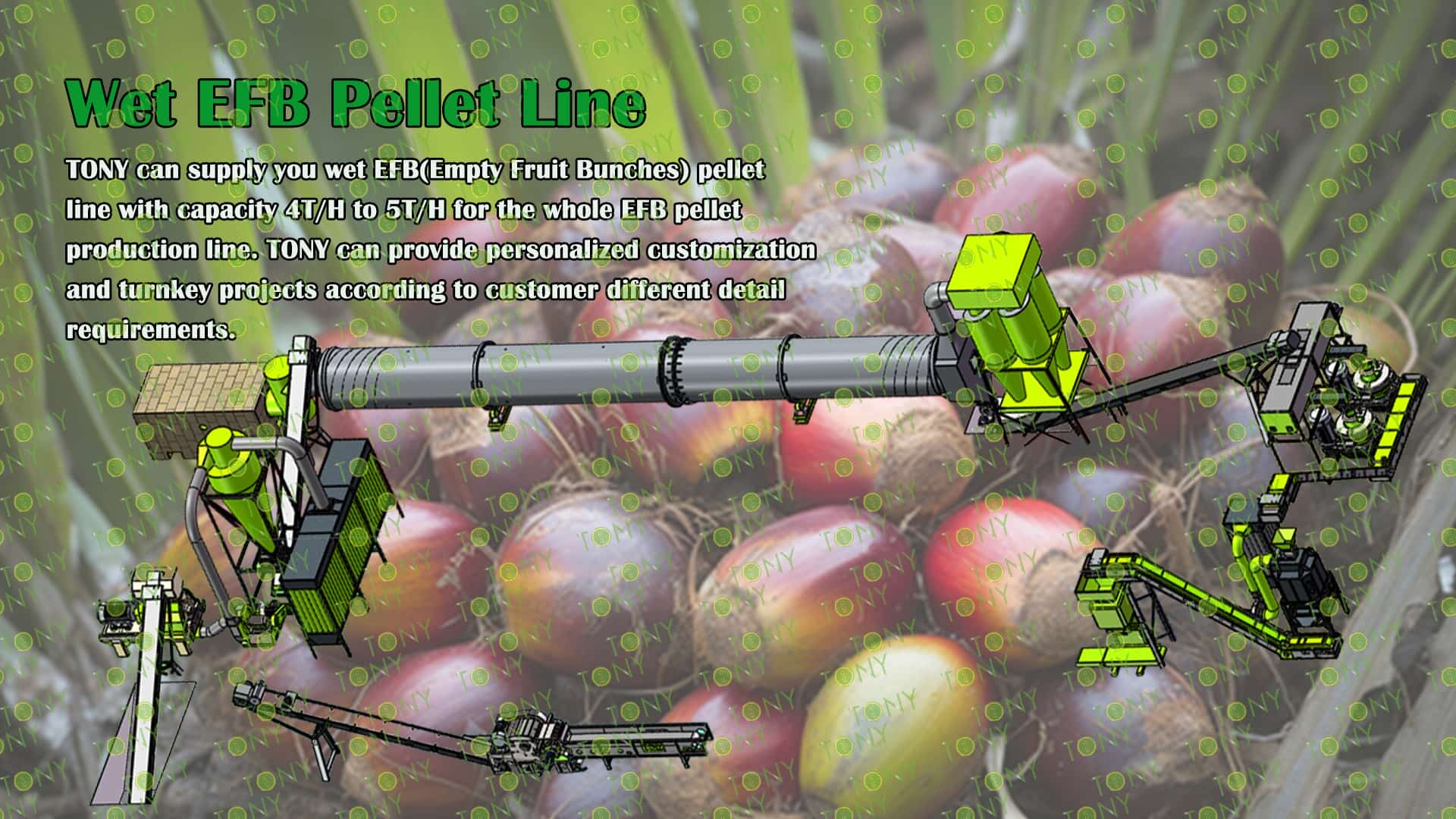
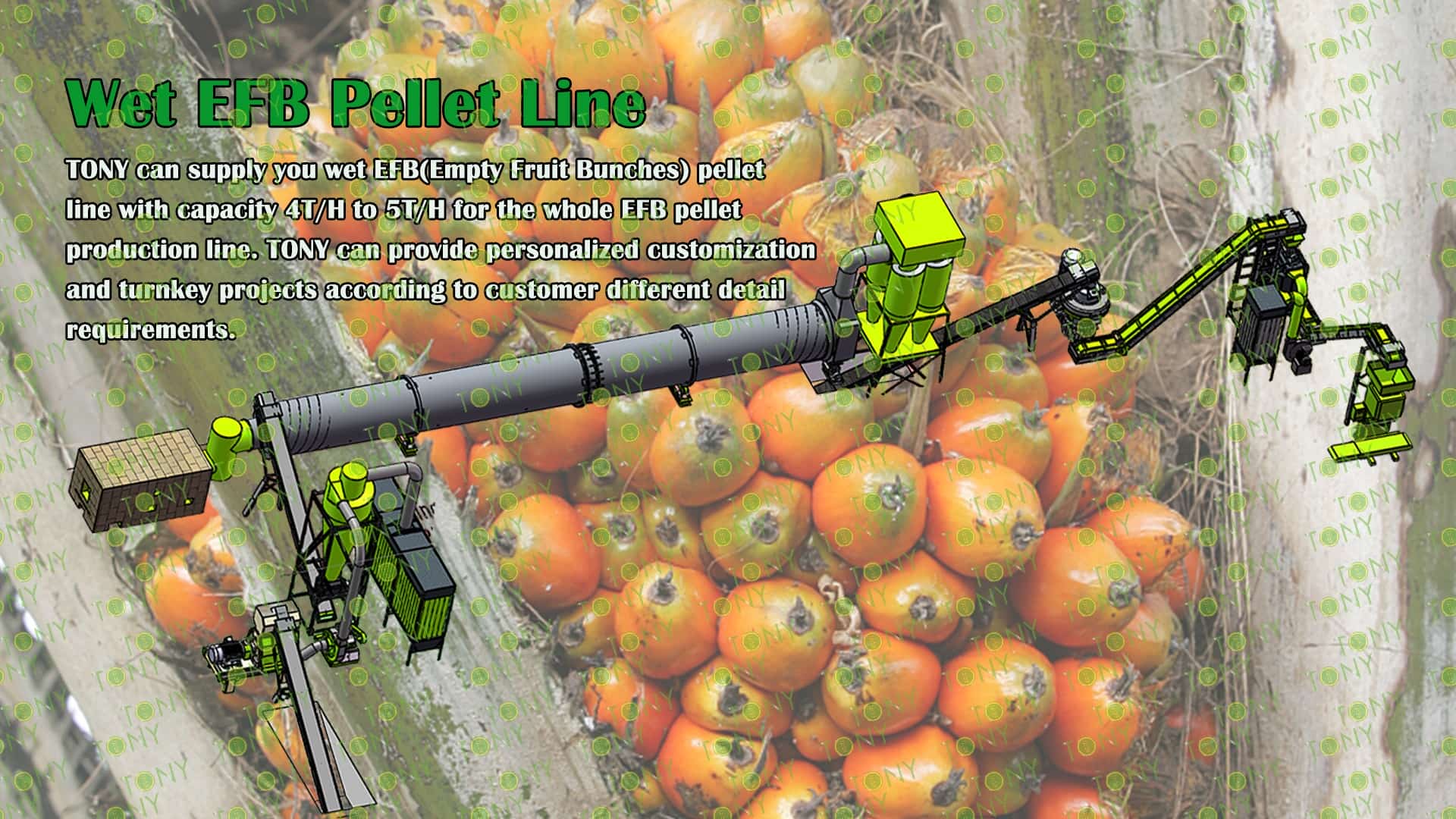
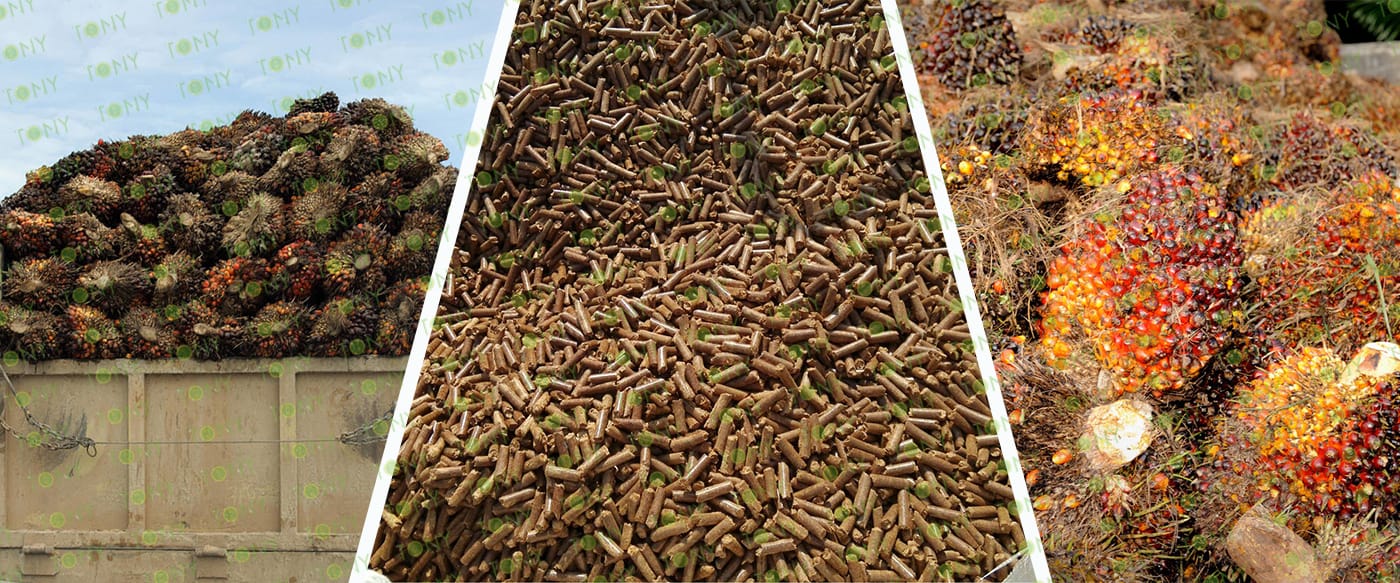
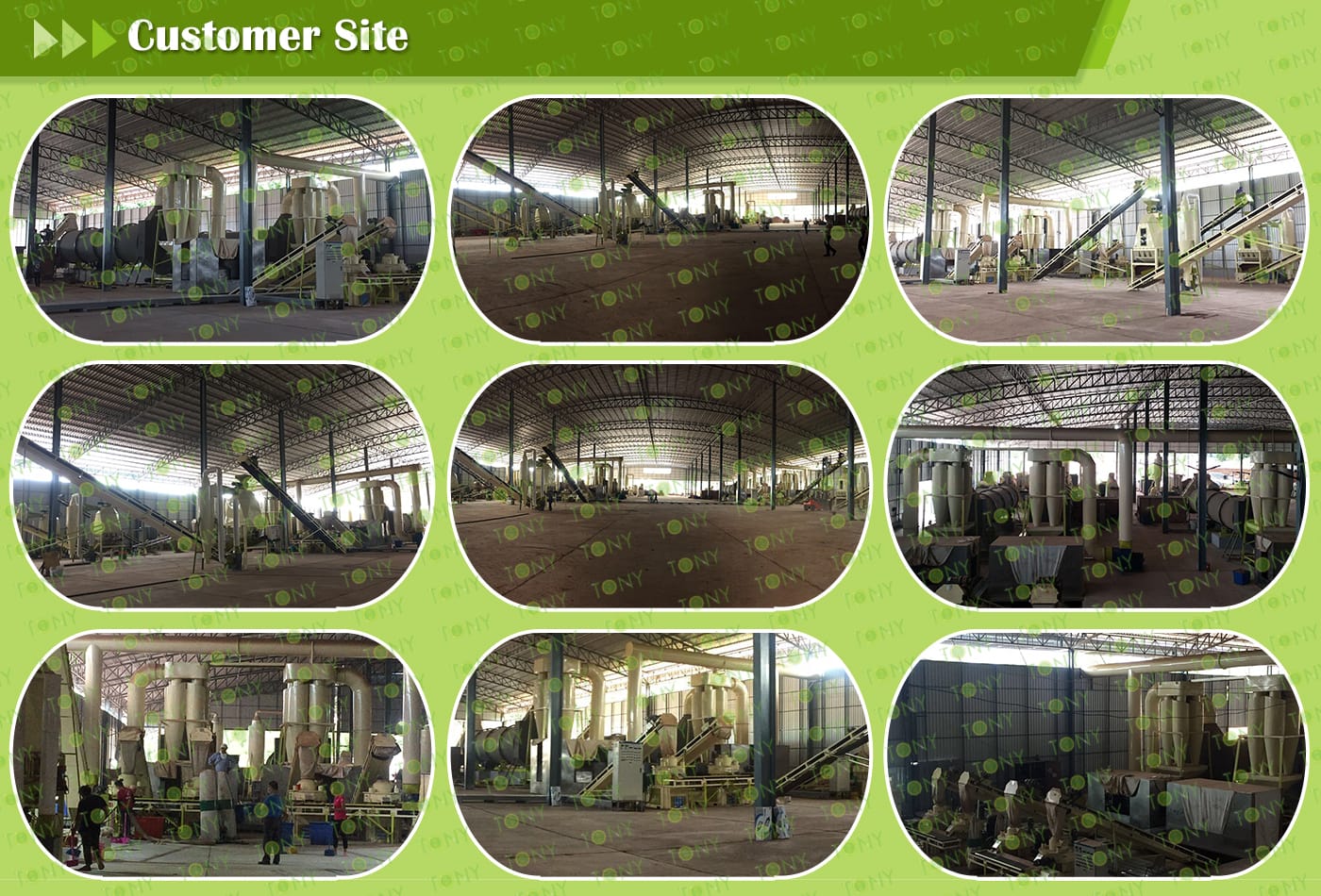
TONY Brand 40-50Ton/Hour Wet EFB Pellet Manufacturing Plant can take wet EFB as the main raw material. After pretreatment and processing, it is solidified into high - density EFB pellet fuel. This fuel is an ideal substitute for coal and oil and plays a role in energy conservation and emission reduction. At present, it has been widely used in regions rich in EFB resources.
1. Capacity: 40-50Ton/Hour
2. Raw materials: Wet EFB
3. Moisture: Wet type, about 40%.
4. Application: All kinds of EFB materials suitable for pellet production.
Suitable customers: Palm plantation owners or related agricultural enterprises have abundant EFB resources. For example, palm oil mills generate a large amount of EFB waste during the production process. Energy companies, EFB biomass pellets as a clean energy, can be used in industrial heating, power generation and other fields, and have synergy with the existing business of energy companies. Environmental investors, investors with financial strength, technology investors, etc.and other places where EFB raw materials have advantages
5. Finished Pellets Markets: Large power plants, domestic heating, industrial heating, combustion heat, heating systems, boiler rooms, school canteens, foundry heat sources.

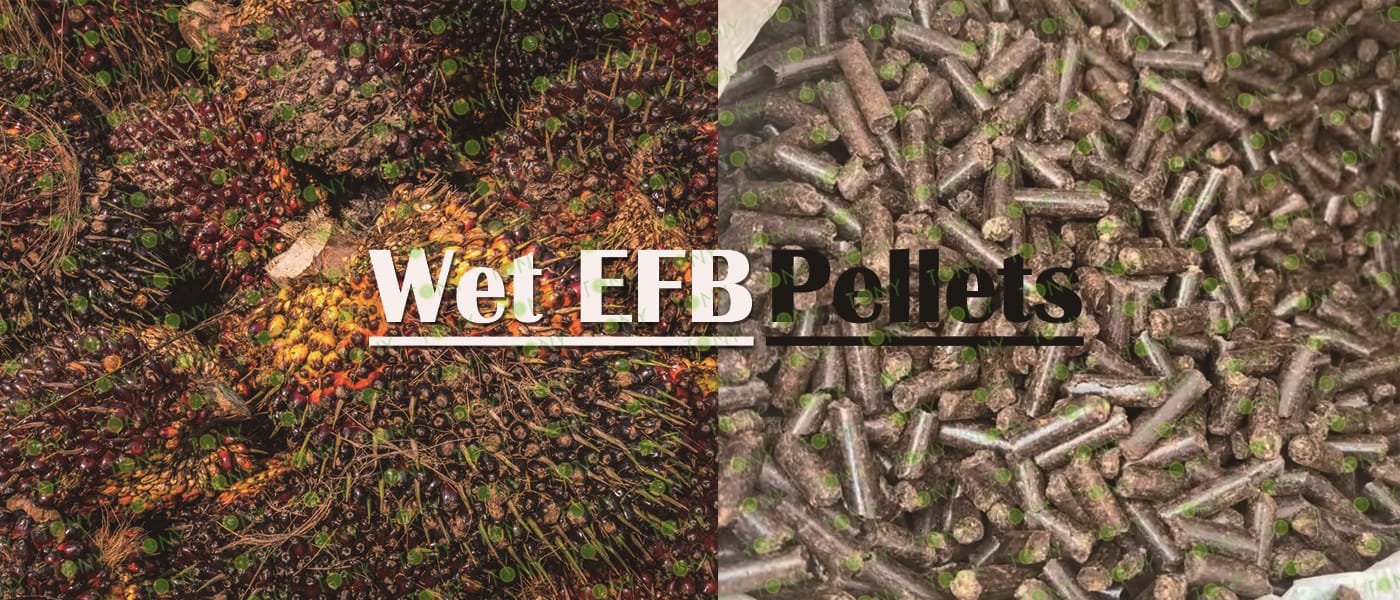
1. Project Name: Wet EFB Pellet Production Line
2. Raw Material: All kinds of wet EFB
3. Moisture Content of Raw Material: 40%
4. Capacity: 40-50 tons per hour
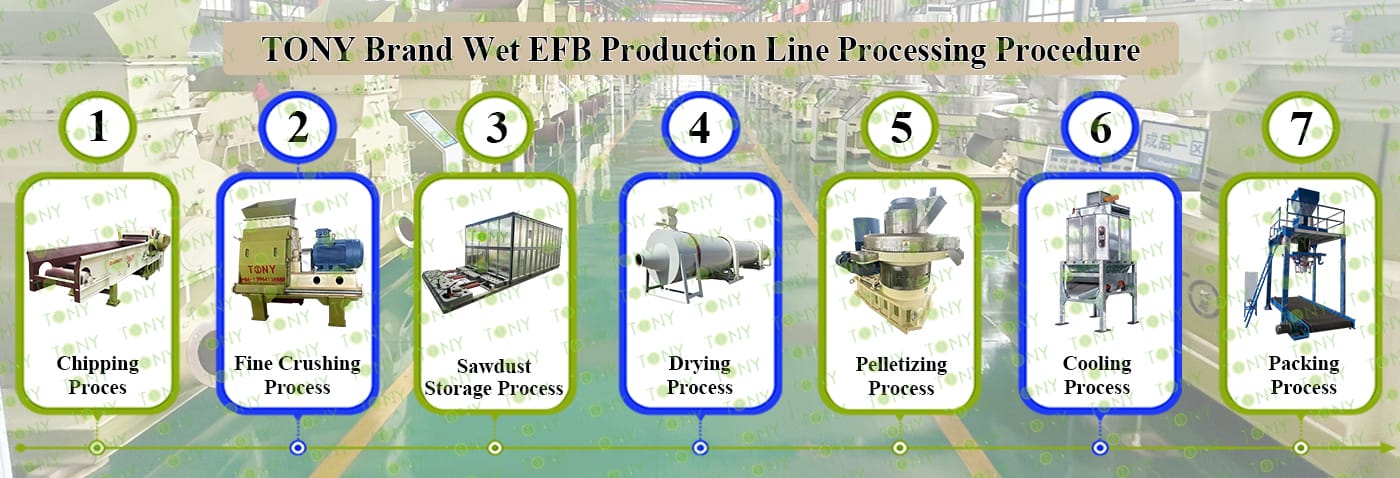
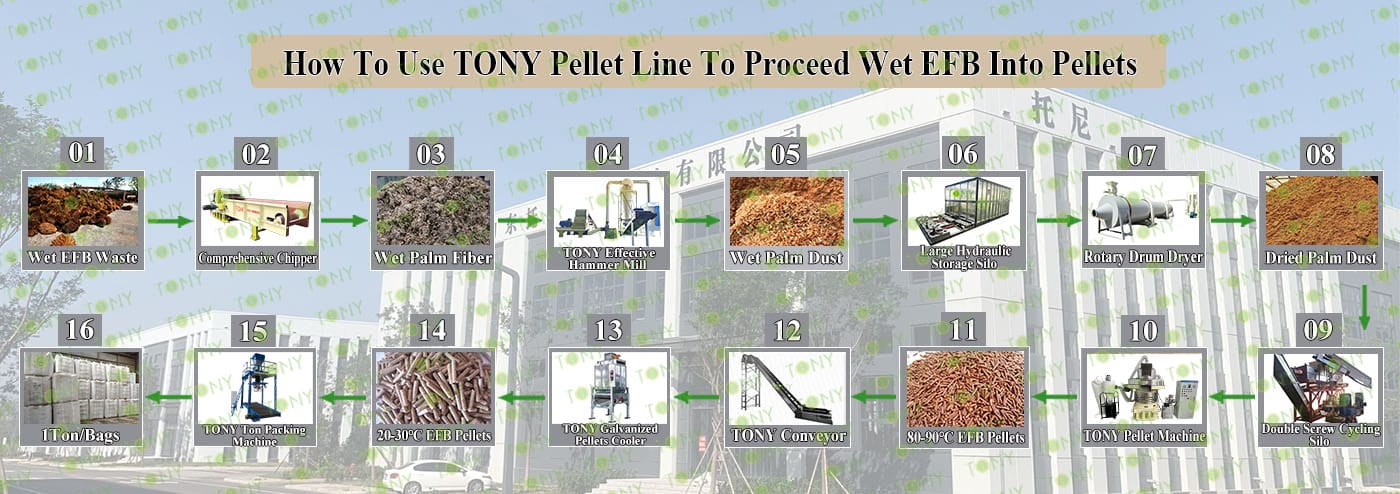
5. Process: Crushing Process - Fine Crushing Process -Palm Dust Storage Process- Drying Process - Pelletizing Process - Cooling Process - Packing Process
6. Main Equipment: Comprehensive Chipper- TPC1600-1000-315KW, Effective Hammer Mill-TFD120-200-355KW, TONY Large Hydraulic Storage Silo,Rotary Drum Dryer-3.2-28m, TONY Pellet Machine- TYJ860-Ⅲ-280KW, Galvanized Pellets Cooler, Ton Packing Machine and Belt Conveyors

|
How to use the TONY pellet production line to make pellets from wet EFB? The process mainly includes the following steps and equipment: 1. Use TONY comprehensive chipper to grind EFB Into 25-55mm palm fiber. 2. Use TONY effective hammer mill to crush the 25-55 mm palm fiber into 8-14 mm palm dust.If customer has enough Investment budget,he can also chose TONY special cutting machine for palm silk which will be more expensive than the hammer mill. 3.Use TONY large hydraulic storage silo to storage 8-14 mm palm dust 4. Use TONY rotary drum dryer to dry the palm dust with a 40% moisture content down to a moisture content of 10%-15%. 5. Use TONY vertical ring die pellet machine to produce pellets with a diameter of 6-8 mm. 6. Use TONY galvanized pellets cooler to cool the pellets from 80-90°C to 20-30°C. 7. Use TONY ton packing machine to pack the pellets into bags, each weighing 1 ton. For more detailed information and quotations, you can contact TONY. TONY can provide all the above - mentioned products at highly competitive prices and with excellent quality. |
|
|||||||||||||||||||||||||||||||||||||||||||||||||||||||

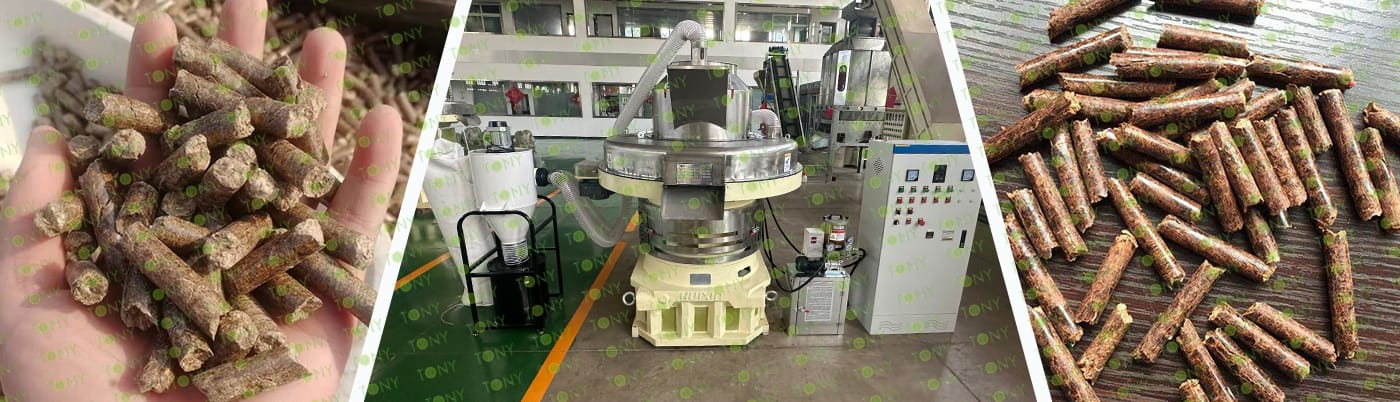
| Next, TONY Will Introduce To You All The Necessary Machinery That Will Be Used For The Whole Pellet Production Line. Some Machines Can Be Custom - Made By Customers According To Different Customers' Detailed Demands. Contact TONY For More Details, Including Quotation And Layout. | |||
 |
 |
 |
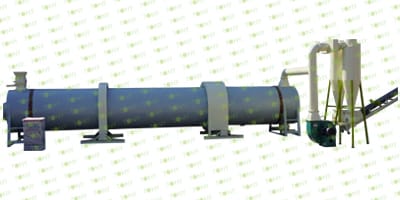 |
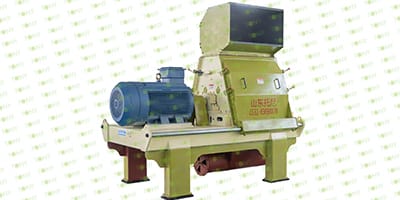
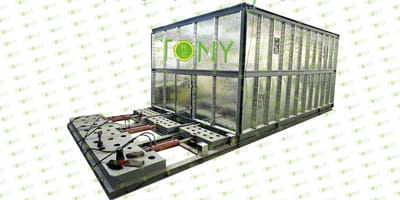
| Comprehensive Chipper | Effective Hammer Mill | Large Hydraulic Storage Silo | Rotary Drum Dryer |
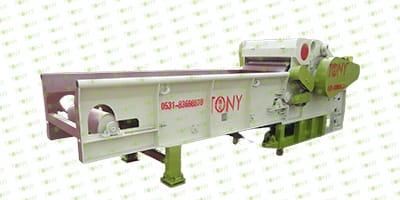
| 1.To Grind EFB Into25-55mm Palm Fiber. 2.Model: TPC1600-1000-315KW With 6 Blades*3sets 3.Capacity:40-50Ton/Hour. |
1.To Crush 25-55mm Palm Fiber Into 8-14mm Palm Dust. 2.Model: TFD120-200-355KW*4sets 3.Capacity:10-12.5Ton/Hour/Set |
1.To Storage Palm Dust Before Dryer Control Palm Dust Flow Entering The Dryer Model: TCY-25*4sets 2.TONY Uses Galvanized Material |
1.To Dry The 40% Palm Dust Into 10-15% Palm Dust. 2.Model: THGD3.2-28*4sets 3.Capacity:10-12.5Ton/Hour/Set |
 |
 |
 |
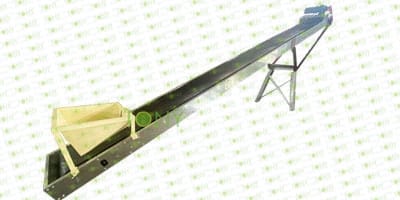 |
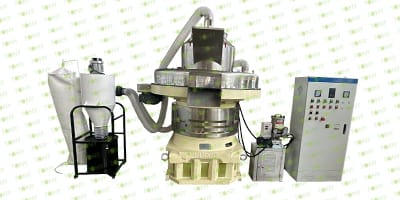
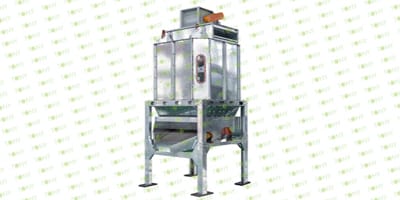
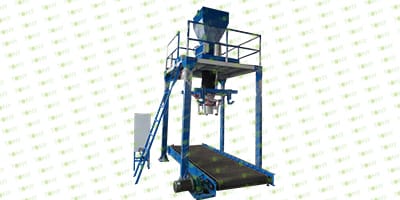
| Vertical Ring Die Pellet Machine | Galvanized Pellets Cooler | Ton Packing Machine | Belt Conveyor |
| 1.To Press Dry Palm Dust Into 6-8mm Biomass Pellets 2.Model: TYJ860-III-280KW*10sets 3.Capacity:4-5Ton/Hour/Set 4.New 304SS Type |
1.To Cool Pellets From 80-90℃ Into 20-30℃ 2.Model: TCN-10*2sets 3.Capacity:40-50Ton/Hour |
1.To Pack Pellets Into 1Ton/Bags 2.Model: TBD*2sets 3.Capacity:40-50Ton/Hour |
1.To Transport Palm Fiber, Palm Dust,Pellets. 2.Width: 80cm*24sets 3.Capacity:Designed With The Whole Line |
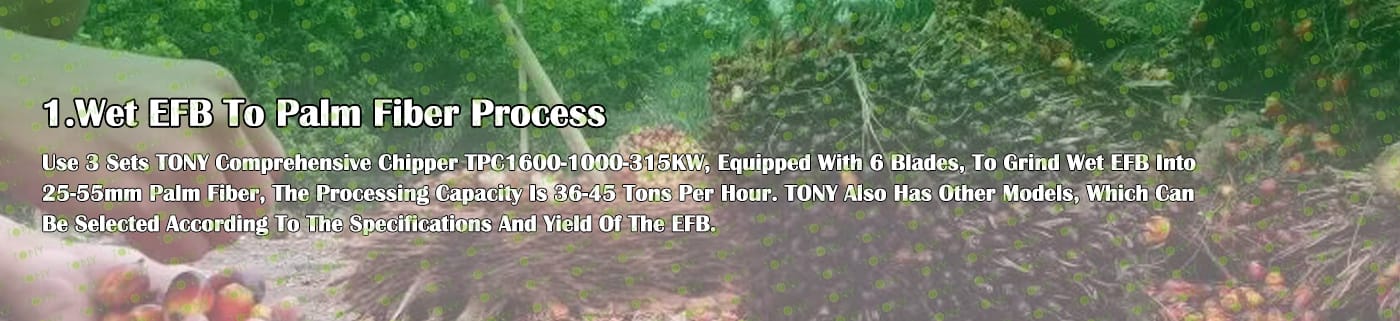
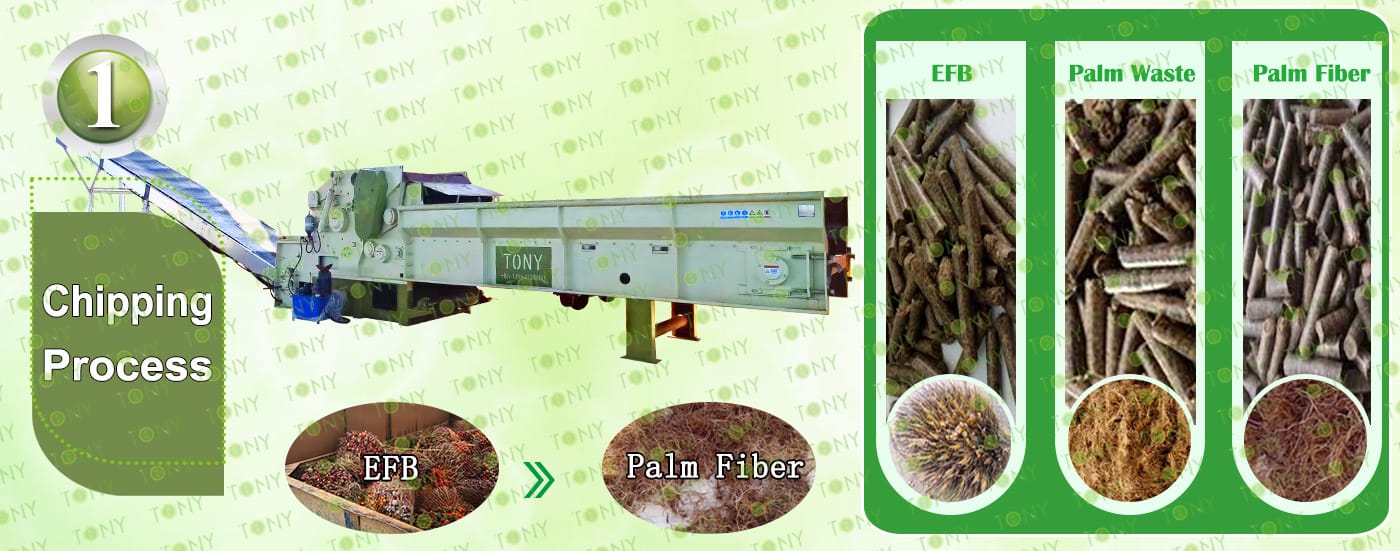
1.Wet EFB To Palm Fiber Process:
A.This process is mainly used to grind the EFB into palm fiber with size 25-55mm. The finish palm fiber size can be adjustable by changing different sizes of screeners and adding flying knives inside the wood chipper.
B.TONY brand comprehensive chipper TPC1600-1000-315KW with 6 flying blades type*3sets
C.Capacity:40-50Ton/Hour.
Main Parts:
(1)TONY's Comprehensive Chipper.
(2)Feed And Discharge Belt Frequency Control To Prevent Card Material
(3)Hydraulic System Control Can Be Used For Thicker Materials
(4)Electronic Control System Allows The Equipment To Be Used Normally
Contact Tony For More Details With Quotation
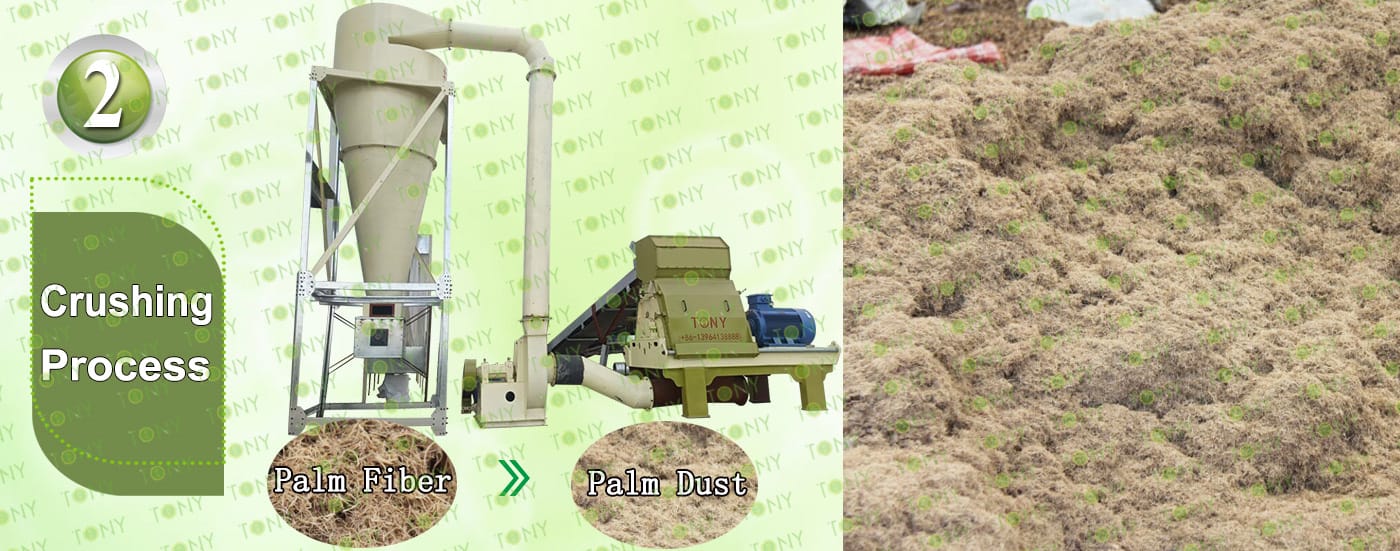
2.Palm Fiber Fine Crushing Process:
A.This process is mainly used to crush 25-55mm palm fiber into 8-14mm palm dust.
B.Capacity:40-50Ton/Hour.
C.TONY brand effective hammer mill TFD120-200-355KW*4 sets
Main Parts:
(1)TONY Effective Hammer Mill.
(2)Galvanized Dust Collector.
(3)Sawdust Transportation Fan Blower.
(4)Cyclone With Airlock.
(5)Electrical Cabinets.
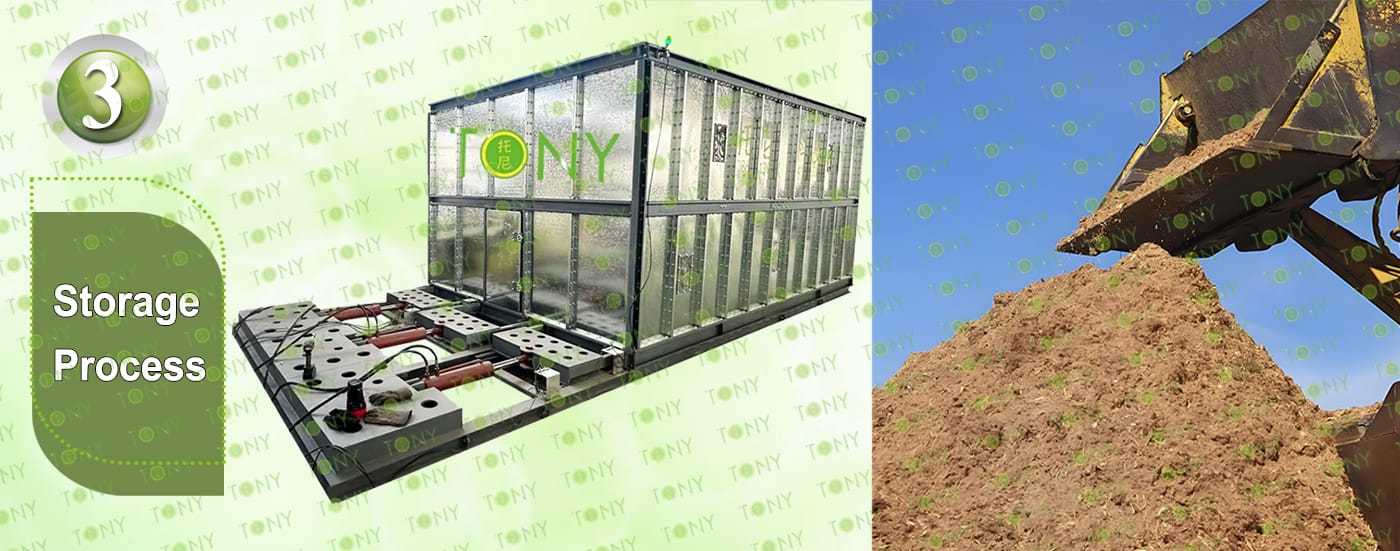
3.Palm Dust Storage Process:
A. This process is mainly used to storage the palm dust that comes out of the hammer mill.It is hydraulic galvanized storage bin which is more stalbe and palm dust in it is not easy to be blocked.
B. TONY Brand Large Hydraulic Storage Silo to storage the palm dust that comes out of the hammer mill.This process can be optional by customer.If customer do not chose the storage bin,he can storage the palm dust on the ground directly which may need some labour.
Main Parts:
(1)TONY's New Large Hydraulic Storage Silo.
(2)With Screws Inside The Storage Bin To Prevent Palm Dust Blocked.

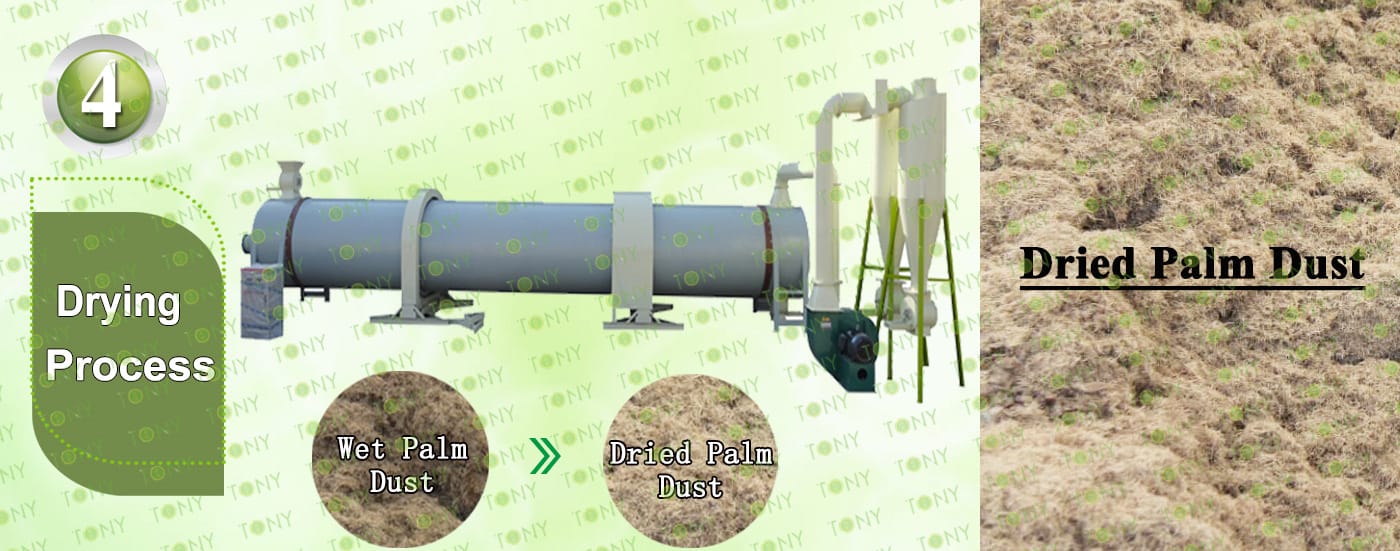
4.Wet Palm Dust Drying Process:
A.This process is mainly used to dry the palm dust from 40% to 10-15%.
B.Capacity:40-50Ton/Hour.
C.TONY use 4 sets of 3.2*28m rotary drum dryer for this process, TONY hot blast stove is made of firebrick pan, shell with H steel plate as the frame. There are 3 layers of fire blocking device inside, which can effectively prevent the fire from entering the tumble dryer.Customers can choose to use waste wood, biomass pellets, natural gas, etc. as fuel for the hot air furnace
TONY dryer use spiral tube material, and is not easy to deform.
Unlike other manufacturers with iron plate splicing welding, very easy to deformation.
Main Parts:
(1)TONY's Rotary Drum Dryer Main Body. (Reducers With Motors and Pips.)
(2)TONY's Hot Stove.
(3)Fan Blower+Cyclone With Airlock.
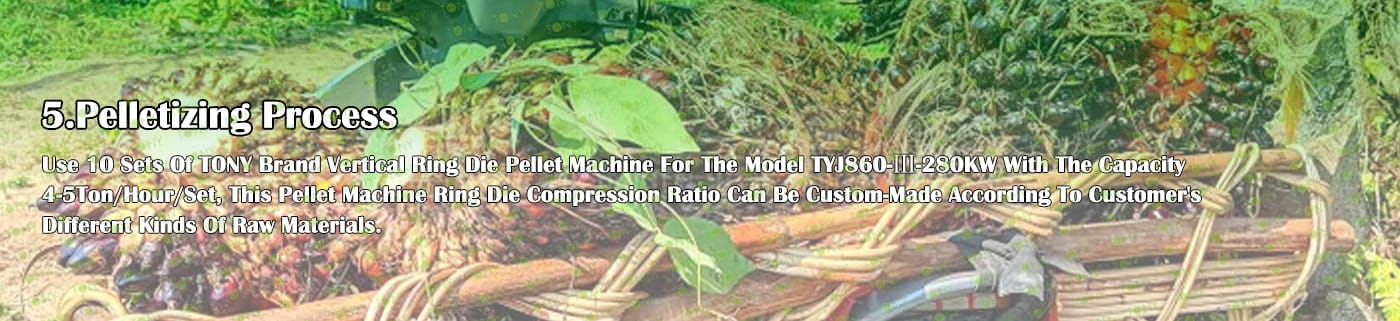
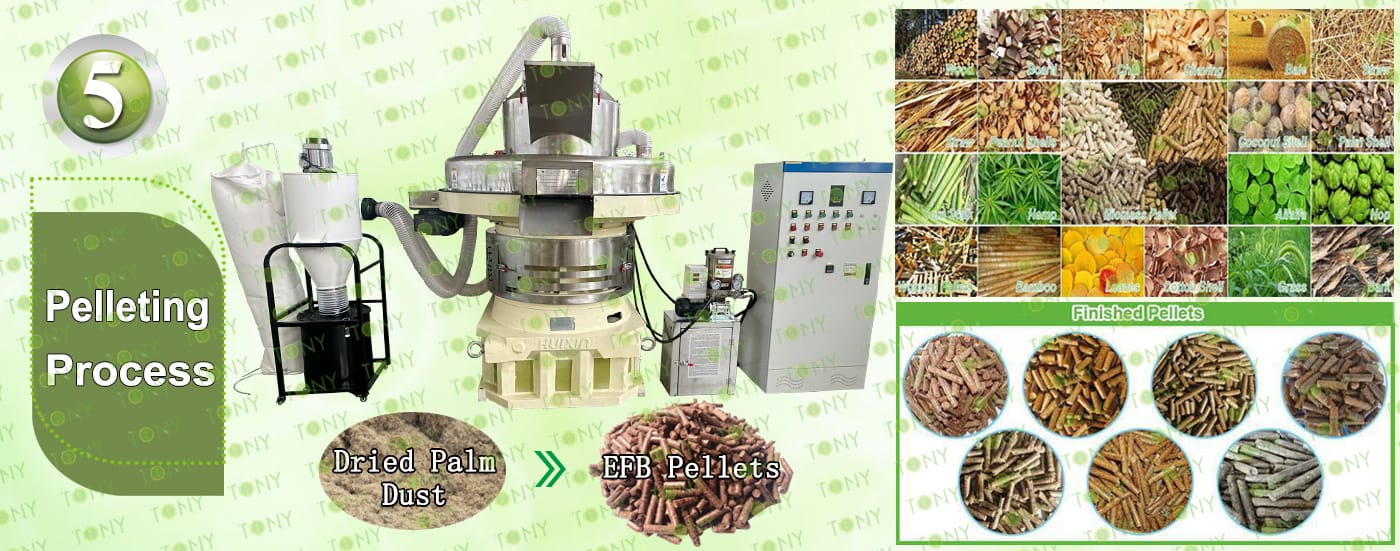
5.Pelletizing Process:
A.This process is mainly used to to product pellets into φ6-8mm.
B.Capacity:40-50Ton/Hour.
C.TONY brand vertical ring die pellet machine TYJ860-Ⅲ-280KW*10 sets
D.Double Screw Cycling Silo is added above the pellet machine, which has the advantages of saving space, saving labor, intelligently controlling the feeding speed, not easy to block the material, and improving production efficiency.
Main Parts:
(1)TONY's new Vertical Ring Die Pellet Machine.
(2)Cyclone And Bags Dust Collectors.
(3)Automatic Lubrication System.
(4)Electrical Cabinets.
You can chose TONY new type SS304 pellet machine
6.Cooling Process:
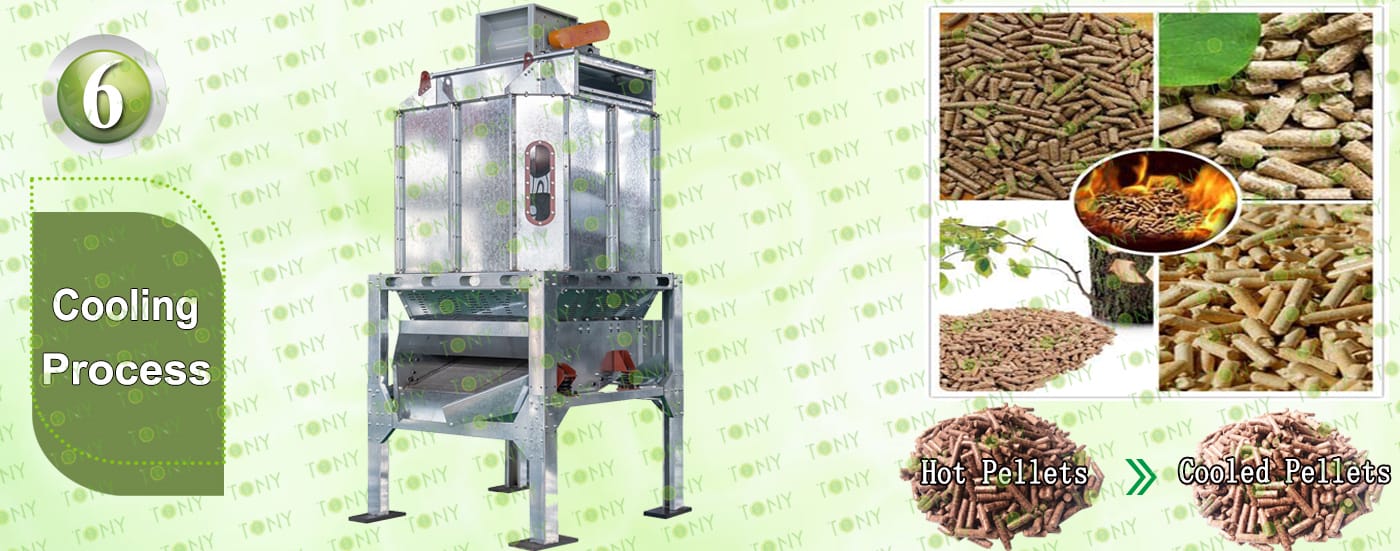
A.This process is mainly used to cool pellets from 80-90℃ to 20-30℃
B.Capacity:40-50Ton/Hour.
C.TONY brand galvanized pellets cooler *2sets
Main Parts:
(1)TONY's new Galvanized Pellets Cooler With Vibrating Screen.
(2)Cyclone And Bags Dust Collectors.
(3)Fan Blower.
(4)Connect Pipes.
7.Packing Process:
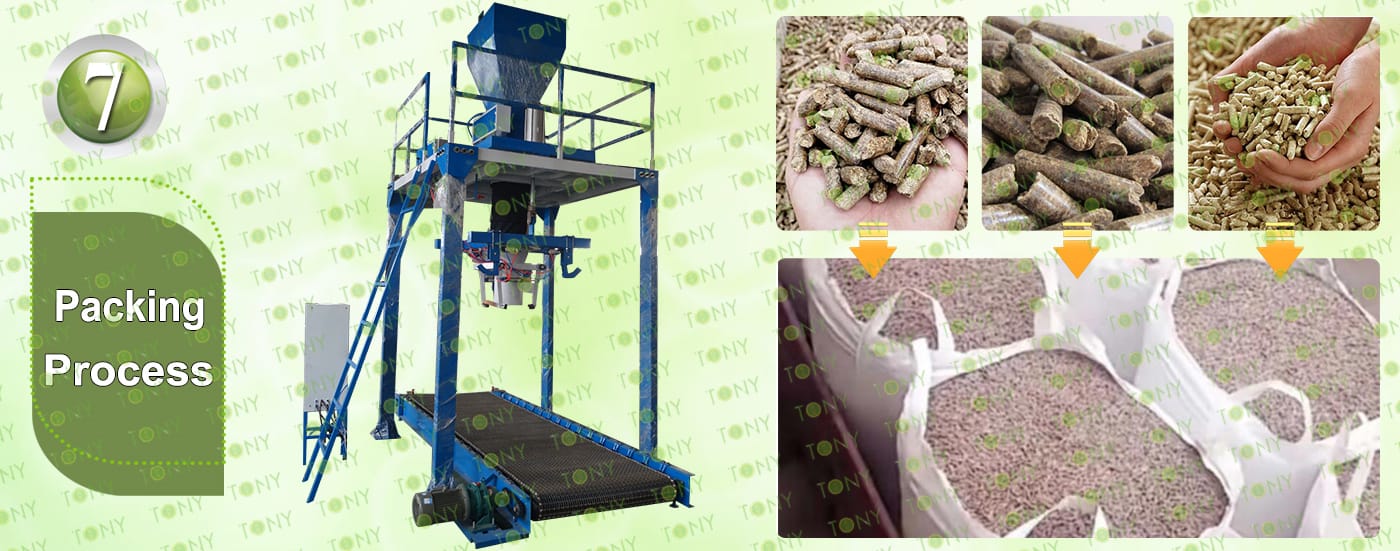
A.This process is mainly used to pack pellets into 1Ton/Bags.
B.Capacity:40-50Ton/Hour.
C.TONY brand ton packing machine*2sets
Main Parts:
(1)TONY Ton Packing Machine
(2)Electronic Platform Scale Metering System
(3)Automatic Tare, Zero, and Drop Correction Functions
(4)Feeding System Features Fast, Medium, and Slow Feeding Speeds to Ensure Measuring Accuracy

Development Trends of EFB Biomass Pellet Projects: Policy and Technology Drive Upgrades
In the future, EFB biomass pellet projects will develop towards scale, high value, and intelligentization:
1.Scale:
More large-scale projects (10,000 tons per year) will emerge in major palm oil-producing regions. Centralized processing will reduce unit costs, while supporting biomass power plants or industrial parks to achieve integrated production, supply, and consumption.
2.High Value:
Beyond fuel, high-value-added applications for pellets will be explored (such as processing into biochar for soil improvement or industrial adsorbents), increasing profit margins.
3.Intelligent:
The introduction of PLC control systems (automatically adjusting drying temperature and pelletizing speed) and IoT monitoring (real-time monitoring of raw material inventory and equipment status) will reduce manual intervention and improve production efficiency.
4.Policy Dividends:
Global carbon tariffs and renewable energy subsidies will continue to drive project development, especially in regions with high environmental protection requirements, leading to further growth in pellet demand.
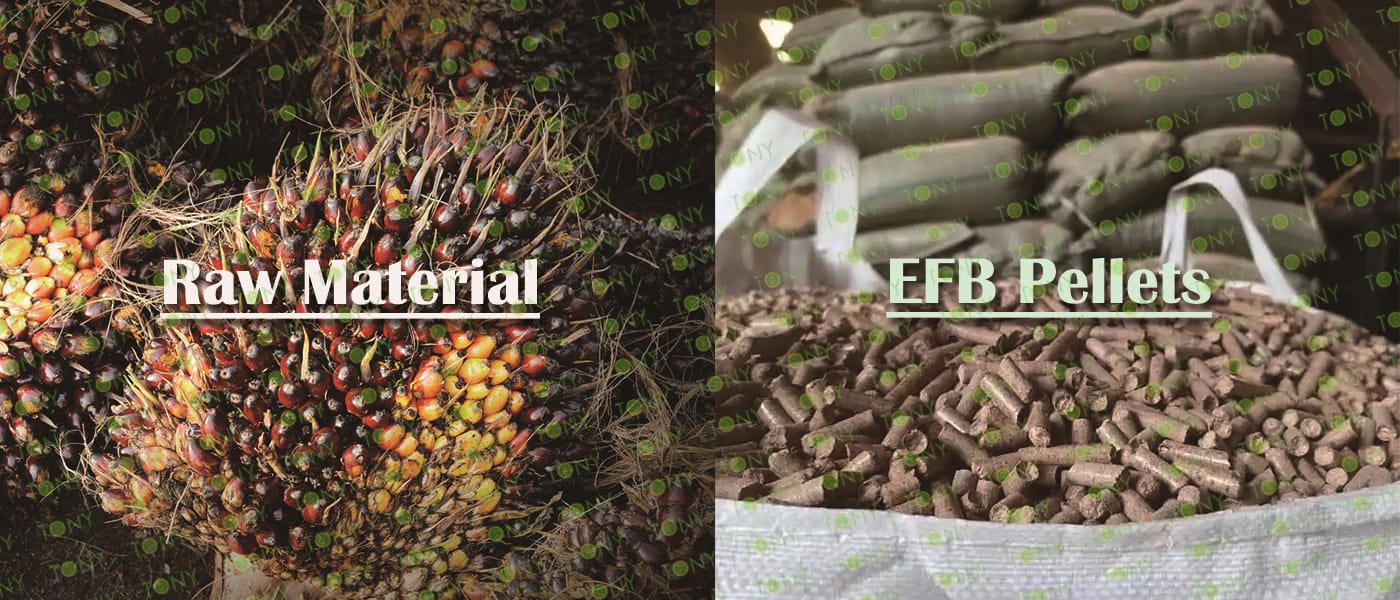
Through industrial processing (precision drying and die extrusion), EFB biomass pellets overcome the drawbacks of EFB raw materials, including their looseness and high moisture content, creating a standardized fuel with stable performance. Their ease of use and compatibility far surpass those of bulk biomass.
1.High density and high hardness for easy storage and transportation
Formed through die extrusion, the pellets achieve a density of 1.1-1.3 g/cm³ (6-8 times that of loose EFB). Their volume is significantly reduced—one cubic meter of pellets can replace 5-6 cubic meters of loose EFB. Storage eliminates the need for large yards, allowing for storage in standard woven bags (25 kg/bag) or ton bags, increasing storage space utilization by over 80%. Furthermore, the pellets have a compressive strength of ≥1.5 MPa and a breakage rate of ≤3% during transportation (compared to the 8%-12% breakage rate for standard biomass pellets). This prevents debris from clogging feed pipes and causing incomplete combustion, making them suitable for long-distance transportation (such as from Southeast Asia to Europe).
2.Stable Combustion Performance and High Thermal Efficiency
The pellets are uniform in size (6-8mm in diameter, 10-30mm in length) and have a high lignin content. During combustion, they produce a stable flame and uniform heat release, achieving a thermal efficiency exceeding 80% (loose EFB combustion efficiency is only 30%-40%). With a volatile matter content of approximately 65%-75%, they are easy to ignite, requiring no complex combustion-supporting equipment. They can be directly adapted to existing industrial boilers, biomass fireplaces, and power generation boilers (without requiring major equipment modifications, at a cost of only 5%-10% of the fuel cost).
3.Stable Moisture Content and Long Shelf Life
Through precise drying during processing (reducing moisture to 10%-15%, known as the "equilibrium moisture content"), the pellets have a shelf life of 6-12 months in a dry and ventilated environment. They are resistant to mold and moisture deterioration, addressing the common issues of loose EFB, such as mold and storage difficulties. They are particularly suitable for businesses requiring long-term fuel reserves (such as winter heating factories and biomass power plants in northern China).
2025 Tony Machinery - All Rights Reserved. Map