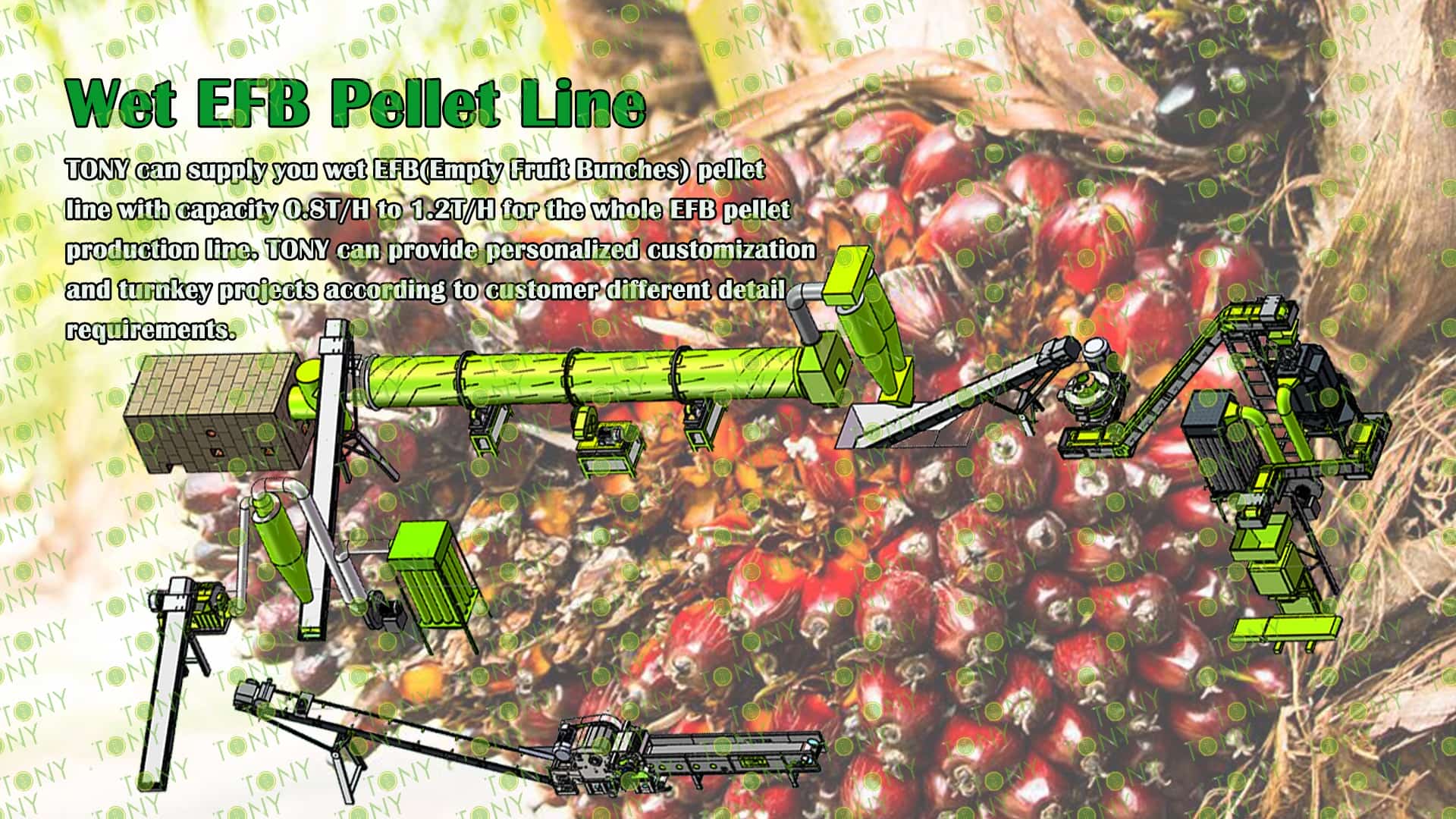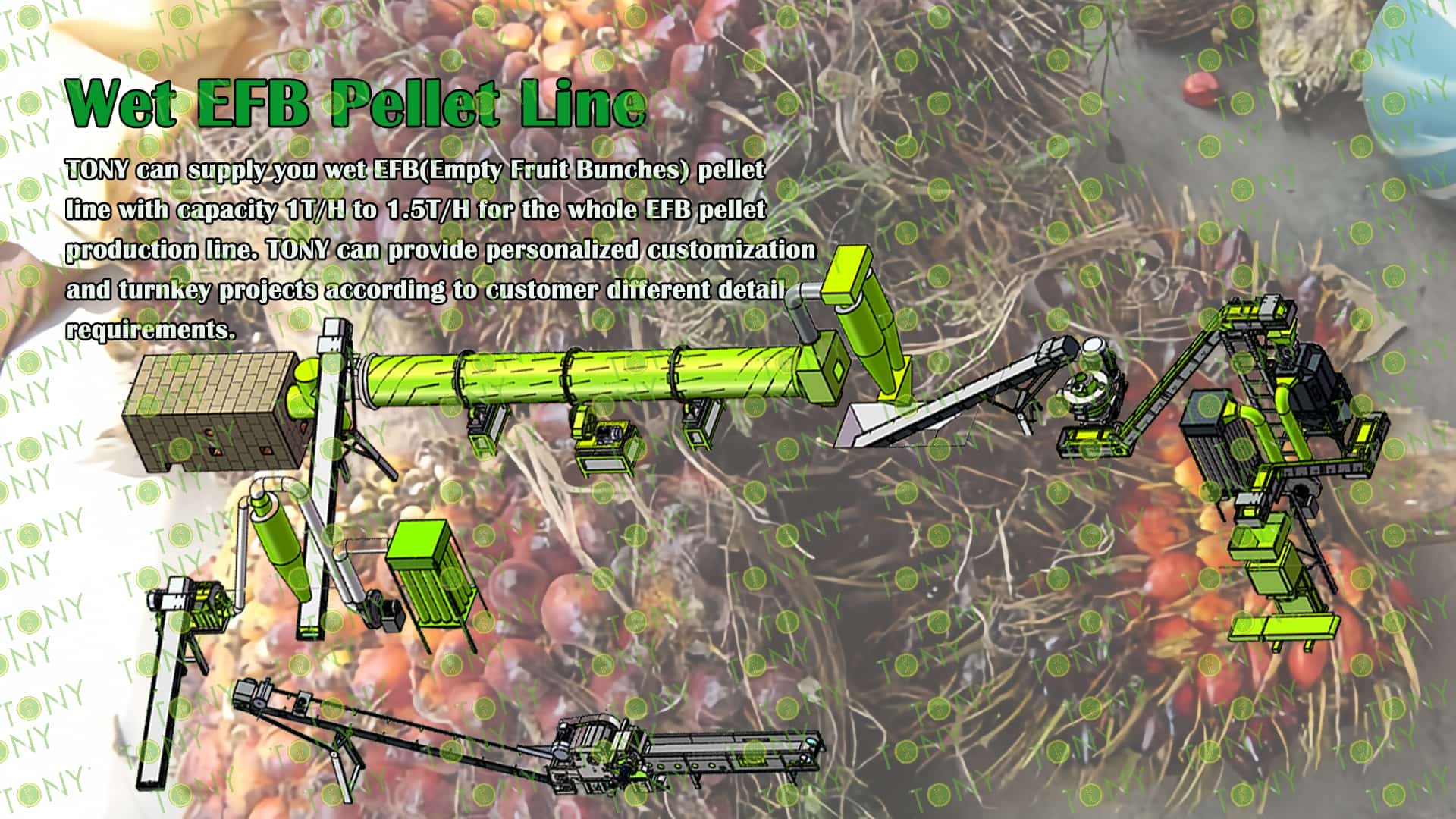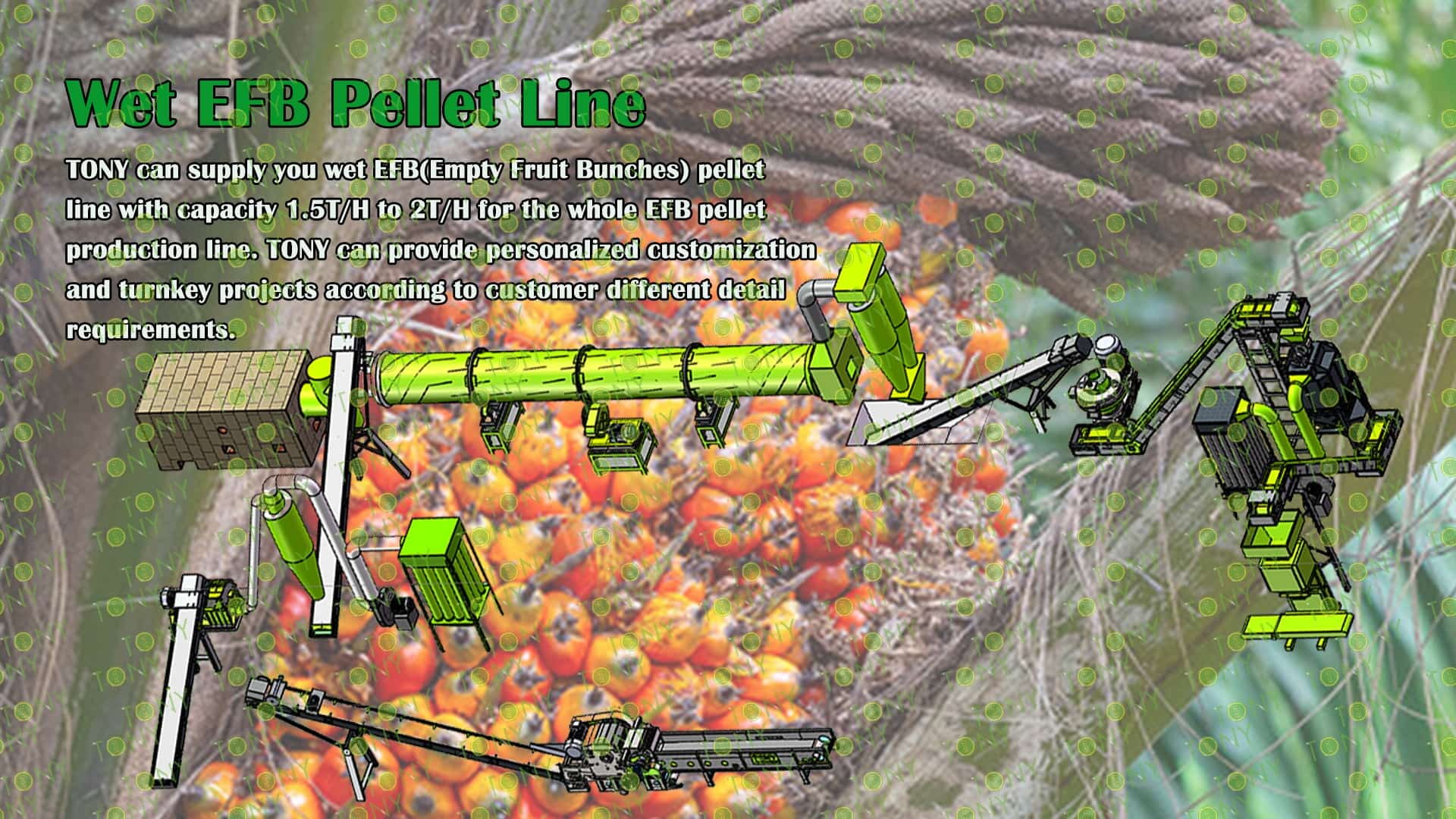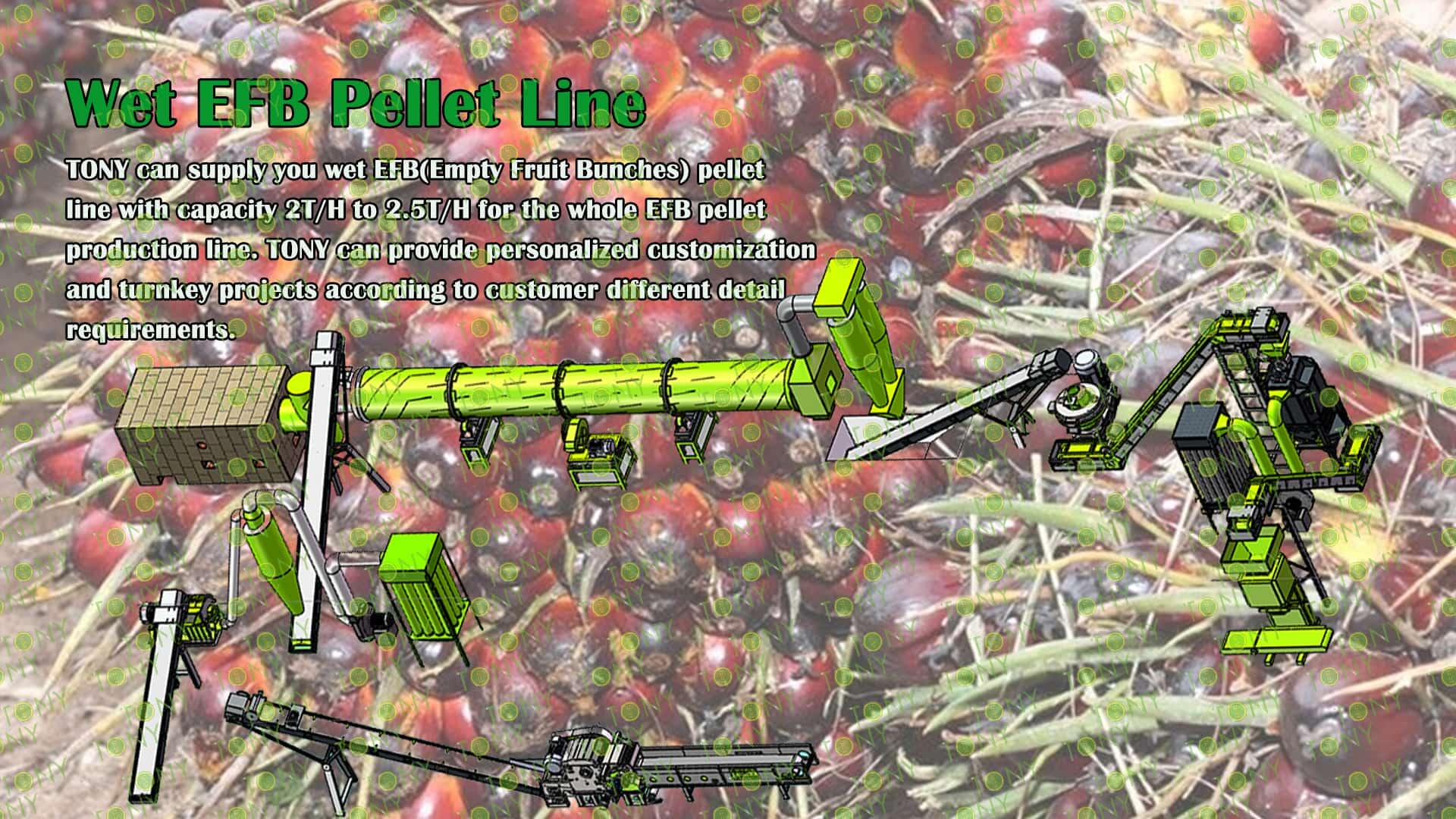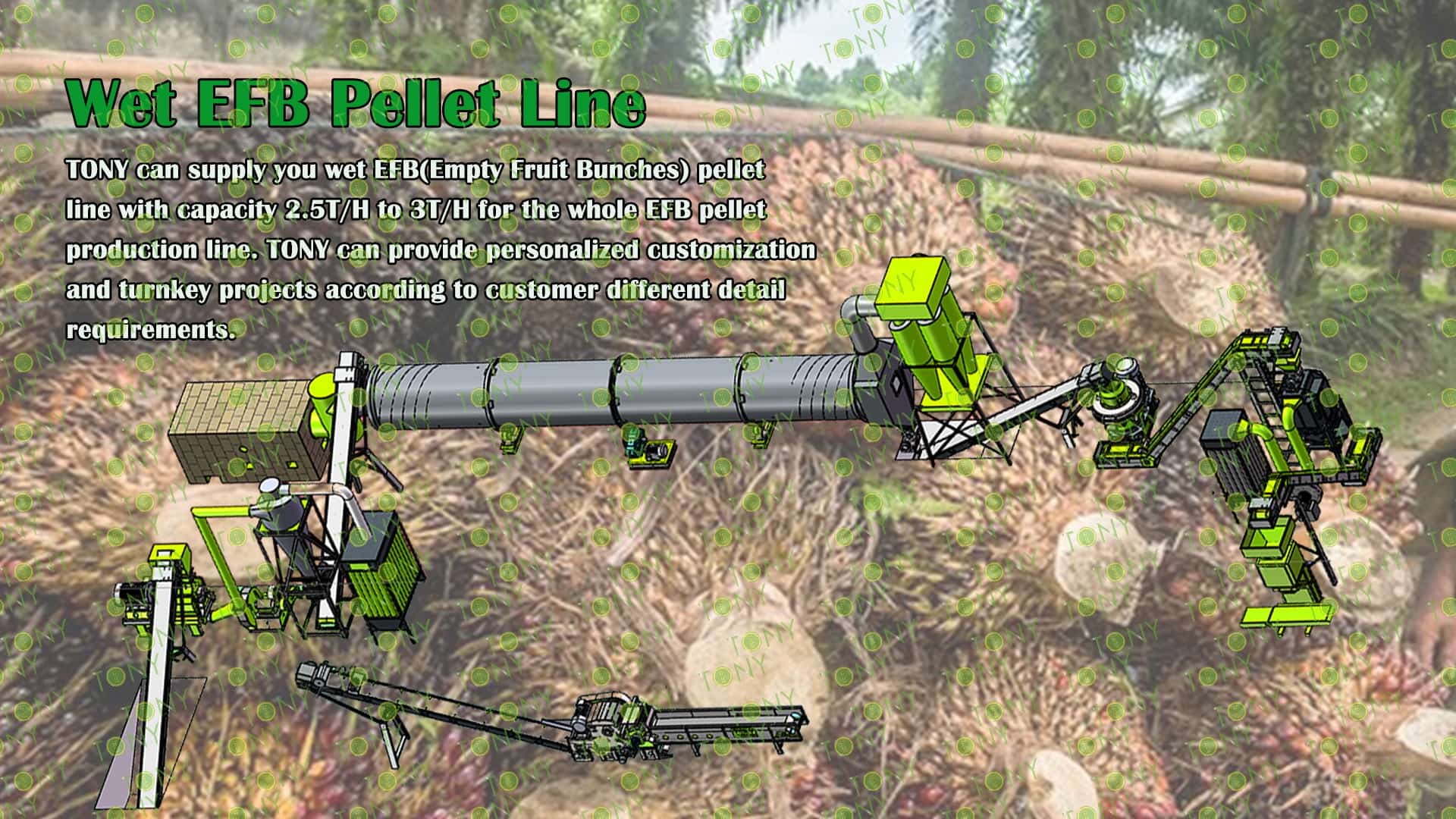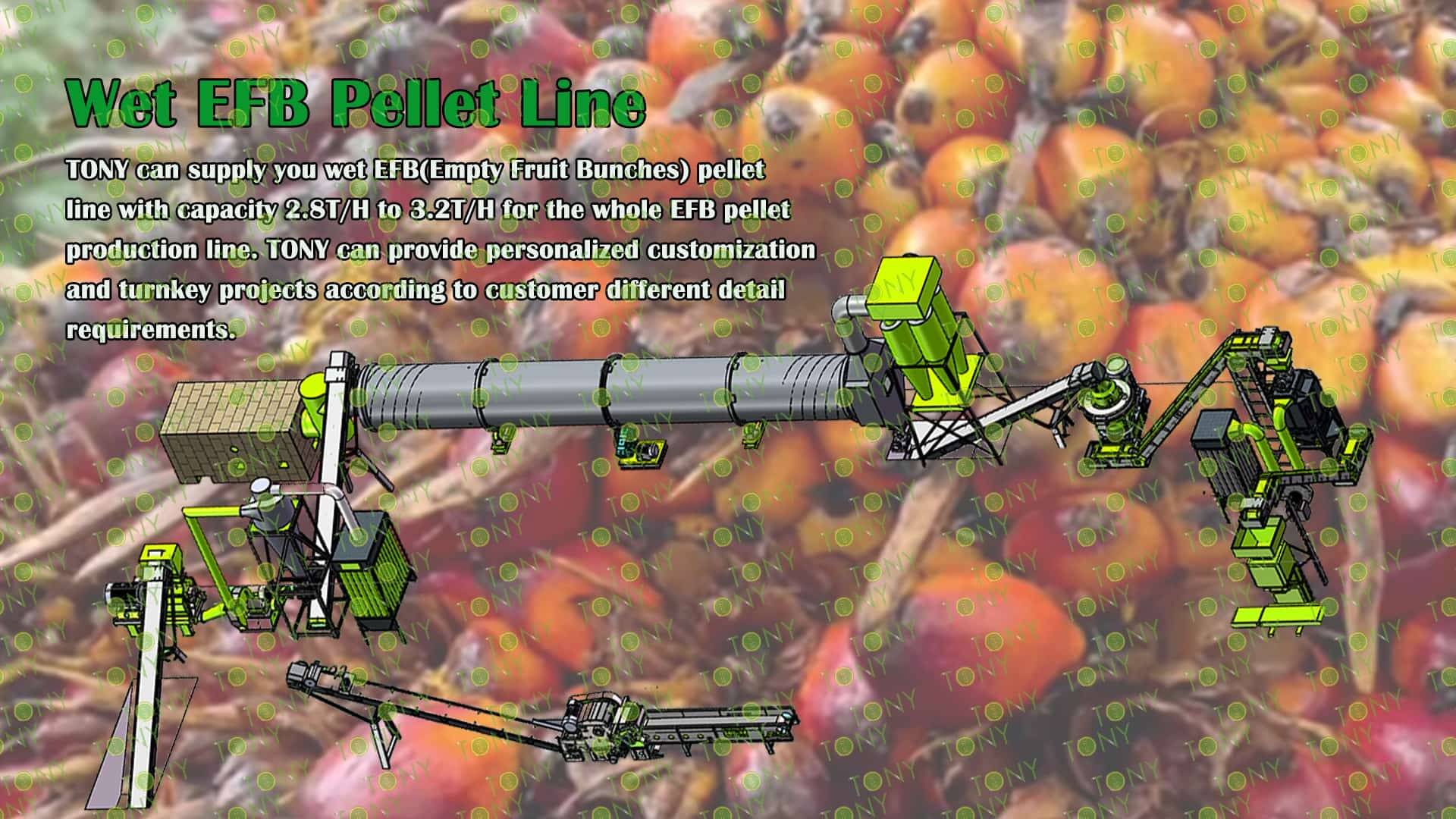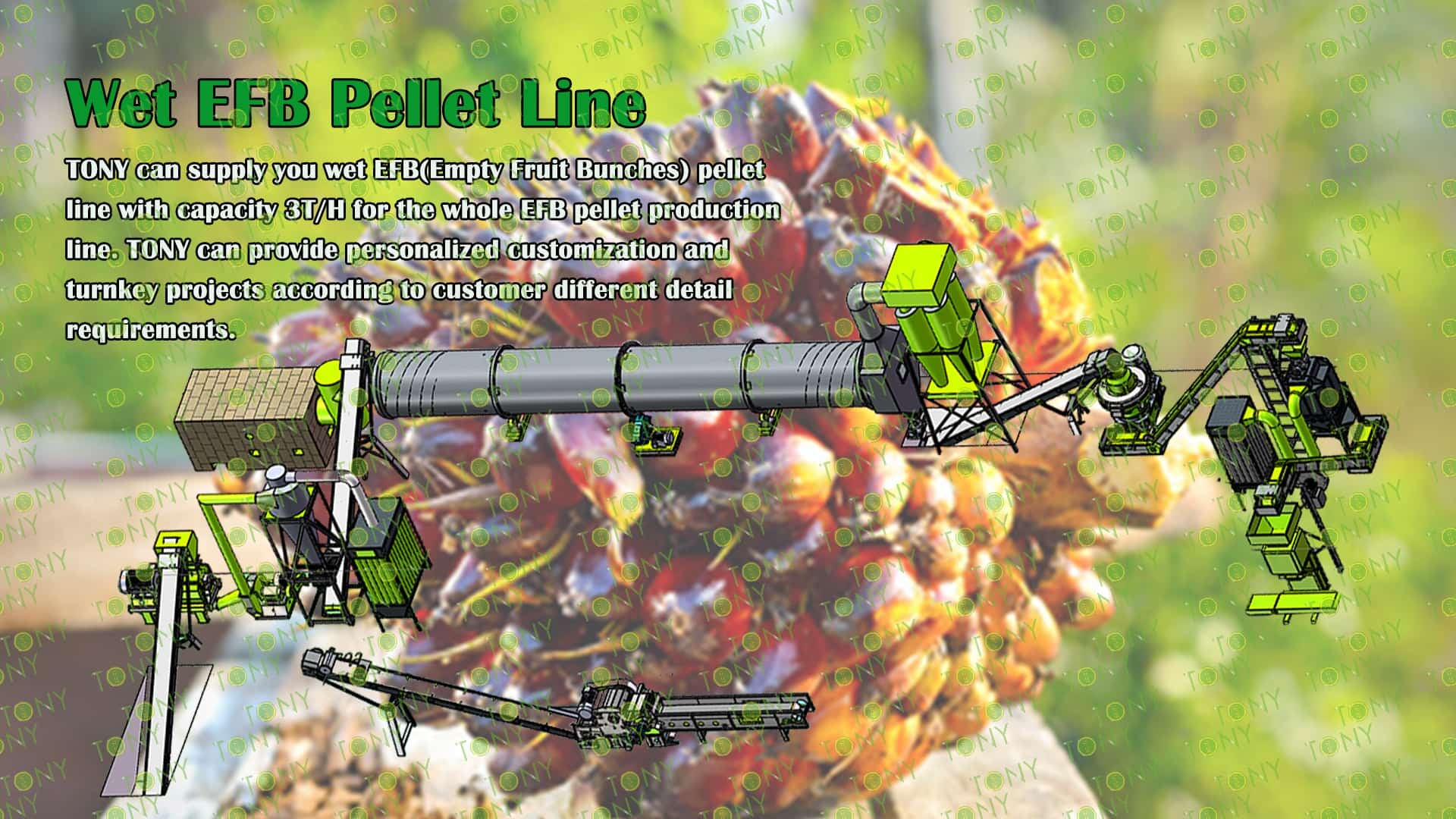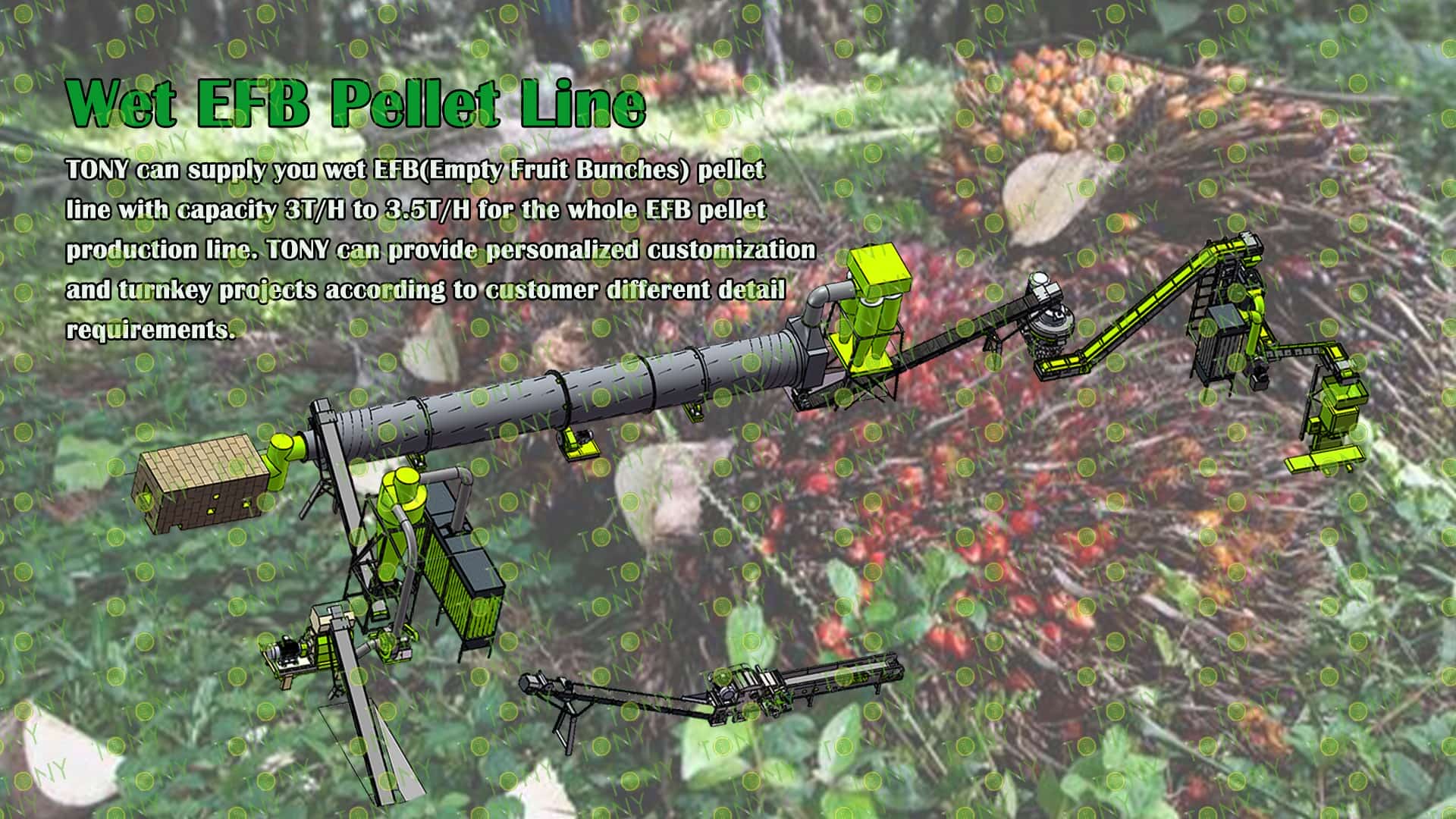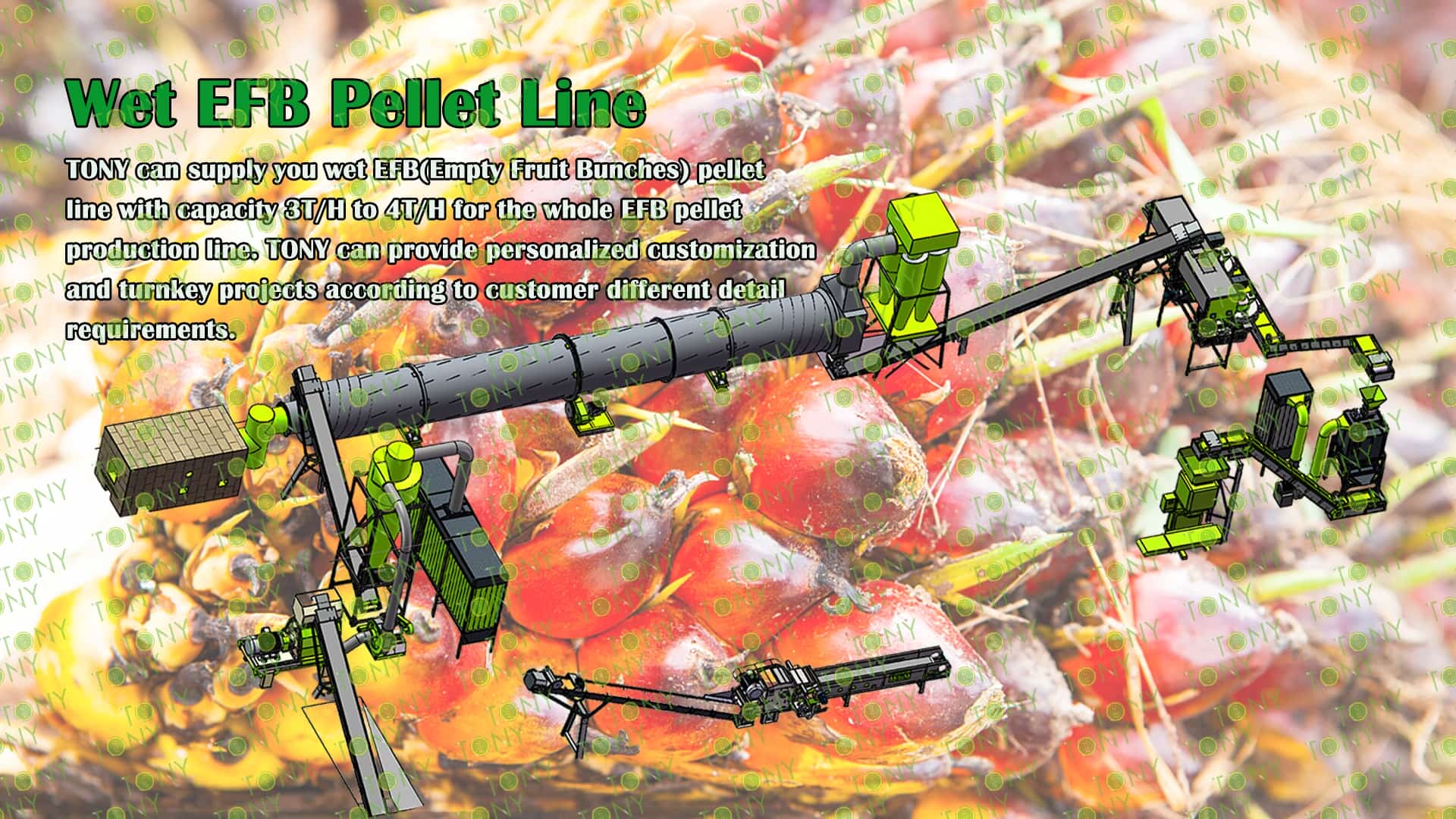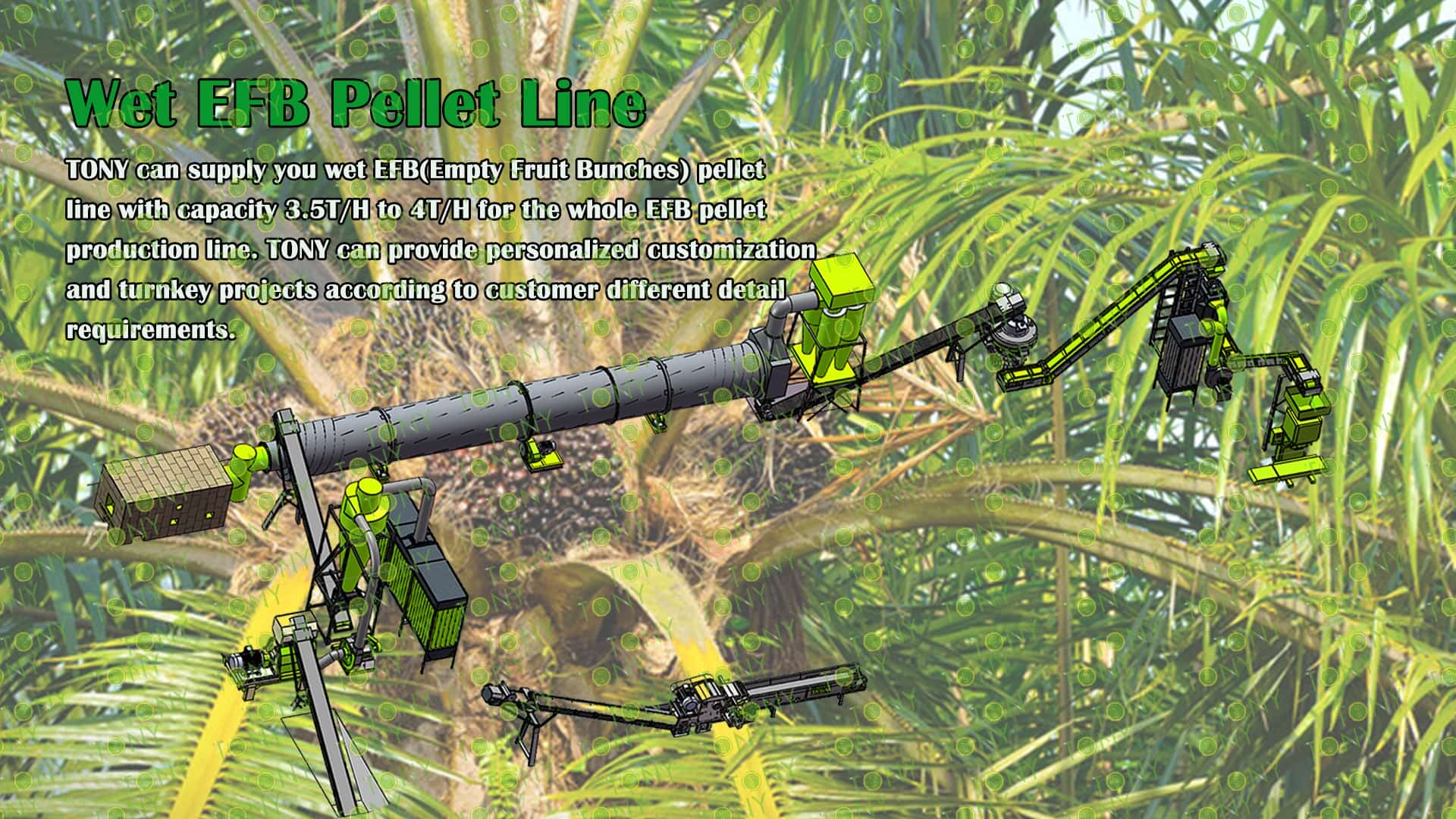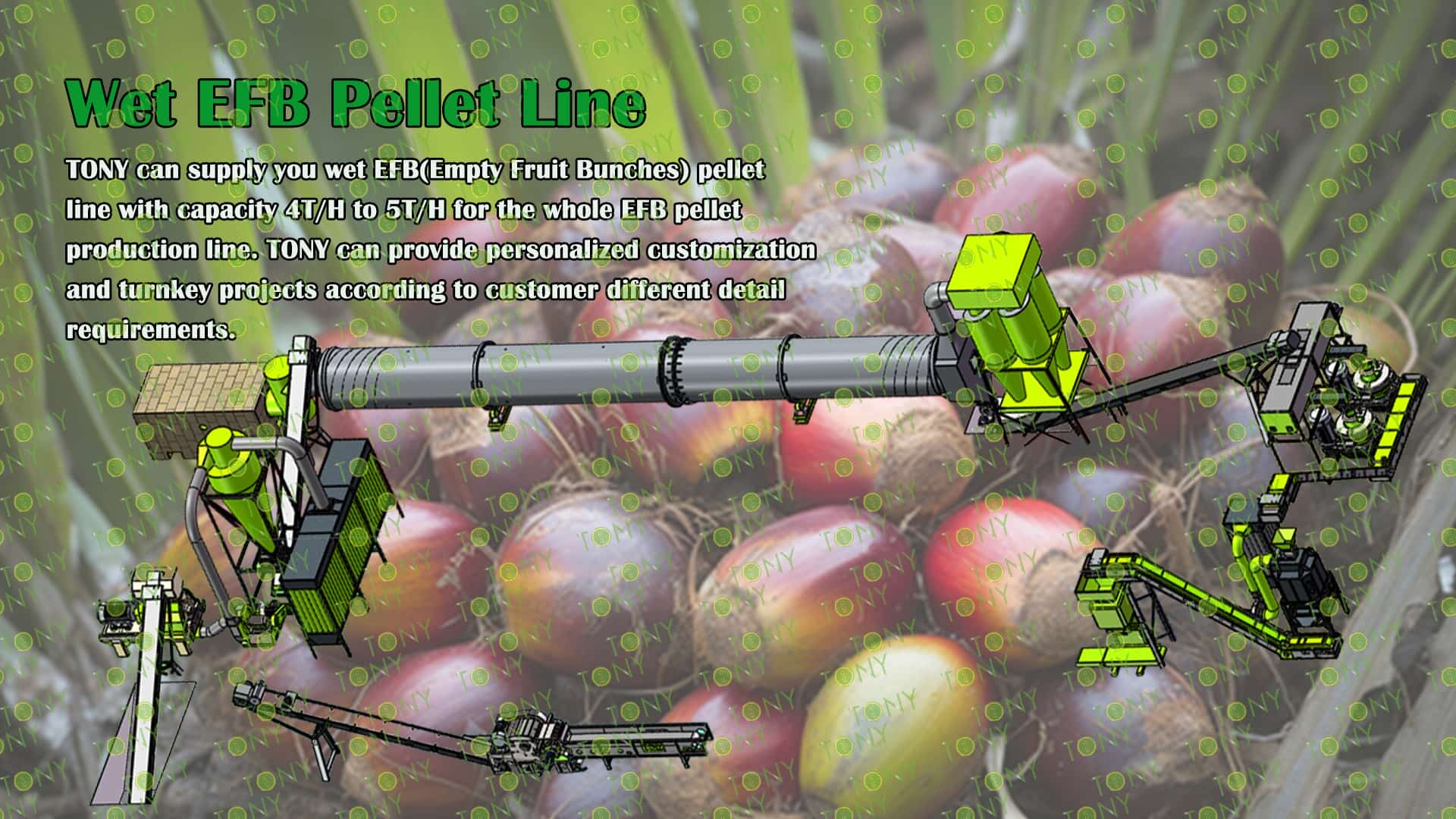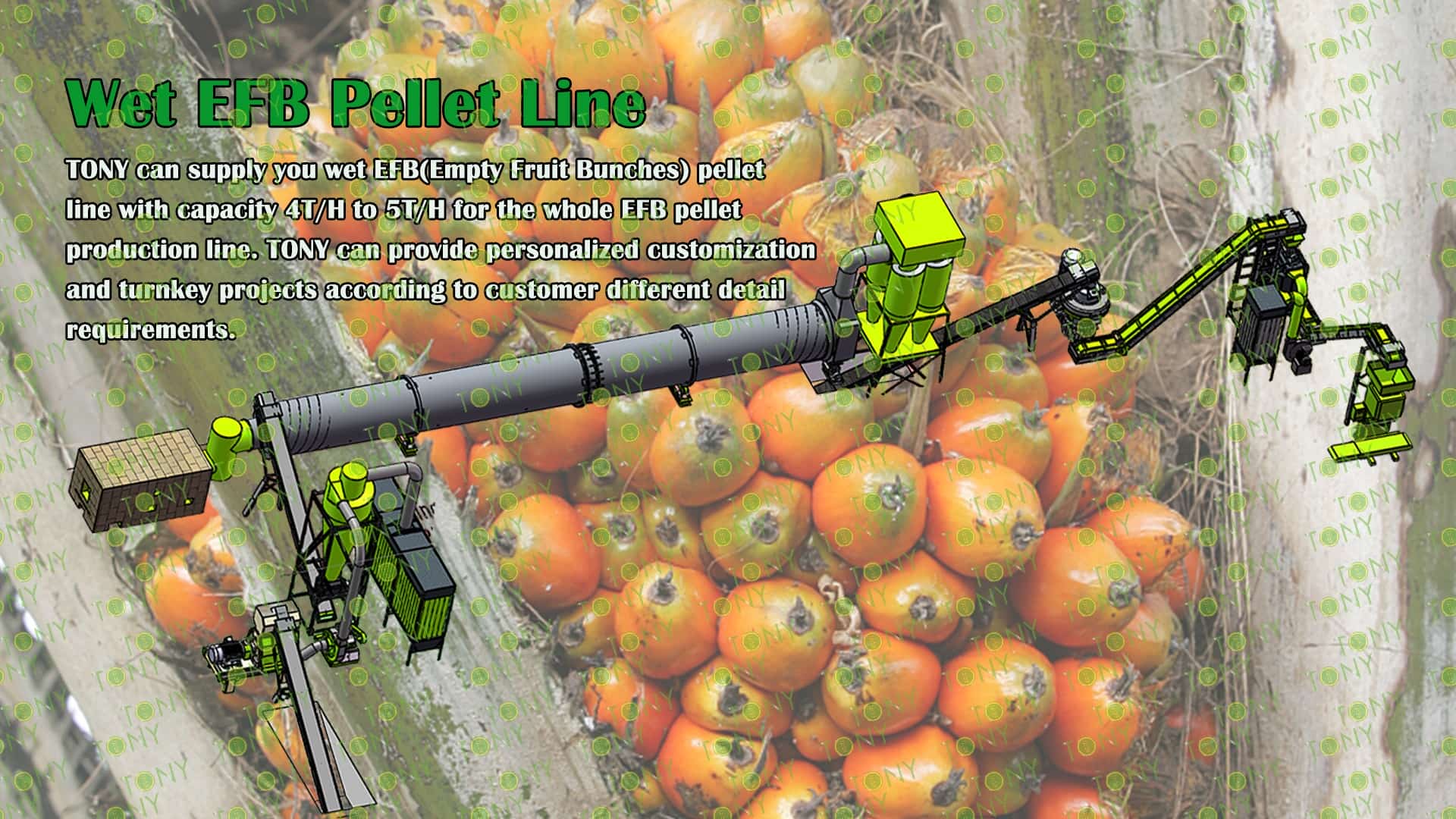




















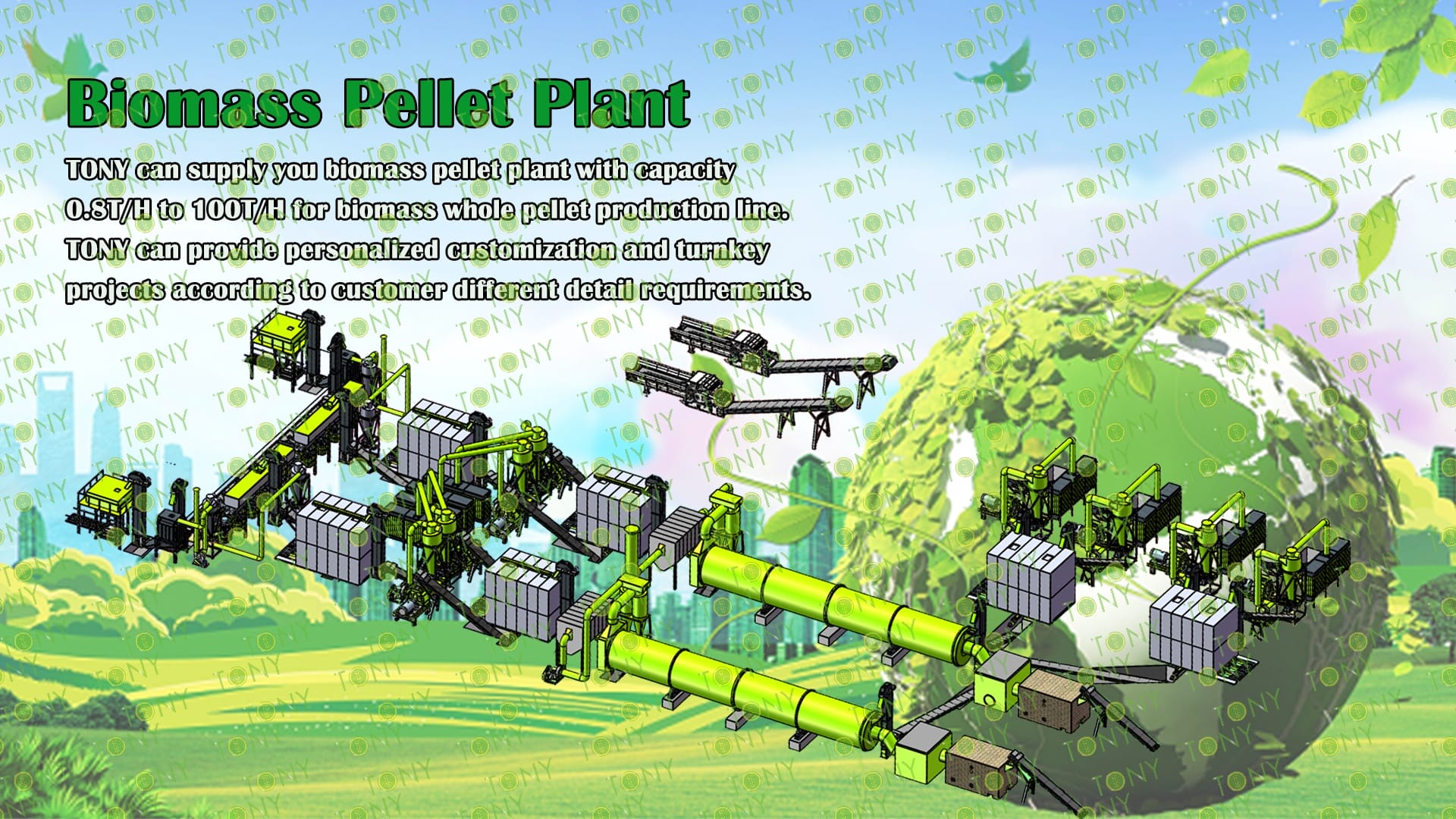
Project Brief Introduction:
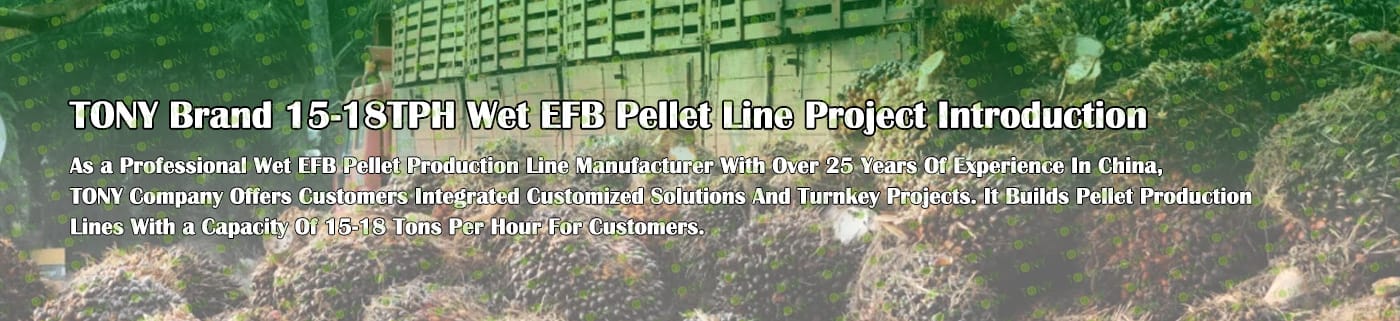
1.Product:Wet EFB Pellet Line
2.Capacity: 15-18T/Hour
3.TONY Brand 15-18Ton /Hour Wet EFB Pellet Line Project Process
4.Main Machine:Comprehensive Chipper, Hammer Mill,Large Hydraulic Storage Silo,Rotary Drum Dryer,TONY Pellet Machine TYJ760-Ⅲ-160KW,Pellets Cooler,Packing Machine And Belt Conveyors
5.Total Power: About 2250KW
6.Need Area: About ㎡ L: M W: M H: M
Project Layout For Customer:
三维图
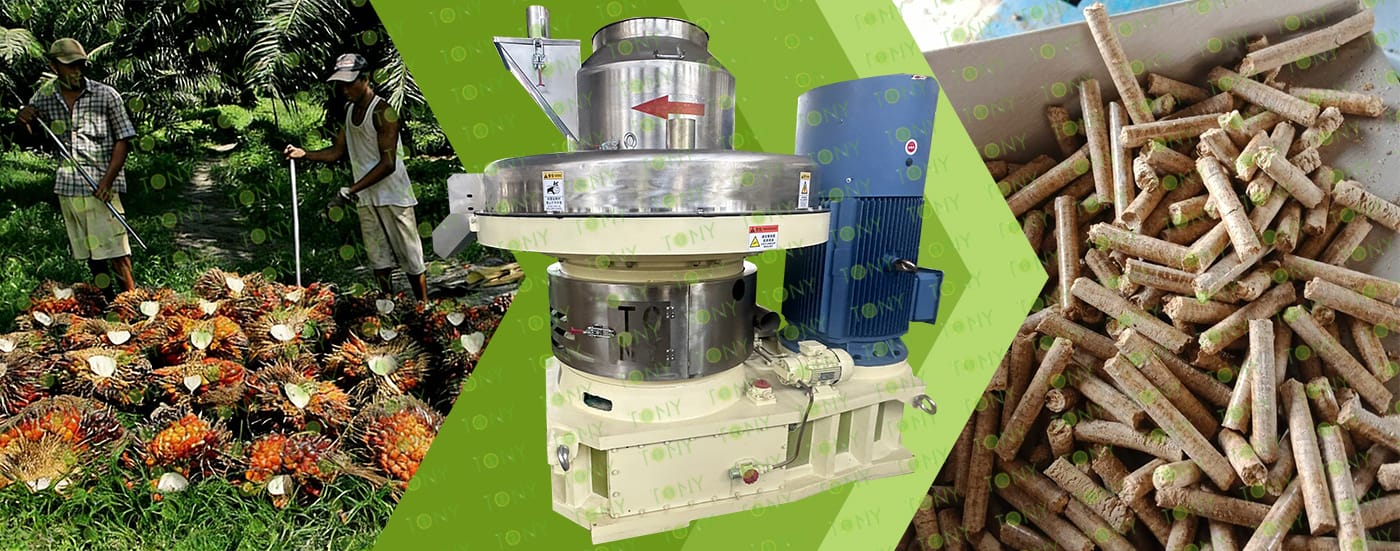
1.The working principle of wet EFB biomass pellet processing equipment
(1)Feeding and pre-pressing:The crushed EFB material is fed into the pelletizing chamber by the feeder and evenly distributed to the gap between the pressing roller and the ring die (0.1-0.3mm) through the material plate;
(2)Extrusion heating:The pressing roller is driven by a motor to rotate (speed 200-300r/min), forcing the material into the cylindrical die hole of the ring die - the material is subjected to a huge extrusion pressure (30-100MPa) in the die hole, and at the same time, it produces intense friction with the die hole wall, and the temperature rises to 60-90℃;
(3)Natural bonding:The high temperature softens and melts the lignin (content 15%-20%) in the EFB, forming a natural adhesive that bonds the cellulose and hemicellulose particles together;
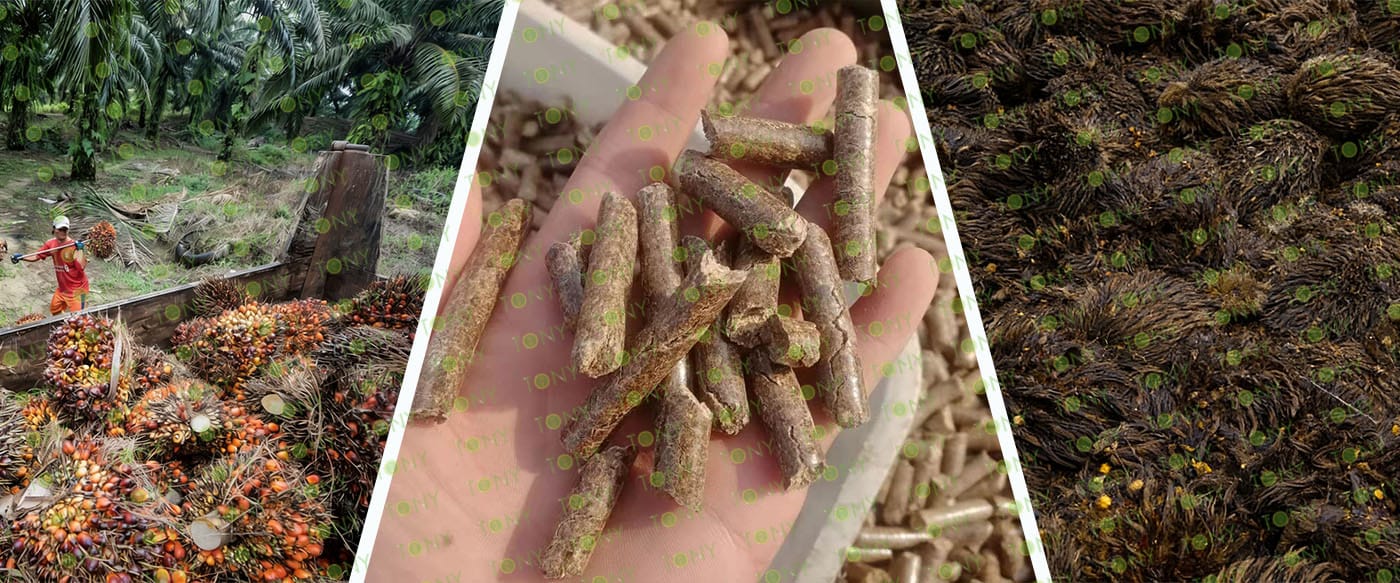
(4)Extrusion molding:The bonded material is extruded from the other end of the die hole to form cylindrical pellets with a diameter of 6-8mm and a length of 10-30mm, which are cut into the set length by a cutter and discharged.
2.Characteristics of wet EFB biomass pellet processing equipment
Pelletizing is the core process, and the equipment design revolves around "using the natural bonding of lignin to ensure pellet density":
(1)Ring-type pelletizer:thick-walled ring die + large-diameter pressure roller The ring die is made of double-layer wear-resistant alloy steel (wall thickness 15-20mm, ordinary ring die wall thickness 8-12mm), with high die hole finish (Ra≤1.6μm), which can withstand the severe friction of EFB coarse fibers and has a service life of 300-500 hours (ordinary ring die only 150-200 hours); the pressure roller diameter is increased to 180-220mm (ordinary pressure roller 120-150mm), with a larger contact area and more uniform extrusion force, avoiding local overload and ring die cracking.
(2)Adhesive-free design, relying on frictional heat generation
The equipment precisely controls the gap between the roller and the ring die (0.1-0.3mm) and the rotation speed (200-300r/min), so that the EFB generates a high temperature of 60-90℃ in the die hole, which just softens the lignin (lignin softening point 50-80℃). There is no need to add artificial adhesives such as starch and resin, which not only reduces costs but also avoids the generation of harmful gases (such as formaldehyde) during combustion.
3.Application scenarios of wet EFB biomass pellet processing equipment
(1)Supporting production lines within palm oil mills
Application scenario: To achieve the goal of "using waste to feed the factory", large palm oil mills build EFB pellet processing workshops within the factory area, directly processing the EFB they produce into pellets, which are used as boiler fuel in the factory (for steam supply for palm fruit cooking and oil extraction), and the remaining pellets are sold to the outside world.
(2)Processing factories around palm industry clusters
In palm industry clusters, some companies build large-scale EFB pellet processing plants in the middle of multiple palm oil mills, uniformly purchase EFB from surrounding small and medium-sized palm oil mills, and supply them to industrial customers or biomass power plants in the area after processing into pellets.
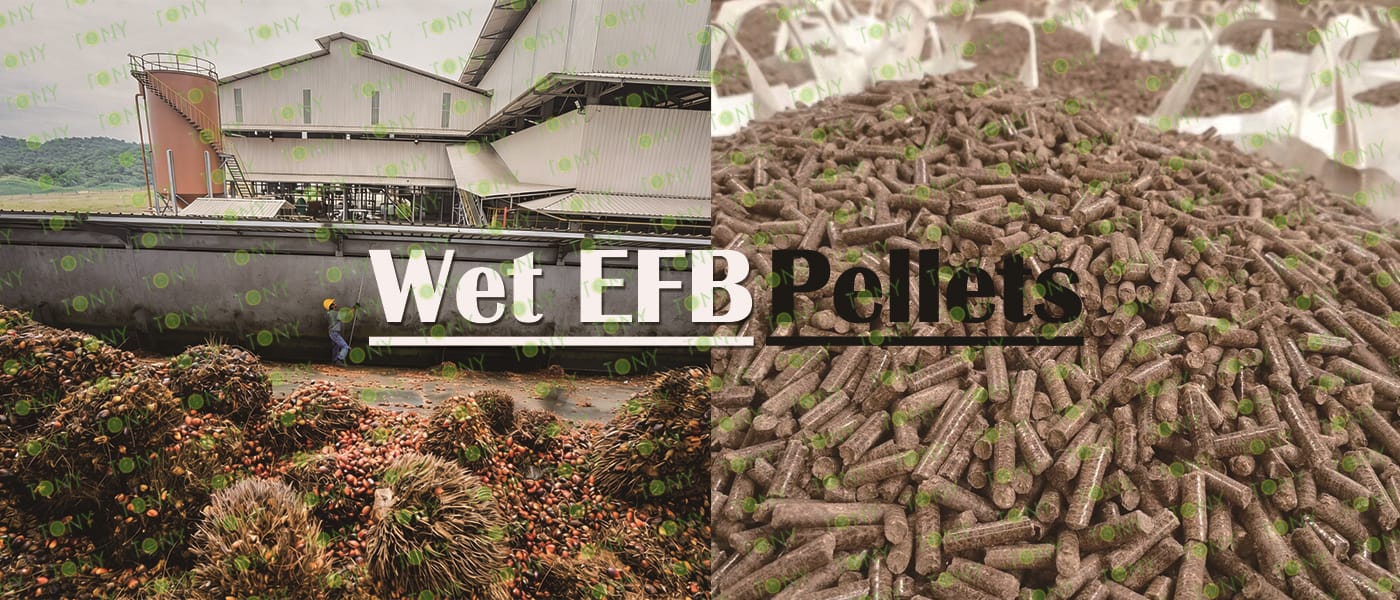
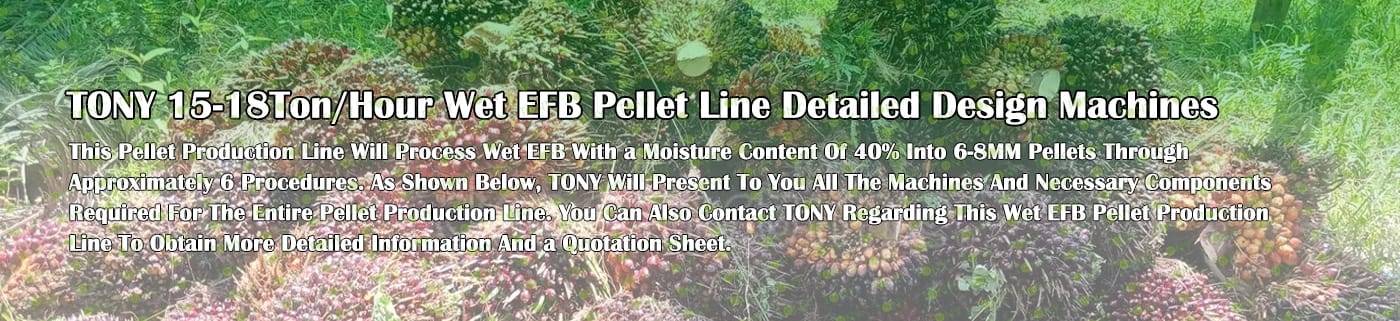
TONY Brand 15-18Ton/Hour Wet EFB Pellet Manufacturing Plant can take wet EFB as the main raw material. After pretreatment and processing, it is solidified into high - density EFB pellet fuel. This fuel is an ideal substitute for coal and oil and plays a role in energy conservation and emission reduction. At present, it has been widely used in regions rich in EFB resources.
1. Capacity: 15-18Ton/Hour
2. Raw materials: Wet EFB
3. Moisture: Wet type, about 40%.
4. Application: All kinds of EFB materials suitable for pellet production.
Suitable customers: Palm plantation owners or related agricultural enterprises have abundant EFB resources. For example, palm oil mills generate a large amount of EFB waste during the production process. Energy companies, EFB biomass pellets as a clean energy, can be used in industrial heating, power generation and other fields, and have synergy with the existing business of energy companies. Environmental investors, investors with financial strength, technology investors, etc.and other places where EFB raw materials have advantages
5. Finished Pellets Markets: Large power plants, domestic heating, industrial heating, combustion heat, heating systems, boiler rooms, school canteens, foundry heat sources.
1. Project Name: Wet EFB Pellet Production Line
2. Raw Material: All kinds of wet EFB
3. Moisture Content of Raw Material: 40%
4. Capacity: 15-18 tons per hour
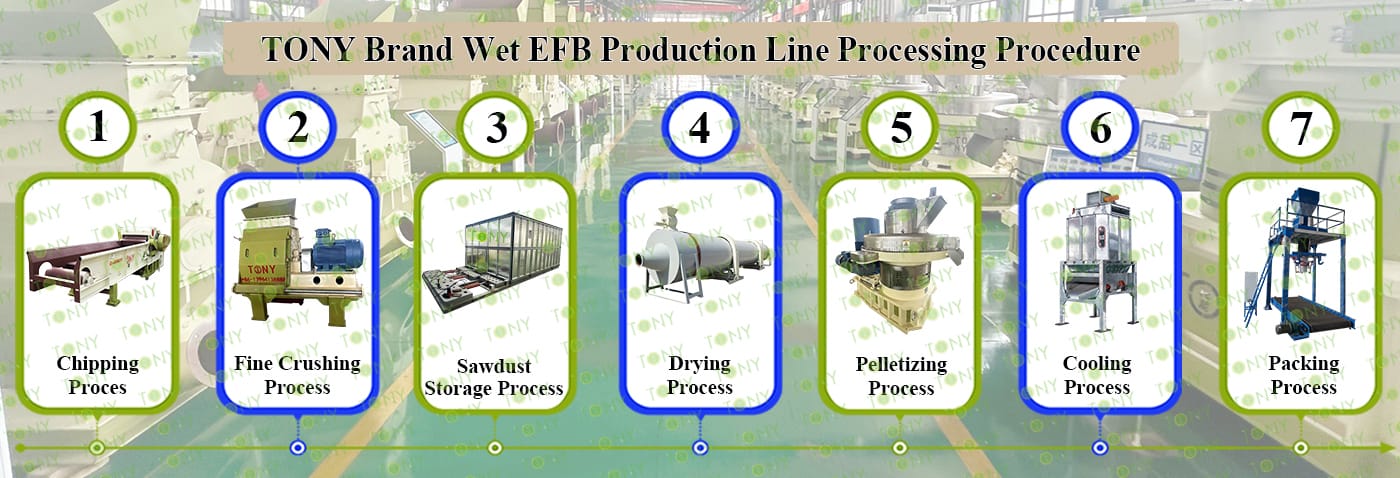
5. Process: Crushing Process - Fine Crushing Process -Palm Dust Storage Process- Drying Process - Pelletizing Process - Cooling Process - Packing Process
6. Main Equipment: Comprehensive Chipper- TPC1600-1000-250KW, Effective Hammer Mill-TFD85-250-250KW, TONY Large Hydraulic Storage Silo,Rotary Drum Dryer-2.5-24m, TONY Pellet Machine- TYJ760-Ⅲ-160KW, Galvanized Pellets Cooler, Ton Packing Machine and Belt Conveyors

|
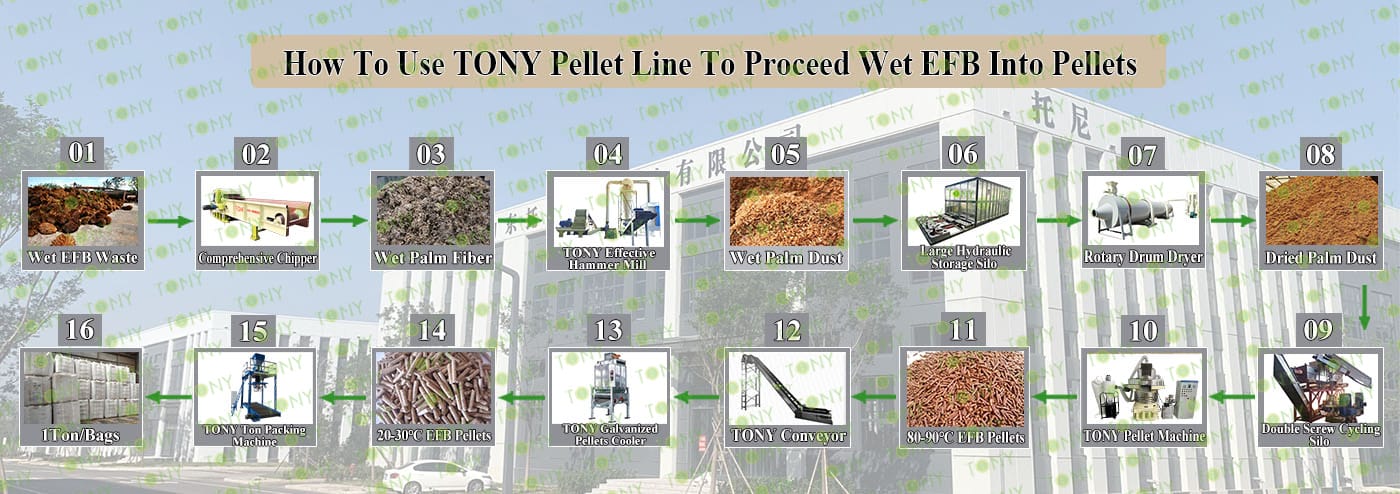
How to use the TONY pellet production line to make pellets from wet EFB? The process mainly includes the following steps and equipment: 1. Use TONY comprehensive chipper to grind EFB Into 25-55mm palm fiber. 2. Use TONY effective hammer mill to crush the 25-55 mm palm fiber into 8-14 mm palm dust.If customer has enough Investment budget,he can also chose TONY special cutting machine for palm silk which will be more expensive than the hammer mill. 3.Use TONY large hydraulic storage silo to storage 8-14 mm palm dust 4. Use TONY rotary drum dryer to dry the palm dust with a 40% moisture content down to a moisture content of 10%-15%. 5. Use TONY vertical ring die pellet machine to produce pellets with a diameter of 6-8 mm. 6. Use TONY galvanized pellets cooler to cool the pellets from 80-90°C to 20-30°C. 7. Use TONY ton packing machine to pack the pellets into bags, each weighing 1 ton. For more detailed information and quotations, you can contact TONY. TONY can provide all the above - mentioned products at highly competitive prices and with excellent quality. |
|
|||||||||||||||||||||||||||||||||||||||||||||||||||||||
三维图
| Next, TONY Will Introduce To You All The Necessary Machinery That Will Be Used For The Whole Pellet Production Line. Some Machines Can Be Custom - Made By Customers According To Different Customers' Detailed Demands. Contact TONY For More Details, Including Quotation And Layout. | |||
 |
 |
 |
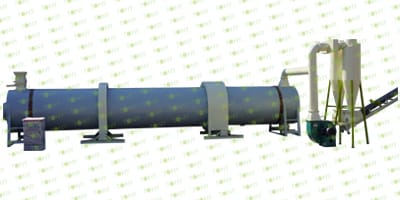 |
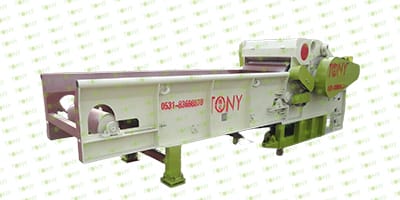
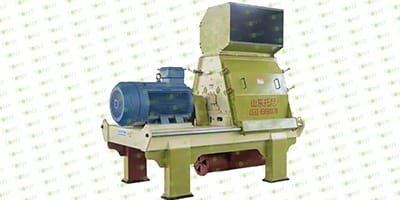
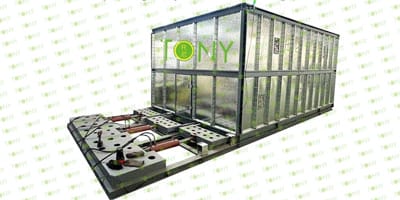
| Comprehensive Chipper | Effective Hammer Mill | Large Hydraulic Storage Silo | Rotary Drum Dryer |
| 1.To Grind EFB Into25-55mm Palm Fiber. 2.Model: TPC1600-1000-250KW With 6 Blades*1set 3.Capacity:20-30Ton/Hour. |
1.To Crush 25-55mm Palm Fiber Into 8-14mm Palm Dust. 2.Model: TFD85-250-250KW*2sets 3.Capacity:8-10Ton/Hour/Set |
1.To Storage Palm Dust Before Dryer Control Palm Dust Flow Entering The Dryer Model: TCY-25*2sets 2.TONY Uses Galvanized Material |
1.To Dry The 40% Palm Dust Into 10-15% Palm Dust. 2.Model: THGD2.5-24*2sets 3.Capacity:8-9Ton/Hour/Set |
 |
 |
 |
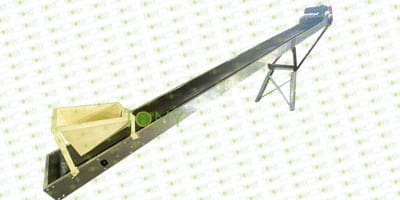 |
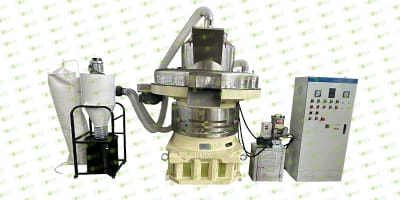
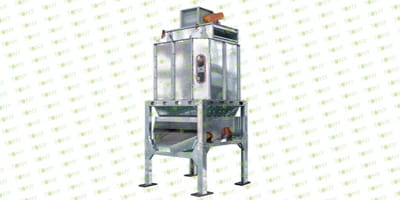
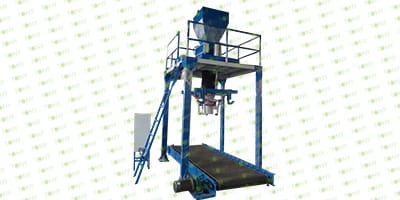
| Vertical Ring Die Pellet Machine | Galvanized Pellets Cooler | Ton Packing Machine | Belt Conveyor |
| 1.To Press Dry Palm Dust Into 6-8mm Biomass Pellets 2.Model: TYJ760-III-160KW*6sets 3.Capacity:2.5-3Ton/Hour/Set 4.New 304SS Type |
1.To Cool Pellets From 80-90℃ Into 20-30℃ 2.Model: TCN-4*2sets 3.Capacity:15-18Ton/Hour |
1.To Pack Pellets Into 1Ton/Bags 2.Model: TBD*2sets 3.Capacity:15-18Ton/Hour |
1.To Transport Palm Fiber, Palm Dust,Pellets. 2.Width: 80cm*18sets 3.Capacity:Designed With The Whole Line |
三维图
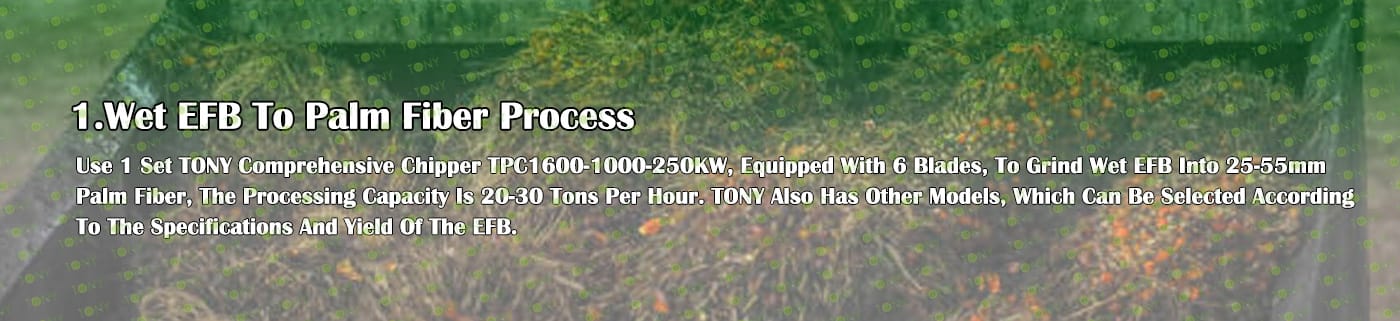
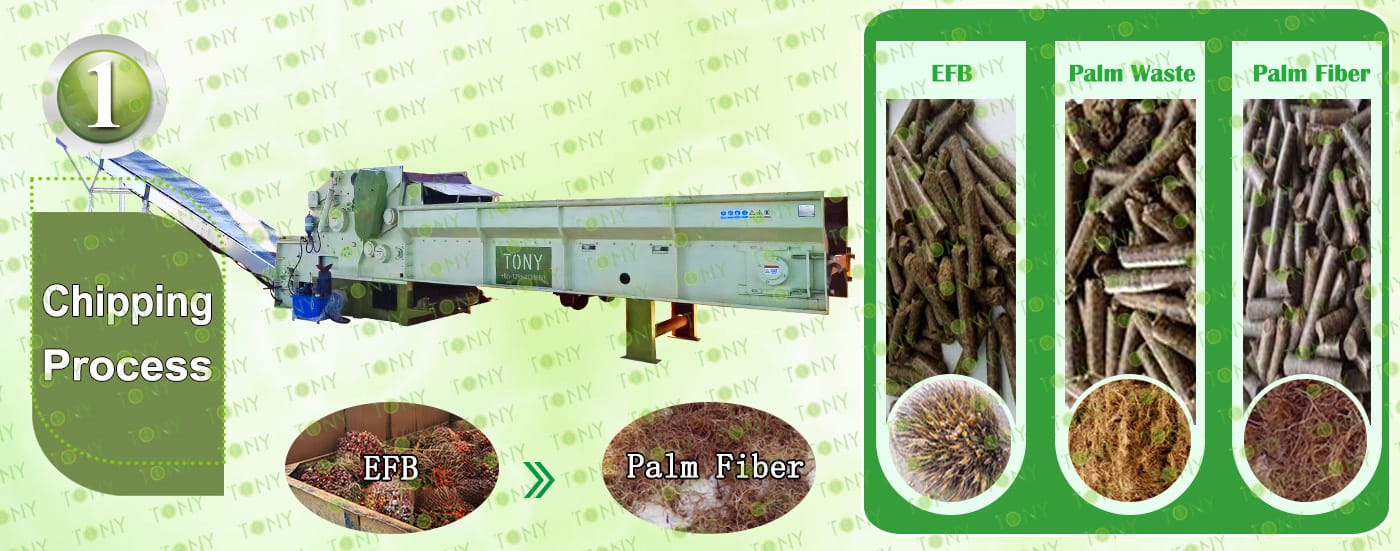
1.Wet EFB To Palm Fiber Process:
A.This process is mainly used to grind the EFB into palm fiber with size 25-55mm. The finish palm fiber size can be adjustable by changing different sizes of screeners and adding flying knives inside the wood chipper.
B.TONY brand comprehensive chipper TPC1600-1000-250KW with 6 flying blades type*1 set
C.Capacity:20-30Ton/Hour.
Main Parts:
(1)TONY's Comprehensive Chipper.
(2)Feed And Discharge Belt Frequency Control To Prevent Card Material
(3)Hydraulic System Control Can Be Used For Thicker Materials
(4)Electronic Control System Allows The Equipment To Be Used Normally
Contact Tony For More Details With Quotation
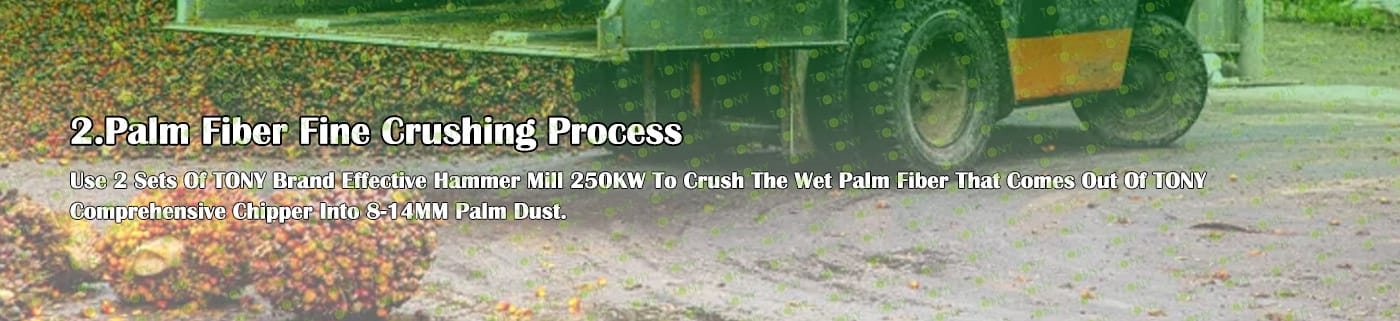
2.Palm Fiber Fine Crushing Process:
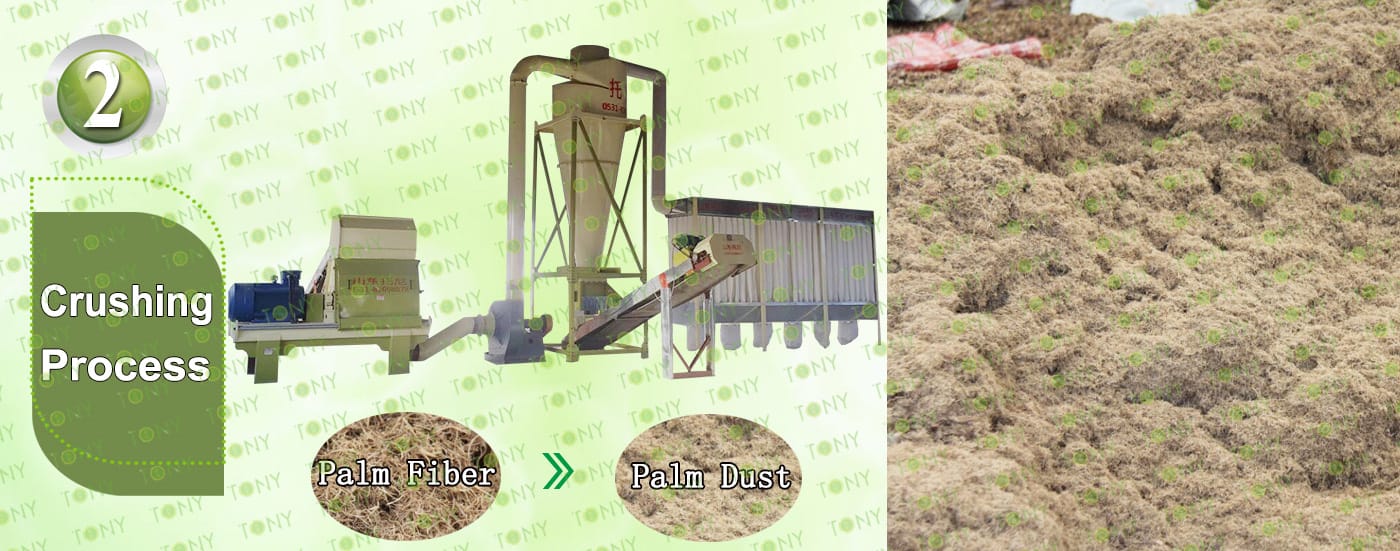
A.This process is mainly used to crush 25-55mm palm fiber into 8-14mm palm dust.
B.Capacity:16-20Ton/Hour.
C.TONY brand effective hammer mill TFD85-250-250KW*2sets
Main Parts:
(1)TONY Effective Hammer Mill.
(2)Galvanized Dust Collector.
(3)Sawdust Transportation Fan Blower.
(4)Cyclone With Airlock.
(5)Electrical Cabinets.
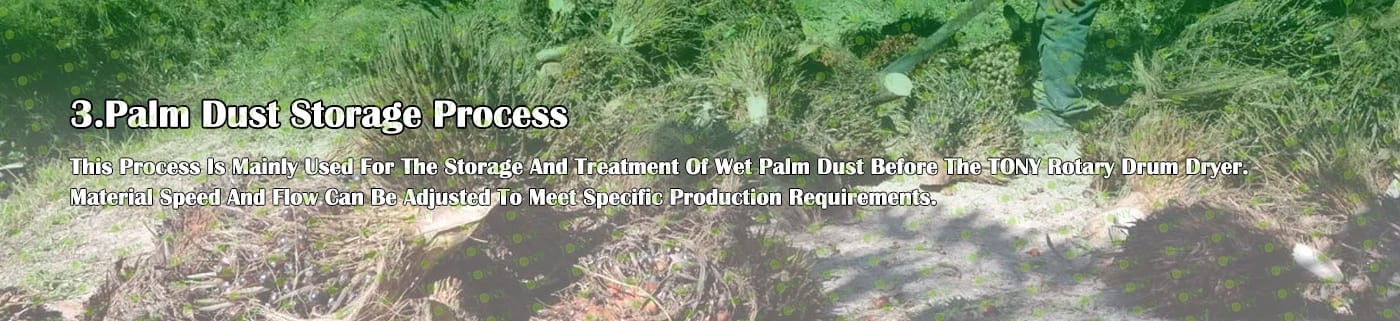
3.Palm Dust Storage Process:
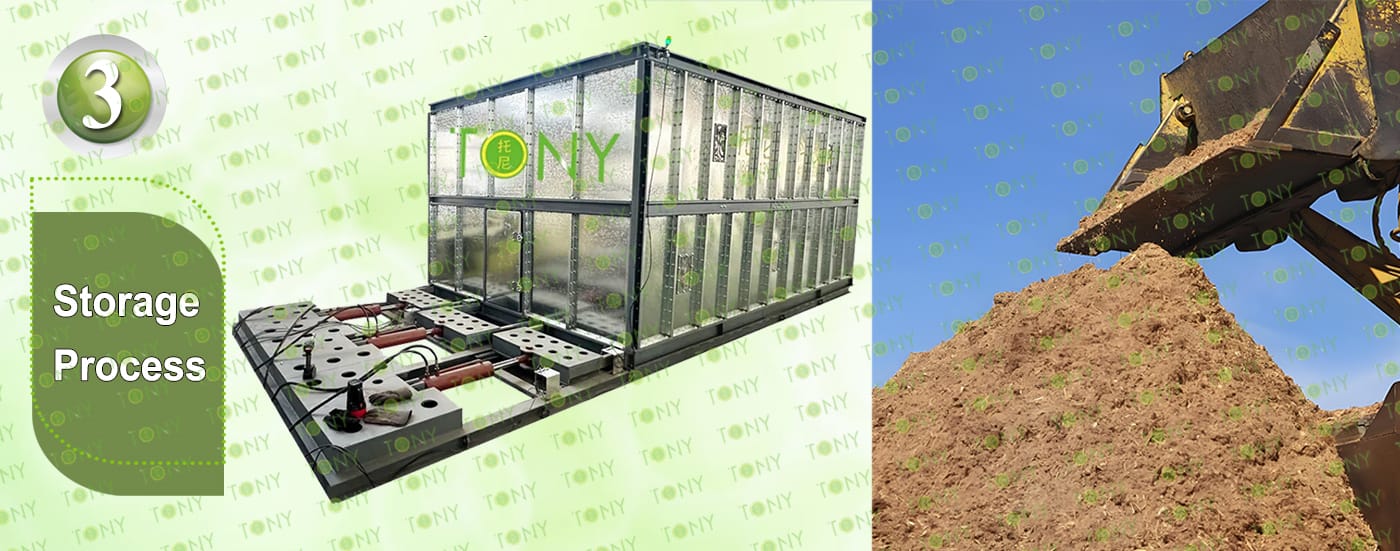
A. This process is mainly used to storage the palm dust that comes out of the hammer mill.It is hydraulic galvanized storage bin which is more stalbe and palm dust in it is not easy to be blocked.
B. TONY Brand Large Hydraulic Storage Silo to storage the palm dust that comes out of the hammer mill.This process can be optional by customer.If customer do not chose the storage bin,he can storage the palm dust on the ground directly which may need some labour.
Main Parts:
(1)TONY's New Large Hydraulic Storage Silo.
(2)With Screws Inside The Storage Bin To Prevent Palm Dust Blocked.
4.Wet Palm Dust Drying Process:
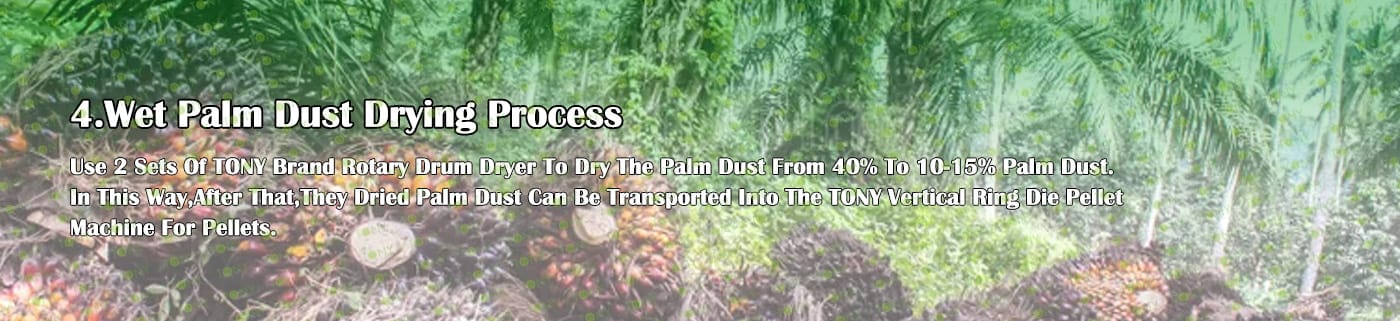
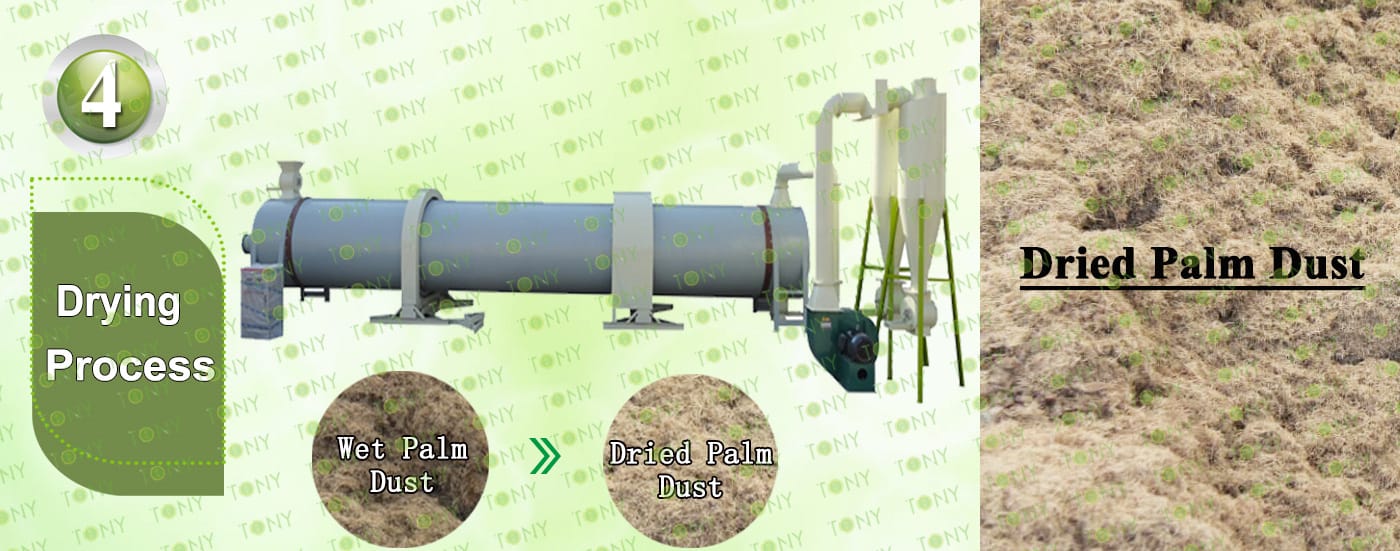
A.This process is mainly used to dry the palm dust from 40% to 10-15%.
B.Capacity:15-18Ton/Hour.
C.TONY use 2 sets of 2.5*24m rotary drum dryer for this process, TONY hot blast stove is made of firebrick pan, shell with H steel plate as the frame. There are 3 layers of fire blocking device inside, which can effectively prevent the fire from entering the tumble dryer.Customers can choose to use waste wood, biomass pellets, natural gas, etc. as fuel for the hot air furnace
TONY dryer use spiral tube material, and is not easy to deform.
Unlike other manufacturers with iron plate splicing welding, very easy to deformation.
Main Parts:
(1)TONY's Rotary Drum Dryer Main Body. (Reducers With Motors and Pips.)
(2)TONY's Hot Stove.
(3)Fan Blower+Cyclone With Airlock.
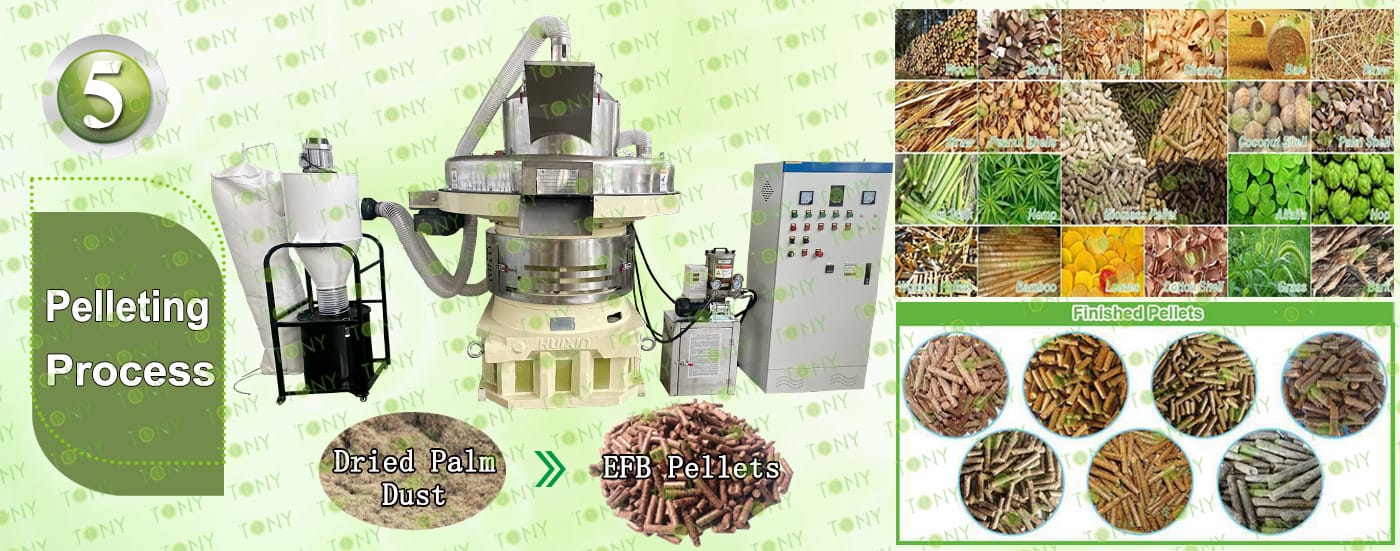
5.Pelletizing Process:
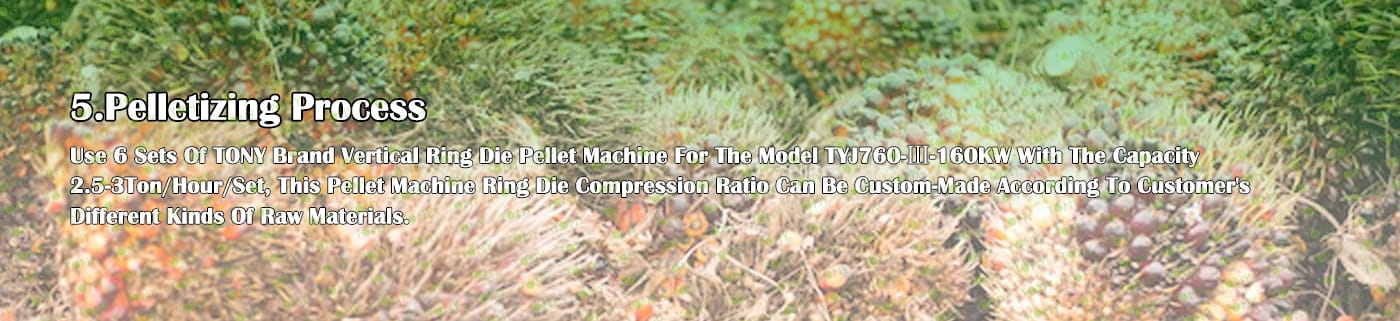
A.This process is mainly used to to product pellets into φ6-8mm.
B.Capacity:15-18Ton/Hour.
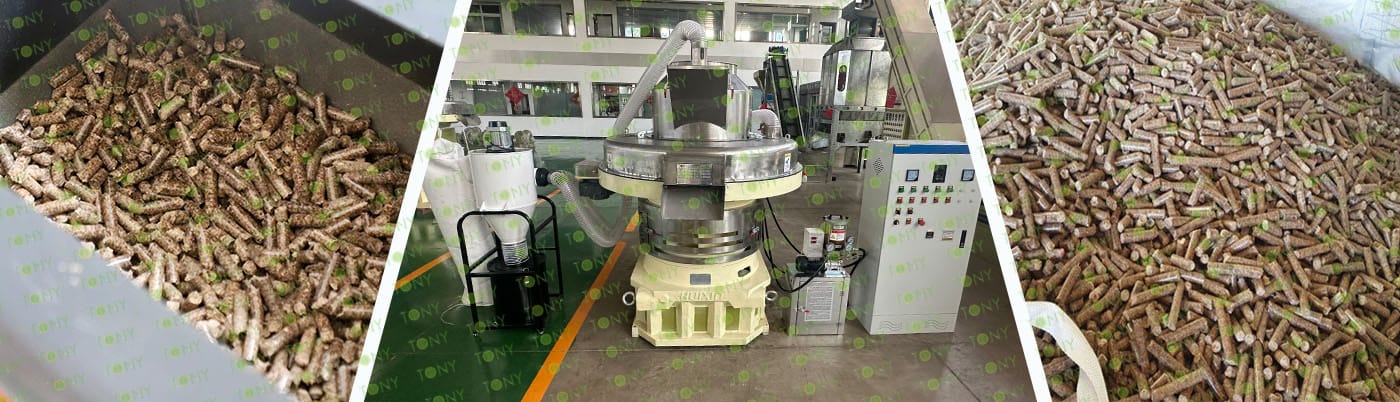
C.TONY brand vertical ring die pellet machine TYJ760-Ⅲ-160KW*6sets
D.Double Screw Cycling Silo is added above the pellet machine, which has the advantages of saving space, saving labor, intelligently controlling the feeding speed, not easy to block the material, and improving production efficiency.
Main Parts:
(1)TONY's new Vertical Ring Die Pellet Machine.
(2)Cyclone And Bags Dust Collectors.
(3)Automatic Lubrication System.
(4)Electrical Cabinets.
You can chose TONY new type SS304 pellet machine
6.Cooling Process:
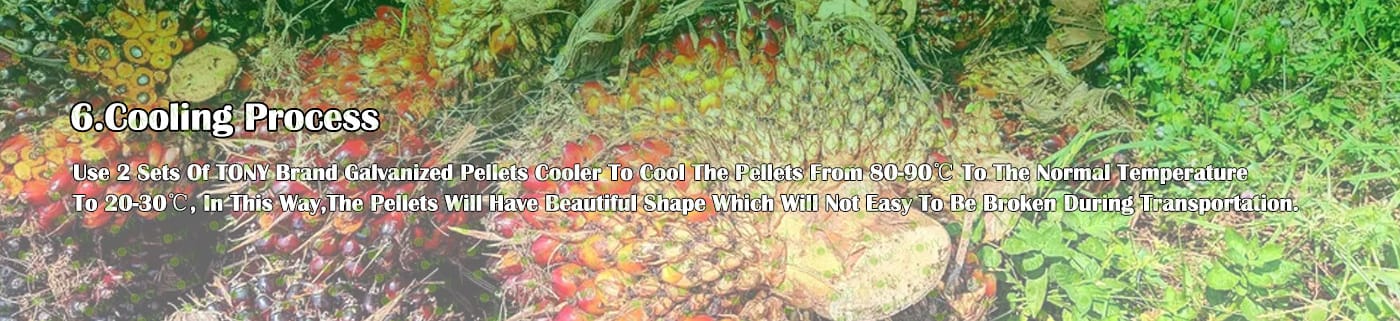
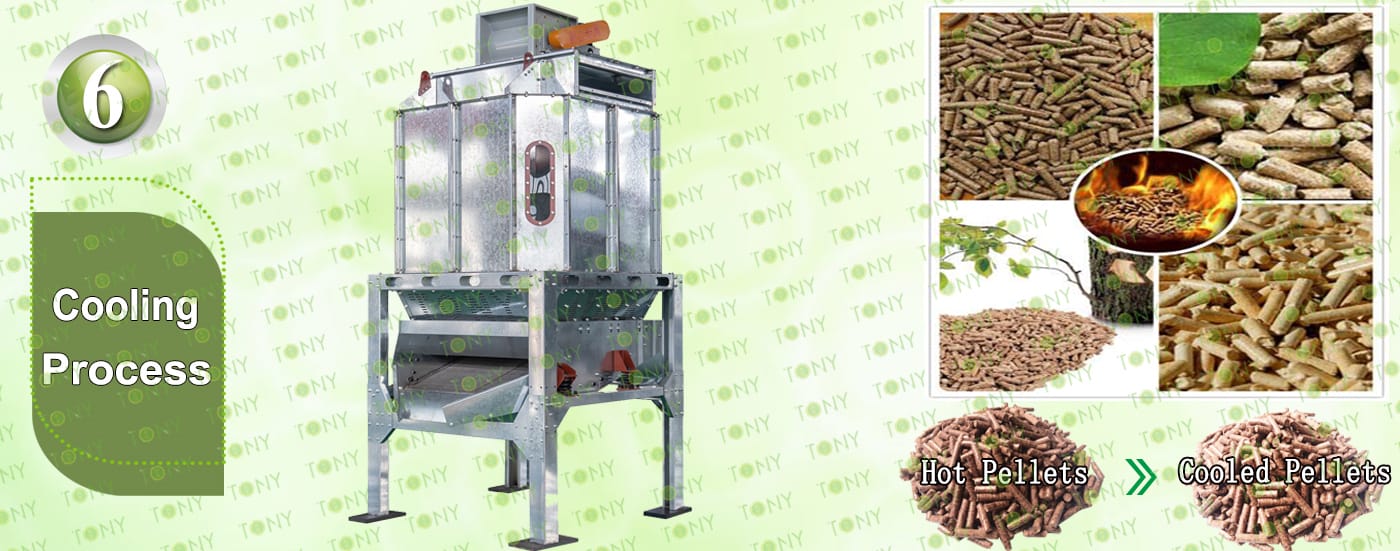
A.This process is mainly used to cool pellets from 80-90℃ to 20-30℃
B.Capacity:15-18Ton/Hour.
C.TONY brand galvanized pellets cooler *2sets
Main Parts:
(1)TONY's new Galvanized Pellets Cooler With Vibrating Screen.
(2)Cyclone And Bags Dust Collectors.
(3)Fan Blower.
(4)Connect Pipes.
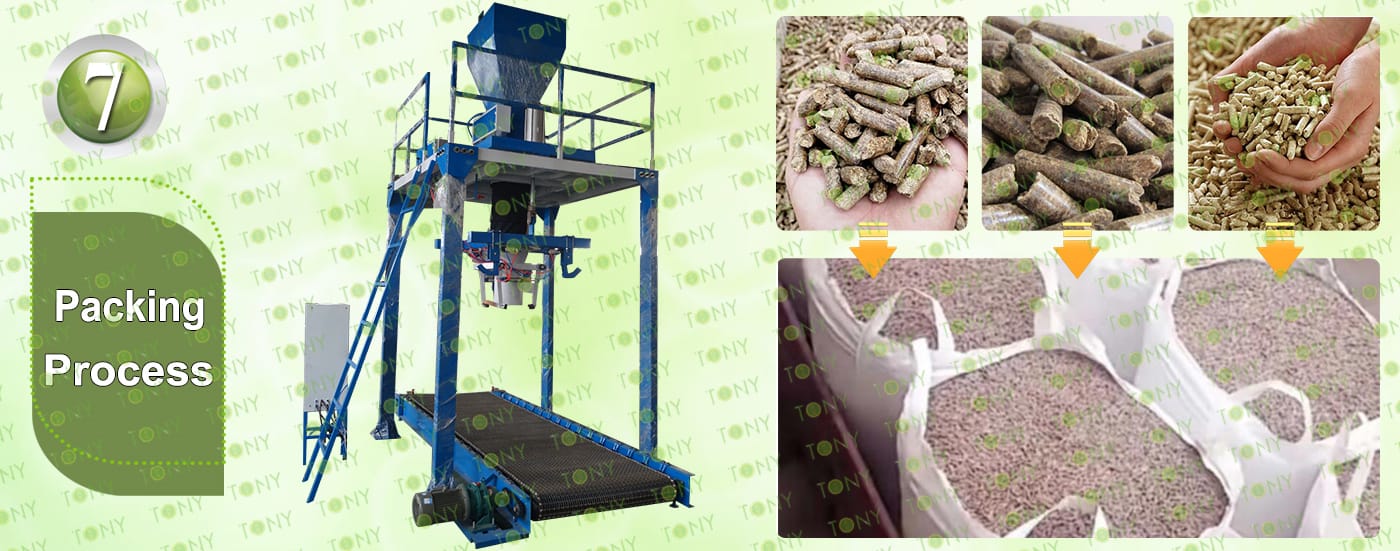
7.Packing Process:
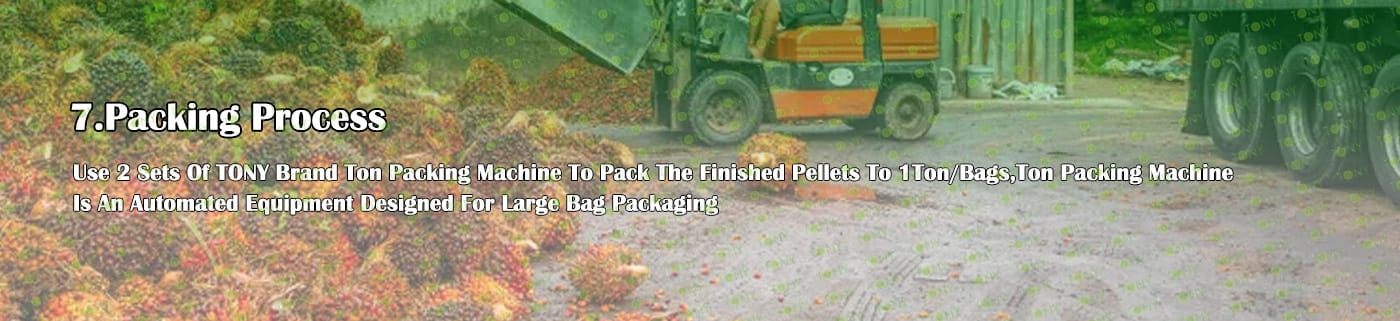
A.This process is mainly used to pack pellets into 1Ton/Bags.
B.Capacity:15-18Ton/Hour.
C.TONY brand ton packing machine*2sets
Main Parts:
(1)TONY Ton Packing Machine
(2)Electronic Platform Scale Metering System
(3)Automatic Tare, Zero, and Drop Correction Functions
(4)Feeding System Features Fast, Medium, and Slow Feeding Speeds to Ensure Measuring Accuracy
EFB Biomass Pellet Project Implementation Process: From Planning to Operation
The implementation cycle of an EFB biomass pellet project typically takes 6-12 months and can be divided into three phases: pre-production preparation, construction and commissioning, and operations management. Each phase has clearly defined key tasks.
1.Preliminary Preparation Phase (2-4 months):Determine project feasibility.
Site Selection:The core principles are "proximity to raw materials + convenient transportation." Priority is given to sites within 10-30 kilometers of a palm oil mill, near national highways or industrial parks (area: 5-10 mu for small and medium-sized lines, 15-20 mu for large lines). These sites must meet environmental impact assessment requirements (away from residential areas and water sources).
2.Construction and Commissioning Phase (3-6 months): Hardware implementation and process optimization.
Plant Construction:Functional areas are divided according to process flow (raw material yard, pretreatment workshop, drying workshop, pelletizing workshop, and finished product warehouse). The raw material yard must be protected from rain (to prevent EFB from rain and humidity). Workshops must be ventilated and dust-proof (install exhaust fans and dust removal equipment).
Equipment Procurement and Installation:Purchase a complete set of equipment based on production capacity (pretreatment: vibrating screen, crusher; drying: hot air furnace + The equipment manufacturer is responsible for installation and commissioning of the following components: drum dryer; crushing: hammer mill; granulation: ring die granulator; cooling: countercurrent cooler; packaging: automatic packaging machine.
Process run-in:During the commissioning period (1-2 months), focus on optimizing parameters (such as drying temperature and granulator speed) to ensure pellet quality meets standards (moisture 10%-15%, density ≥1.1g/cm³, and crushing rate ≤3%). Operator training is also required (2-5 people per line are required to master equipment operation and maintenance and parameter adjustment).
3.Operations Management Phase (Long-Term): Cost Reduction, Efficiency Improvement, and Stable Supply
Raw Material Management:Sign long-term supply agreements with palm oil mills (lock in raw material sources), control raw material transportation radius (≤30 kilometers), and avoid excessive moisture content (store fresh EFB for no more than three days to prevent mold).
Production Management:Implement continuous production to reduce equipment idleness; regularly maintain consumable parts (hammers and ring dies, with a lifespan of 300-500 hours) to minimize downtime; utilize EFB dust as drying fuel (instead of purchased coal, reducing energy costs).
Sales Management:Prioritize developing long-term customers (such as nearby palm oil mills and biomass power plants) and sign annual supply agreements (lock in pricing and sales volume). Domestic and export markets can be accessed through distributors, with emphasis on brand packaging.
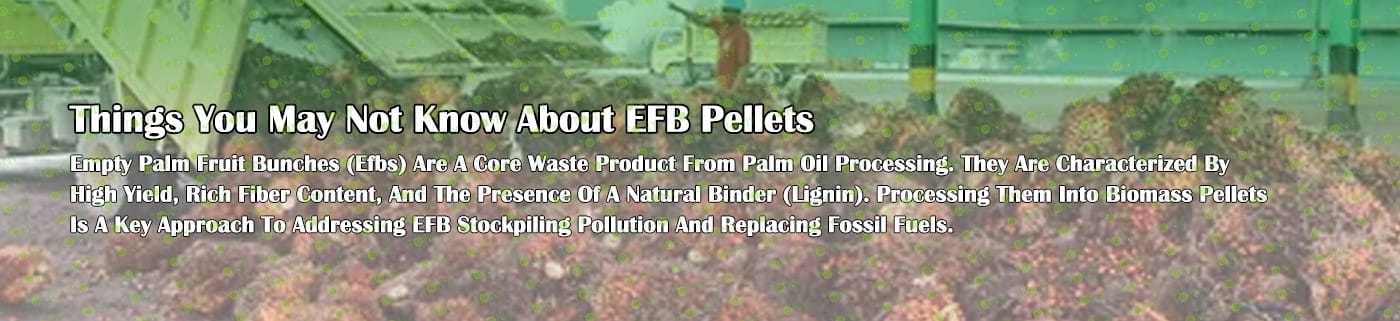
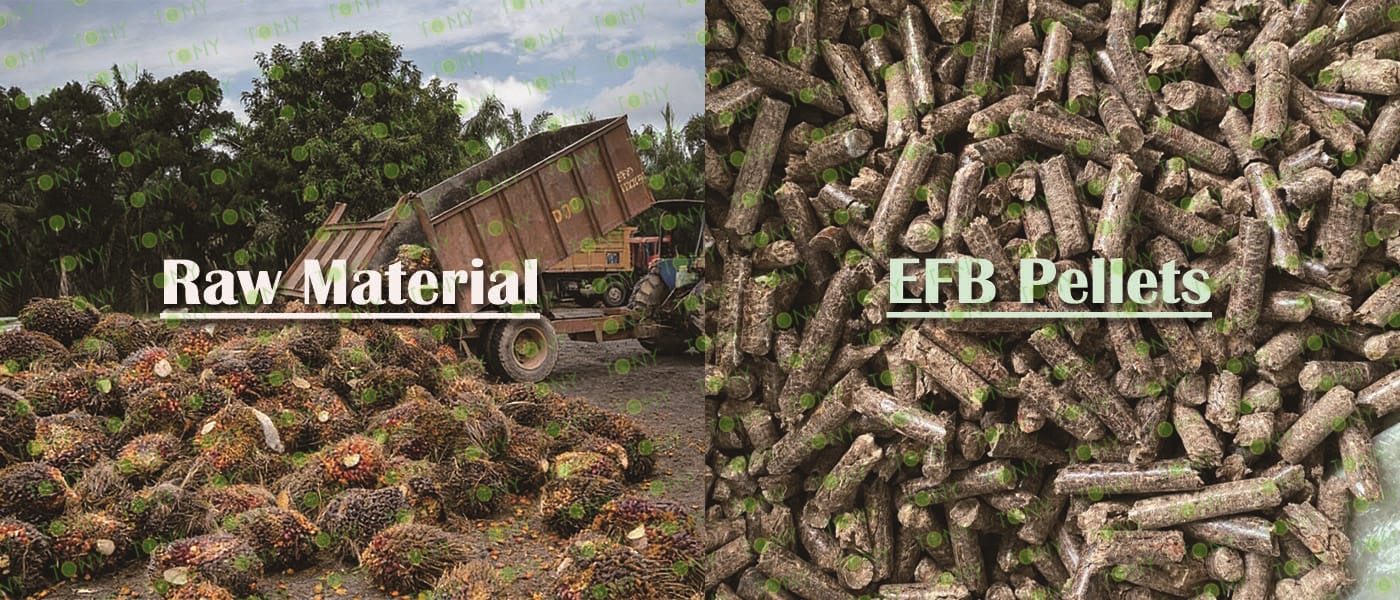
The core environmental value of EFB biomass pellets lies in their low environmental impact throughout their entire life cycle. They perfectly align with global "dual carbon" policies and high environmental standards, making them an ideal alternative to fossil fuels (coal and natural gas).
1.Carbon-neutral cycle, contributing to carbon reduction goals
EFB is a natural product of palm tree growth. The CO₂ absorbed by palm trees through photosynthesis is essentially balanced by the CO₂ released by burning EFB pellets, achieving "carbon neutrality" (no additional carbon emissions). This characteristic can significantly reduce carbon emissions for industrial users (such as palm oil mills and cement plants) and biomass power plants.
2.Extremely low pollutant emissions, eliminating the need for additional pollution control costs
Compared to coal combustion, EFB pellets emit significantly fewer pollutants during combustion. They are naturally sulfur- and heavy metal-free, eliminating the need for expensive desulfurization and denitrification equipment:
SO₂ emissions are <50mg/m³ (compared to 1500-2000mg/m³ for coal combustion)
NOₓ emissions are <200mg/m³ (compared to 800-1000mg/m³ for coal combustion), reducing nitrogen oxide pollution to the atmosphere.
With an ash content of only 2%-3% (compared to approximately 10%-20% for coal combustion), combustion produces a small amount of ash, which is rich in minerals such as potassium and calcium. This ash can be directly reused as organic fertilizer in palm plantations or farmland, achieving "zero solid waste" and avoiding landfill costs.
3.No artificial additives, suitable for applications requiring high cleanliness.
The pelletizing process relies on the EFB's natural lignin (15%-20%) as a natural binder (softened and melted under high-temperature extrusion), eliminating the need for artificial binders such as starch or resin. Combustion does not release harmful gases such as formaldehyde and VOCs. This advantage makes it particularly suitable for applications requiring high cleanliness, such as food processing plants (such as baking and beverage production) and home heating, preventing fuel impurities from affecting product quality or harming human health.
2025 Tony Machinery - All Rights Reserved. Map