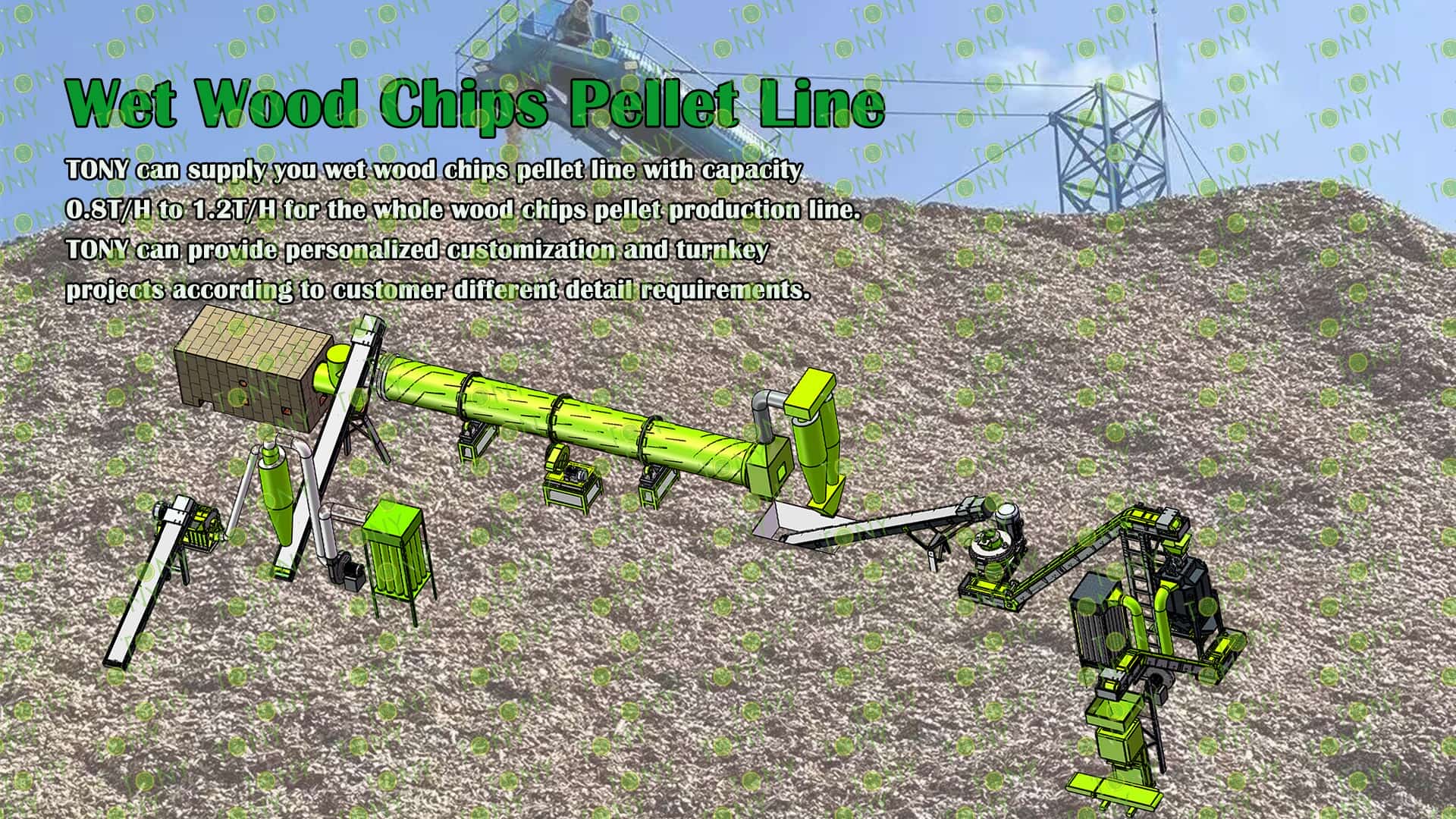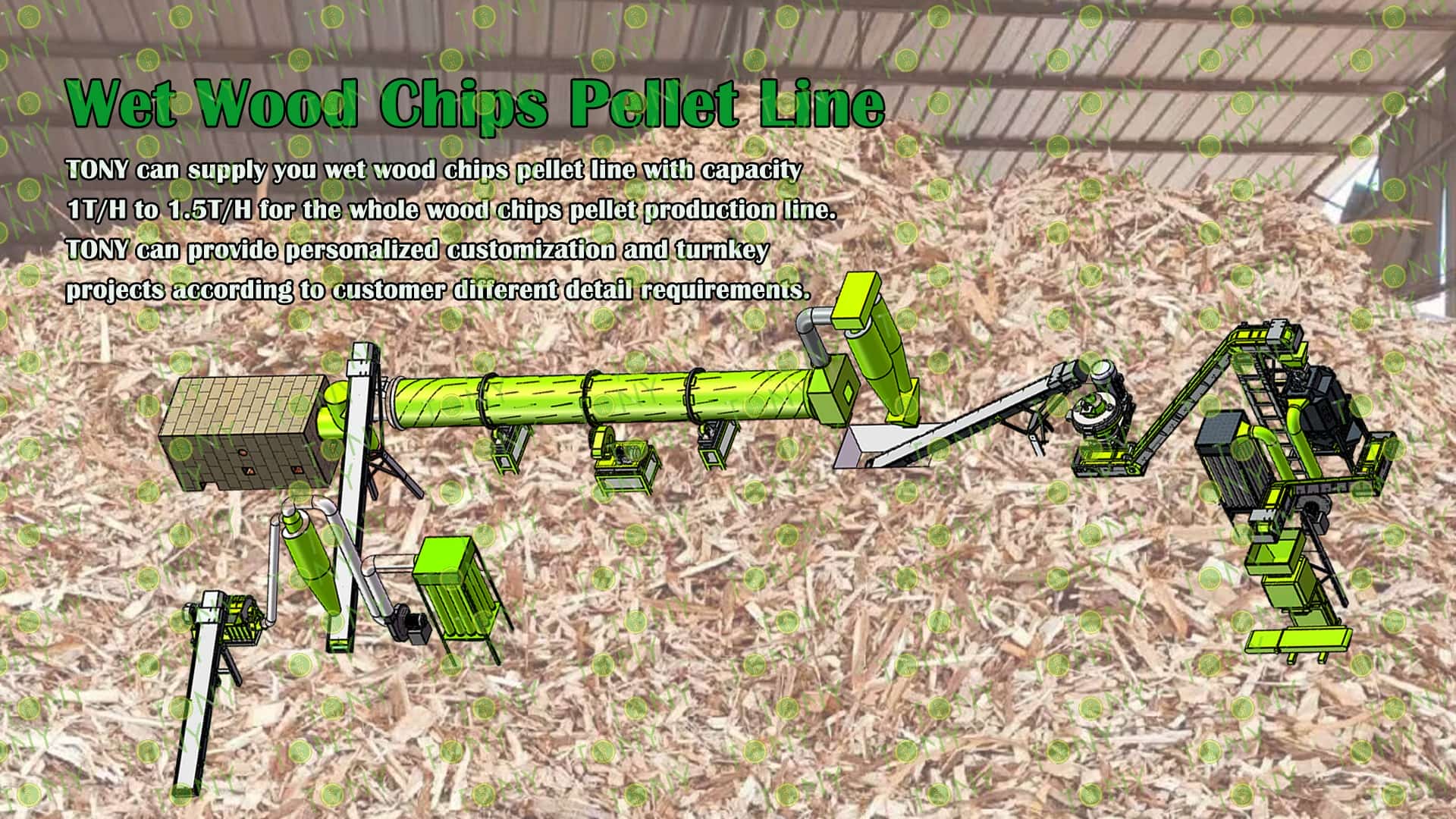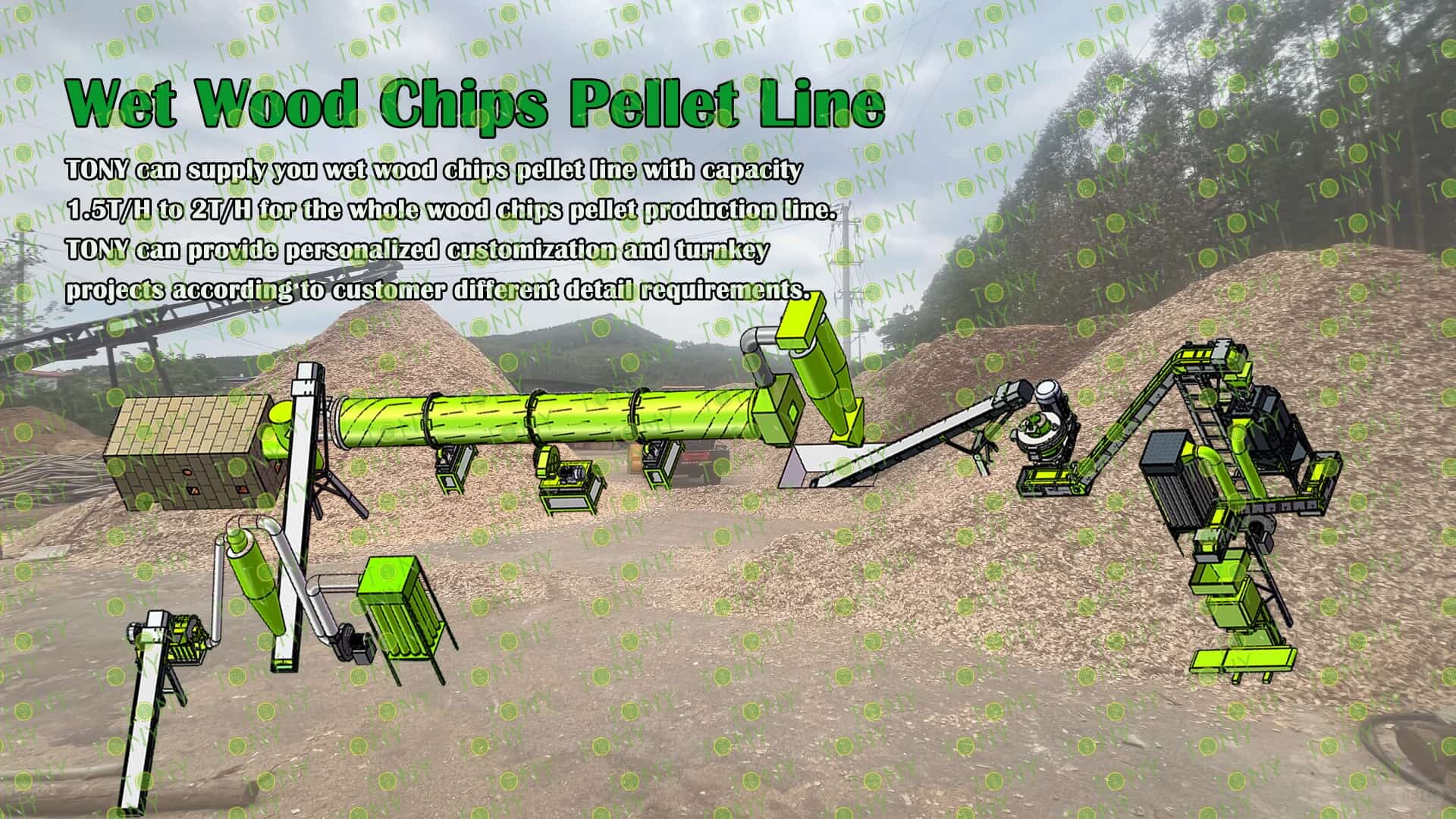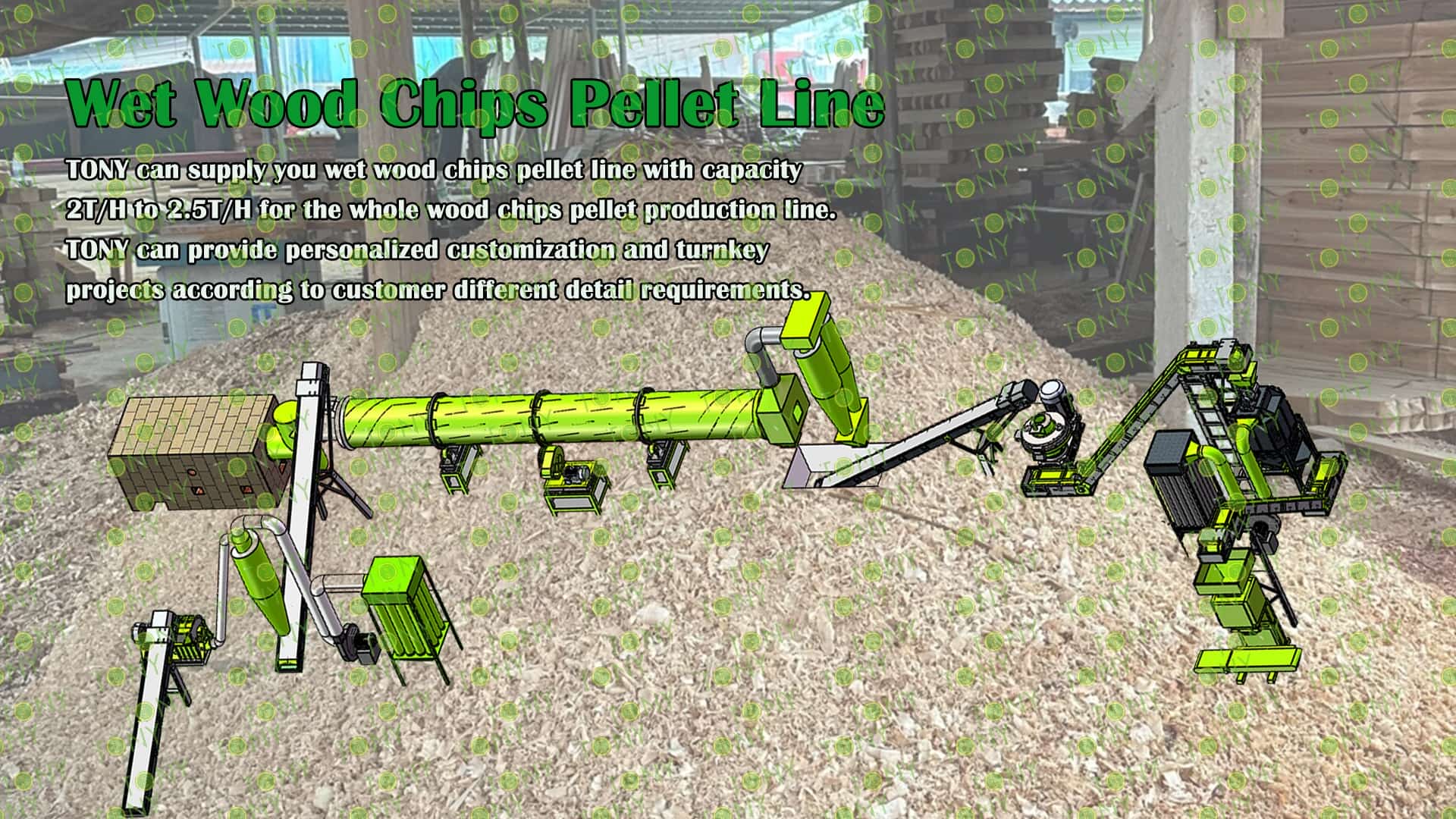




















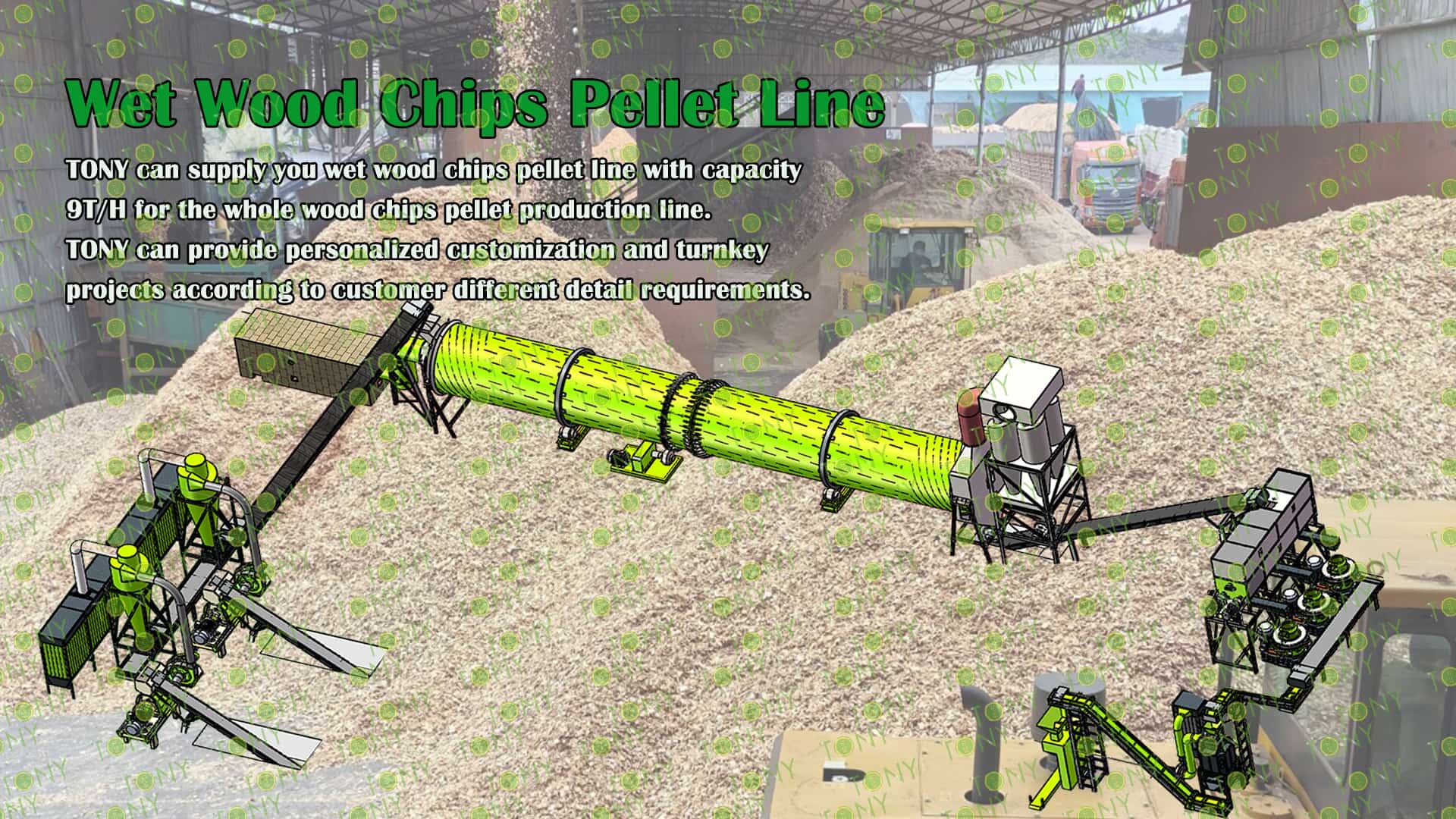

Project Brief Introduction:
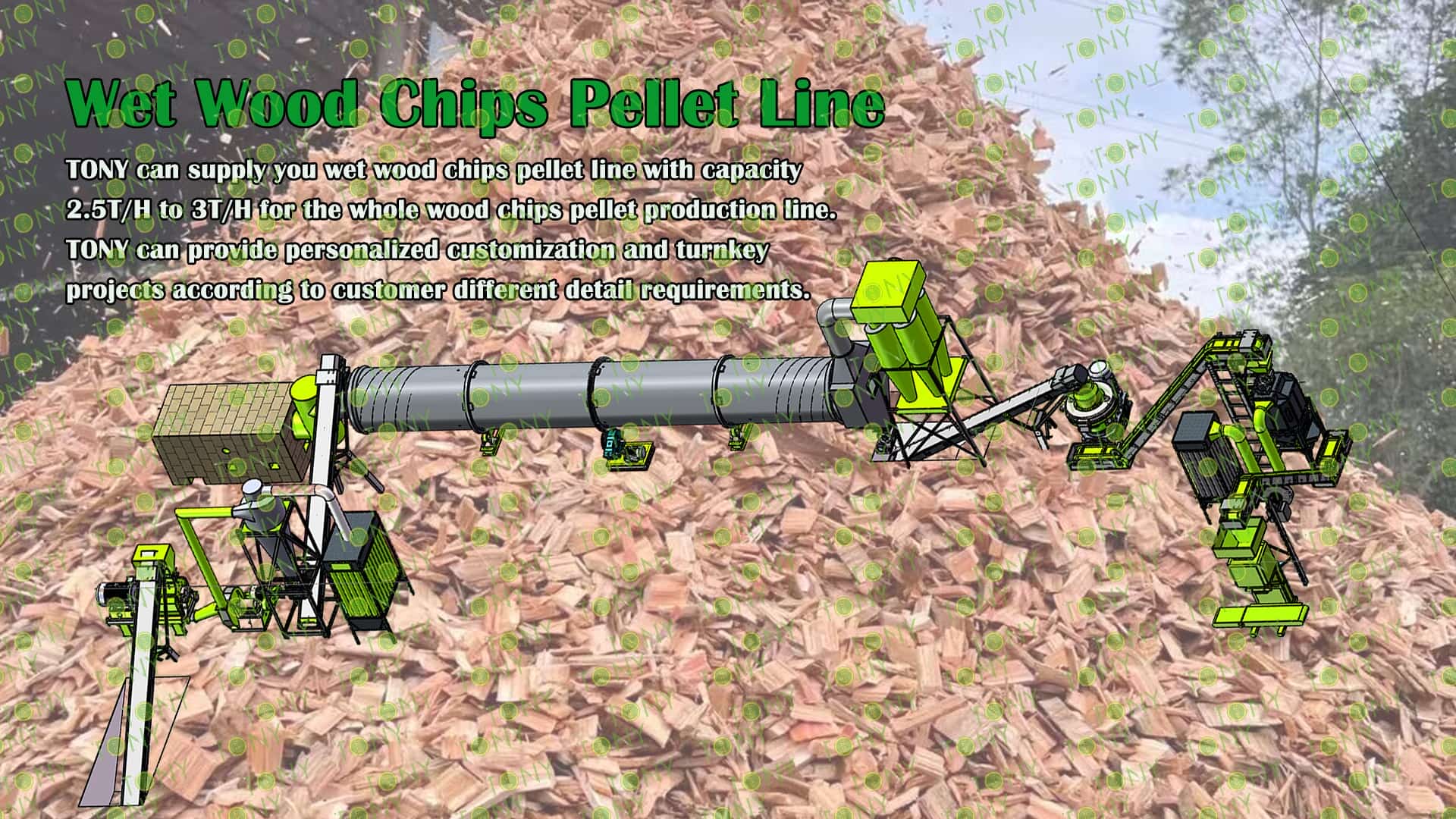
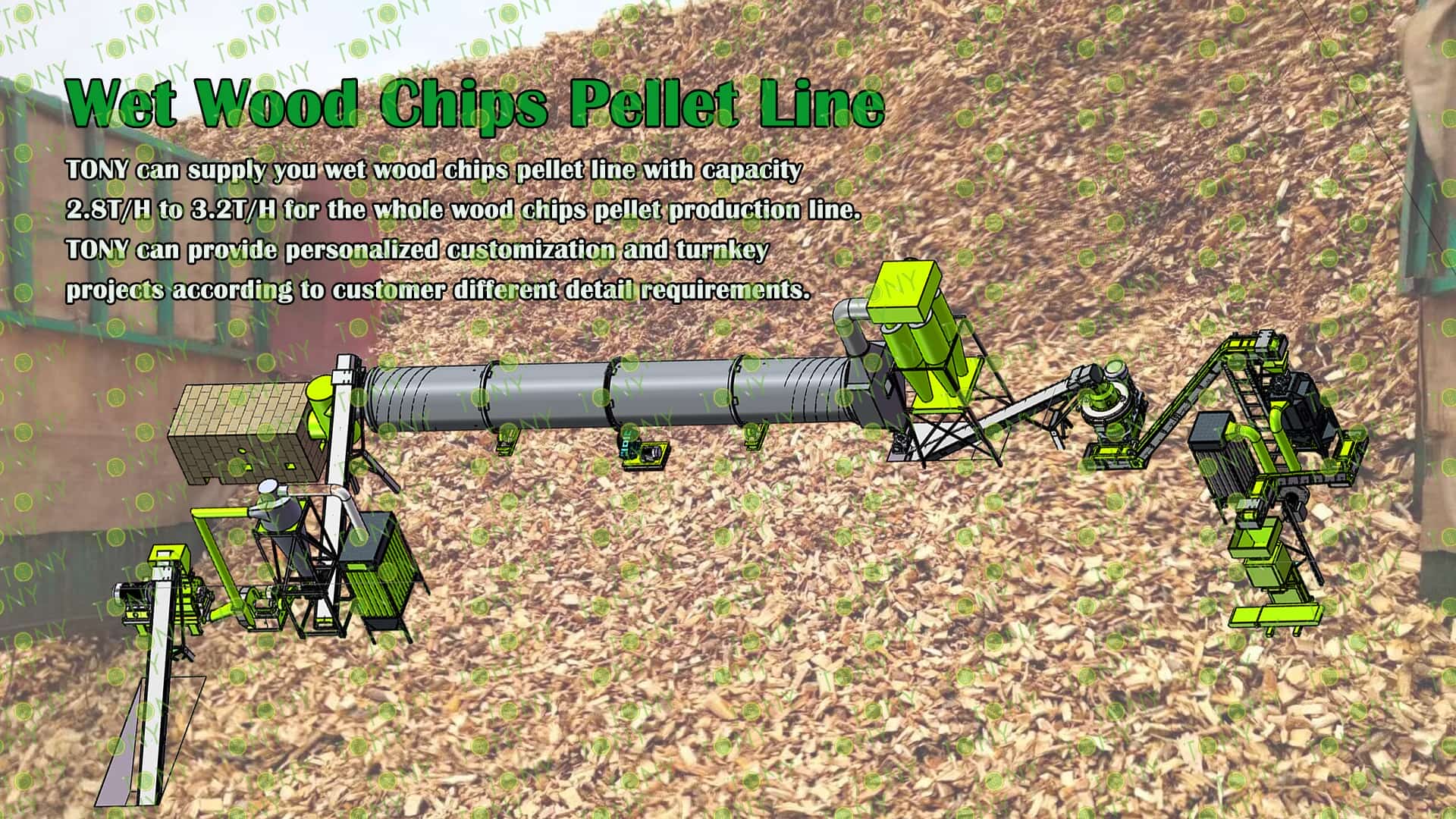
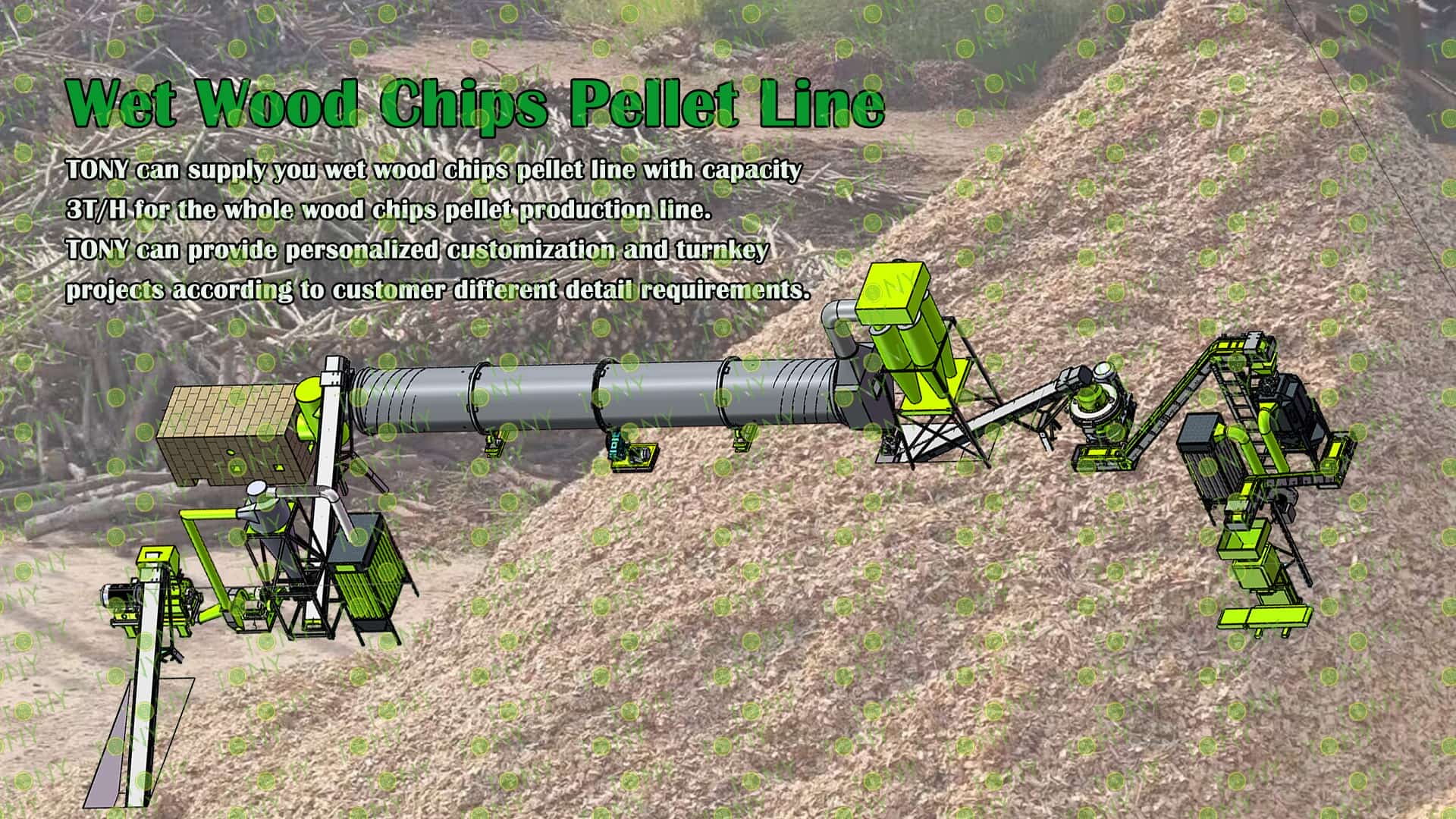
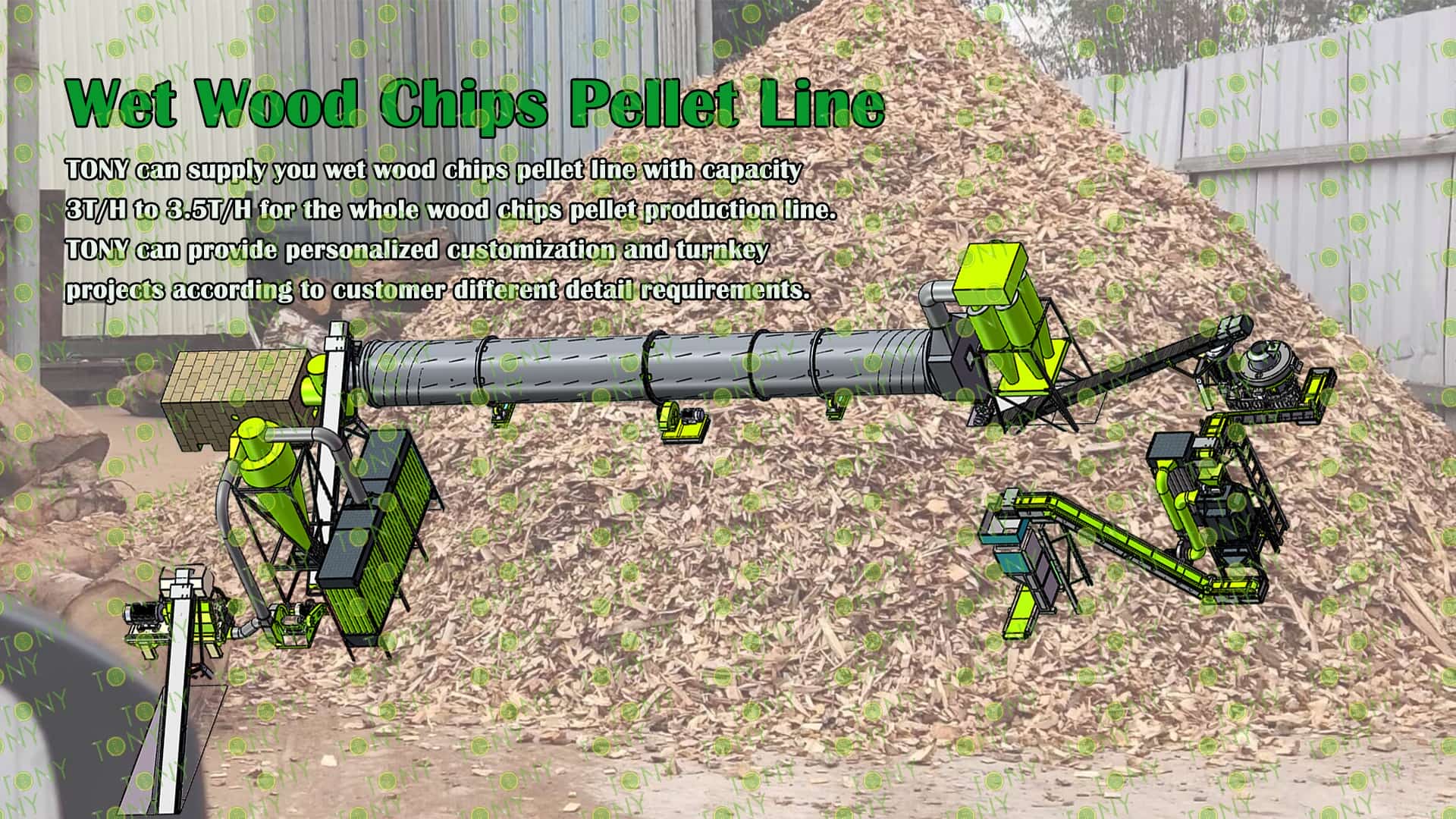
1.Product:Wet Wood Chips Pellet Line
2.Capacity: 9T/Hour
3.TONY Brand 9Ton /Hour Wet Wood Chips Pellet Line Project Process
4.Main Machine: Hammer Mill, Rotary Drum Dryer,TONY Pellet Machine TYJ760-III-200KW,Pellets Cooler,Packing Machine And Belt Conveyors
5.Total Power: About 1080KW
6.Need Area: About ㎡ L: M W: M H: M
Project Layout For Customer:
三维图
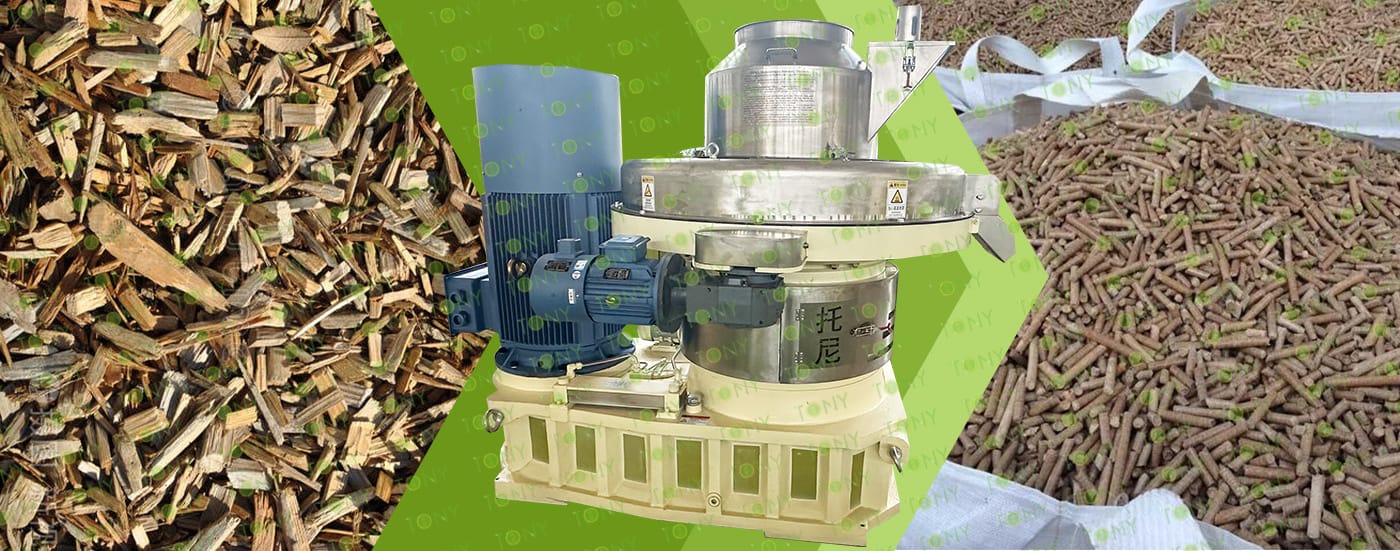
1.The working principle of wet wood chips biomass pellet processing equipment
Biomass pellet processing converts loose agricultural and forestry waste (such as wood chips, sawdust, straw, and rice husks) into high-density, regularly shaped pellet fuel through a series of physical and mechanical processes. The core process includes three key steps: raw material pretreatment (crushing and pulverization), drying, and pelletizing. Each step requires specialized equipment to transform the material's physical state.
2.Characteristics of wet wood chips biomass pellet processing equipment
Wood pellet processing equipment (i.e., wood biomass pellet machines and supporting production lines) is specifically designed to process wood materials such as wood chips, sawdust, wood shavings, and branches into high-density pellets.
It is compatible with a wide range of wood materials: wood chips, sawdust, wood chips, shavings, wood chaff, shredded branches, and waste wood. Both softwoods (such as pine and fir) and hardwoods (such as oak and birch) can be efficiently processed after pretreatment (crushing and pulverization).
To address raw material moisture fluctuations: Dedicated drying equipment (such as drum dryers) can control the moisture content of wood raw materials to 10%-15% (the optimal moisture range for wood pellet production), avoiding problems such as clogging and loose pellets caused by excessive moisture.
Flexible particle size control: The accompanying pulverizer can crush wood raw materials to the size of sawdust, meeting the pellet machine's fineness requirements and ensuring uniform pellets.
3.Application scenarios of wet wood chips biomass pellet processing equipment
Processing equipment provides fuel (replacing coal and oil) for factory boilers and kilns, such as steam boilers in textile and food factories, and heating kilns in the ceramic and building materials industries. This stable production of pellets ensures energy supply.
(1)Power Generation:Biomass power plants require large quantities of standardized pellets as fuel. Large-scale processing equipment can meet the power plants' stringent requirements for pellet calorific value and density, ensuring combustion efficiency and stable power generation.
(2)Agriculture and Animal Husbandry: Some processing equipment can produce pellets for livestock bedding (such as straw pellets) or raw material pellets for organic fertilizer production. The equipment can be adapted to different agricultural needs by adjusting the process.
(3)Residential Heating:For pellets used in home fireplaces and small heating appliances, processing equipment must control pellet size and hardness to accommodate residential combustion equipment. The equipment's refined production capacity directly impacts the user experience of these pellets.
(4)Environmental Protection and Waste Management: In garbage and sewage treatment plants, processing equipment can convert organic waste (such as sludge and food waste) into fuel pellets for resource utilization. Corrosion- and clogging-resistant designs are key.

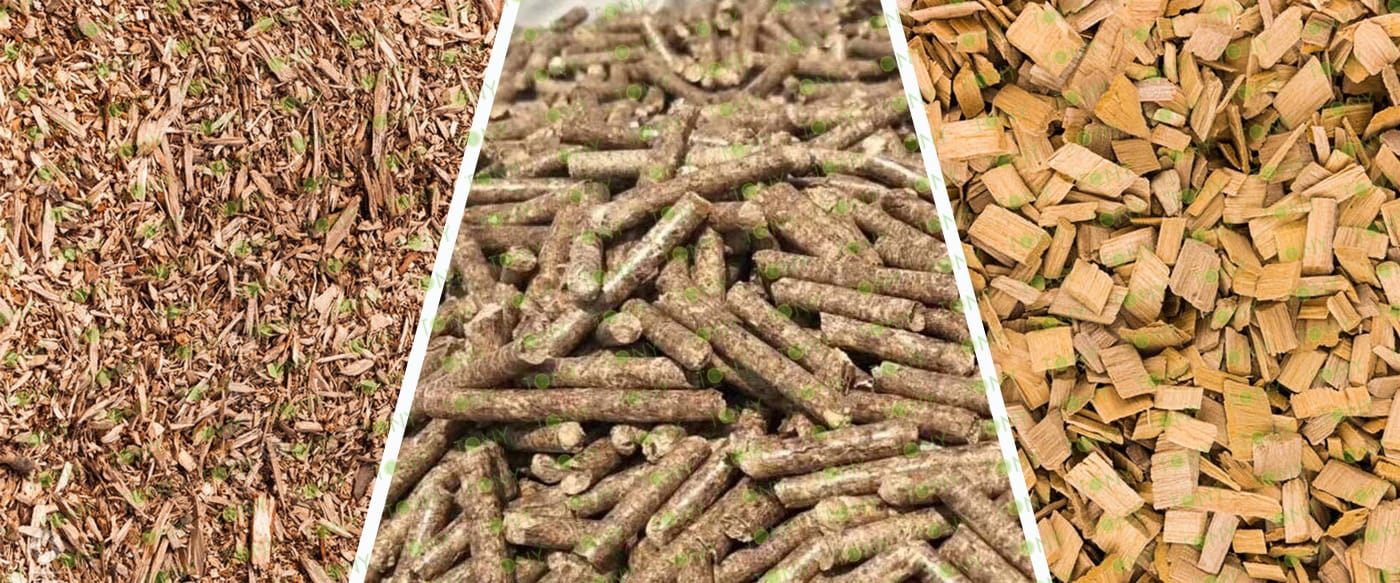
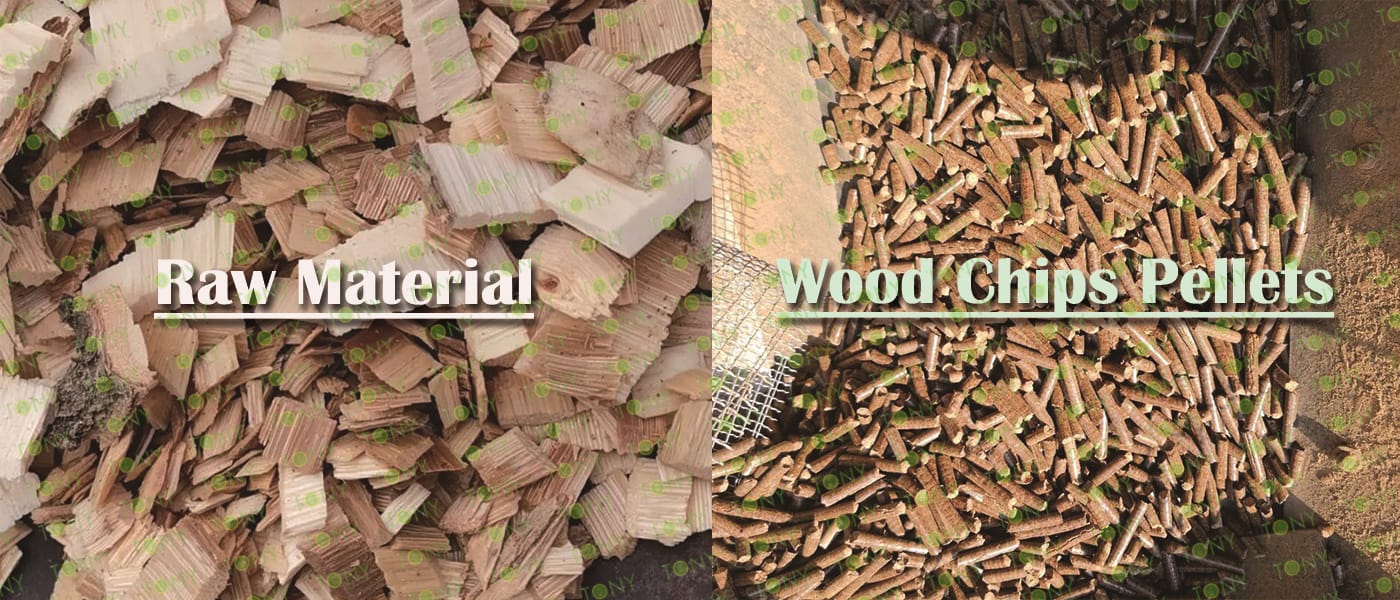
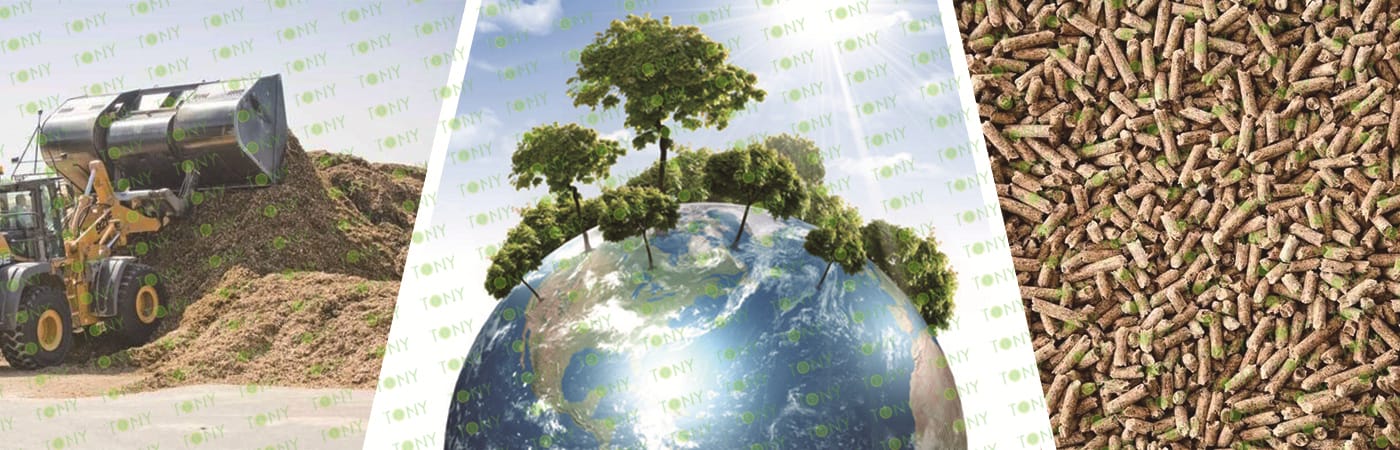
TONY Brand 9Ton/Hour Wet Wood Chips Pellet Manufacturing Plant can take wet wood chips, various types of wood - related biomass materials, such as wood pallets ,branches, wood logs, and wood shavings. After pretreatment and processing, wet wood chips is solidified into high - density wood pellet fuel. This fuel is an ideal substitute for coal and oil and plays a role in energy conservation and emission reduction. At present, it has been widely used in regions rich in wood resources.
1. Capacity: 9Ton/Hour
2. Raw materials: Wet wood chips
3. Moisture: Wet type, about 40%.
4. Application: All kinds of wood chips or more waste wood raw materials
Suitable customers: Solid wood furniture production, artificial board processing (plywood, fiberboard, particleboard), wood component processing, construction and decoration, packaging and logistics, such as pallets and wooden boxes, will generate a large amount of waste wood chips due to repeated use, size mismatch or changes in cargo transportation needs. Paper and pulp production where waste wood chips have advantages
5. Finished Pellets Markets: Large power plants ,domestic heating, industrial heating, combustion heat, heating systems, boiler rooms, school canteens, foundry heat sources.

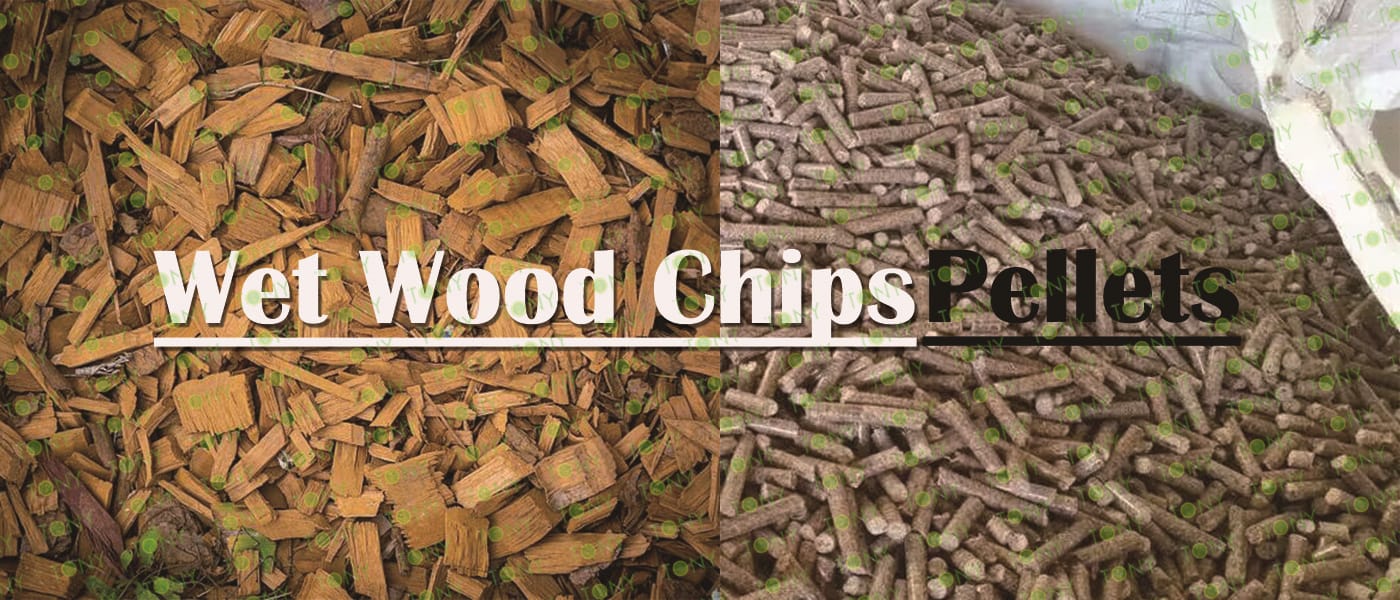
1. Project Name: Wet Wood Chips Pellet Production Line
2. Raw Material: All kinds of wet wood chips
3. Moisture Content of Raw Material: 40%
4. Capacity: 9 tons per hour
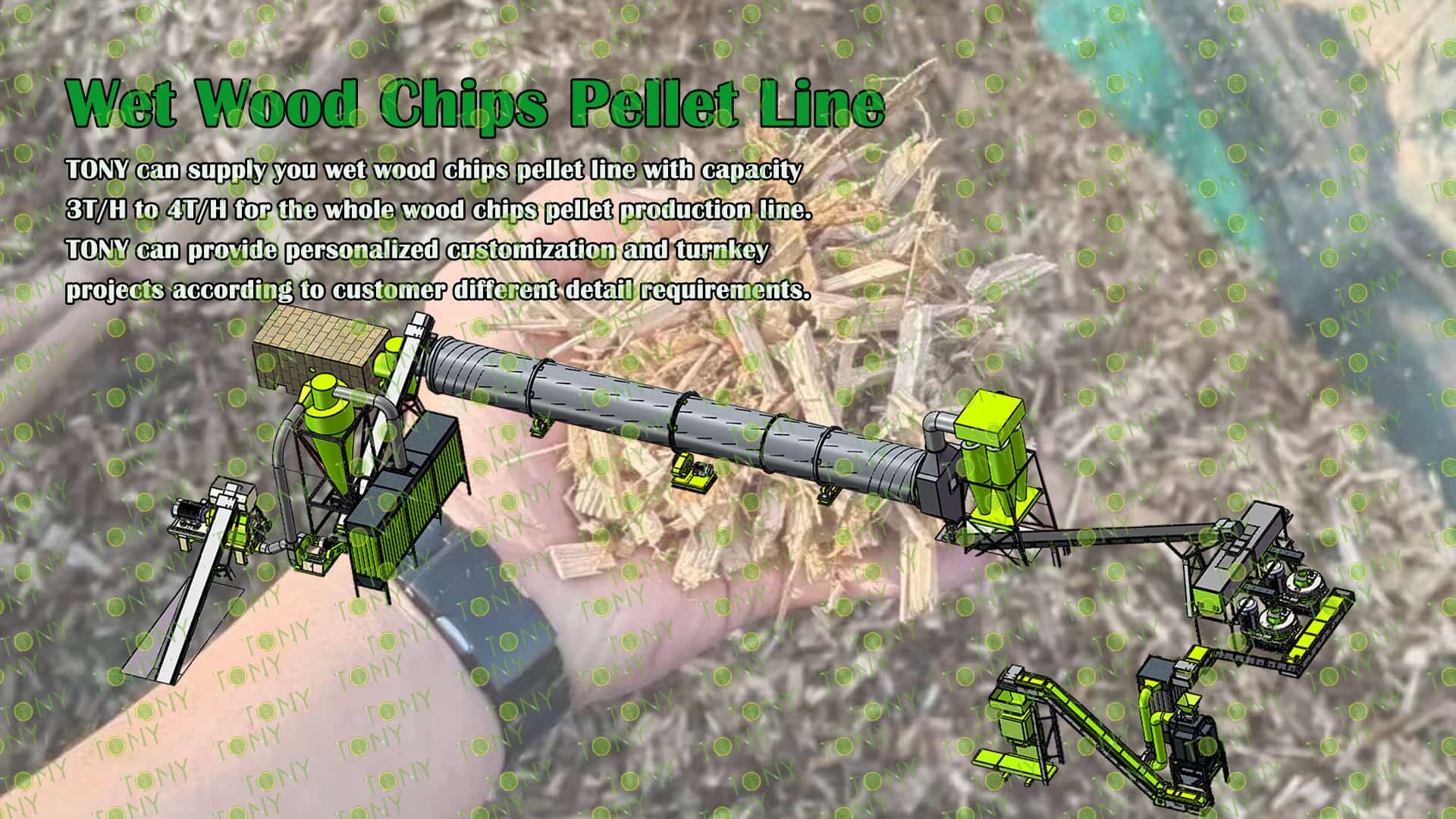
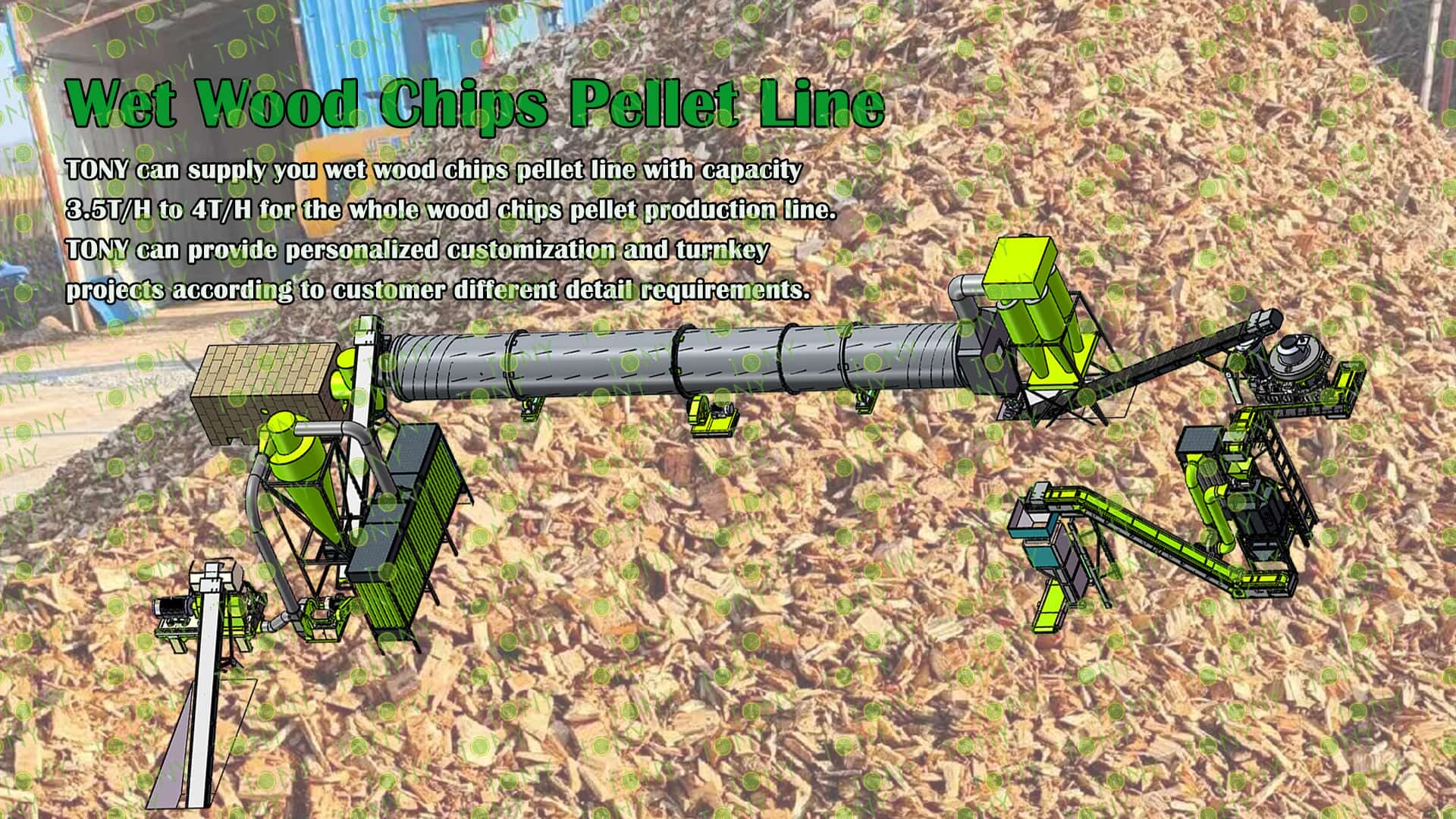
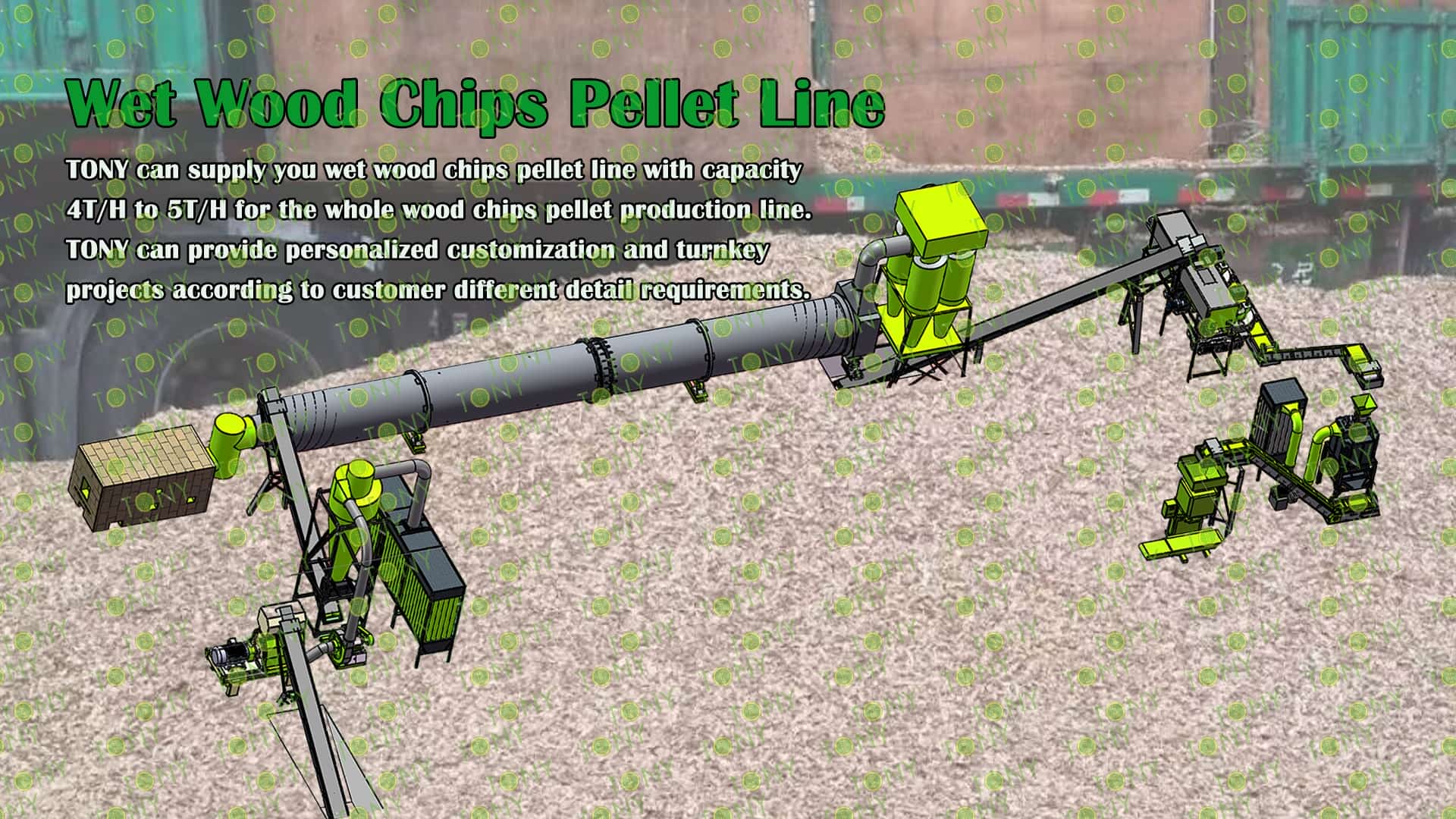
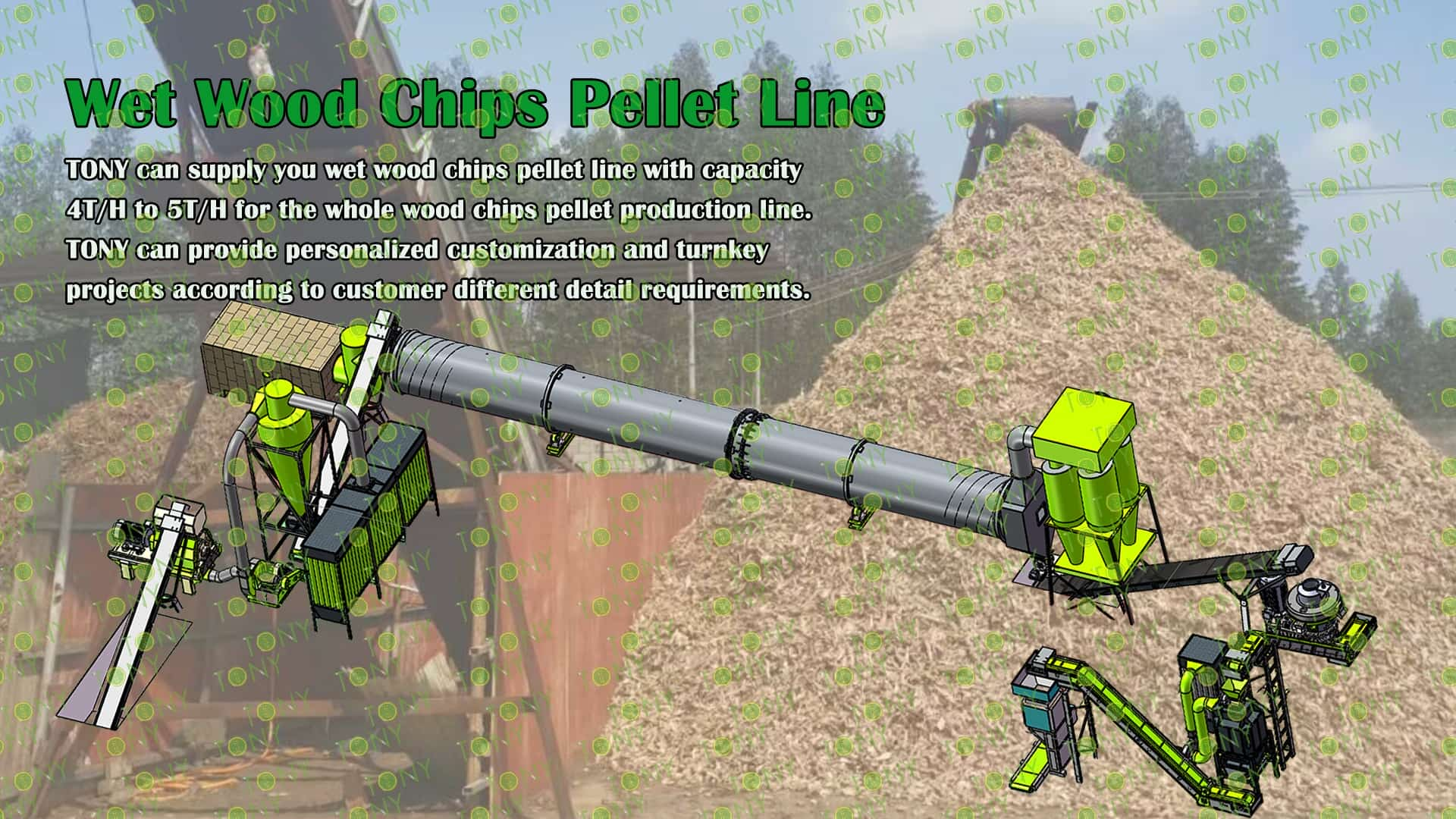
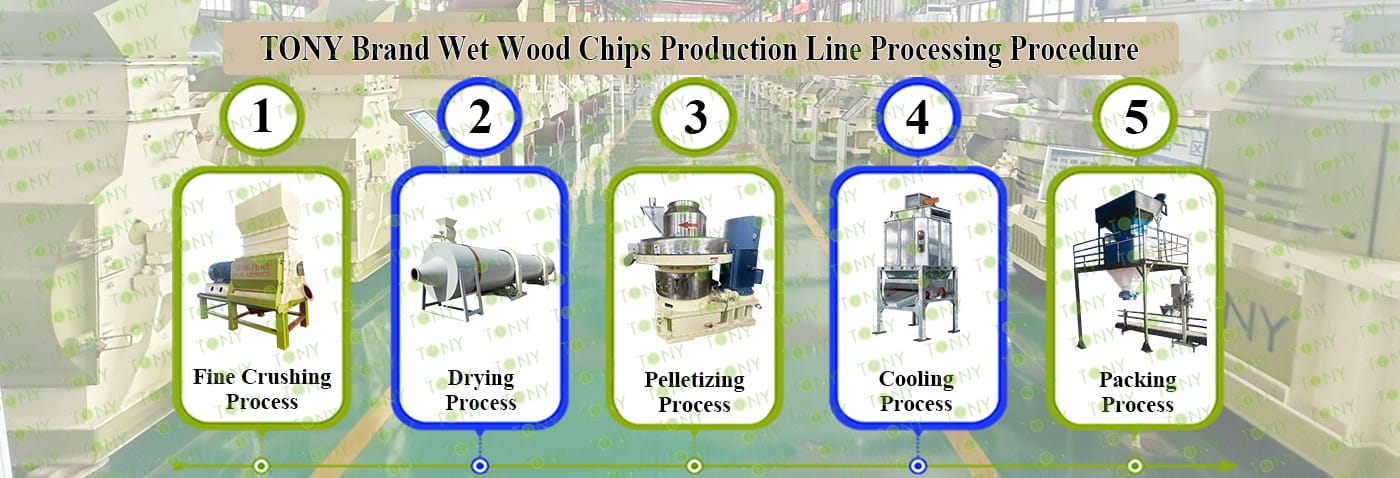
5. Process: Fine Crushing Process - Drying Process - Pelletizing Process - Cooling Process - Packing Process
6. Main Equipment: Effective Hammer Mill-TFD75*132-132KW, Rotary Drum Dryer-2.5-24m, TONY Pellet Machine TYJ760-Ⅲ-200KW, Pellet Cooler, Double Packing Machine and Belt Conveyors

|
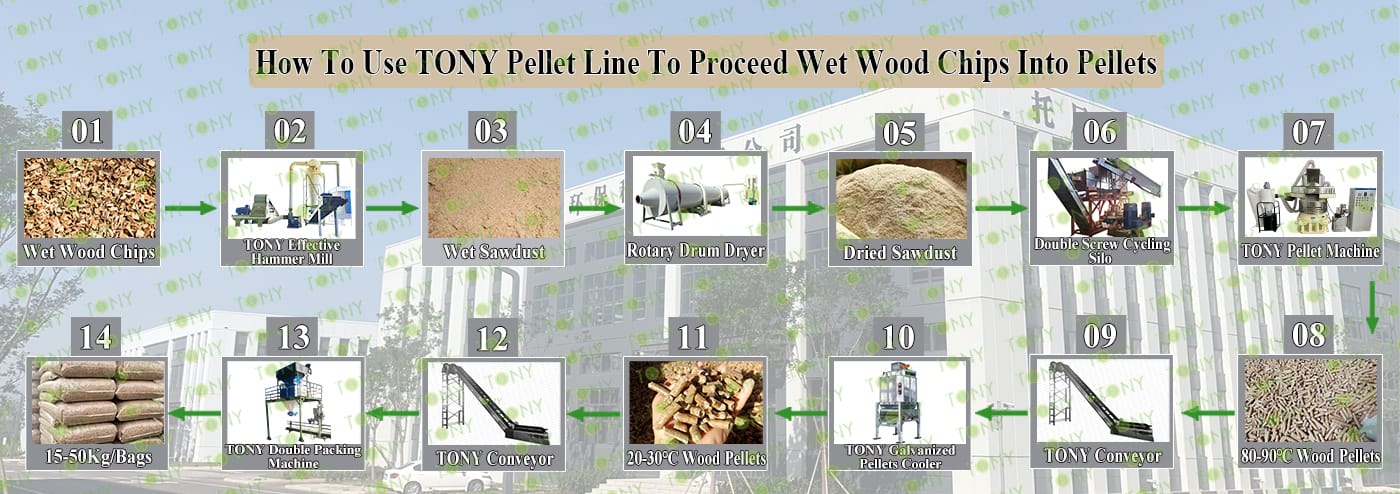
How to use the TONY pellet production line to make pellets from wet wood chips? The process mainly includes the following steps and equipment: 1. Use TONY effective hammer mill to crush the 25-55 mm wood chips into 8-14 mm sawdust. 2. Use TONY rotary drum dryer to dry the sawdust with a 40% moisture content down to a moisture content of 10%-15%. 3. Use TONY vertical ring die pellet machine to produce pellets with a diameter of 6-8 mm. 4. Use TONY galvanized cooler to cool the pellets from 80-90°C to 20-30°C. 5. Use TONY Double Packing Machine to pack the pellets into bags, each weighing 15-50 kg. For more detailed information and quotations, you can contact TONY. TONY can provide all the above - mentioned products at highly competitive prices and with excellent quality. |
|
|||||||||||||||||||||||||||||||||||||||||||||
三维图
三维图
| Next, TONY Will Introduce To You All The Necessary Machinery That Will Be Used For The Whole Pellet Production Line. Some Machines Can Be Custom - Made By Customers According To Different Customers' Detailed Demands. Contact TONY For More Details, Including Quotation And Layout. | ||
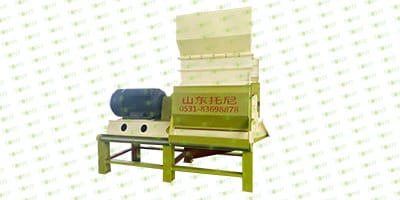 |
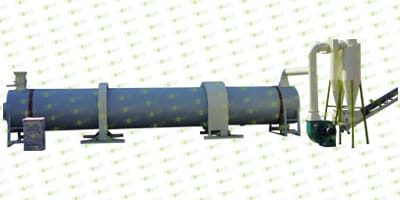 |
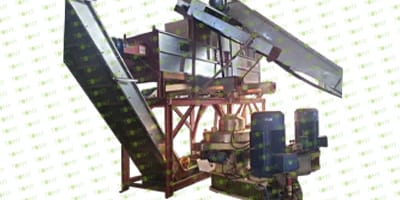 |
| Effective Hammer Mill | Rotary Drum Dryer | Double Screw Cycling Silo |
| 1.To Crush 25-55mm Wood Chips Into 8-14mm Sawdust. 2.Model: TFD75*132-132KW*2sets 3.Capacity: 4-5Ton/Hour/Set |
1.To Dry The 40% Sawdust Into 10-15% Sawdust. 2.Model: THGD2.5-24*1set 3.Capacity:9Ton/Hour/Set |
1.To Stroage Sawdust Before Pellet Machine; Adjust The Speed Of Sawdust Entering The Pellet Machine 2.Model: TLC-9*1set 3.Capacity:9Ton/Hour/Set |
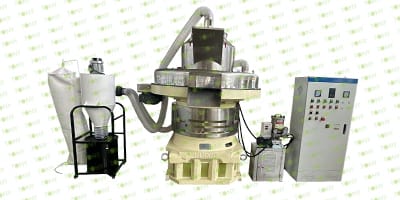 |
 |
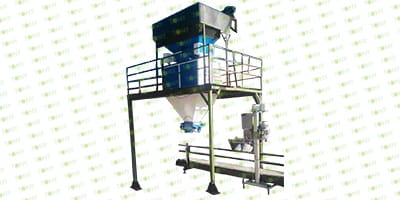 |
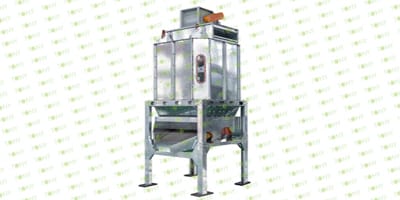
| Vertical Ring Die Pellet Machine | Galvanized Pellets Cooler | Double Packing Machine |
| 1.To Press Dry Sawdust Into 6-8mm Biomass Pellets 2.Model: TYJ760-III-200KW*3sets 3.Capacity:3Ton/Hour/Set 4.New 304SS Type |
1.To Cool Pellets From 80-90℃ Into 20-30℃ 2.Model: TCN-4*1set 3.Capacity:9Ton/Hour |
1.To Pack Pellets Into 15-50Kg/Bags. 2.Model: TPZ-50*1set 3.Capacity: 9Ton/Hour |
三维图
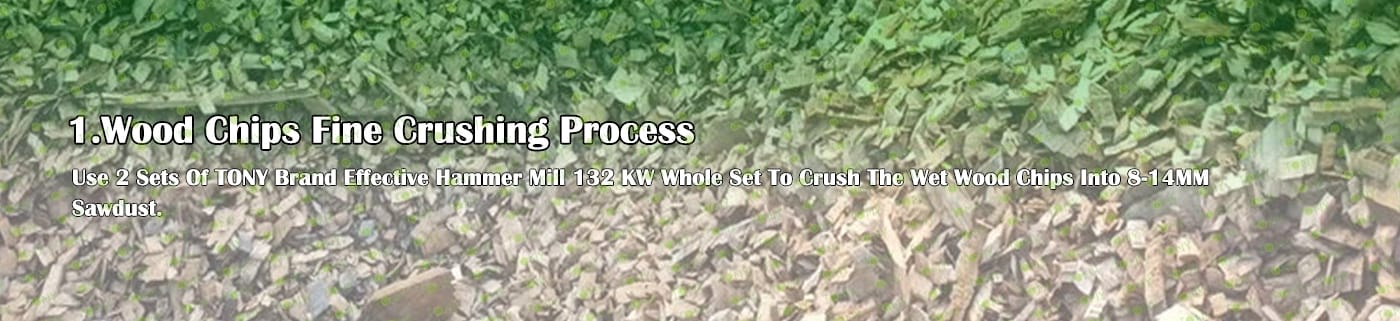
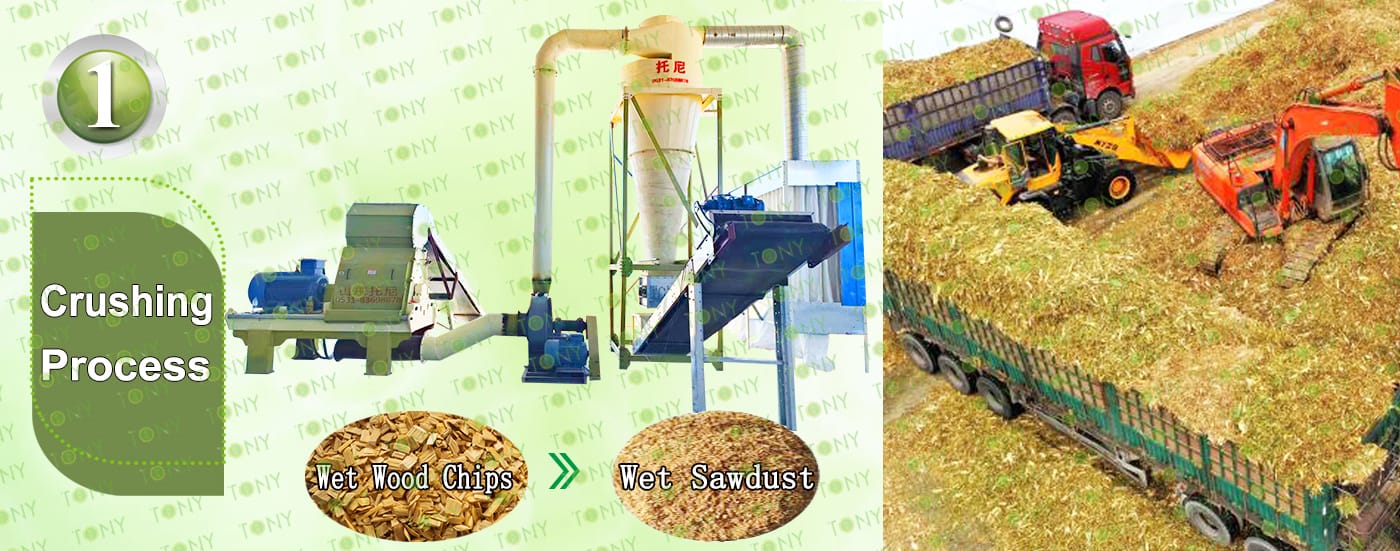
1.Wood Chips Fine Crushing Process:
A.This process is mainly used to crush 25-55mm wood chips into 8-14mm sawdust.
B.Capacity:9Ton/Hour.
C.TONY brand effective hammer mill TFD75*132-132KW*2sets
Main Parts:
(1)TONY Effective Hammer Mill.
(2)Galvanized Dust Collector.
(3)Sawdust Transportation Fan Blower.
(4)Cyclone With Airlock.
(5)Electrical Cabinets.
2.Sawdust Drying Process:
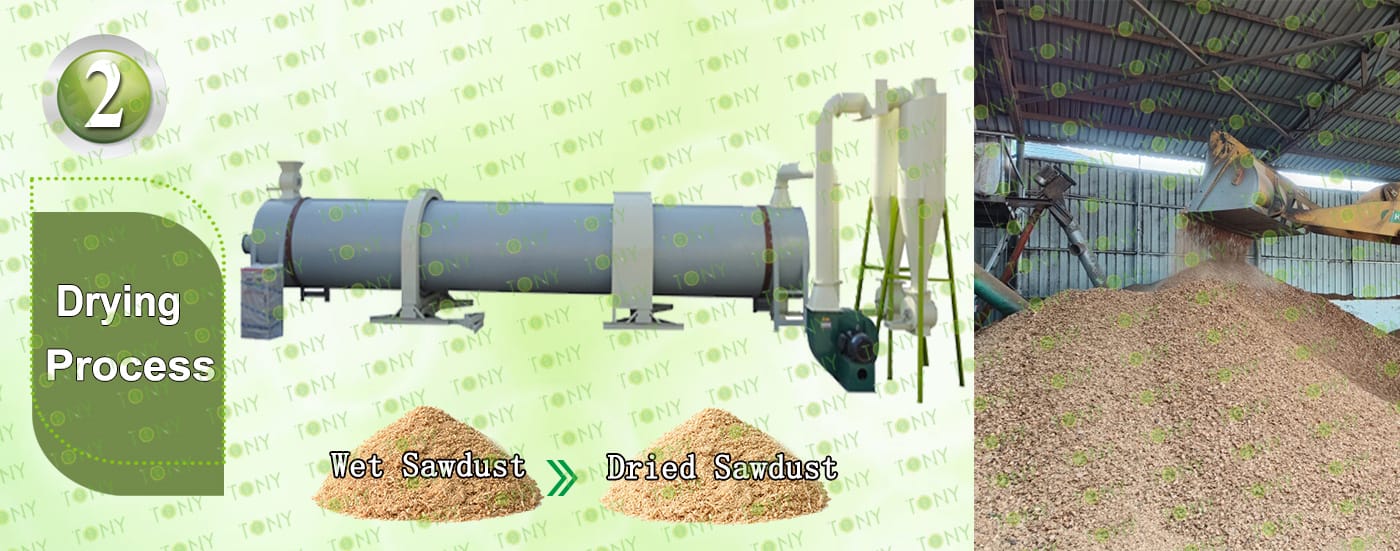
A.This process is mainly used to dry the sawdust from 40% to 10-15%.
B.Capacity:9Ton/Hour.
C.TONY use 1set of 2.5-24m rotary drum dryer for this process, TONY hot blast stove is made of firebrick pan, shell with H steel plate as the frame. There are 3 layers of fire blocking device inside, which can effectively prevent the fire from entering the tumble dryer.Customers can choose to use waste wood, biomass pellets, natural gas, etc. as fuel for the hot air furnace
TONY dryer use spiral tube material, and is not easy to deform.
Unlike other manufacturers with iron plate splicing welding, very easy to deformation.
Main Parts:
(1)TONY's Rotary Drum Dryer Main Body. (Reducers With Motors and Pips.)
(2)TONY's Hot Stove.
(3)Fan Blower+Cyclone With Airlock.

3.Pelletizing Process:
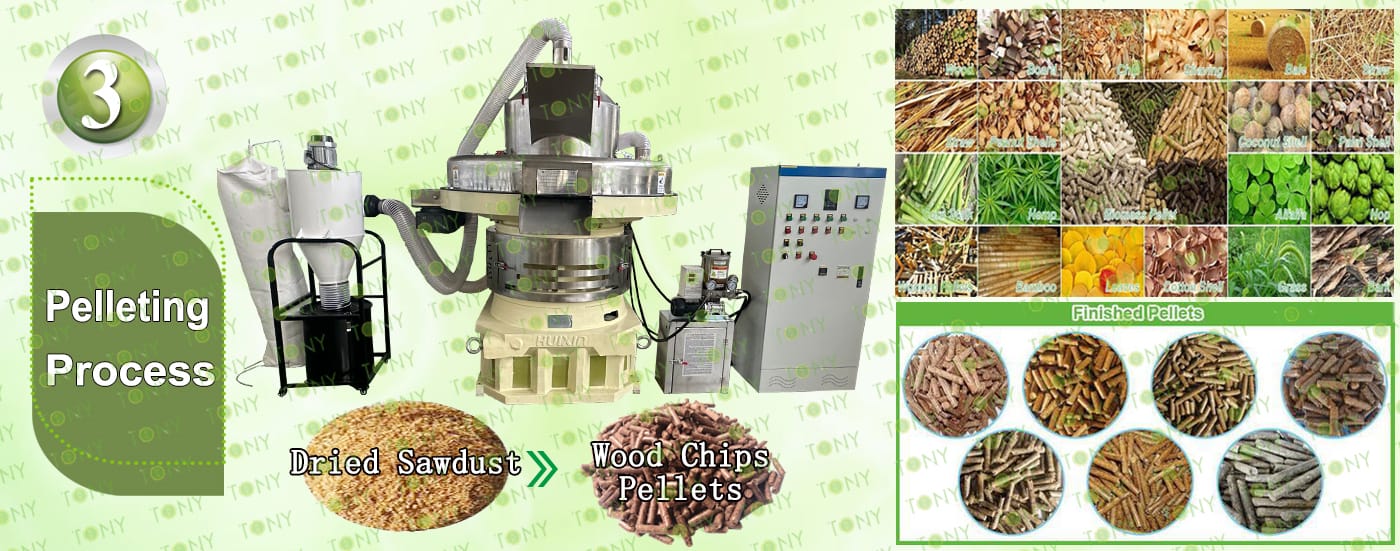
A.This process is mainly used to to product pellets into φ6-8mm.
B.Capacity:9Ton/Hour.
C.TONY brand vertical ring die pellet machine TYJ760-Ⅲ-200KW*3sets
D.Double screw cycling silo is added above the pellet machine, which has the advantages of saving space, saving labor, intelligently controlling the feeding speed, not easy to block the material, and improving production efficiency.
Main Parts:
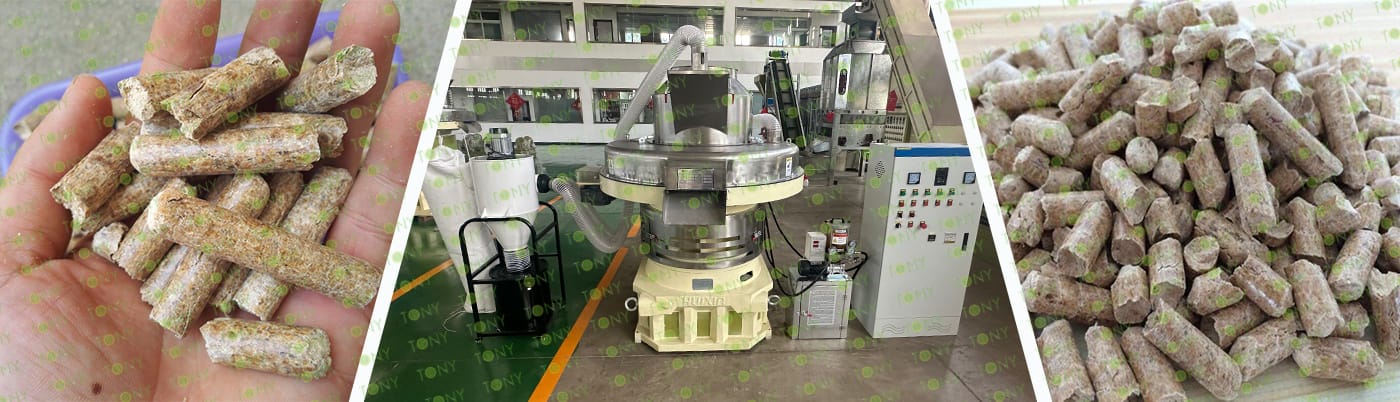
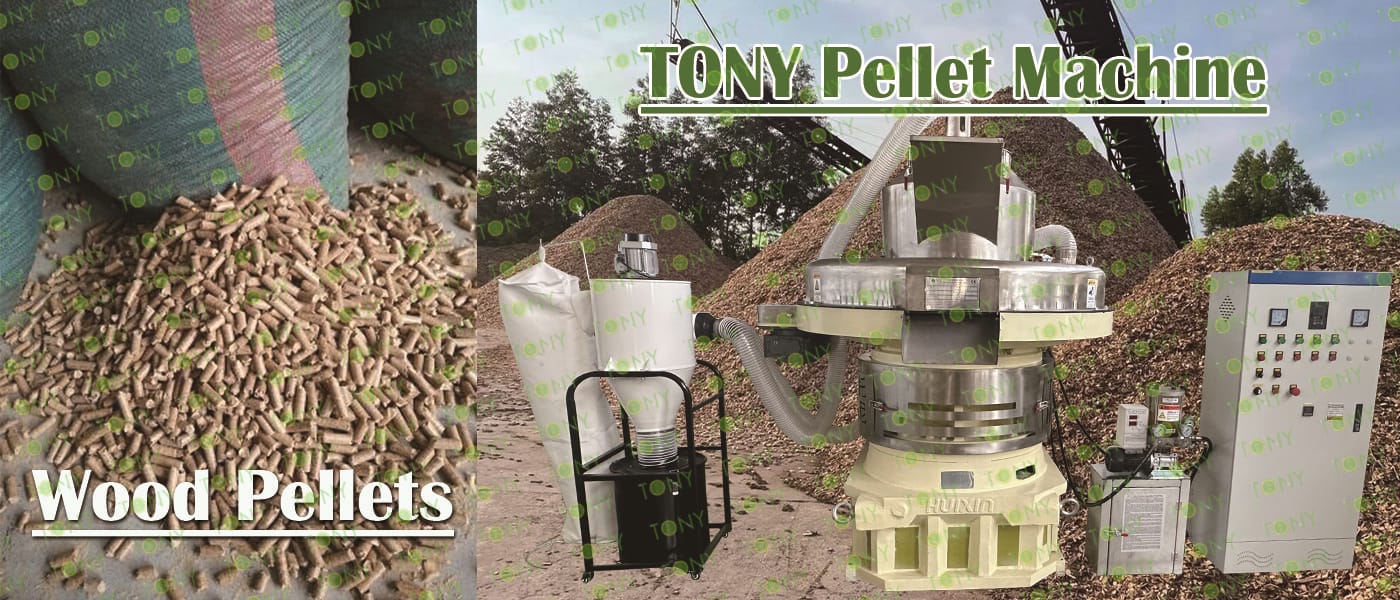
(1)TONY's New Vertical Ring Die Pellet Machine.
(2)Cyclone And Bags Dust Collectors.
(3)Automatic Lubrication System.
(4)Electrical Cabinets.
You can chose TONY new type SS304 pellet machine

4.Cooling Process:
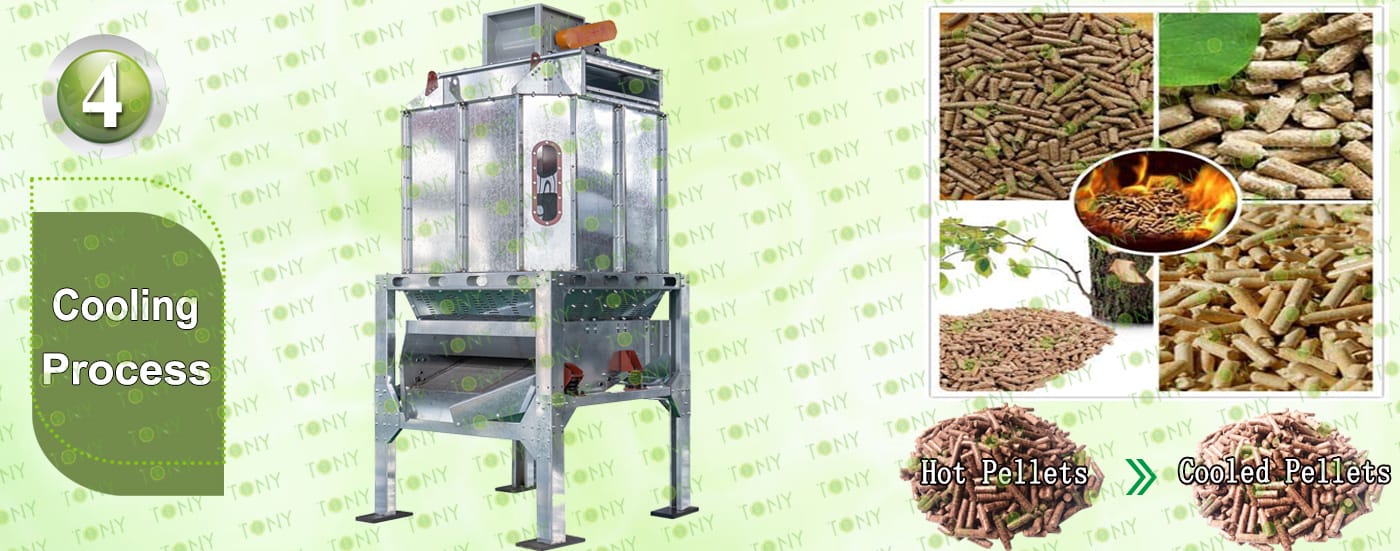
A.This process is mainly used to cool pellets from 80-90℃ to 20-30℃
B.Capacity:9Ton/Hour.
C.TONY brand galvanized cooler separator*1set
Main Parts:
(1)TONY's Galvanized Cooler Separator With Vibrating Screen.
(2)Cyclone And Bags Dust Collectors.
(3)Fan Blower.
(4)Connect Pipes.

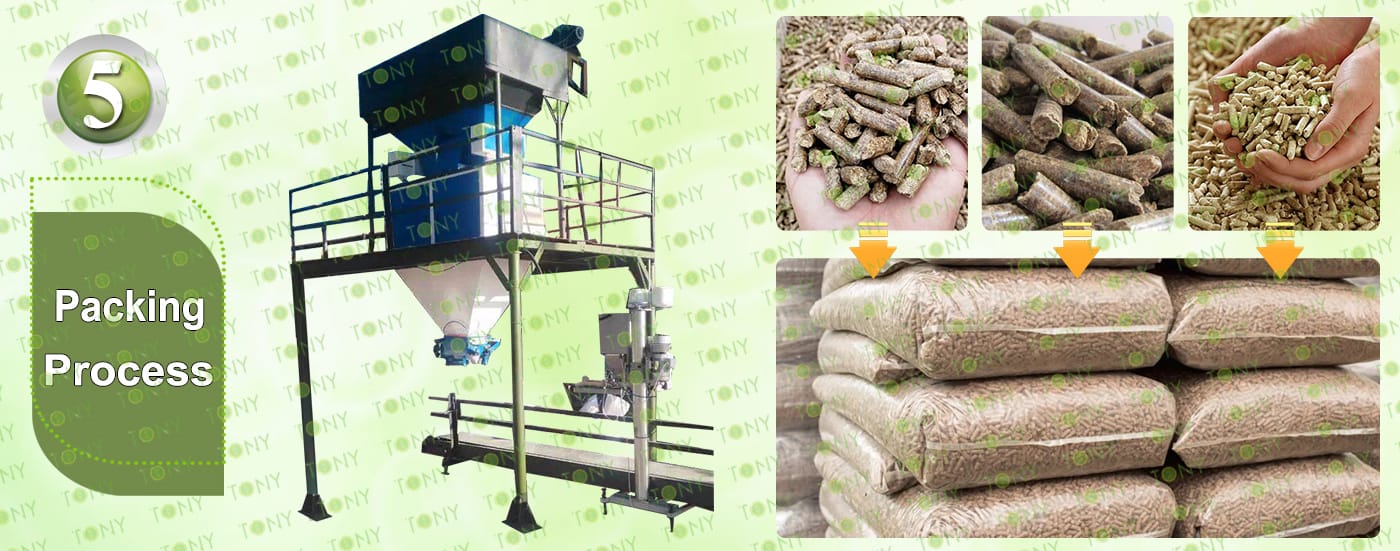
5.Packing Process:
A.This process is mainly used to pack pellets into 15-50Kg/Bags.
B.Capacity:9Ton/Hour.
C.TONY double packing machine*1set
Main Parts:
(1)TONY's Double Packing Machine.
(2)Sew Machine, Buyer Can Also Choose Hot Seal Machine For Chosen,To Confirm With Tony For The Price Difference.
(3)Bags Transportation Conveyors.
(4)Feeding Inlet Silo.
(5)Electrical Cabinets.

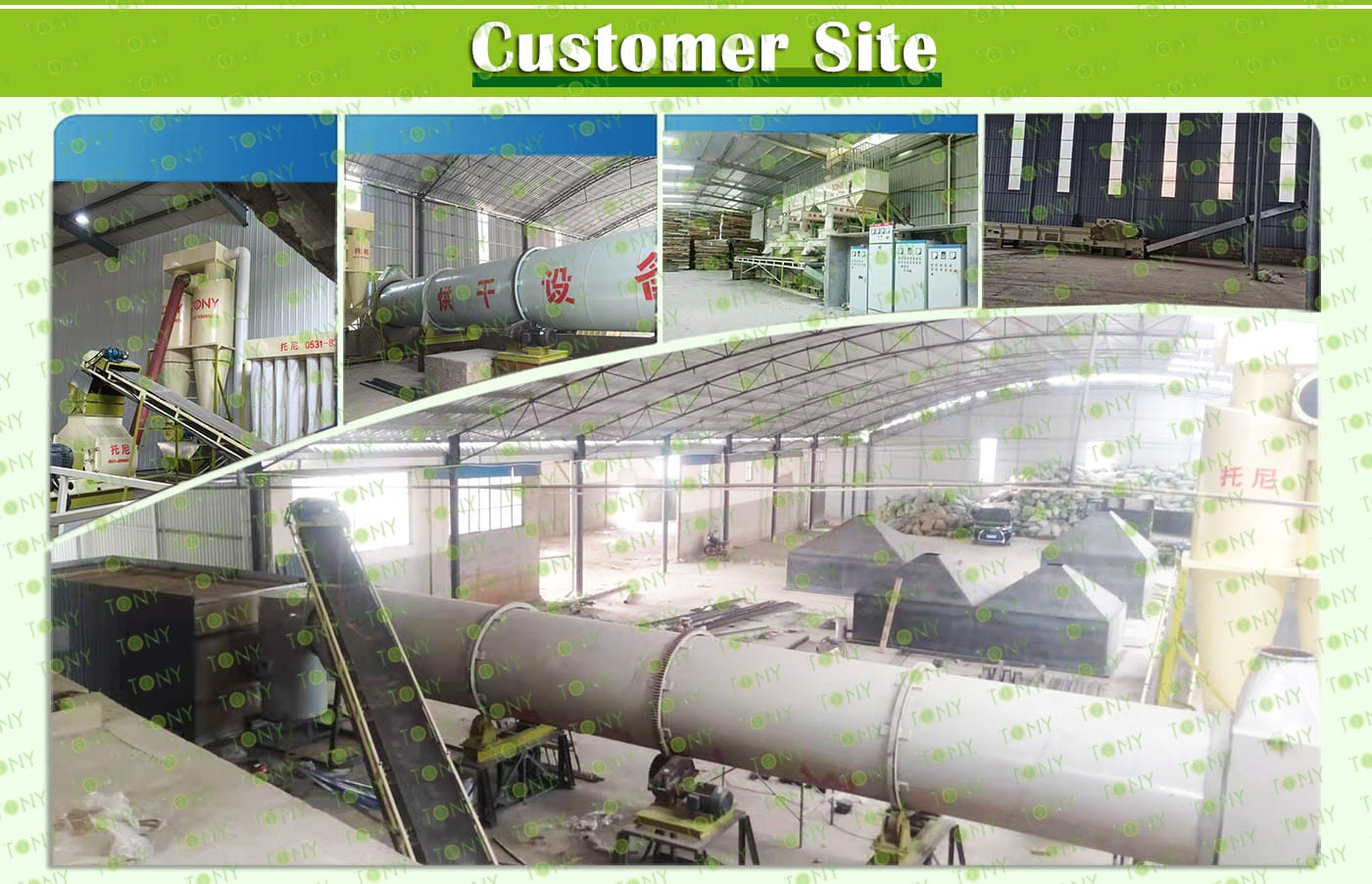
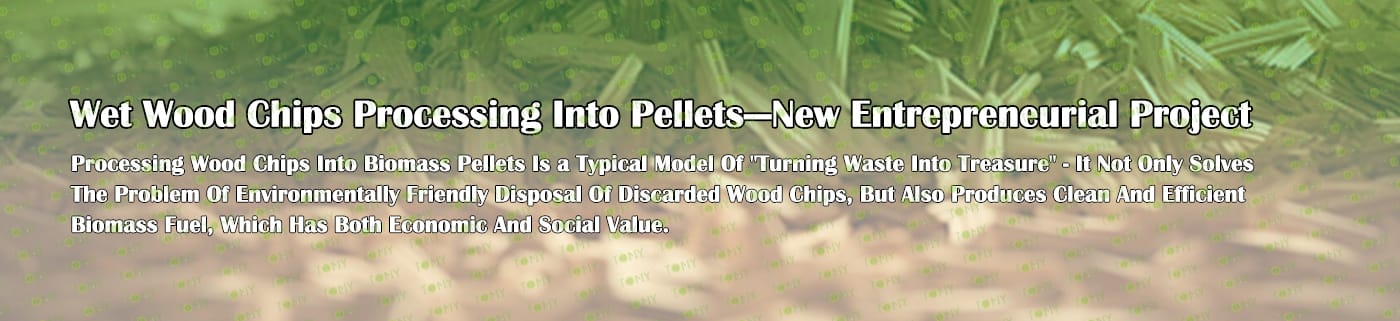
1.Wood processing and furniture manufacturing industry clusters
Typical scenarios: solid wood furniture factories, plywood factories, wood flooring factories, and woodworking machinery factories;
Equipment function: converts wet waste wood that originally required payment for removal into biomass pellets that can be used for self-use or export (for example, furniture factories use pellets instead of natural gas to heat and dry wood, reducing energy costs).
2.Forestry felling and wood storage and transportation sites
Typical scenarios: forest farms, log purchasing stations, and wood transfer terminals;
Equipment function: prevent wet wood chips from becoming moldy and deteriorating during storage and transportation (especially in the rainy season). After being processed into pellets, the volume is reduced to 1/3-1/4 of the original size, reducing transportation costs by more than 60%, and can be sold directly to biomass power plants.
3.Construction and renovation waste wood processing sites
Typical scenarios: building demolition sites, renovation waste treatment stations, and waste wood recycling plants;
Equipment function: Solve the problem of "wet waste wood being difficult to degrade and easy to pollute" (traditional treatment methods are mostly incineration or landfill, which pollute the environment) and convert it into clean pellet fuel, in line with the "construction waste resource utilization" policy requirements.
Advantages of Wet Wood Pellets
Processing wet wood chips into biomass pellets not only offers numerous advantages in terms of environmental protection, economy, social development, and energy structure improvement, but also boasts exceptional combustion properties. The main advantages are as follows:
1.Calorific Value and Combustion Residue
The calorific value and ash content of wet wood pellets after combustion are approximately 10% lower than those of medium-quality coal. However, wet wood pellets burn completely under normal operating conditions. Coal, on the other hand, does not burn completely, leaving behind ash containing 10% to 15% combustible components. Therefore, in practical applications, the effective calorific value of the two is comparable.
2.Flammability
Wet wood pellets ignite better than coal, igniting easily and significantly reducing the ignition time required to initiate combustion.
3.Solid Emissions
Wet wood biomass pellets have significantly lower solid emissions than coal. This not only reduces slag disposal costs but also reduces environmental pollution. Solid emissions from wet wood biomass pellets are primarily ash, accounting for approximately 0.4% to 7.0% of the total weight. In contrast, coal combustion produces a mixture of ash, alkali, and unburned coal, accounting for approximately 25% to 40% of the total weight.
4.Air Pollution and Corrosion
Coal causes significantly higher levels of air pollution and boiler corrosion than wet wood biomass pellets. Coal smoke contains a large amount of particulate carbon, as well as toxic and corrosive gases such as sulfur dioxide and carbon monoxide. Wet wood biomass pellets are primarily composed of C-H organic matter, and their flue gas contains no particulate carbon or sulfur dioxide. Instead, it consists primarily of C-H volatile gases, with virtually zero SO₂ and CO emissions. The smoke color during combustion is below Ringelmann Grade 1, significantly reducing air pollution and CO₂ emissions. Wet wood biomass pellets are internationally recognized as a "clean fuel."
5.Cost and Time Savings
Compared to coal, using wet wood biomass pellets for boiler operation can save costs and time. For example, using wet wood biomass pellets for a 0.5-ton boiler reduces costs by 11% and saves time by 34%. For example, for a 0.5-ton boiler, fuel costs are reduced by 10% and time savings are 16% compared to coal.
6.Continuous Combustion
Wet wood chip biomass pellets typically burn 8 to 10 times longer than loose, soft materials, maintaining a stable and continuous combustion state, ensuring a more reliable energy supply.



2025 Tony Machinery - All Rights Reserved. Map