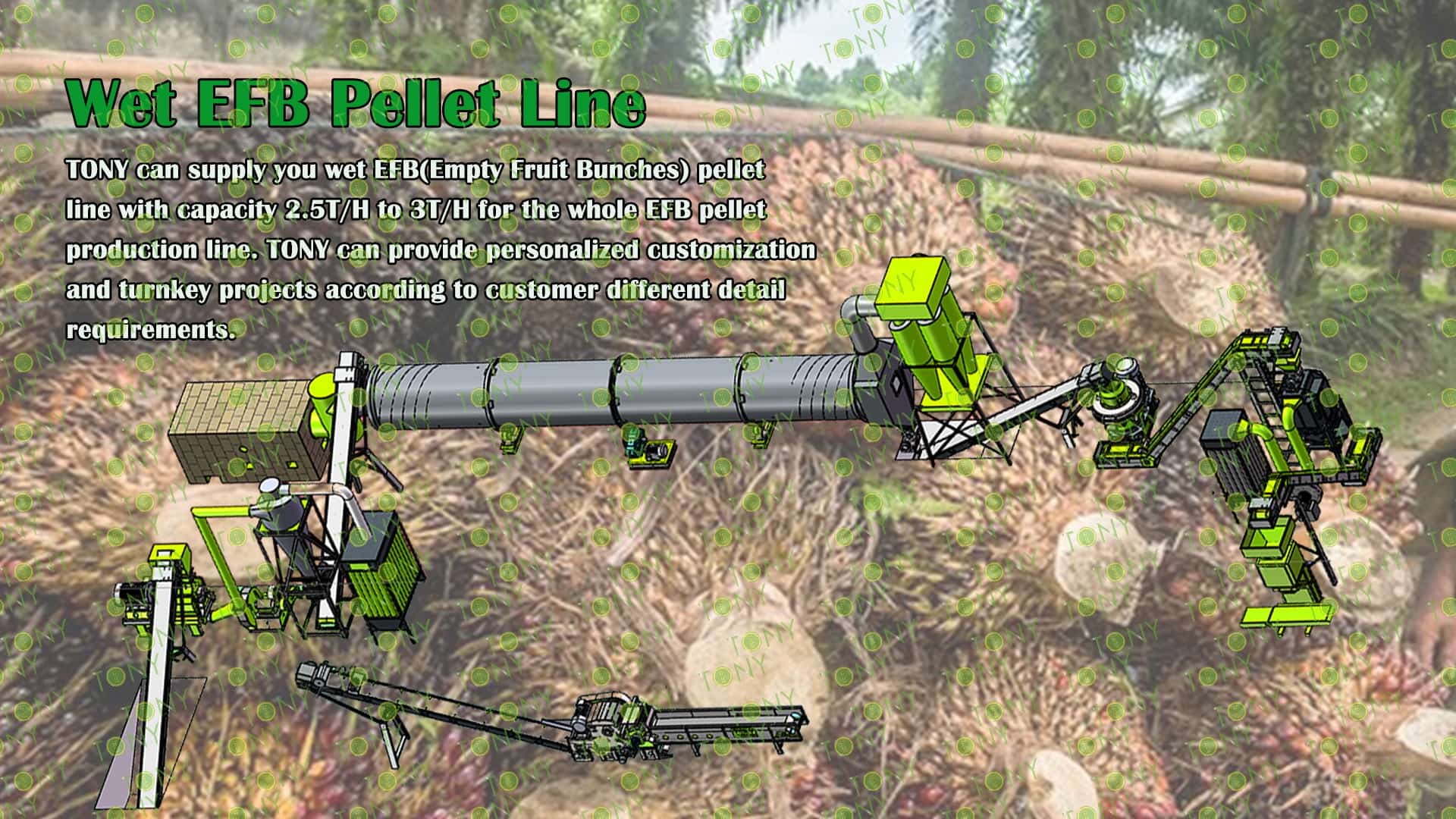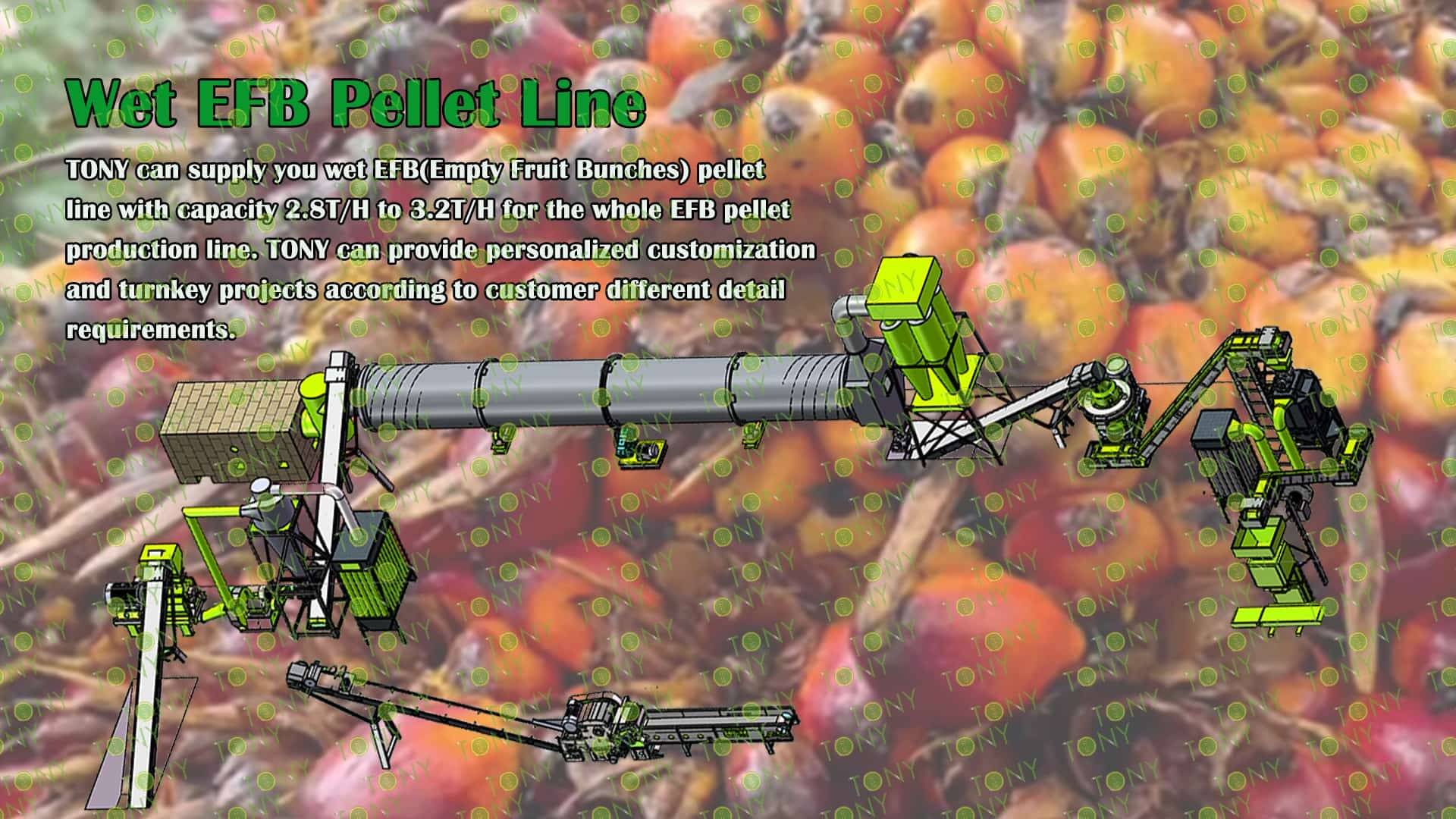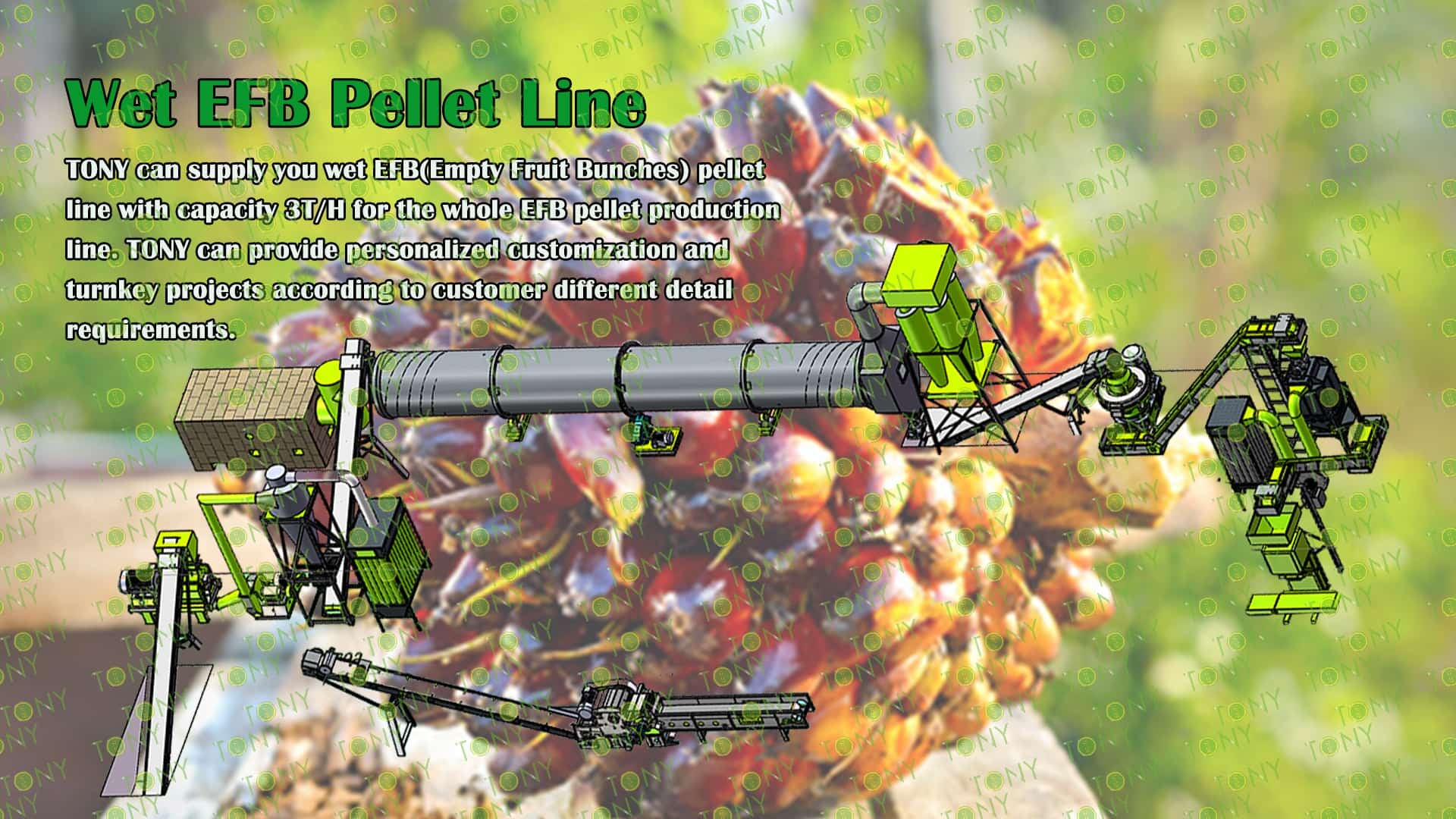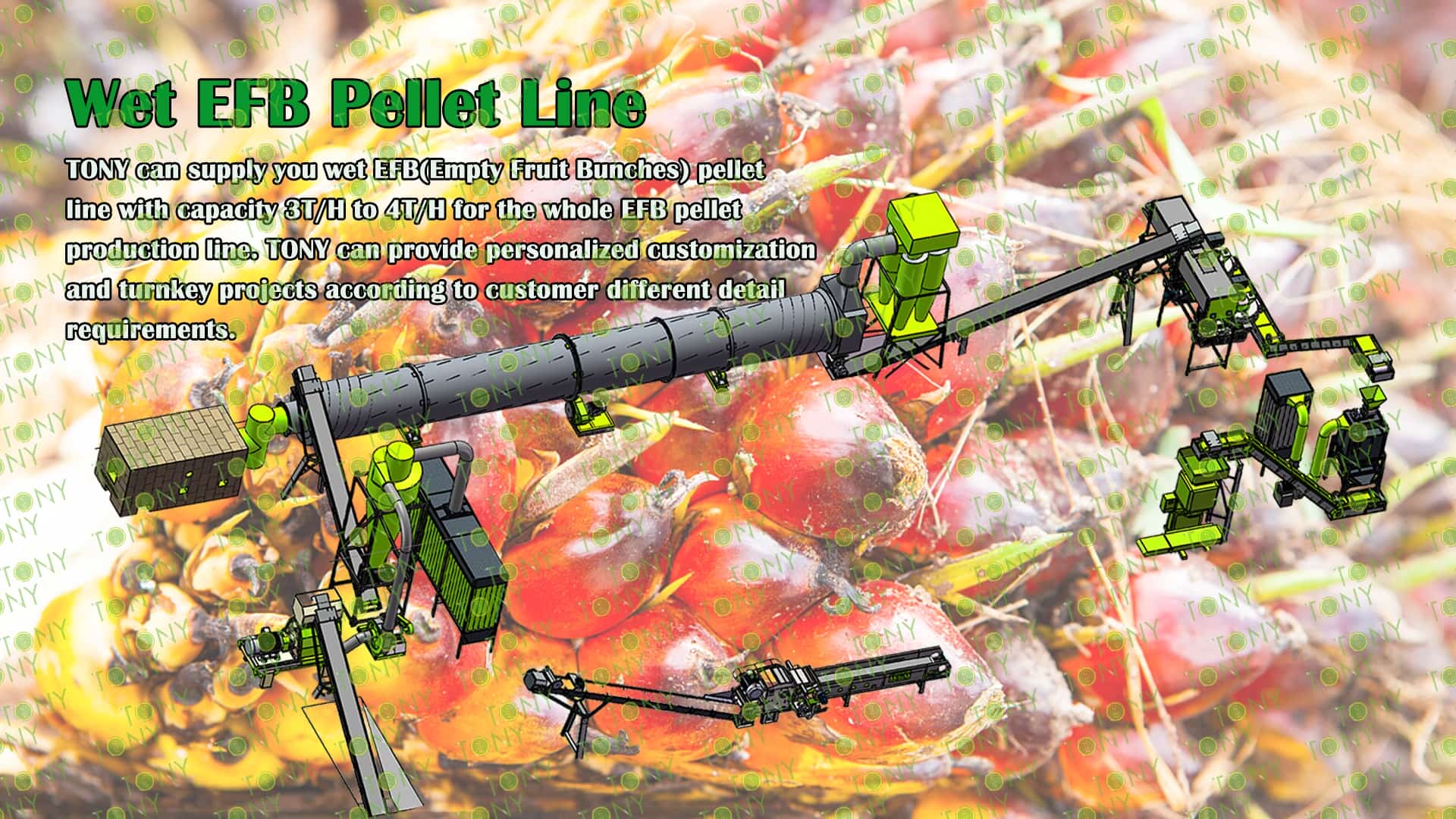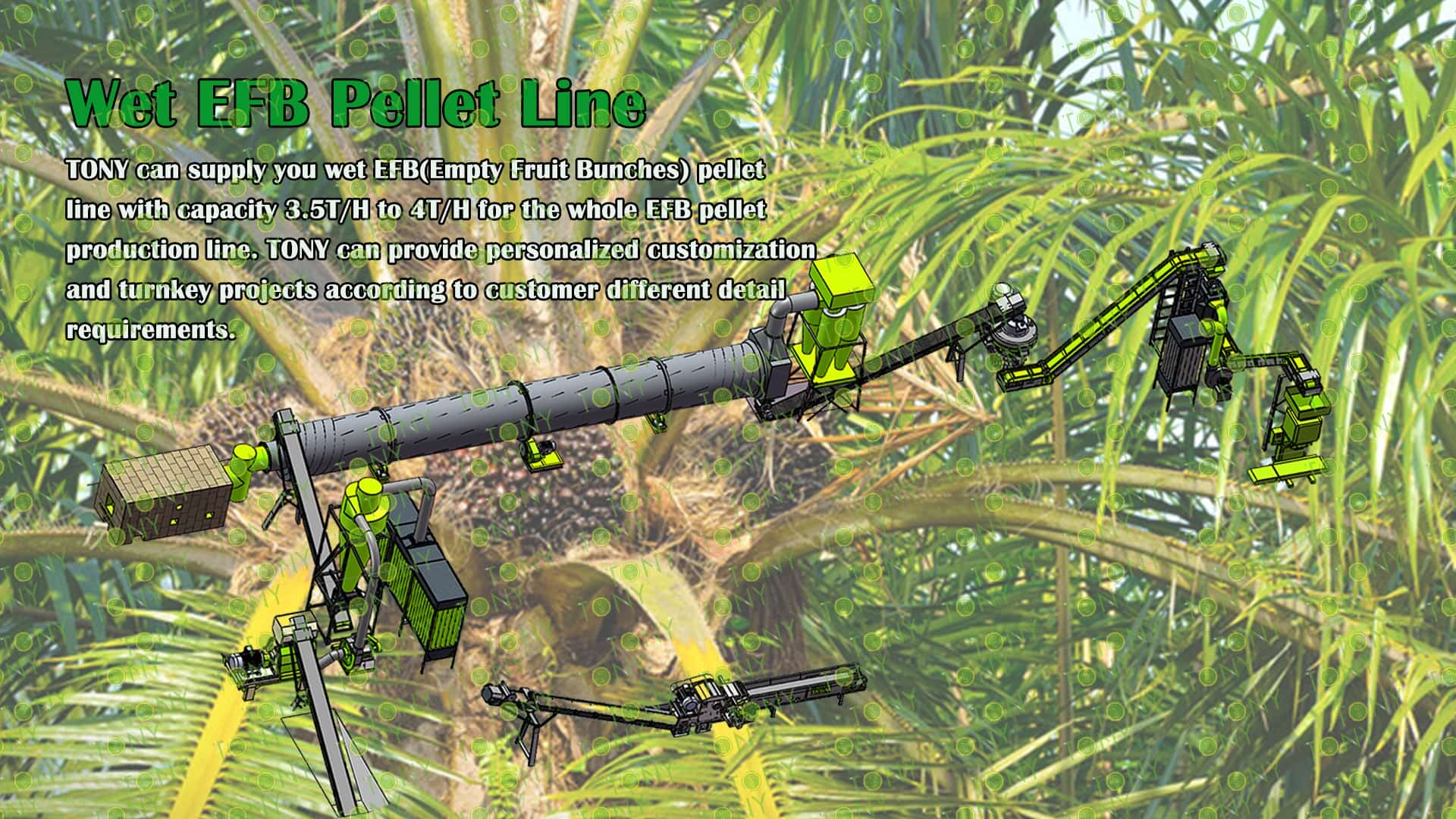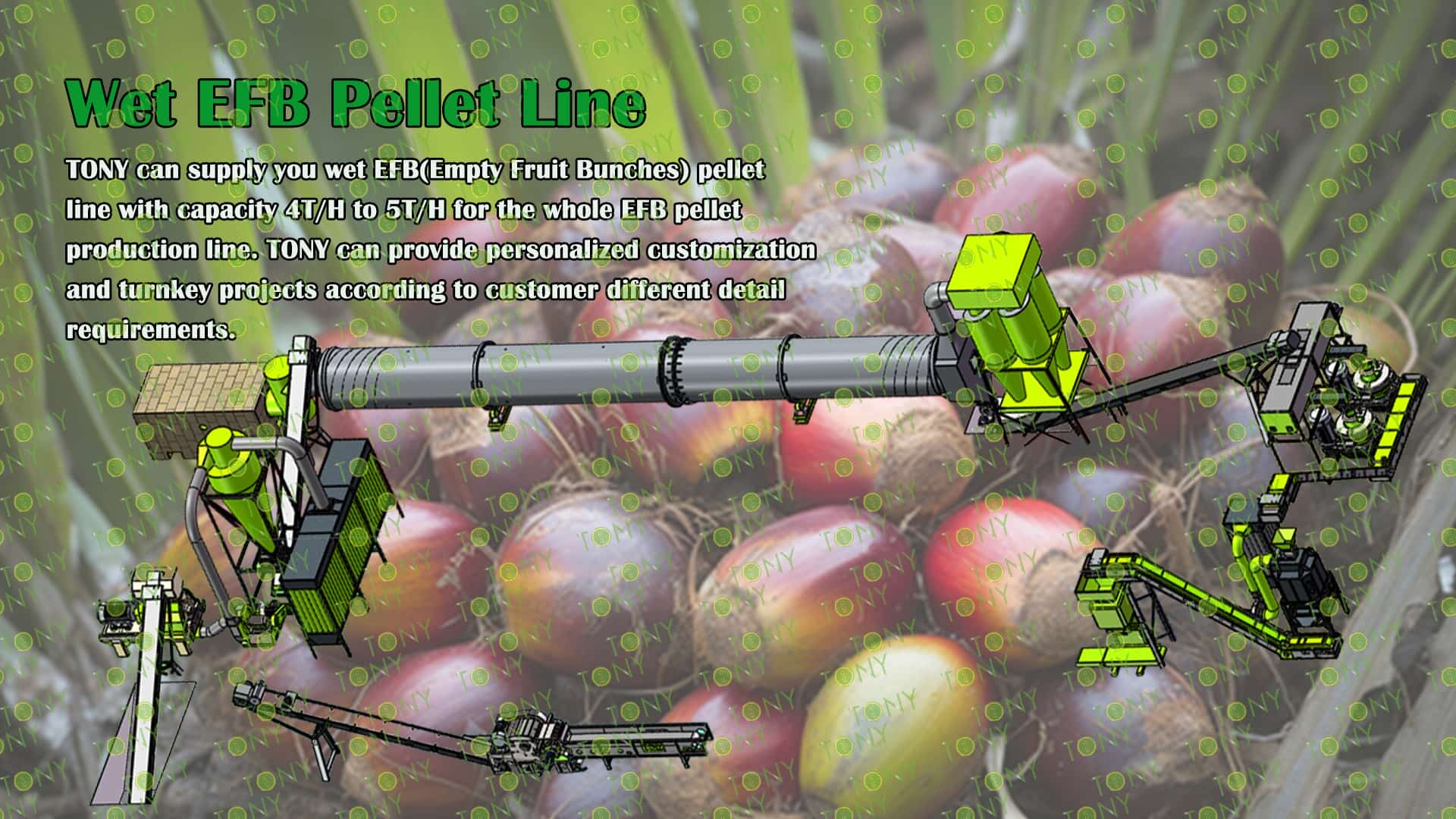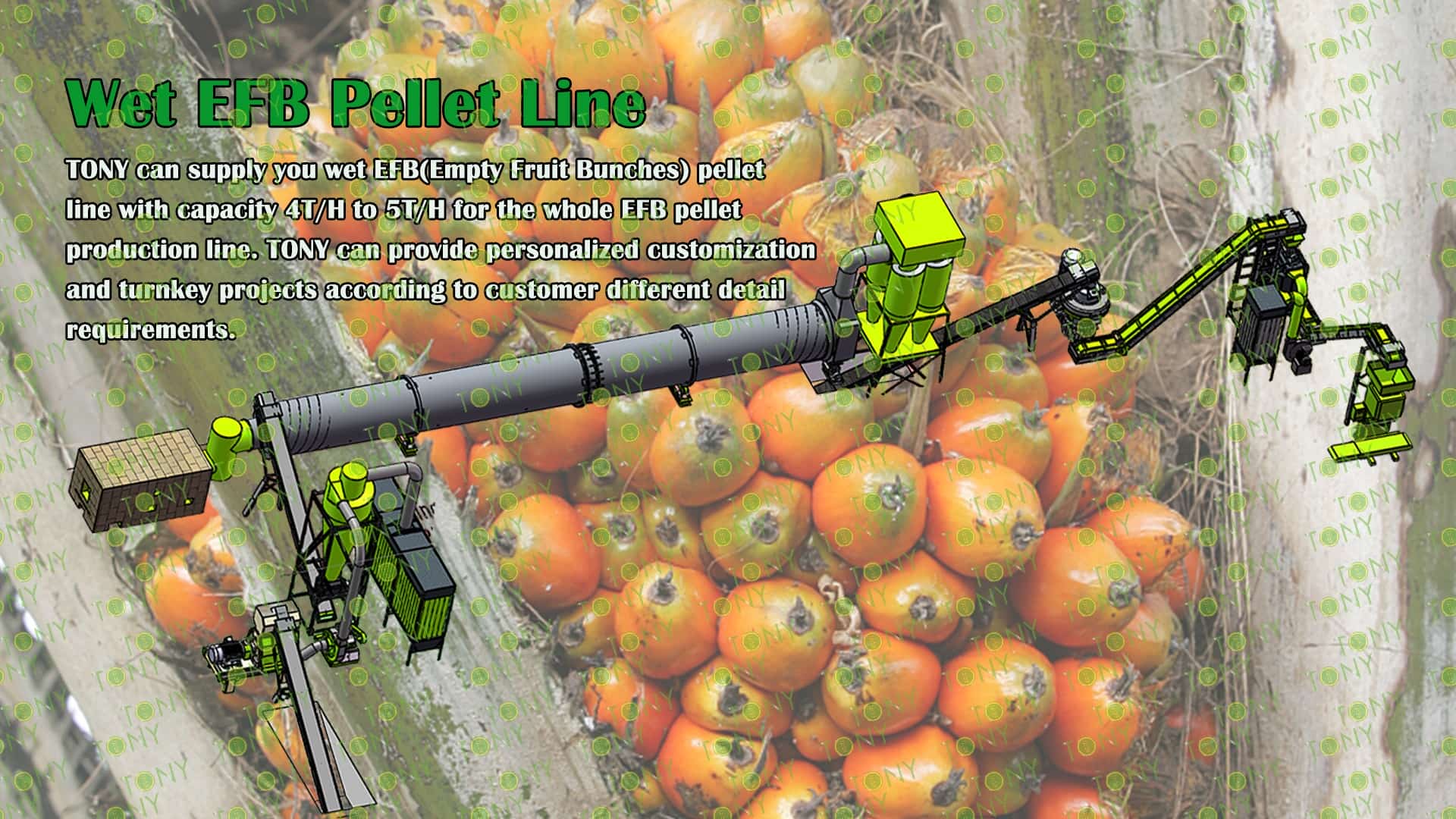




















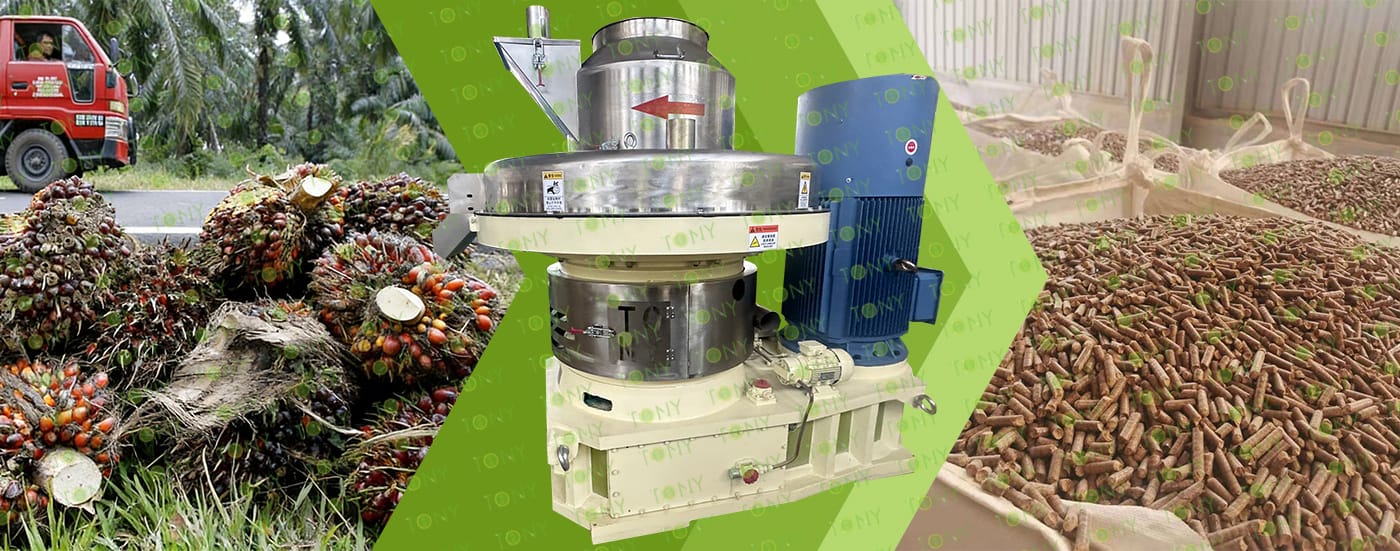
1.The working principle of wet EFB biomass pellet processing equipment
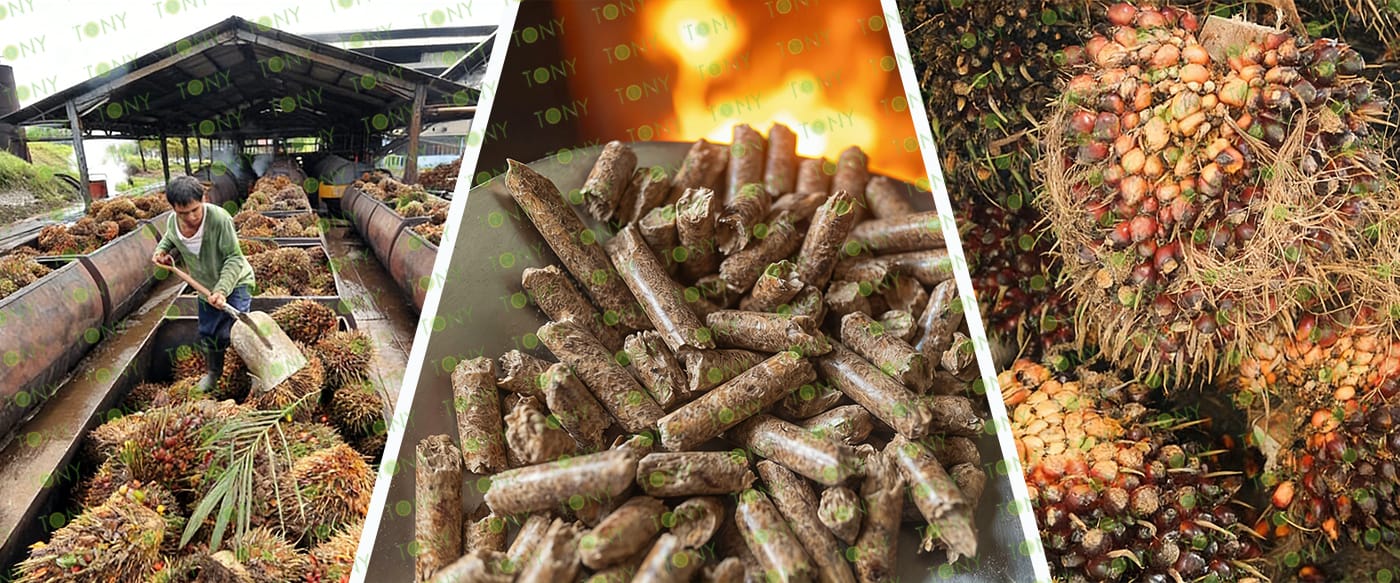
The core of palm kernel processing equipment lies in its "pre-treatment - molding - cooling - packaging" process, which transforms palm shells, fibers, and other raw materials into standardized pellets. The key principles revolve around adapting to the characteristics of the raw materials and ensuring pellet stability. During pre-treatment, the raw materials are crushed to 4-14mm using a crusher, and then dried to a moisture content of 10-15% using a dryer, preparing them for molding.
Molding is the core process. A vertical ring die pelletizer uses high pressure between the rollers and the ring die to extrude the raw material through the die holes. The natural lignin in the palm material acts as a binder. After extrusion, the pellets are cut to 2-5cm lengths. In the cooling stage, a counter-current cooler reduces the temperature of the hot pellets (70-90°C) to room temperature, simultaneously reducing moisture content to below 10% to prevent clumping and mold growth. Finally, an automatic weighing and packaging machine completes the process. Different types of pellets have slight variations; fuel pellets require higher molding pressure and no binders, while horticultural pellets require lower pressure and can include environmentally friendly additives.
2.Characteristics of wet EFB biomass pellet processing equipment
Pelletizing is the core process, and the equipment design revolves around "using the natural bonding of lignin to ensure pellet density":
(1)Ring-type pelletizer:thick-walled ring die + large-diameter pressure roller The ring die is made of double-layer wear-resistant alloy steel (wall thickness 15-20mm, ordinary ring die wall thickness 8-12mm), with high die hole finish (Ra≤1.6μm), which can withstand the severe friction of EFB coarse fibers and has a service life of 300-500 hours (ordinary ring die only 150-200 hours); the pressure roller diameter is increased to 180-220mm (ordinary pressure roller 120-150mm), with a larger contact area and more uniform extrusion force, avoiding local overload and ring die cracking.
(2)Adhesive-free design, relying on frictional heat generation
The equipment precisely controls the gap between the roller and the ring die (0.1-0.3mm) and the rotation speed (200-300r/min), so that the EFB generates a high temperature of 60-90℃ in the die hole, which just softens the lignin (lignin softening point 50-80℃). There is no need to add artificial adhesives such as starch and resin, which not only reduces costs but also avoids the generation of harmful gases (such as formaldehyde) during combustion.
3.Application scenarios of wet EFB biomass pellet processing equipment
In the horticulture and landscaping sector, palm fiber granules produced by this equipment can be used as a mulch for potted plants and green spaces (improving moisture retention, nutrient retention, and suppressing weeds), or as a potting mix (mixed with peat moss to enhance aeration). They are suitable for nurseries, municipal landscaping, and home gardening. Some equipment can even produce pest-resistant granules by adjusting parameters, catering to high-end landscaping needs. In the industrial filling sector, the processed palm fiber granules can serve as an environmentally friendly filling material for mattresses and sofas (replacing traditional synthetic fibers), or as a filtration material for industrial applications (such as wastewater treatment), meeting the large-scale raw material needs of furniture manufacturers and environmental equipment manufacturers.
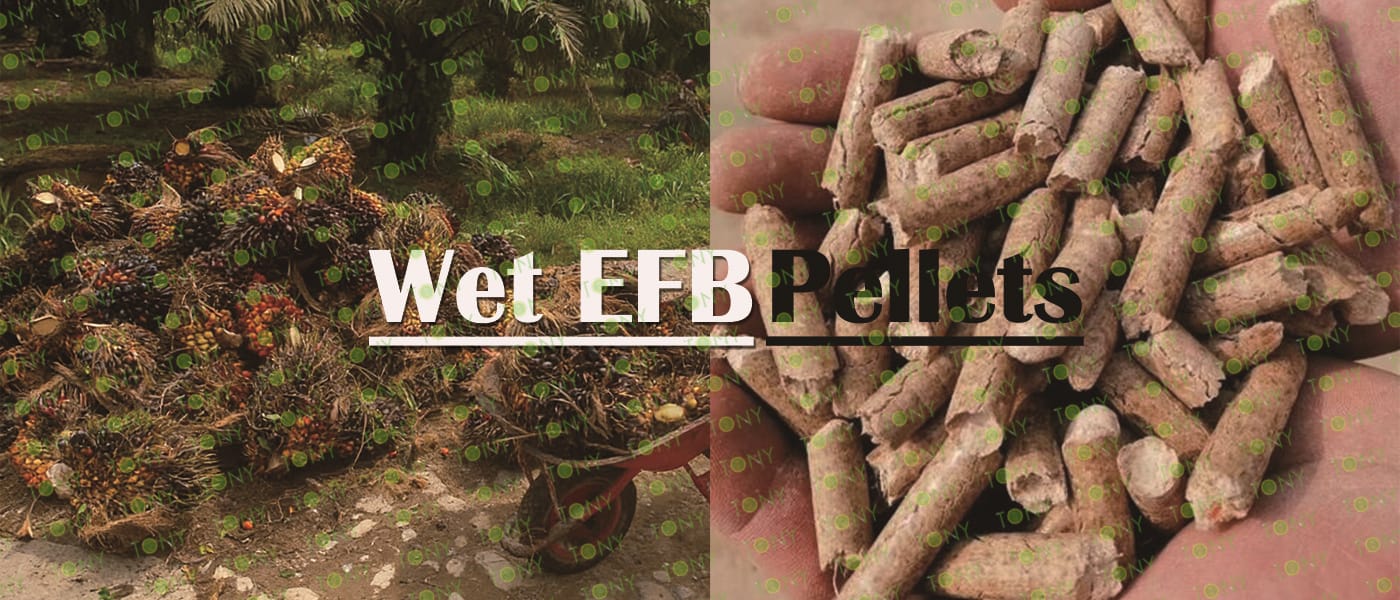
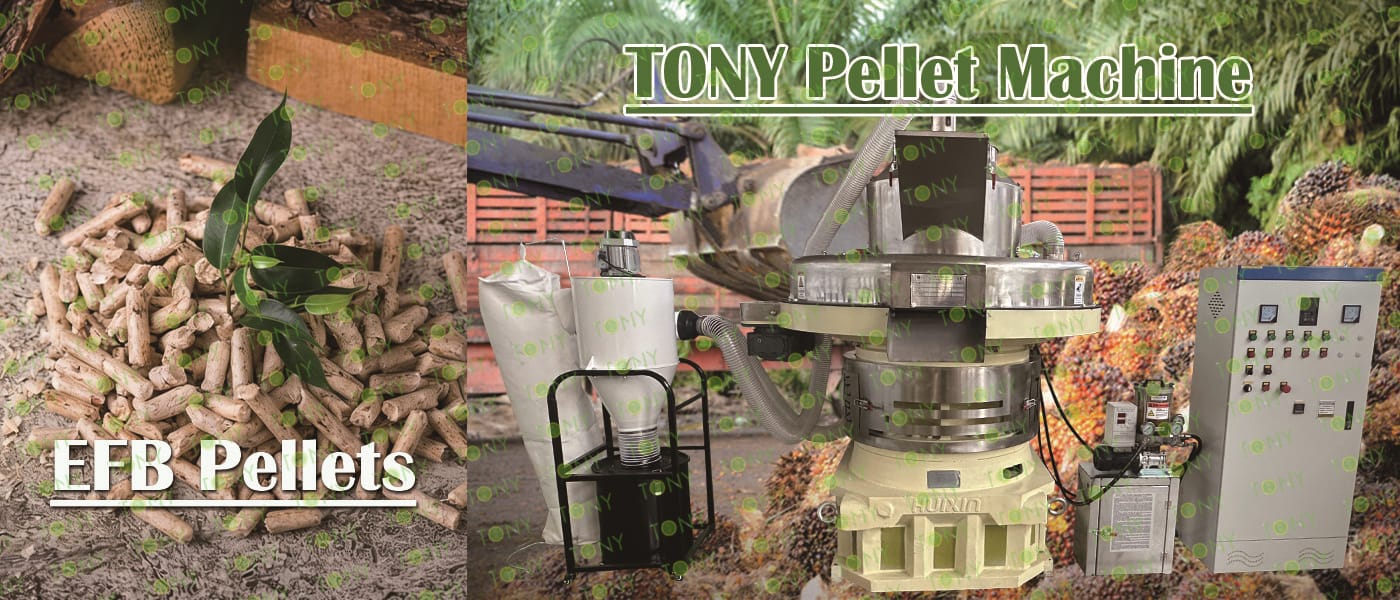
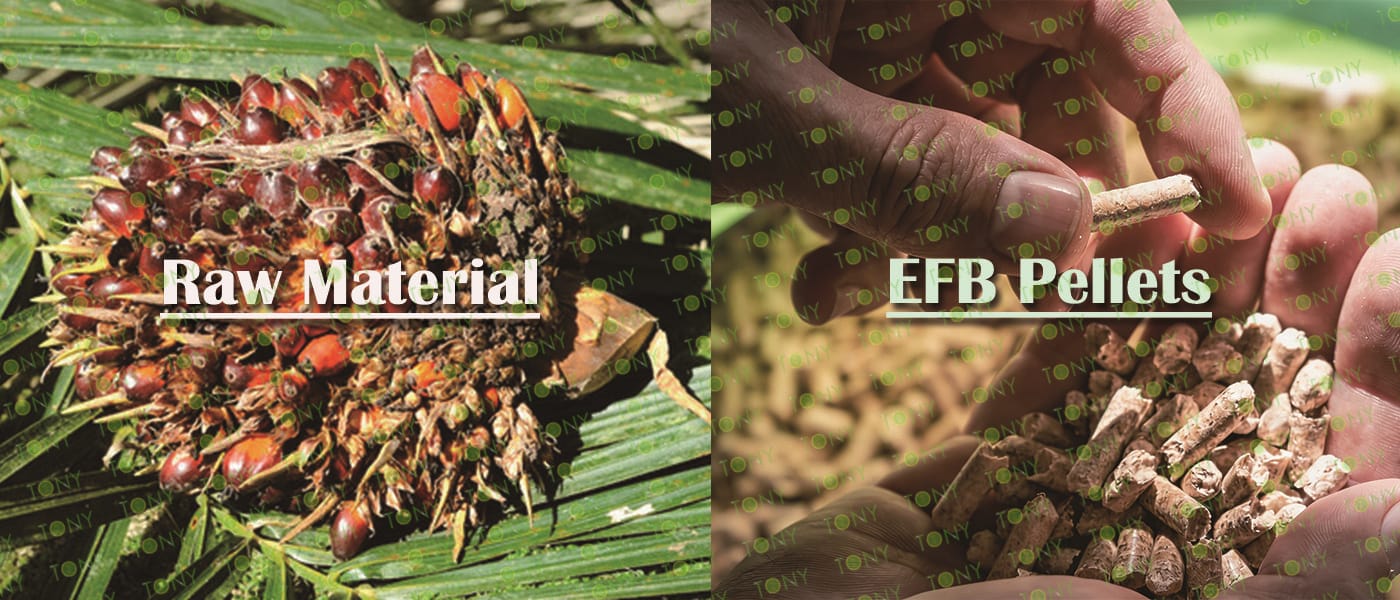
TONY Brand 28-35Ton/Hour Wet EFB Pellet Manufacturing Plant can take wet EFB as the main raw material. After pretreatment and processing, it is solidified into high - density EFB pellet fuel. This fuel is an ideal substitute for coal and oil and plays a role in energy conservation and emission reduction. At present, it has been widely used in regions rich in EFB resources.
1. Capacity: 28-35Ton/Hour
2. Raw materials: Wet EFB
3. Moisture: Wet type, about 40%.
4. Application: All kinds of EFB materials suitable for pellet production.
Suitable customers: Palm plantation owners or related agricultural enterprises have abundant EFB resources. For example, palm oil mills generate a large amount of EFB waste during the production process. Energy companies, EFB biomass pellets as a clean energy, can be used in industrial heating, power generation and other fields, and have synergy with the existing business of energy companies. Environmental investors, investors with financial strength, technology investors, etc.and other places where EFB raw materials have advantages
5. Finished Pellets Markets: Large power plants, domestic heating, industrial heating, combustion heat, heating systems, boiler rooms, school canteens, foundry heat sources.
1. Project Name: Wet EFB Pellet Production Line
2. Raw Material: All kinds of wet EFB
3. Moisture Content of Raw Material: 40%
4. Capacity: 28-35 tons per hour
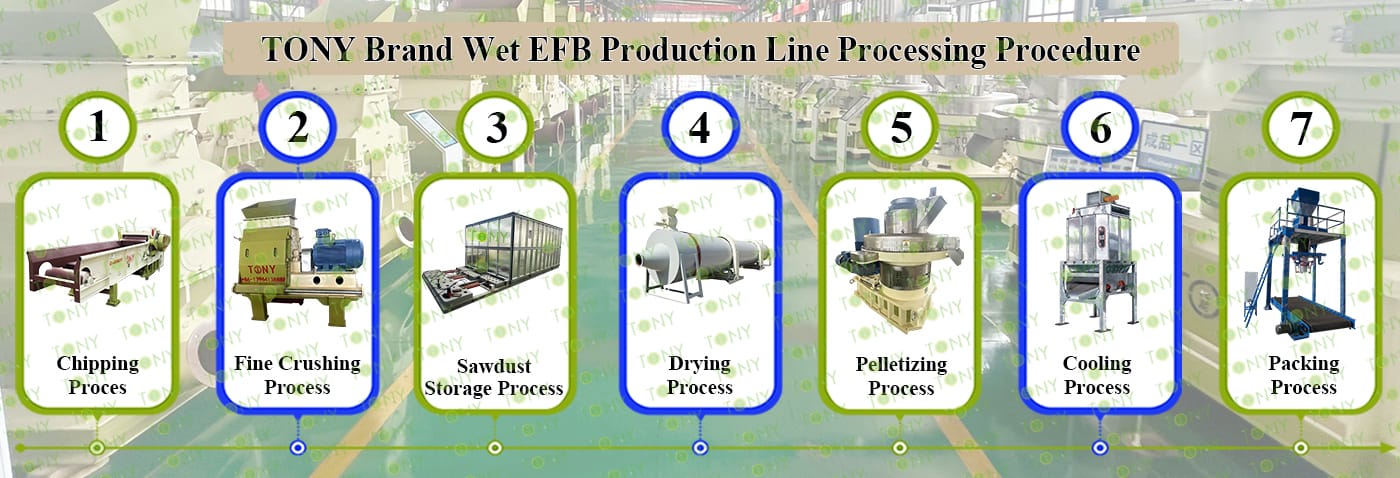
5. Process: Crushing Process - Fine Crushing Process -Palm Dust Storage Process- Drying Process - Pelletizing Process - Cooling Process - Packing Process
6. Main Equipment: Comprehensive Chipper- TPC1400-700-250KW, Effective Hammer Mill-TFD85-250-250KW, TONY Large Hydraulic Storage Silo,Rotary Drum Dryer-2.2-24m, TONY Pellet Machine- TYJ860-Ⅲ-280KW, Galvanized Pellets Cooler, Ton Packing Machine and Belt Conveyors

|
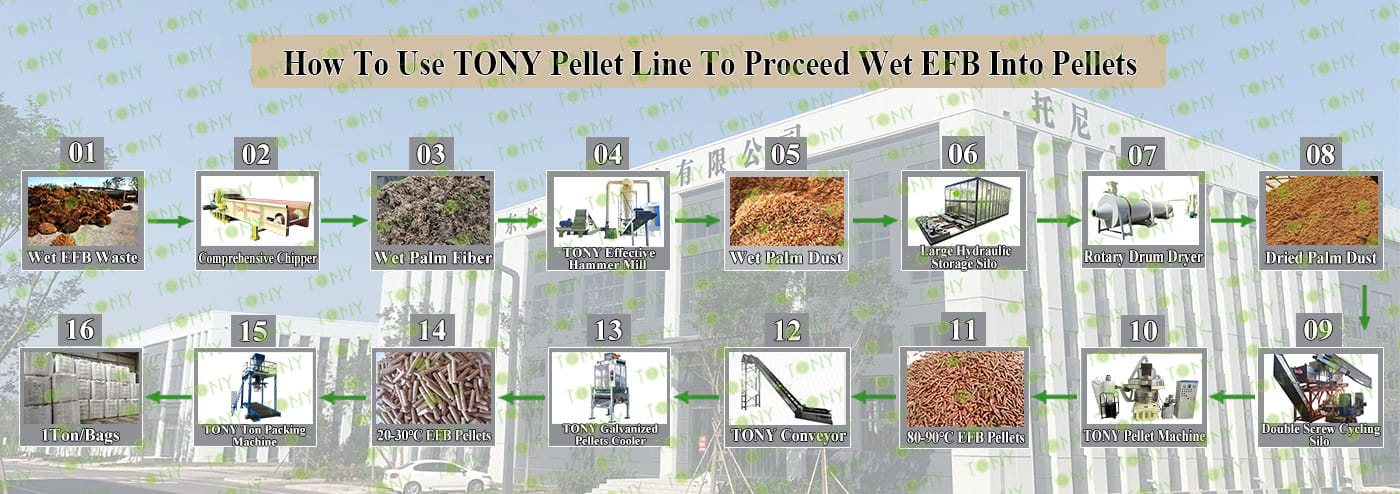
How to use the TONY pellet production line to make pellets from wet EFB? The process mainly includes the following steps and equipment: 1. Use TONY comprehensive chipper to grind EFB Into 25-55mm palm fiber. 2. Use TONY effective hammer mill to crush the 25-55 mm palm fiber into 8-14 mm palm dust.If customer has enough Investment budget,he can also chose TONY special cutting machine for palm silk which will be more expensive than the hammer mill. 3.Use TONY large hydraulic storage silo to storage 8-14 mm palm dust 4. Use TONY rotary drum dryer to dry the palm dust with a 40% moisture content down to a moisture content of 10%-15%. 5. Use TONY vertical ring die pellet machine to produce pellets with a diameter of 6-8 mm. 6. Use TONY galvanized pellets cooler to cool the pellets from 80-90°C to 20-30°C. 7. Use TONY ton packing machine to pack the pellets into bags, each weighing 1 ton. For more detailed information and quotations, you can contact TONY. TONY can provide all the above - mentioned products at highly competitive prices and with excellent quality. |
|
|||||||||||||||||||||||||||||||||||||||||||||||||||||||
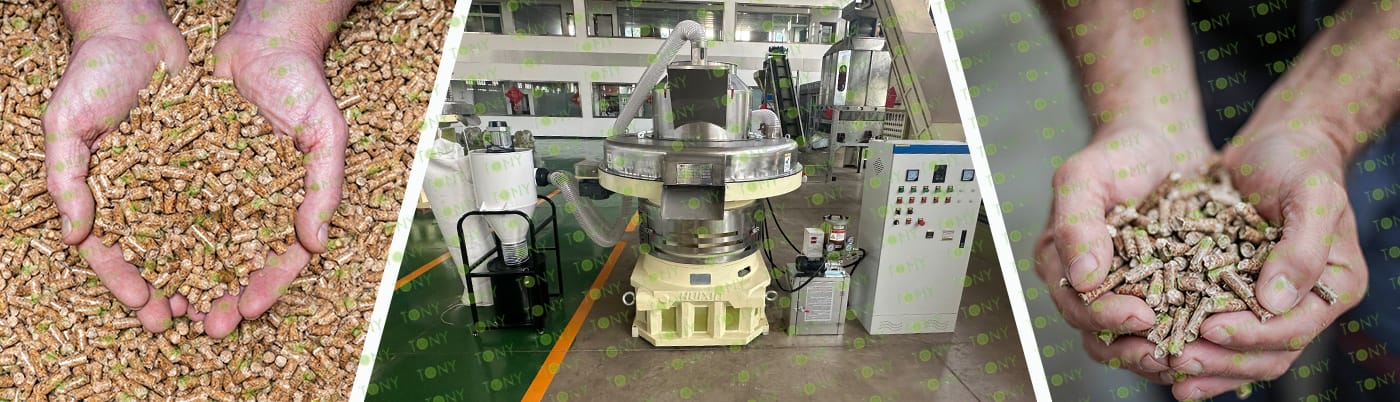
| Next, TONY Will Introduce To You All The Necessary Machinery That Will Be Used For The Whole Pellet Production Line. Some Machines Can Be Custom - Made By Customers According To Different Customers' Detailed Demands. Contact TONY For More Details, Including Quotation And Layout. | |||
 |
 |
 |
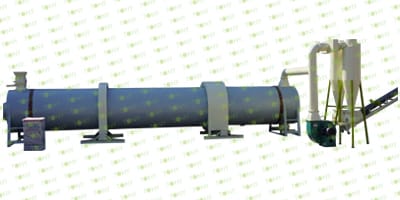 |
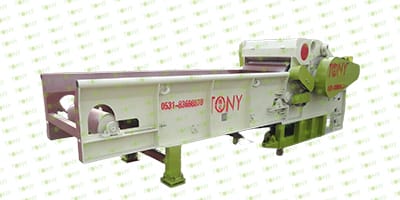
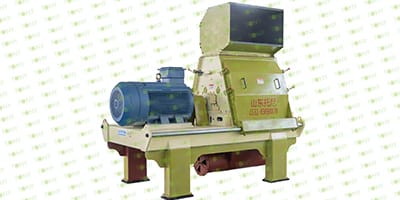
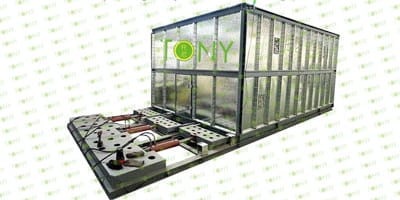
| Comprehensive Chipper | Effective Hammer Mill | Large Hydraulic Storage Silo | Rotary Drum Dryer |
| 1.To Grind EFB Into25-55mm Palm Fiber. 2.Model: TPC1400-700-250KW With 6 Blades*2sets 3.Capacity:20-30Ton/Hour. |
1.To Crush 25-55mm Palm Fiber Into 8-14mm Palm Dust. 2.Model: TFD85-250-250KW*5sets 3.Capacity:6-7Ton/Hour/Set |
1.To Storage Palm Dust Before Dryer Control Palm Dust Flow Entering The Dryer Model: TCY-45*2sets 2.TONY Uses Galvanized Material |
1.To Dry The 40% Palm Dust Into 10-15% Palm Dust. 2.Model: THGD2.2-24*5sets 3.Capacity:6-7Ton/Hour/Set |
 |
 |
 |
 |
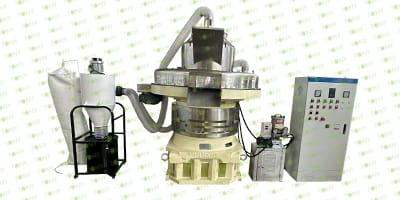
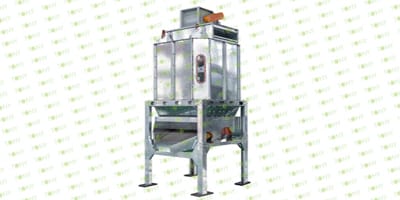
| Vertical Ring Die Pellet Machine | Galvanized Pellets Cooler | Ton Packing Machine | Belt Conveyor |
| 1.To Press Dry Palm Dust Into 6-8mm Biomass Pellets 2.Model: TY860-III-280KW*7sets 3.Capacity:4-5Ton/Hour/Set 4.New 304SS Type |
1.To Cool Pellets From 80-90℃ Into 20-30℃ 2.Model: TCN-10*2sets 3.Capacity:28-35Ton/Hour |
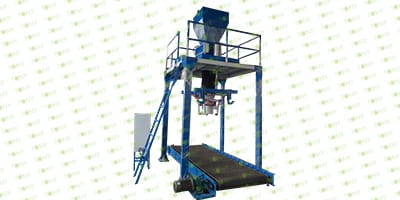
1.To Pack Pellets Into 1Ton/Bags 2.Model: TBD*2sets 3.Capacity:28-35Ton/Hour |
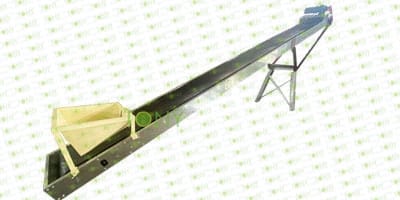
1.To Transport Palm Fiber, Palm Dust,Pellets. 2.Width: 80cm*32sets 3.Capacity:Designed With The Whole Line |
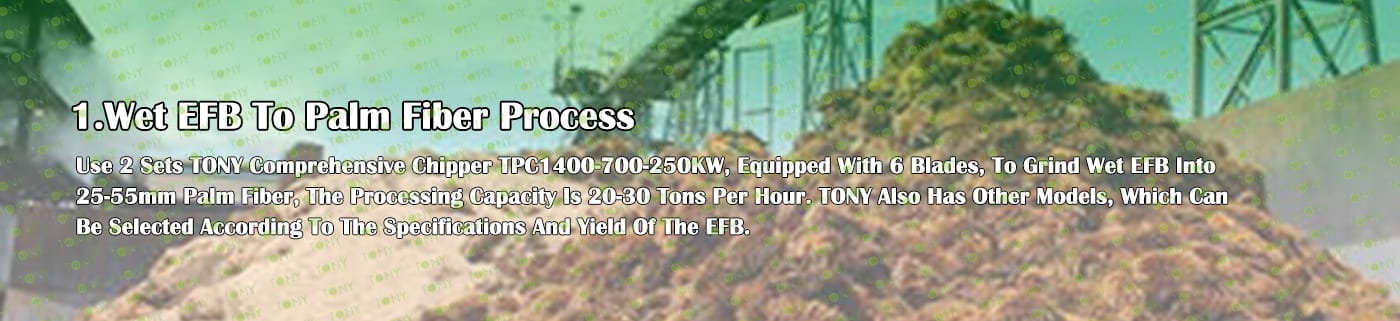
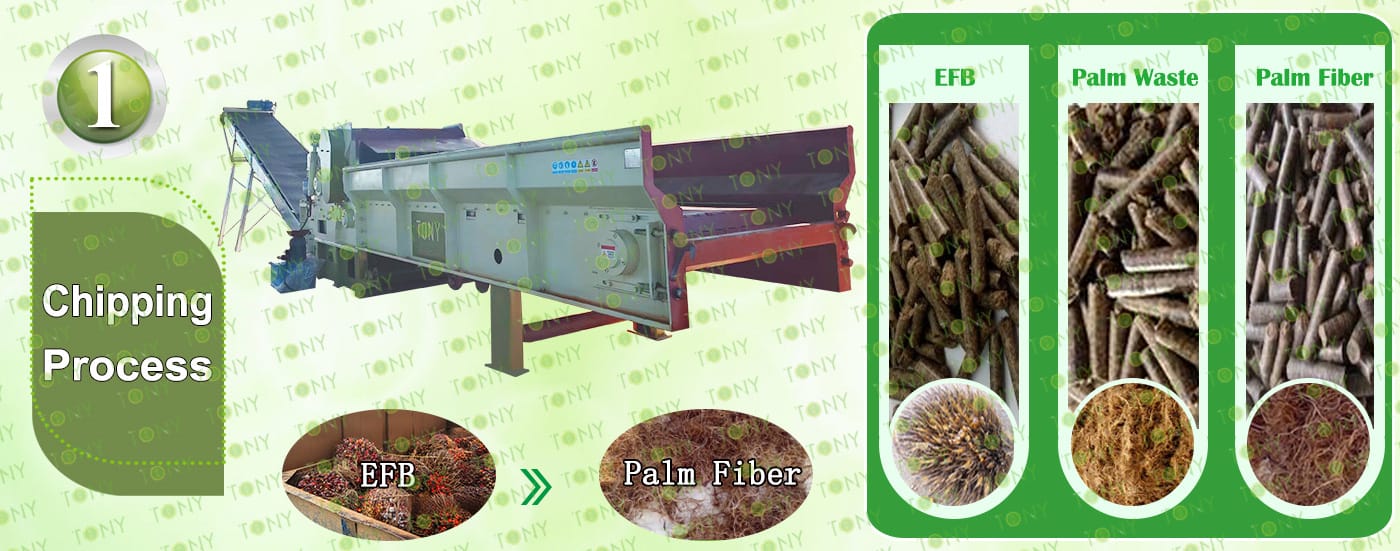
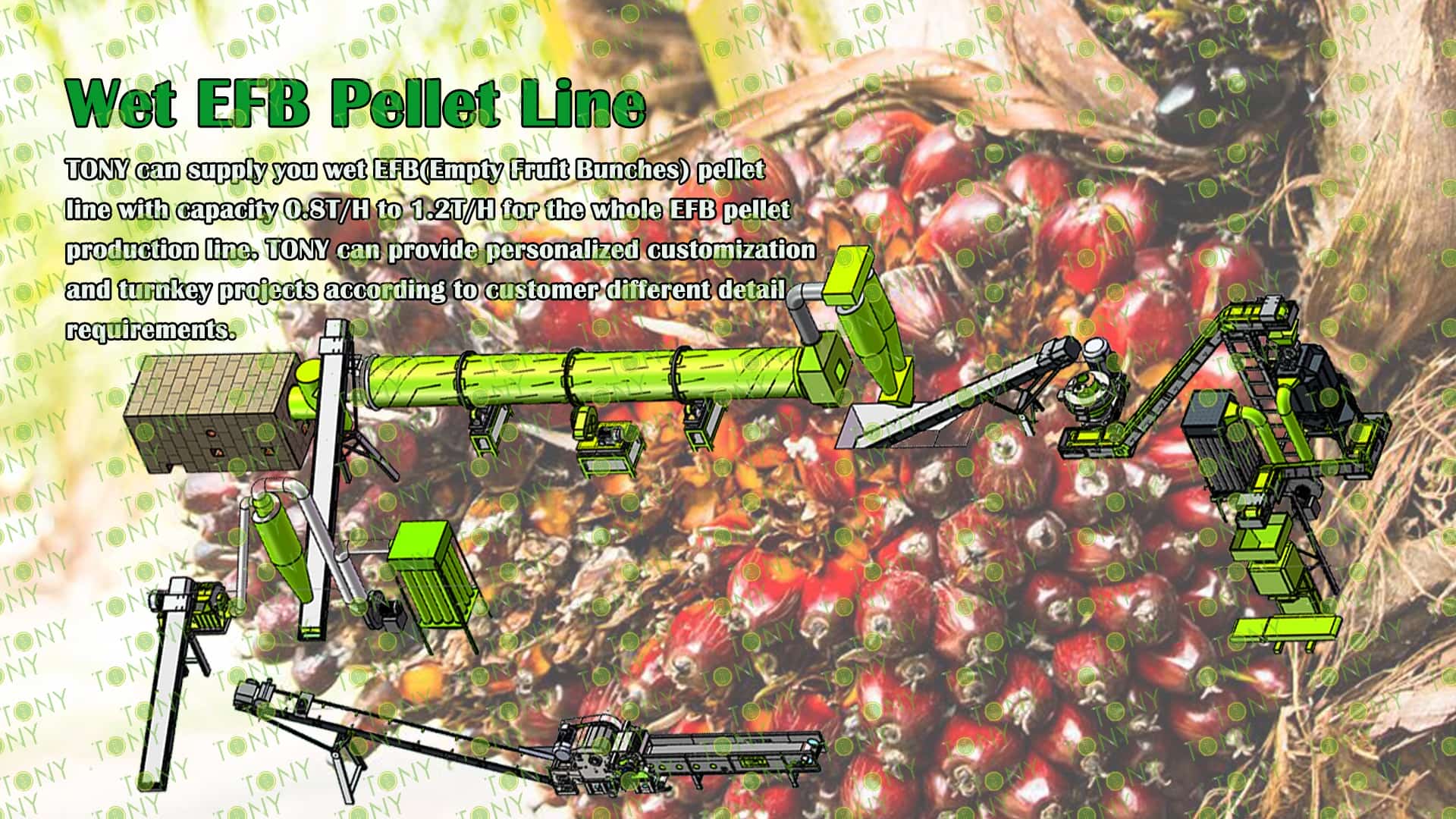
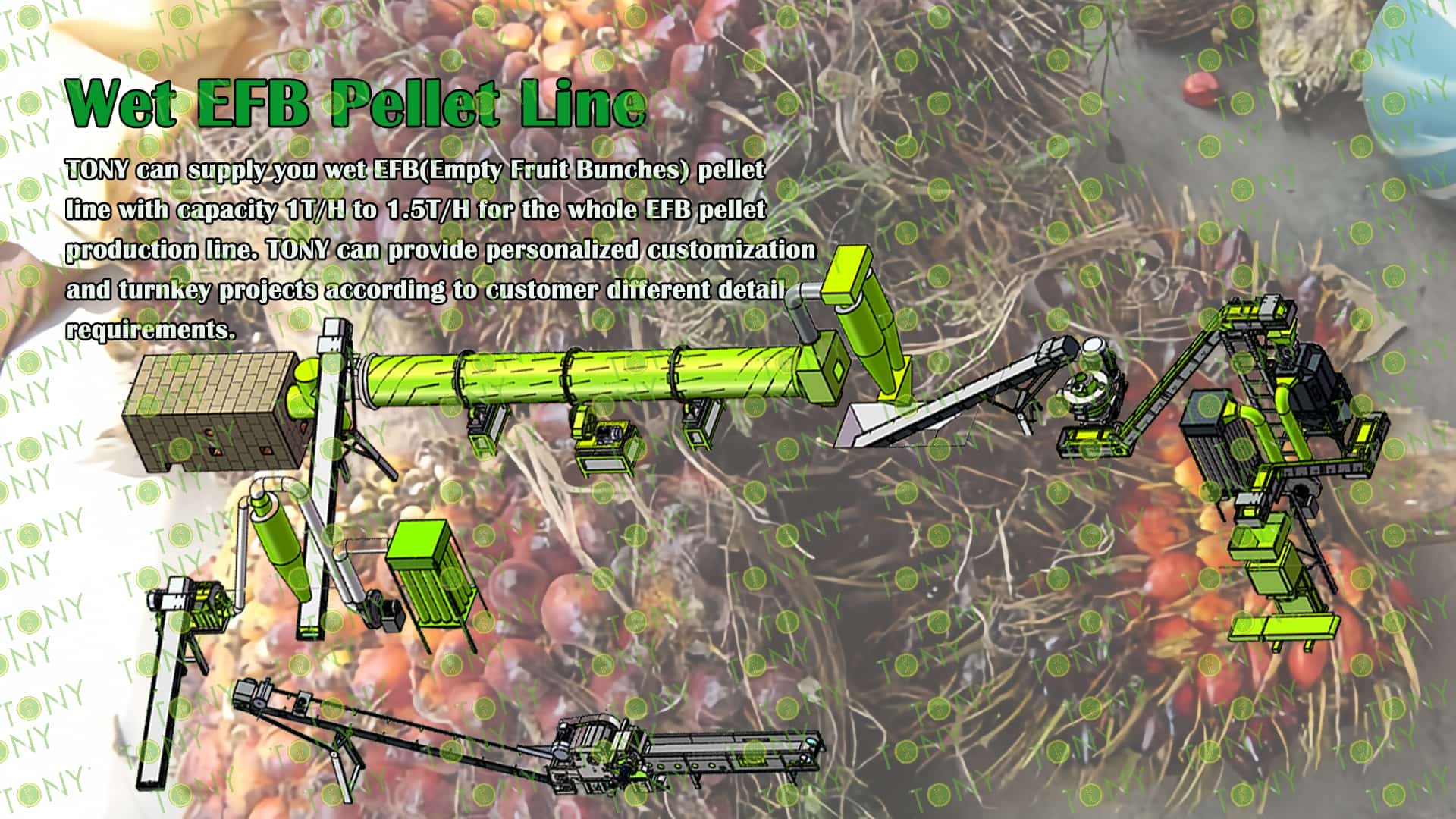
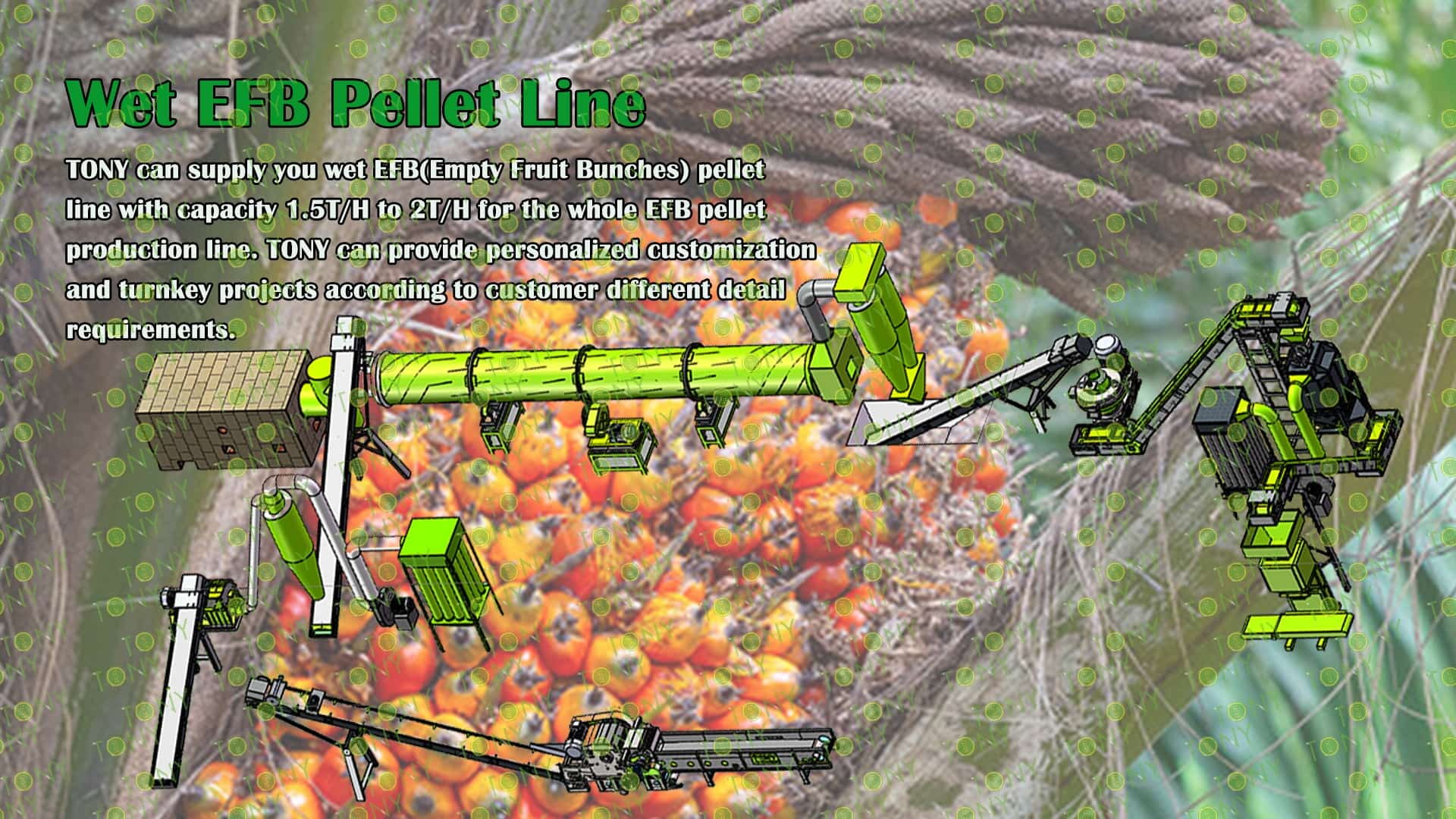
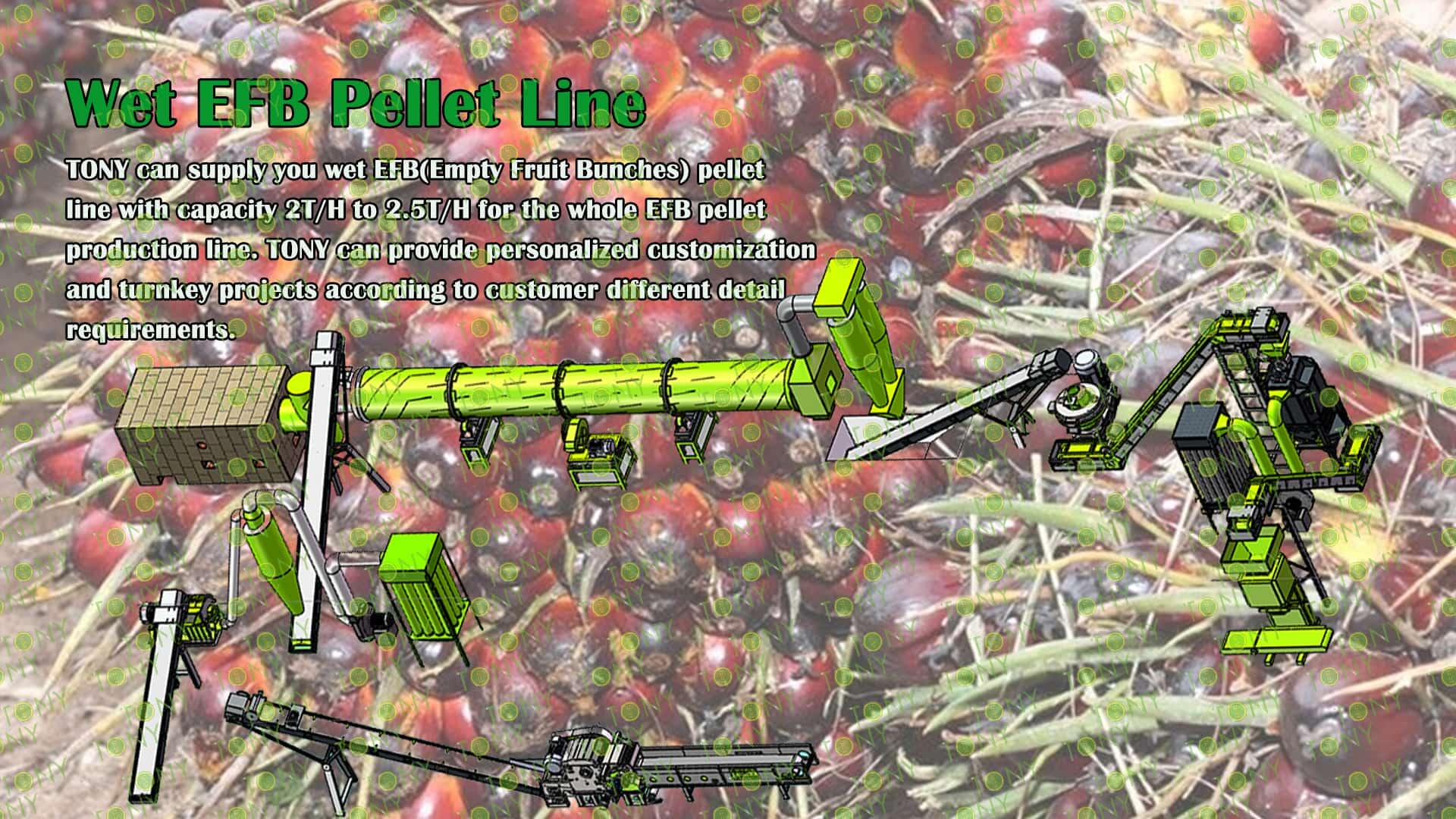
1.Wet EFB To Palm Fiber Process:
A.This process is mainly used to grind the EFB into palm fiber with size 25-55mm. The finish palm fiber size can be adjustable by changing different sizes of screeners and adding flying knives inside the wood chipper.
B.TONY brand comprehensive chipper TPC1400-700-250KW with 6 flying blades type*2sets
C.Capacity:20-30Ton/Hour.
Main Parts:
(1)TONY's Comprehensive Chipper.
(2)Feed And Discharge Belt Frequency Control To Prevent Card Material
(3)Hydraulic System Control Can Be Used For Thicker Materials
(4)Electronic Control System Allows The Equipment To Be Used Normally
Contact Tony For More Details With Quotation

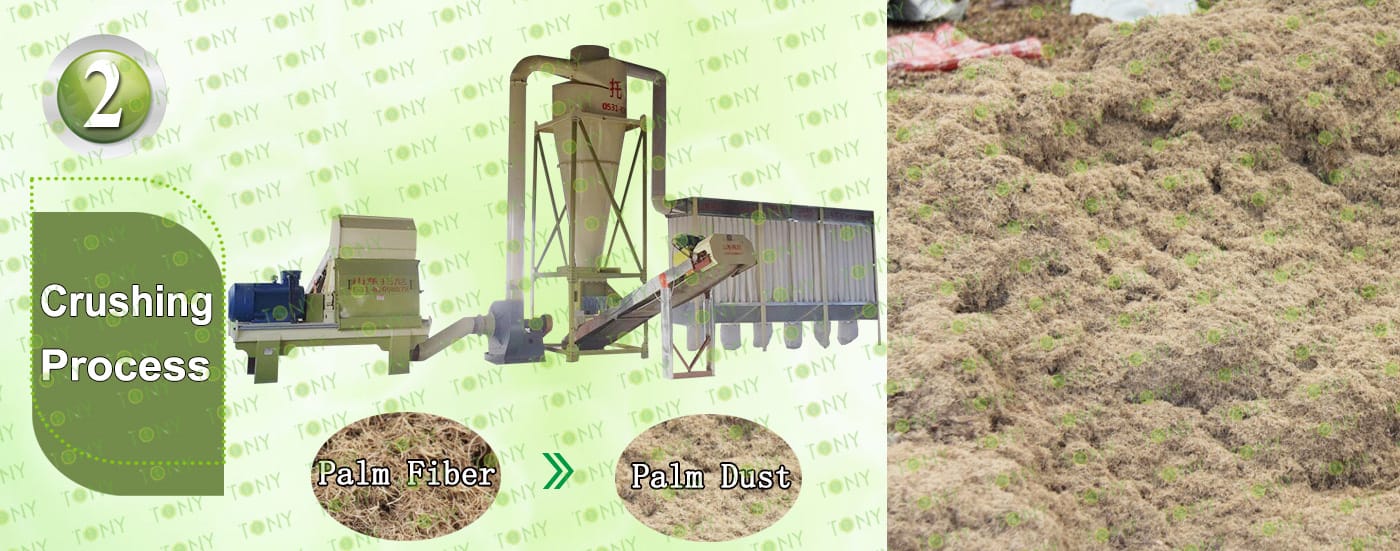
2.Palm Fiber Fine Crushing Process:
A.This process is mainly used to crush 25-55mm palm fiber into 8-14mm palm dust.
B.Capacity:28-35Ton/Hour.
C.TONY brand effective hammer mill TFD85-250-250KW*5sets
Main Parts:
(1)TONY Effective Hammer Mill.
(2)Galvanized Dust Collector.
(3)Sawdust Transportation Fan Blower.
(4)Cyclone With Airlock.
(5)Electrical Cabinets.
3.Palm Dust Storage Process:
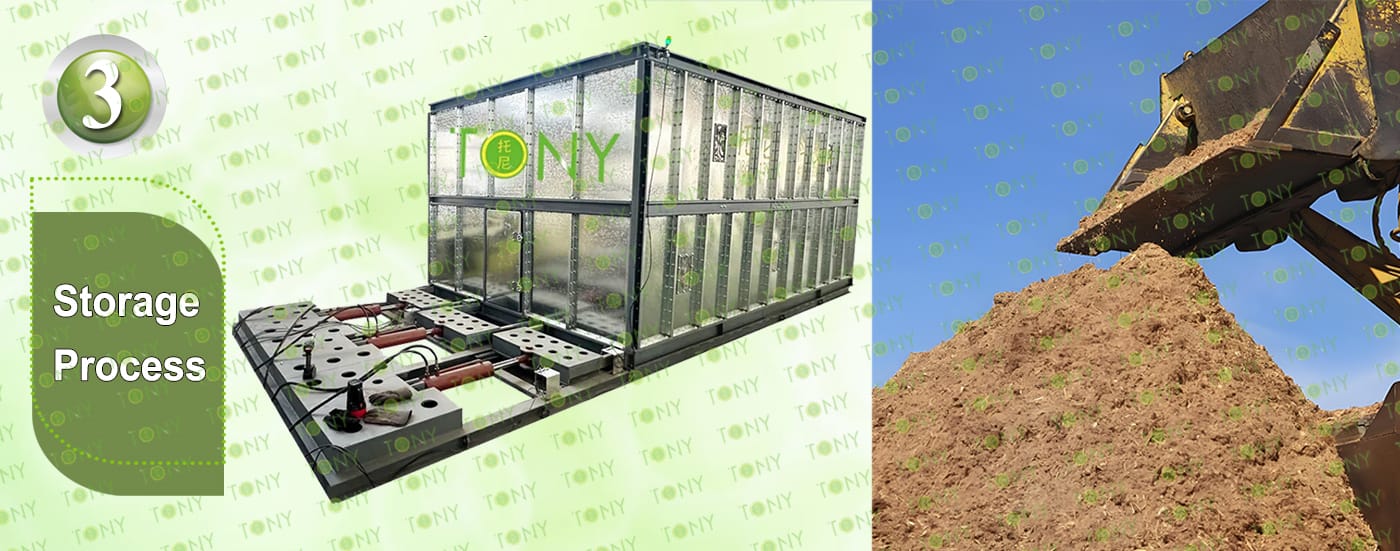
A. This process is mainly used to storage the palm dust that comes out of the hammer mill.It is hydraulic galvanized storage bin which is more stalbe and palm dust in it is not easy to be blocked.
B. TONY Brand Large Hydraulic Storage Silo to storage the palm dust that comes out of the hammer mill.This process can be optional by customer.If customer do not chose the storage bin,he can storage the palm dust on the ground directly which may need some labour.
Main Parts:
(1)TONY's New Large Hydraulic Storage Silo.
(2)With Screws Inside The Storage Bin To Prevent Palm Dust Blocked.
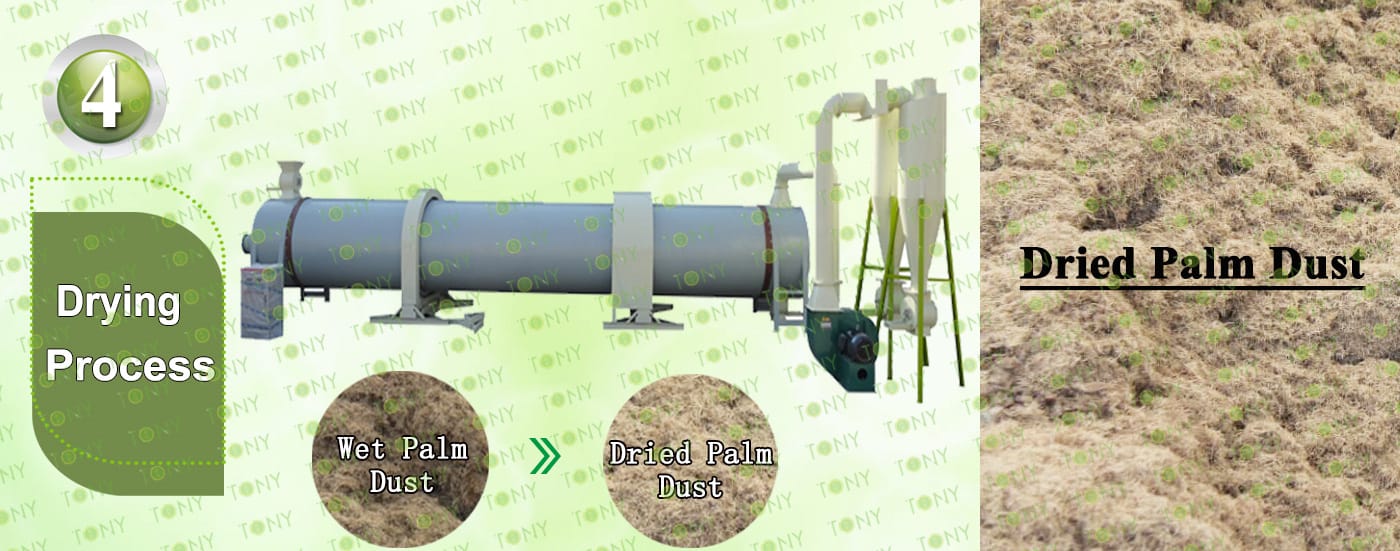
4.Wet Palm Dust Drying Process:
A.This process is mainly used to dry the palm dust from 40% to 10-15%.
B.Capacity:28-35Ton/Hour.
C.TONY use 5 sets of 2.2*24m rotary drum dryer for this process, TONY hot blast stove is made of firebrick pan, shell with H steel plate as the frame. There are 3 layers of fire blocking device inside, which can effectively prevent the fire from entering the tumble dryer.Customers can choose to use waste wood, biomass pellets, natural gas, etc. as fuel for the hot air furnace
TONY dryer use spiral tube material, and is not easy to deform.
Unlike other manufacturers with iron plate splicing welding, very easy to deformation.
Main Parts:
(1)TONY's Rotary Drum Dryer Main Body. (Reducers With Motors and Pips.)
(2)TONY's Hot Stove.
(3)Fan Blower+Cyclone With Airlock.
5.Pelletizing Process:
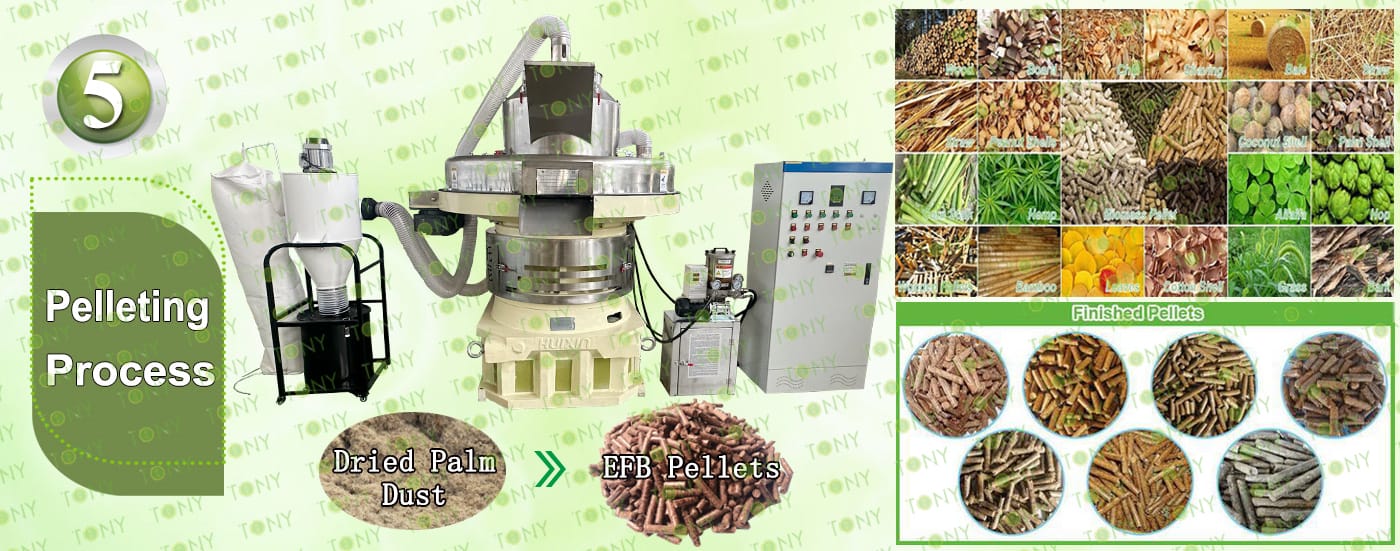
A.This process is mainly used to to product pellets into φ6-8mm.
B.Capacity:28-35Ton/Hour.
C.TONY brand vertical ring die pellet machine TYJ860-Ⅲ-280KW*7sets
D.Double Screw Cycling Silo is added above the pellet machine, which has the advantages of saving space, saving labor, intelligently controlling the feeding speed, not easy to block the material, and improving production efficiency.
Main Parts:
(1)TONY's new Vertical Ring Die Pellet Machine.
(2)Cyclone And Bags Dust Collectors.
(3)Automatic Lubrication System.
(4)Electrical Cabinets.
You can chose TONY new type SS304 pellet machine
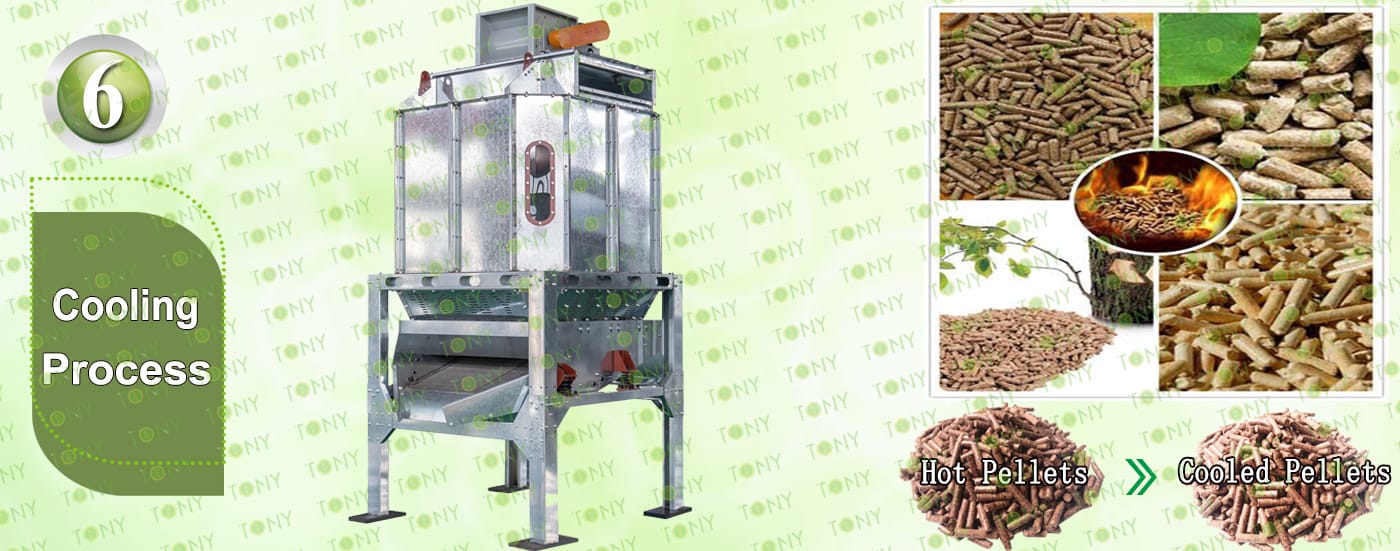
6.Cooling Process:
A.This process is mainly used to cool pellets from 80-90℃ to 20-30℃
B.Capacity:28-35Ton/Hour.
C.TONY brand galvanized pellets cooler *2sets
Main Parts:
(1)TONY's new Galvanized Pellets Cooler With Vibrating Screen.
(2)Cyclone And Bags Dust Collectors.
(3)Fan Blower.
(4)Connect Pipes.
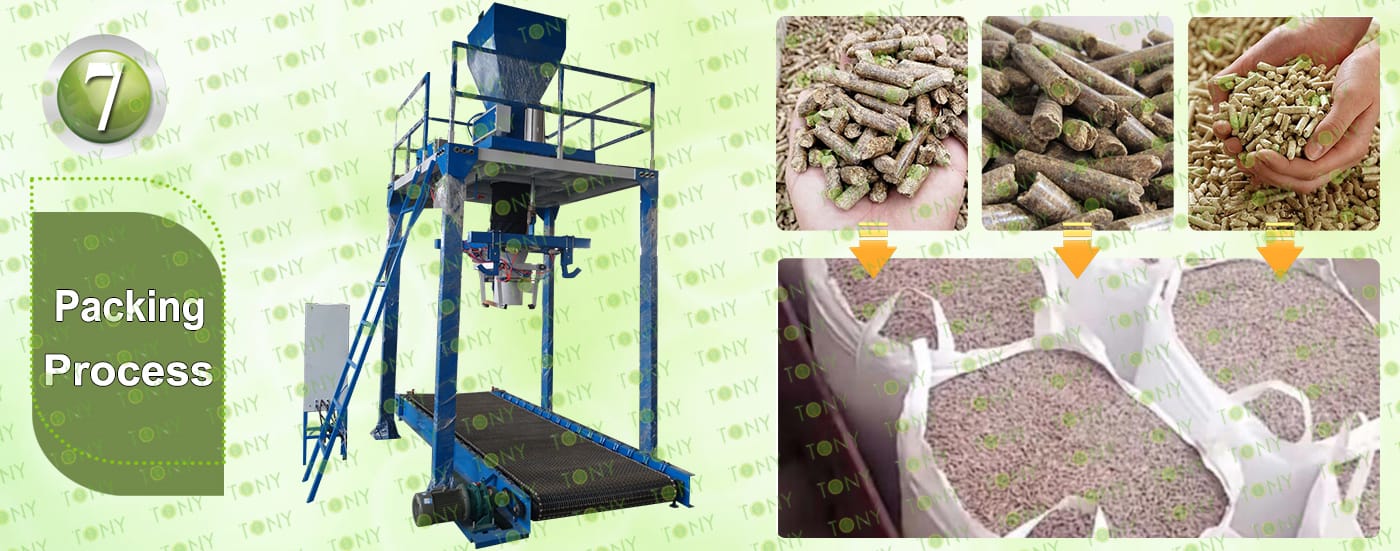
7.Packing Process:
A.This process is mainly used to pack pellets into 1Ton/Bags.
B.Capacity:28-35Ton/Hour.
C.TONY brand ton packing machine*2sets
Main Parts:
(1)TONY Ton Packing Machine
(2)Electronic Platform Scale Metering System
(3)Automatic Tare, Zero, and Drop Correction Functions
(4)Feeding System Features Fast, Medium, and Slow Feeding Speeds to Ensure Measuring Accuracy
1.Project Core Positioning: Turning Palm Waste into Value
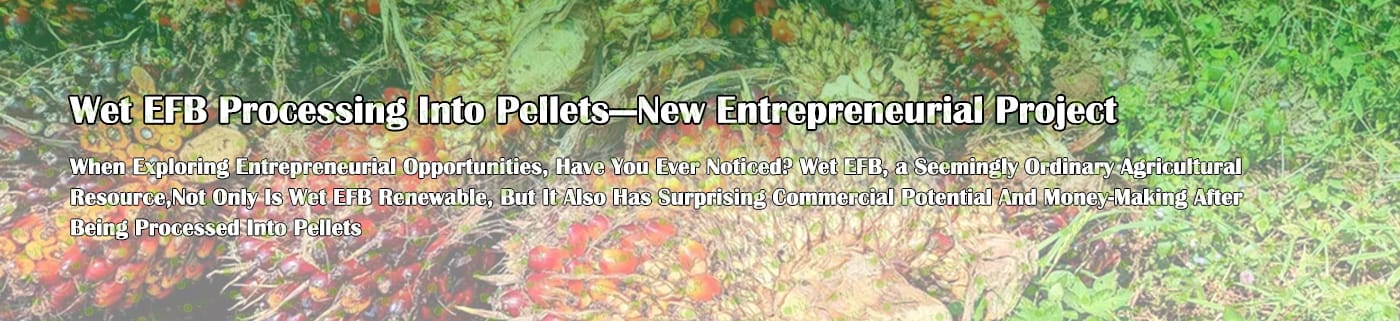
This project focuses on the resource utilization of waste generated from palm oil plantations and processing plants. Using palm shells, palm fibers, and palm kernel residue as raw materials, it processes these byproducts into high-density biomass pellets through specialized equipment. These pellets are then supplied to industrial boilers, biomass power plants, and commercial heating systems, creating a green economic model of "local resource utilization → nearby product supply → waste recycling."
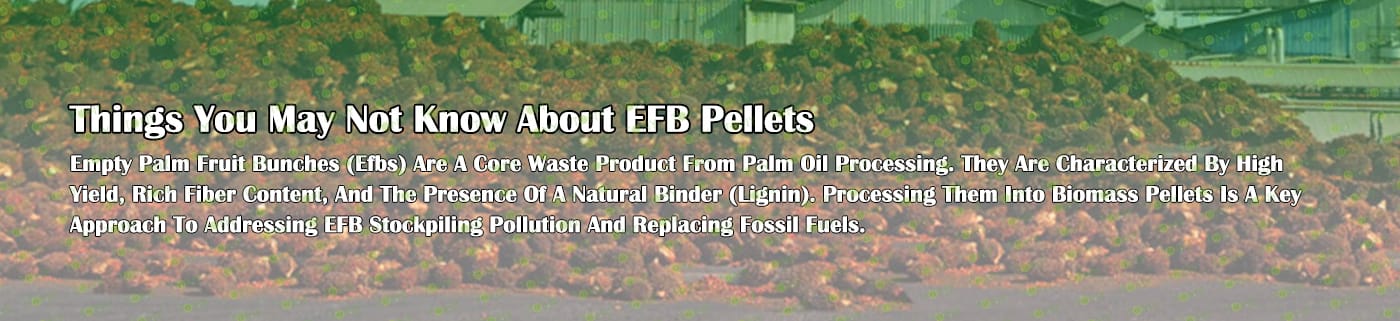
2.The Core Value Lies In Addressing Three Key Pain Points:
(1)Environmental Pain Point:
Palm waste accumulation easily breeds pests and insects, polluting soil and water, and incurs high disposal costs (a palm oil factory in Indonesia spends over one million US dollars annually on landfill fees).
(2)Energy Pain Point:
The industrial sector urgently needs to transition from coal to clean energy; palm pellets have a calorific value of 18-20 MJ/kg (close to lignite) and an ash content of only 3%-5%, making them suitable for existing combustion equipment.
(3)Economic Pain Point:
The cost of procuring palm waste is low, while the processed pellets command a high selling price, resulting in significant profit margins.
Energy Performance: High calorific value and stable combustion, suitable for various applications.
As a biomass fuel pellet, palm kernel pellets offer superior energy performance compared to most similar products. Their key advantages include:
1.High calorific value and density:
The palm kernel fibers have a high lignification rate, resulting in pellets with a calorific value close to that of medium-grade coal, and a density of ≥1.1 g/cm³. They are hard and resistant to breakage, with a loss rate of less than 5% during storage and transportation.
2.Excellent combustion characteristics:
Low ash content during combustion, far lower than that of straw pellets, reducing clinker formation and cleaning frequency in the furnace, thus lowering maintenance costs. Furthermore, combustion produces no sulfur or heavy metal emissions, and only releases the CO₂ absorbed during the raw material's growth, achieving carbon neutrality and meeting environmental emission standards.
3.Wide applicability:
It can directly replace fossil fuels such as coal and natural gas, and be used in industrial boilers (e.g., for food processing and textile dyeing), biomass power plants, and home fireplaces, without requiring major modifications to existing equipment, resulting in low conversion costs.

2025 Tony Machinery - All Rights Reserved. Map