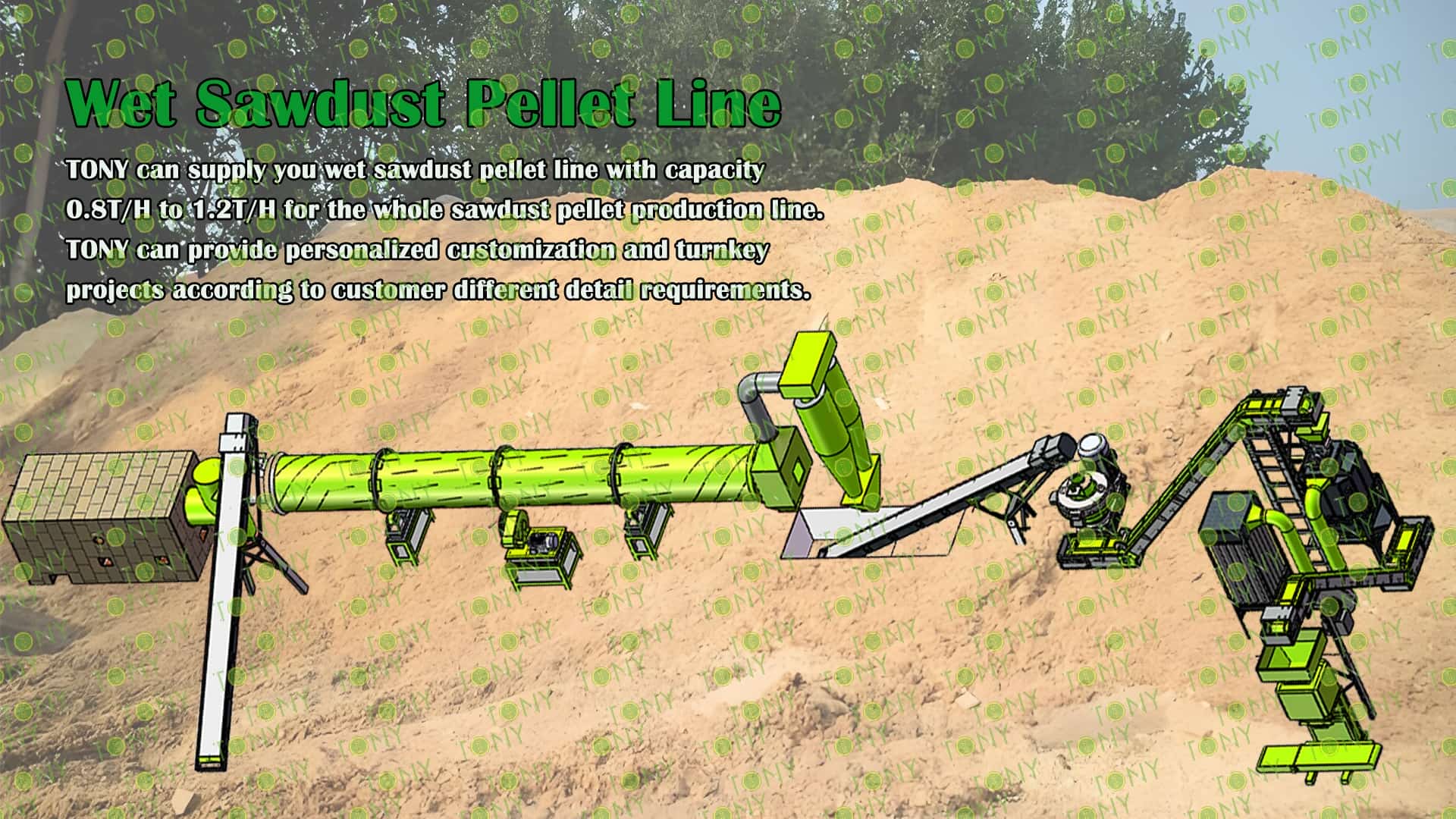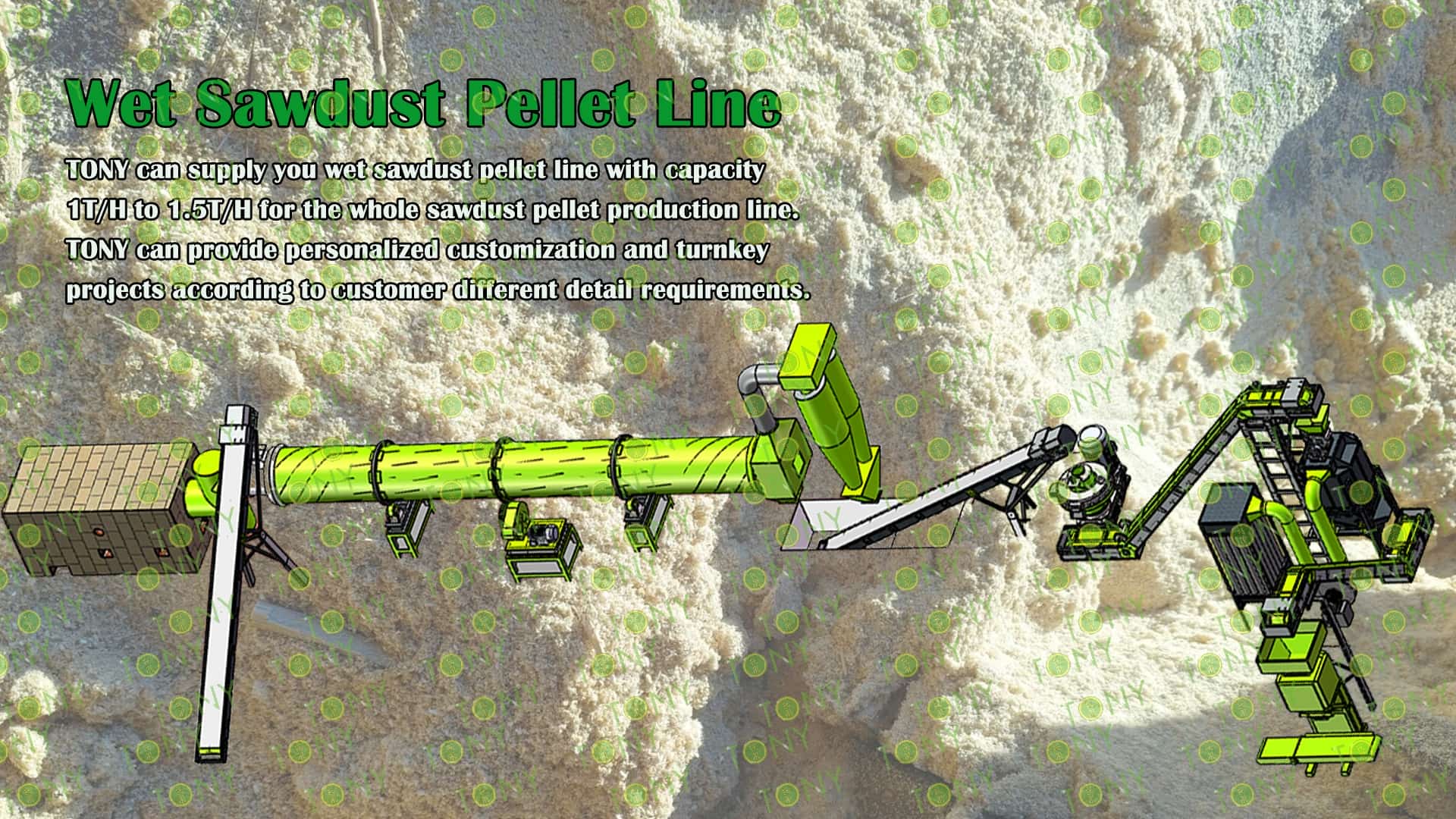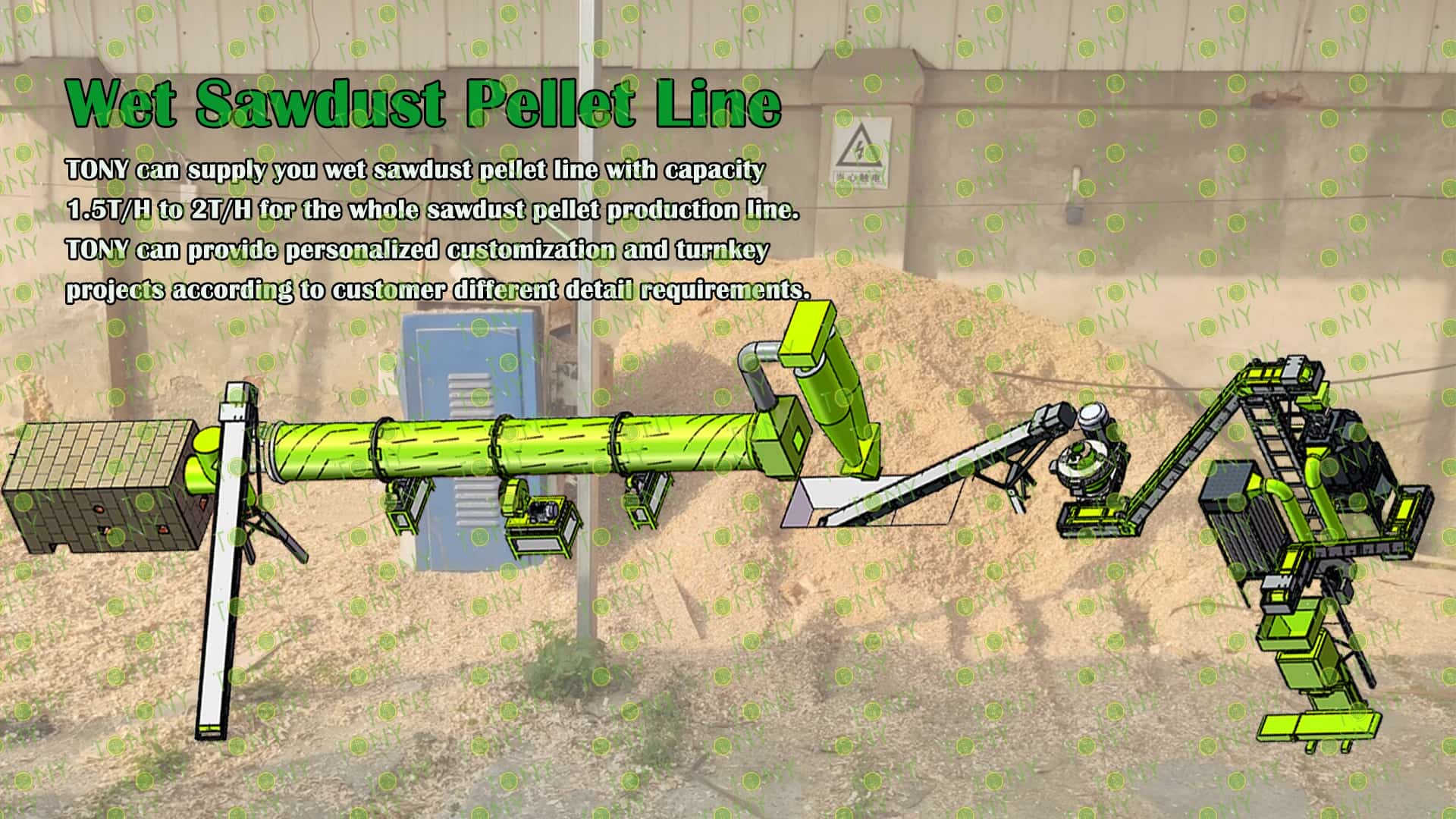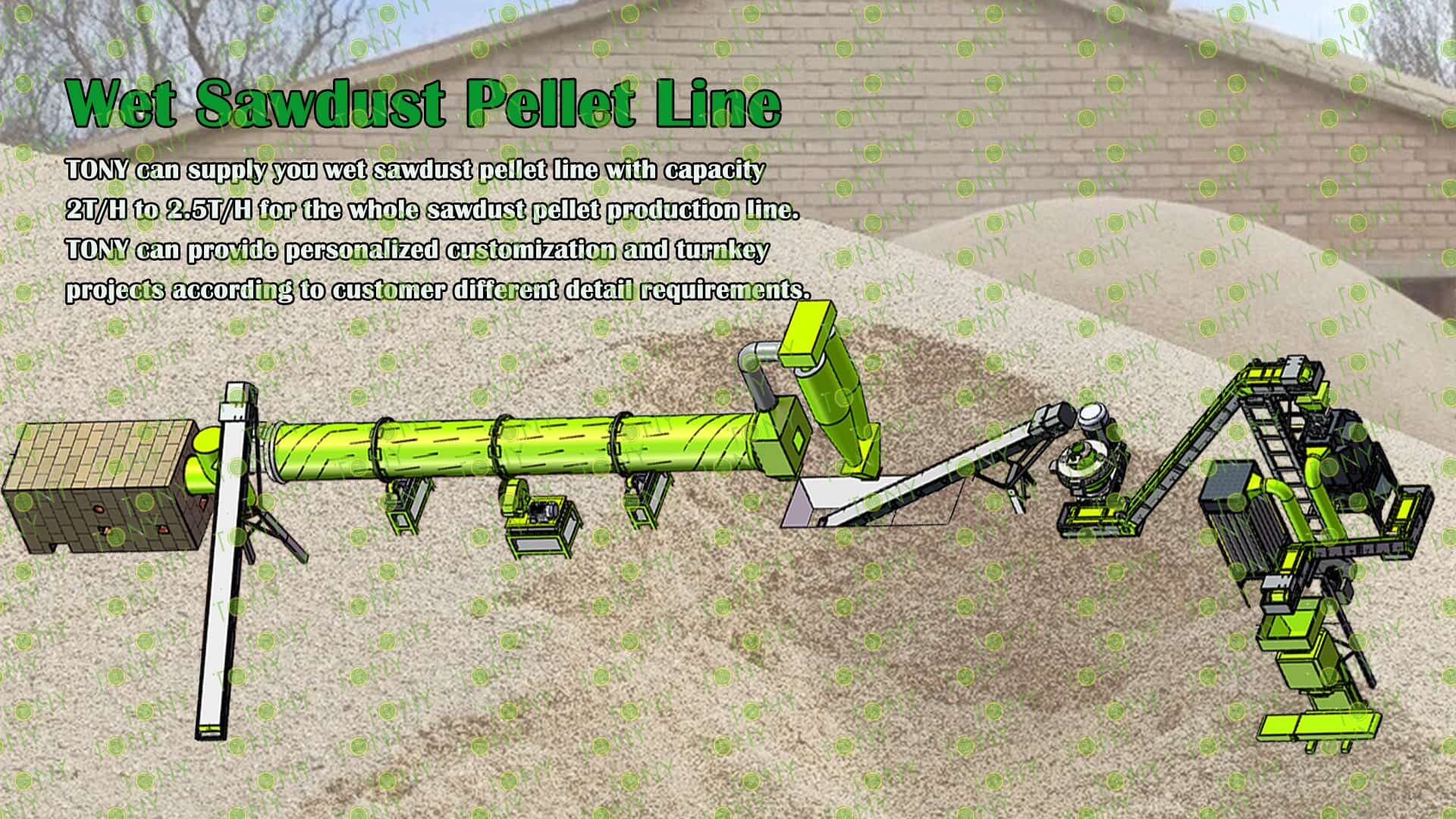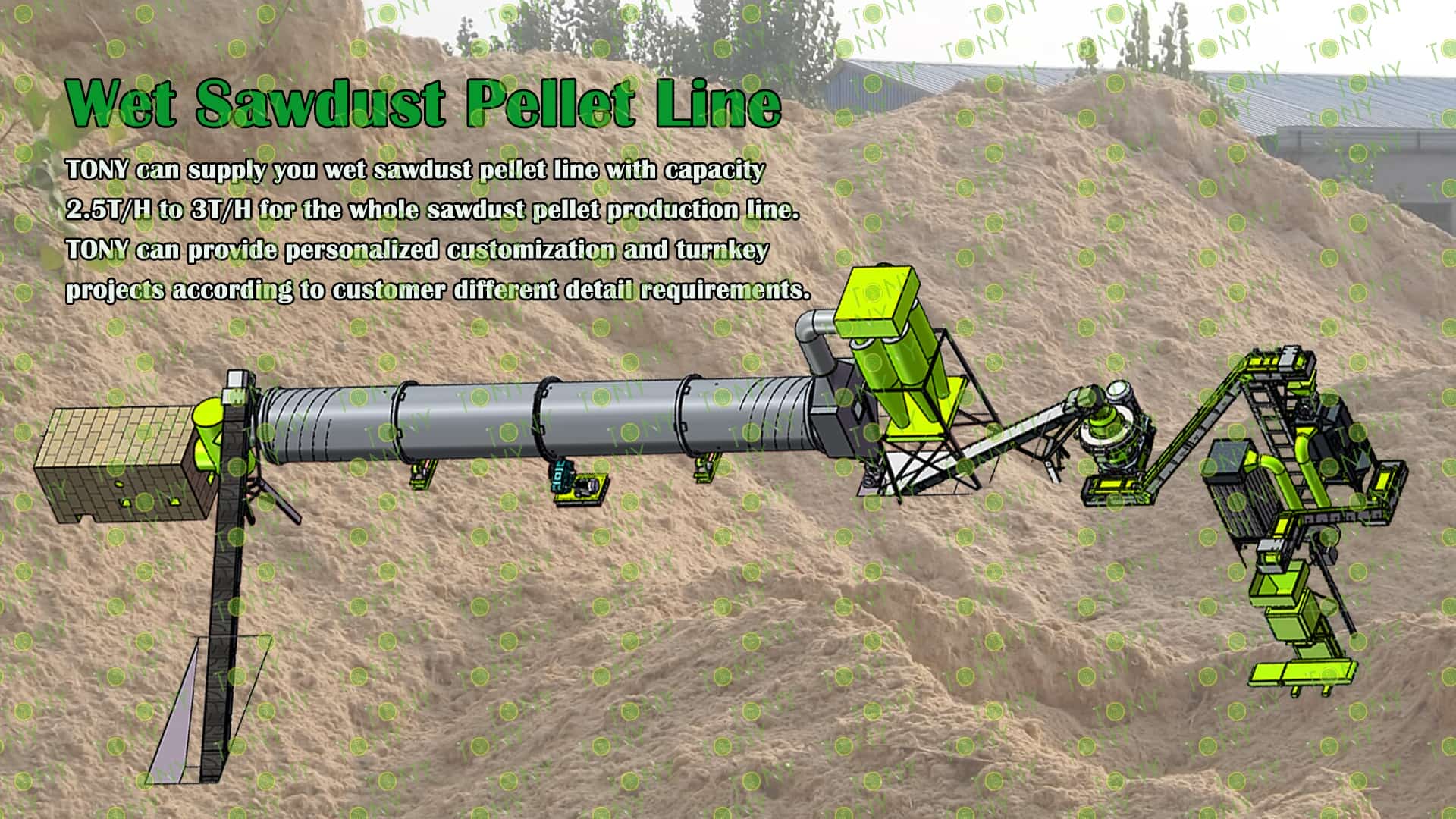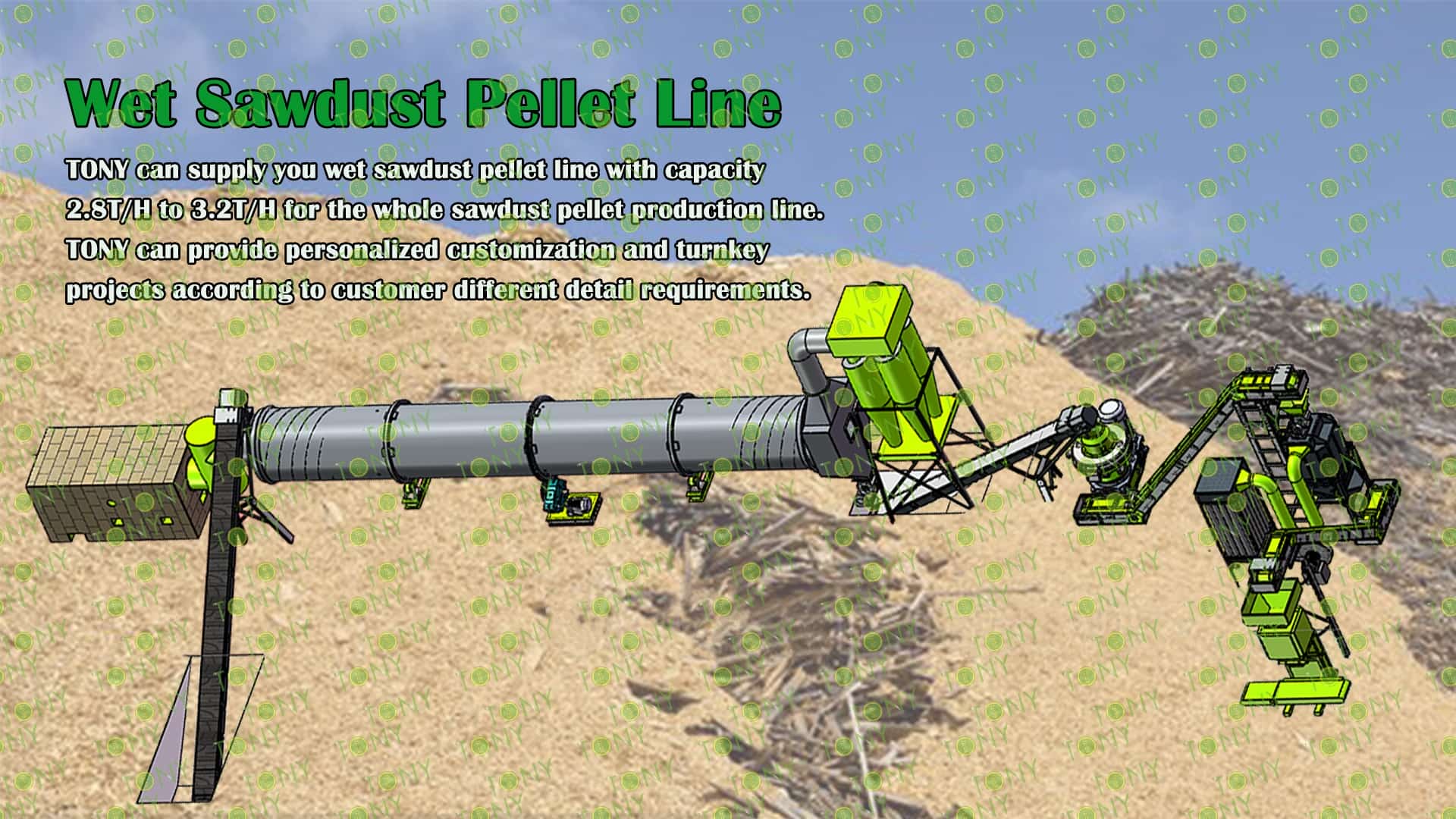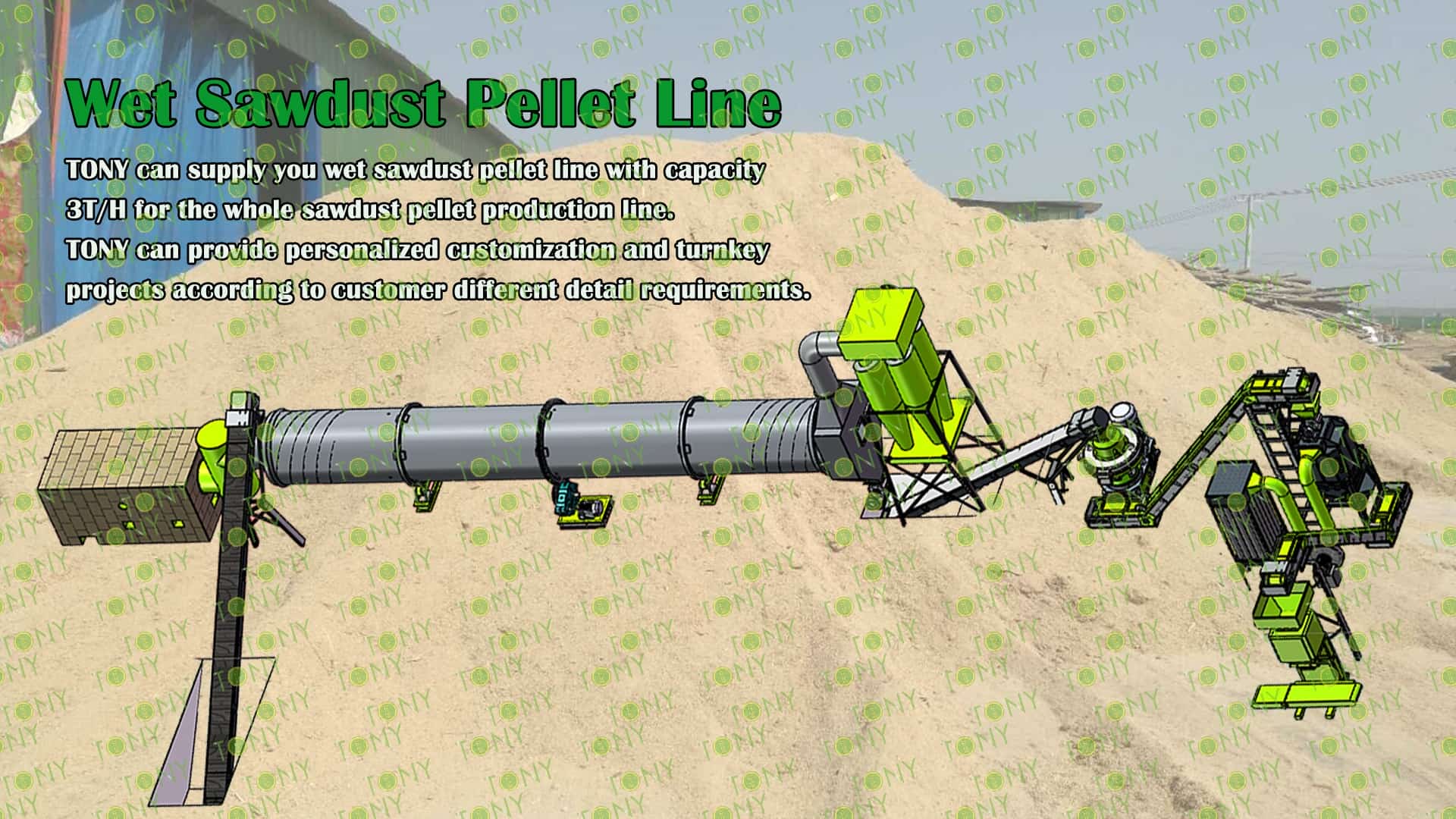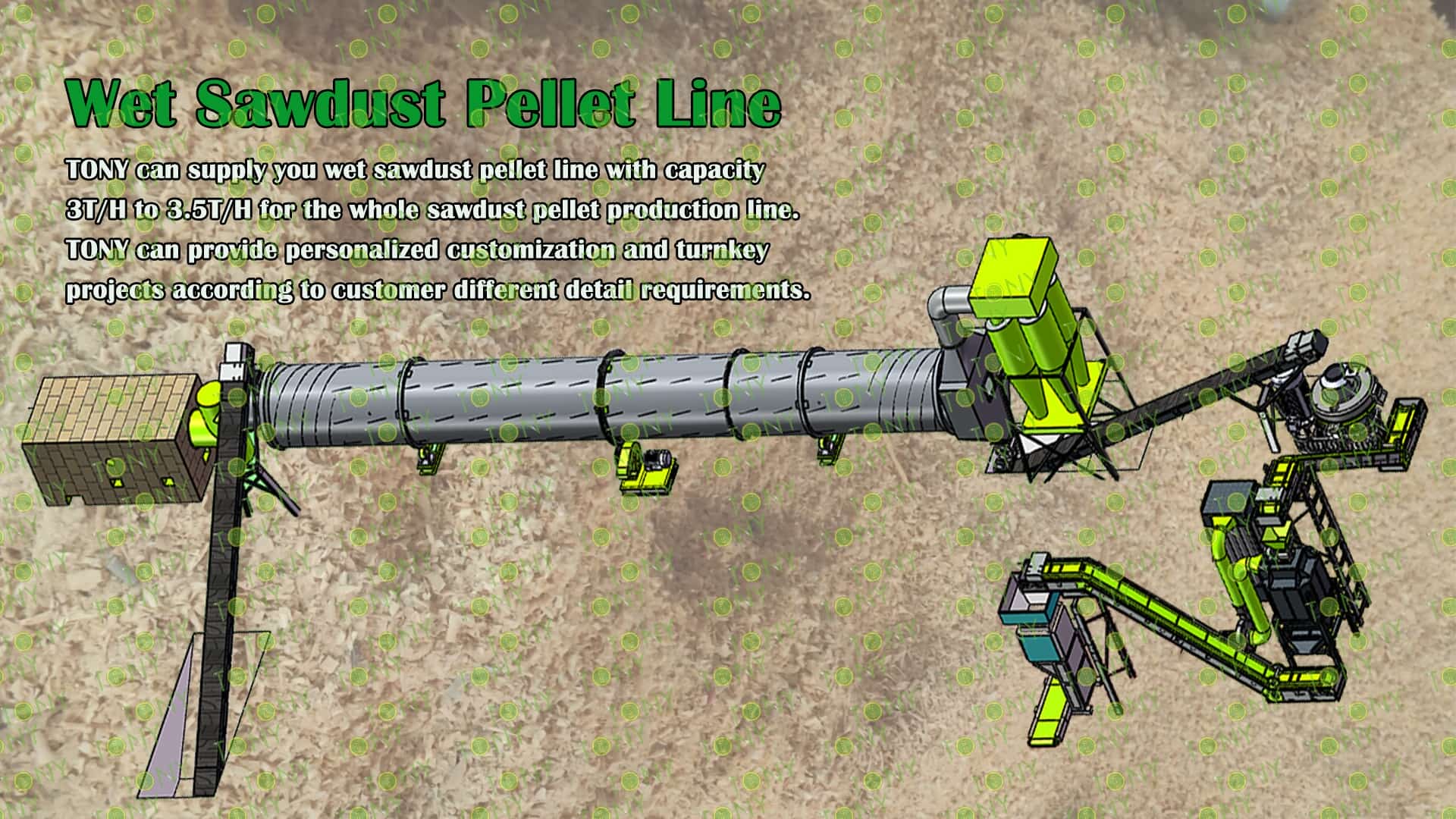





















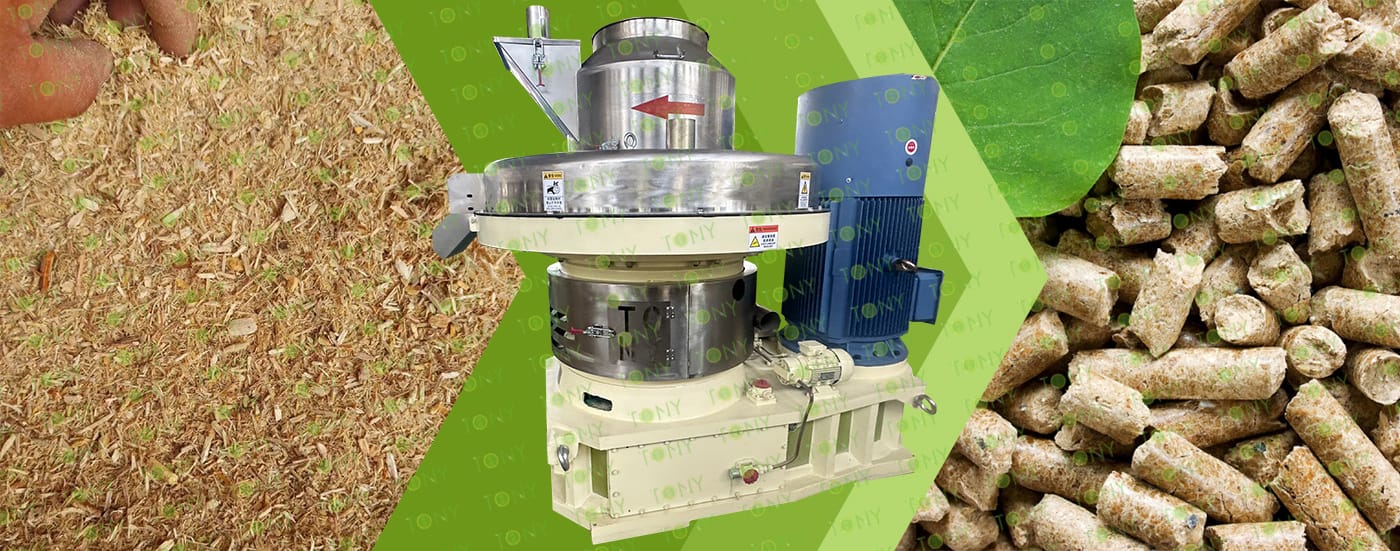
1.The working principle of wet sawdust biomass pellet processing equipment
(1)Core Forming:Fiber reorganization and densification under mechanical extrusion is a key step in converting sawdust into pellets. The core principle is "high-pressure extrusion + wood fiber self-bonding." Lignin in the sawdust (a natural adhesive that softens under pressure and frictional heat) works together with moisture to tightly bind the fibers, forming pellets with a fixed shape.
(2)Core component:The forming machine—the "ring die pellet machine"—is more adaptable to wet materials and less prone to clogging.
During the extrusion process, intense friction between the sawdust and the inner wall of the die and the surface of the rollers generates frictional heat of 60-90°C. This temperature softens the lignin in the sawdust (the softening point of lignin is approximately 70-100°C). Simultaneously, the moisture forms "liquid bridges" that bind the dispersed fibers together, providing a foundation for subsequent shaping.
2.Characteristics of wet sawdust biomass pellet processing equipment
(1)Strong adaptability to raw materials, compatible with a variety of biomass
Wide processing capacity: Processable raw materials include wet sawdust, wood shavings, etc.
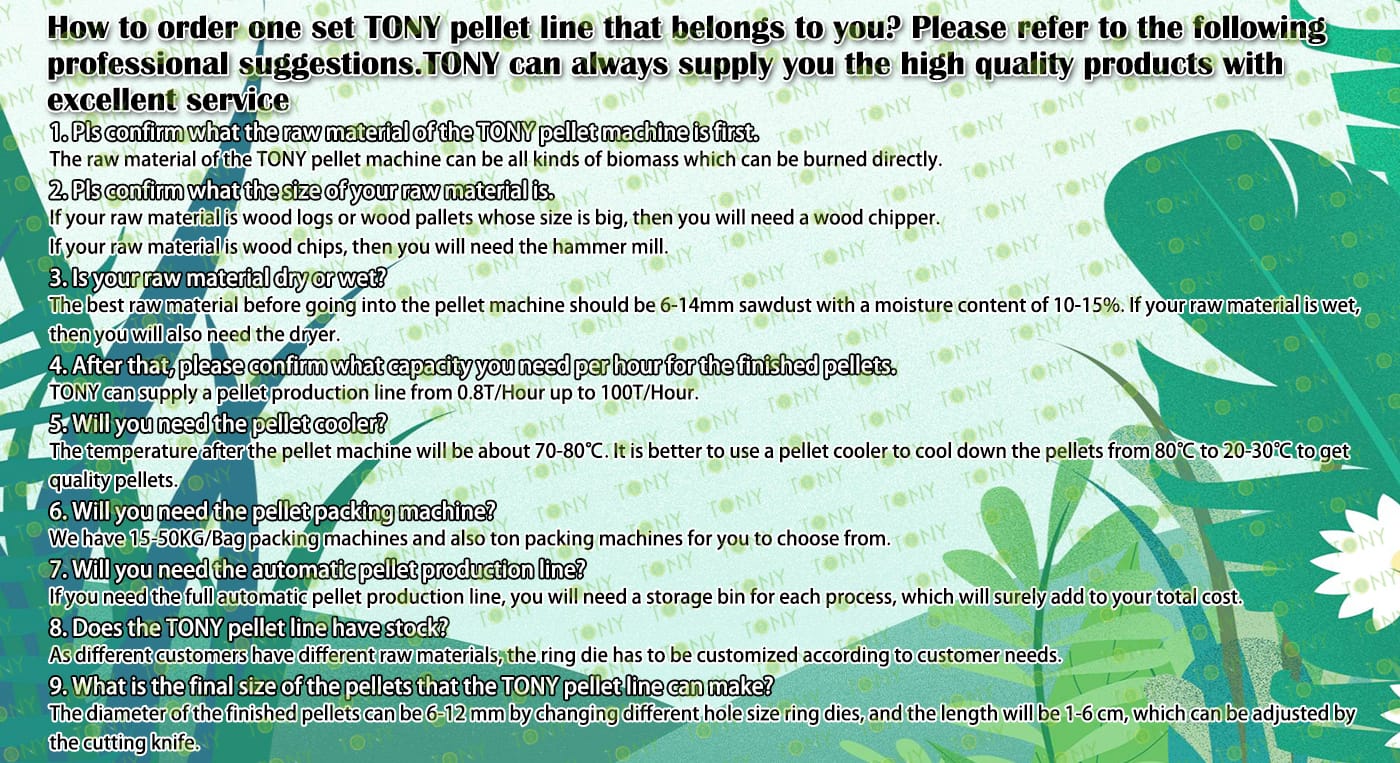
Clear requirements for raw material pretreatment: The moisture content of the raw materials must be controlled at 10%-15% (too high a moisture content will easily cause adhesion and mold clogging, while too low a moisture content will result in insufficient pellet strength), and the particle size is usually required to be 1-3mm.
(2)Modularization of core equipment and continuous production process
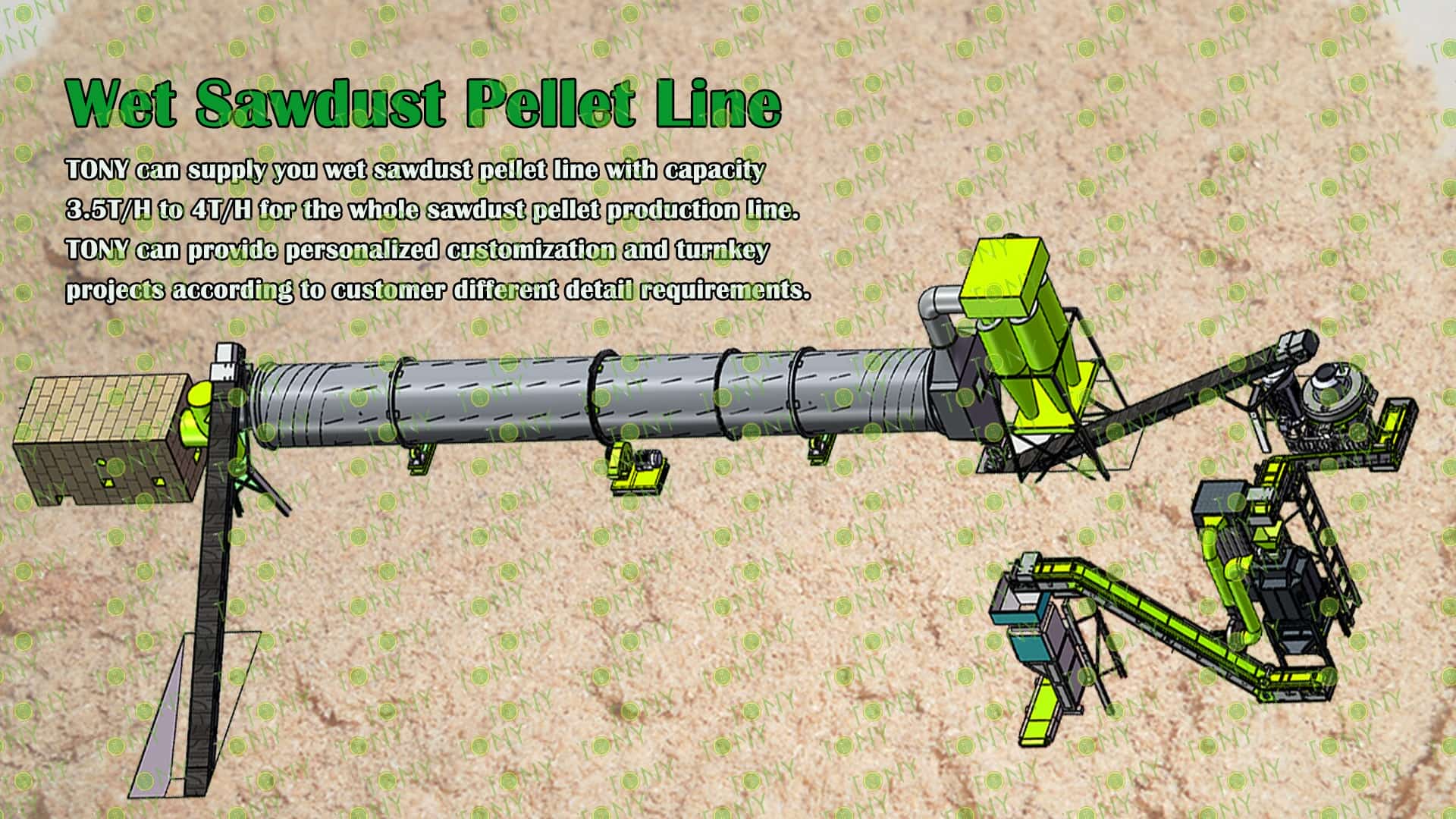
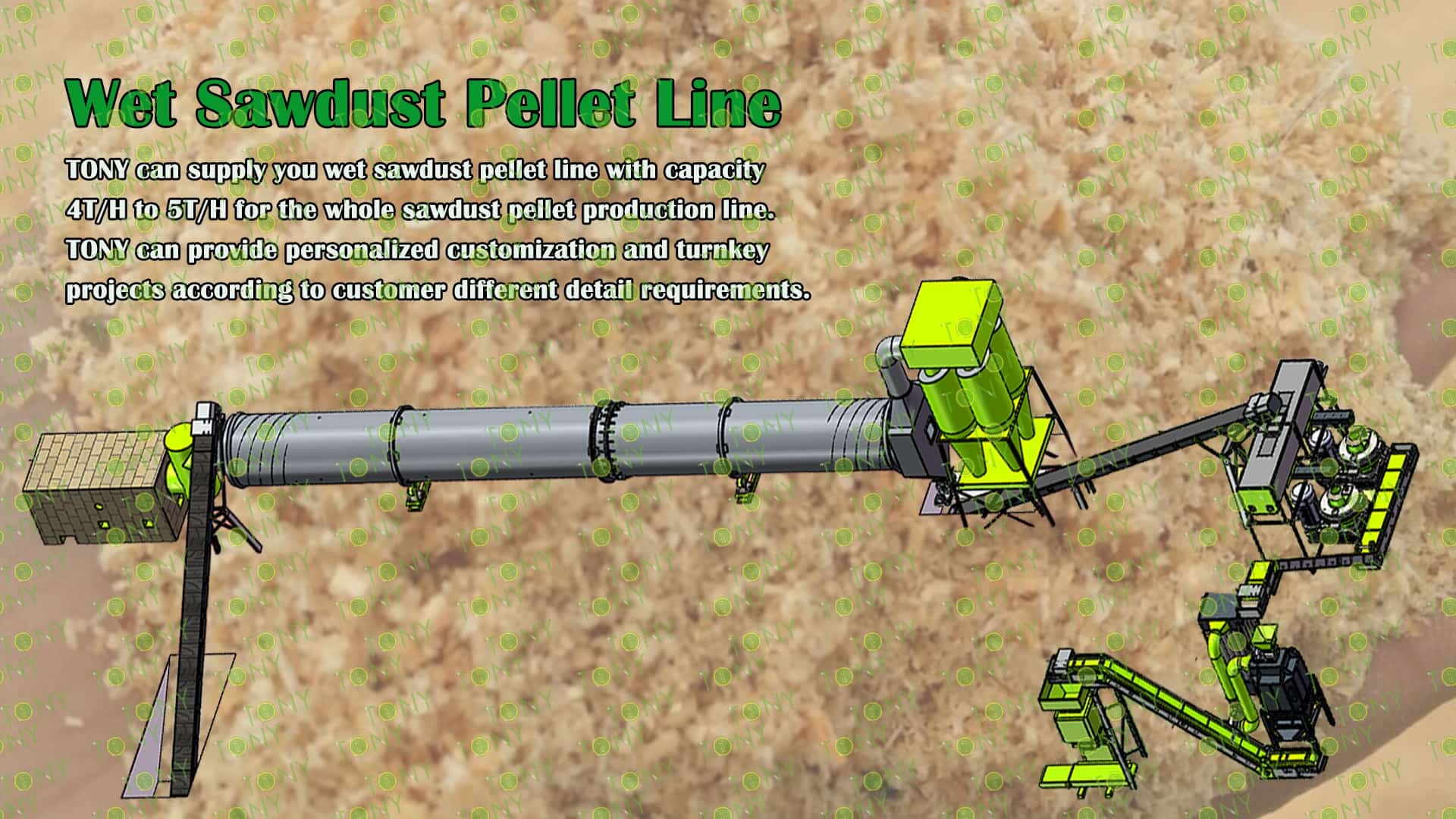
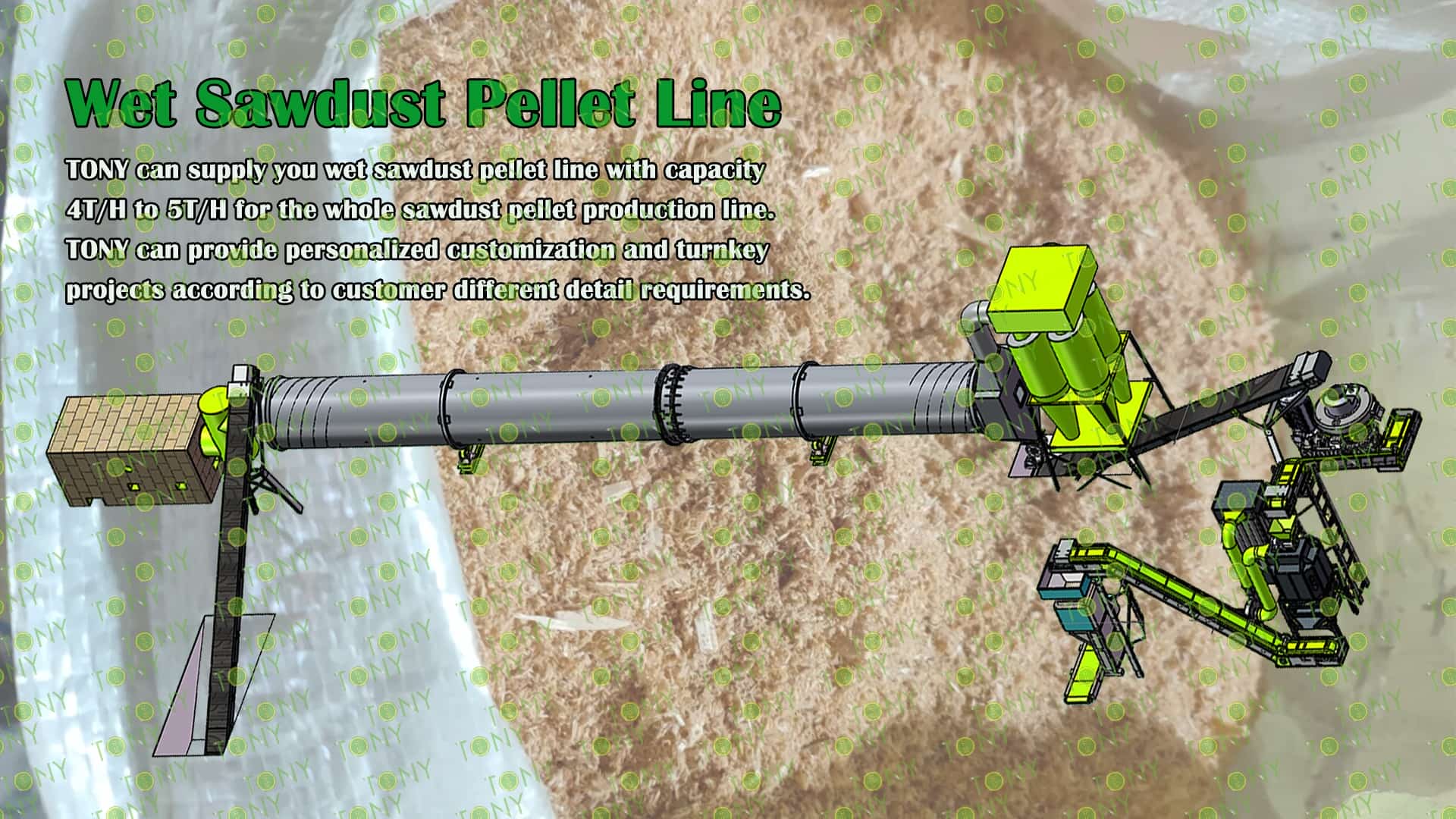
Modular combination: A typical production line consists of "drying equipment (humidification) → granulation equipment (forming) → cooling equipment (cooling) → screening equipment (screening) → packaging equipment". Each module can be flexibly increased or decreased according to production capacity requirements (for example, for small production lines, some auxiliary equipment can be omitted).
Continuous operation: Through the connection of various links such as conveyor belts and screw feeders, automated continuous production from raw material input to finished product output is achieved.
3.Application scenarios of wet sawdust biomass pellet processing equipment
Processing equipment provides fuel for factory boilers and kilns (replacing coal and oil), such as steam boilers in textile and food processing plants, and heating kilns in the ceramics and building materials industries. Stable pellet production ensures energy supply.
(1)Power Generation:Biomass power plants require large quantities of standardized pellets as fuel. Large-scale processing equipment can meet the power plant's stringent requirements for pellet calorific value and density, ensuring efficient combustion and stable power generation.
(2)Residential Heating:For pellets used in home fireplaces and space heaters, processing equipment must control pellet size and hardness to accommodate residential combustion equipment. The equipment's refined production capabilities directly impact the user experience of these pellets.
(3)Environmental Protection and Waste Management:In waste and sewage treatment plants, processing equipment converts organic waste (such as sludge and food waste) into fuel pellets for resource recovery. Corrosion-resistant and clogging-resistant designs are crucial.

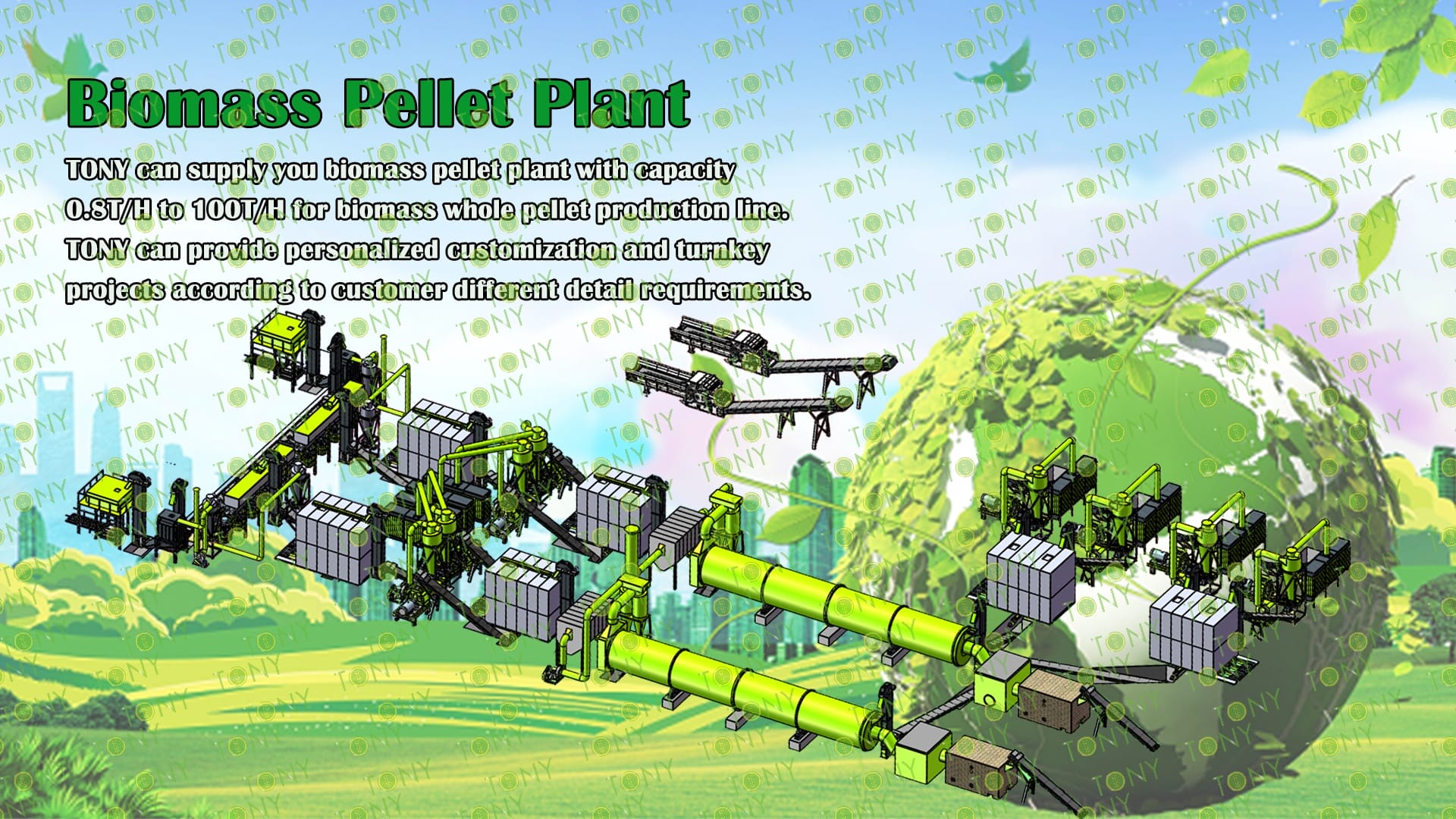
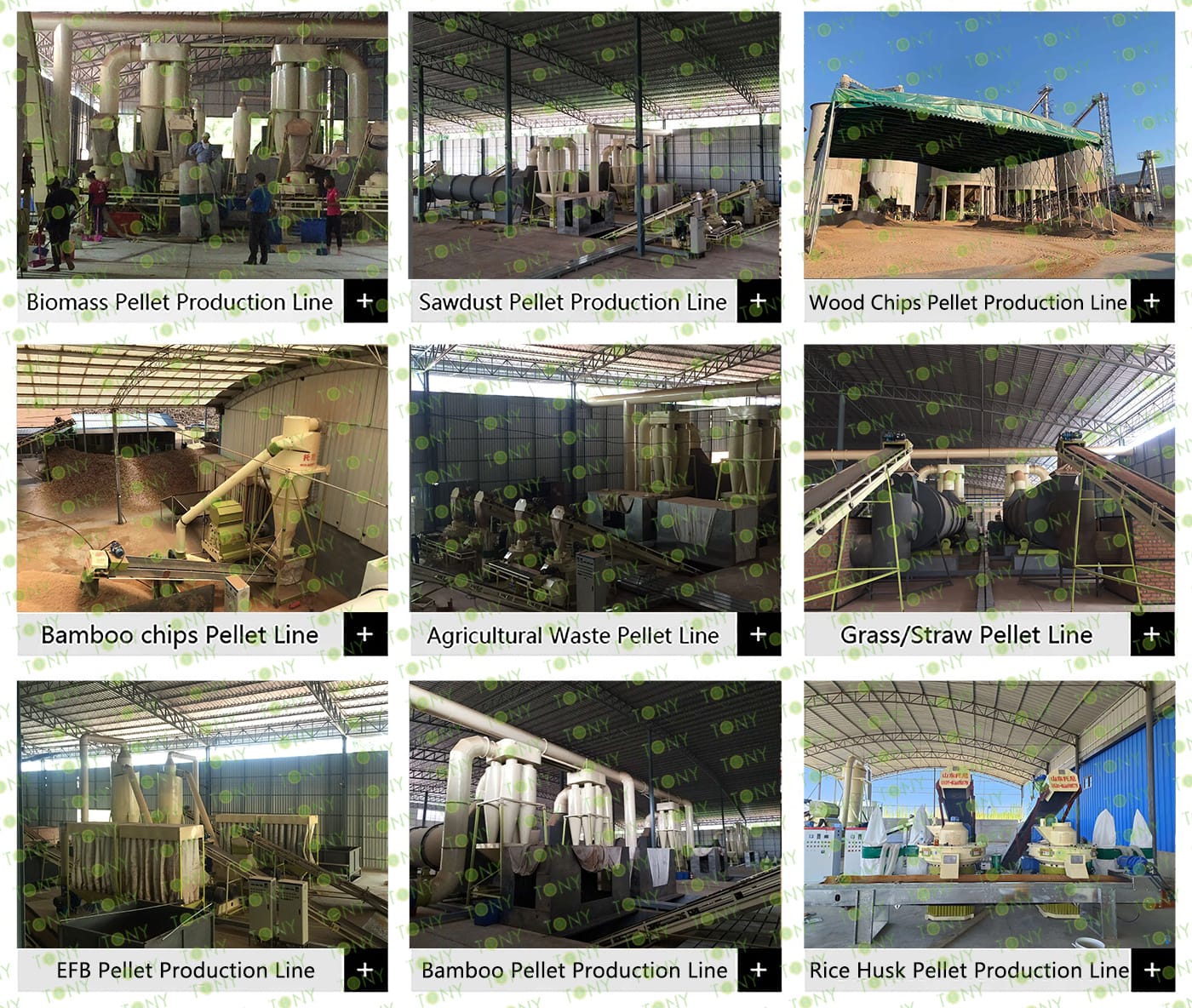
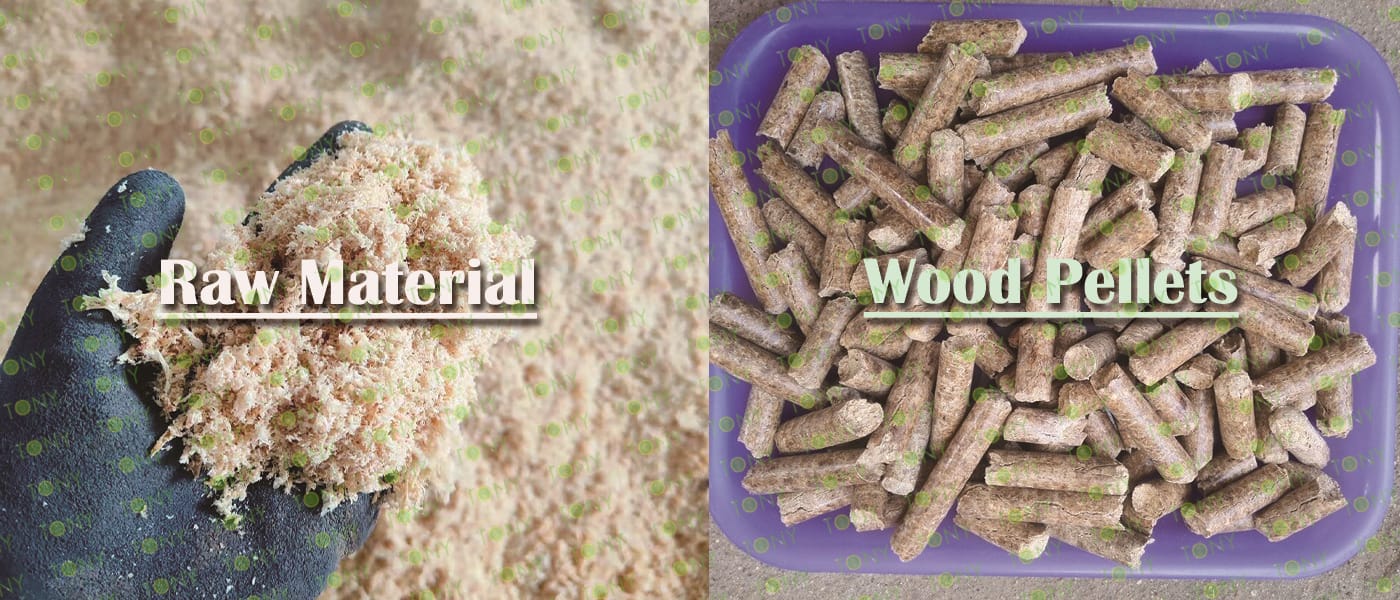
TONY Brand 36-45Ton/Hour Wet Sawdust Pellet Manufacturing Plant can take wet sawdust,wood chips, various types of wood - related biomass materials, such as wood pallets ,branches, wood logs, and wood shavings. After pretreatment and processing, wet sawdust is solidified into high - density wood pellet fuel. This fuel is an ideal substitute for coal and oil and plays a role in energy conservation and emission reduction.
1. Capacity: 36-45Ton/Hour
2. Raw materials: Wet sawdust
3. Moisture: Wet type, about 40%.
4. Application: All kinds of wood sawdust or more waste wood raw materials
Suitable customers:Wood processing plants, furniture manufacturing plants, construction sites, landscaping companies and other places with advantageous sawdust resources
5. Finished Pellets Markets: Large power plants ,domestic heating, industrial heating, combustion heat, heating systems, boiler rooms, school canteens, foundry heat sources.


1. Project Name: Wet Sawdust Pellet Production Line
2. Raw Material: All kinds of wet sawdust
3. Moisture Content of Raw Material: 40%
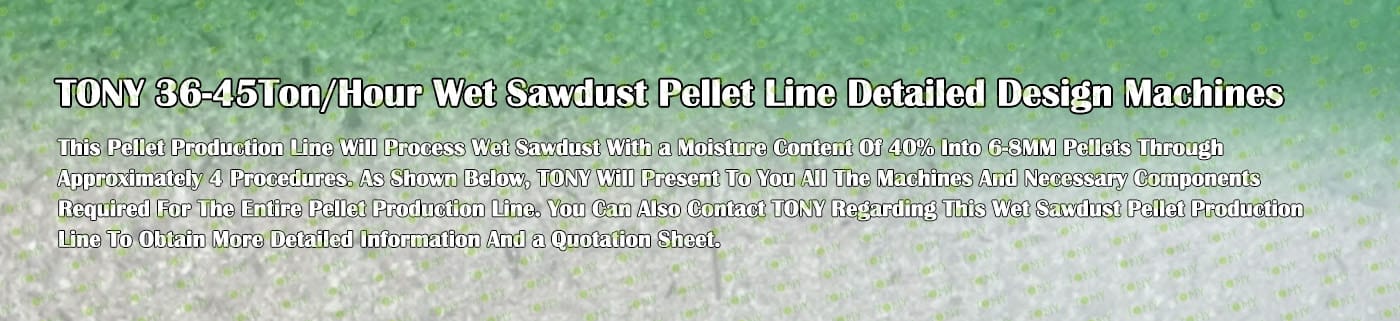
4. Capacity: 36-45 tons per hour
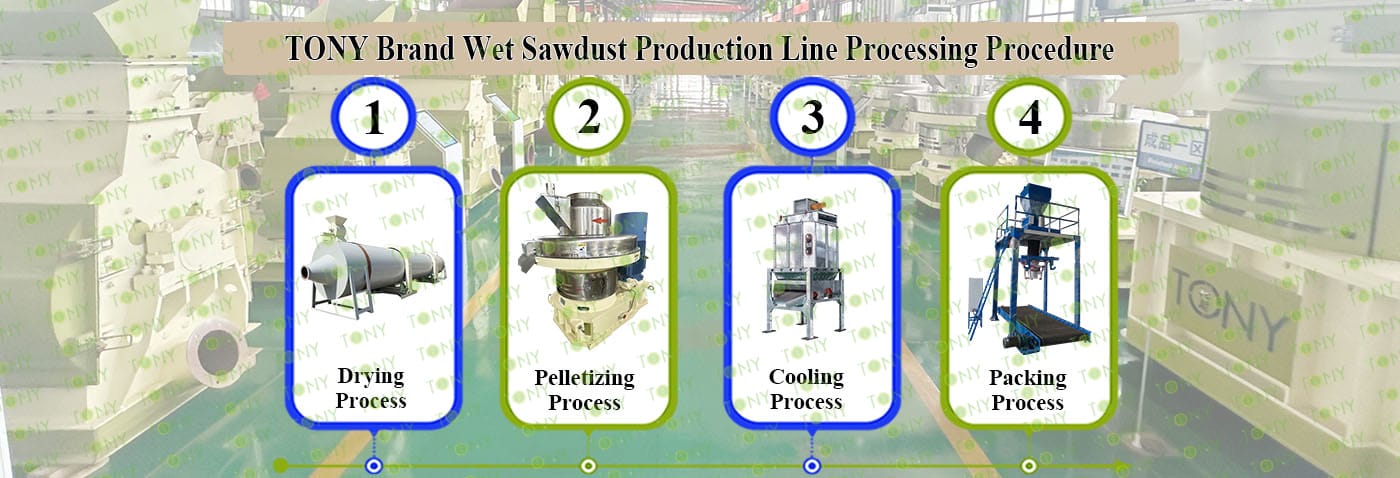
5. Process: Drying Process - Pelletizing Process - Cooling Process - Packing Process
6. Main Equipment: Rotary Drum Dryer-3.2-24m, TONY Pellet Machine TYJ860-Ⅲ-280KW, Galvanized Pellets Cooler, Ton Packing Machine and Belt Conveyors

|
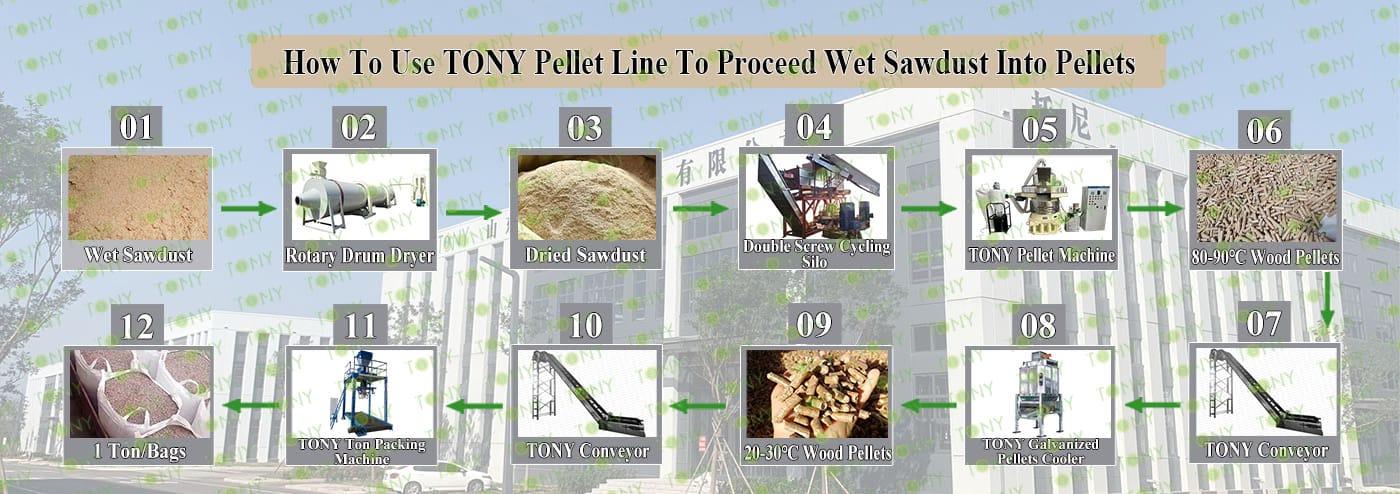
How to use the TONY pellet production line to make pellets from wet sawdust? The process mainly includes the following steps and equipment: 1. Use TONY rotary drum dryer to dry the sawdust with a 40% moisture content down to a moisture content of 10%-15%. 2. Use TONY vertical ring die pellet machine to produce pellets with a diameter of 6-8 mm. 3. Use TONY galvanized pellets cooler to cool the pellets from 80-90°C to 20-30°C. 4. Use TONY ton packing machine to pack the pellets into bags, each weighing 1 ton. For more detailed information and quotations, you can contact TONY. TONY can provide all the above - mentioned products at highly competitive prices and with excellent quality. |
|
||||||||||||||||||||||||||||||||||||||||
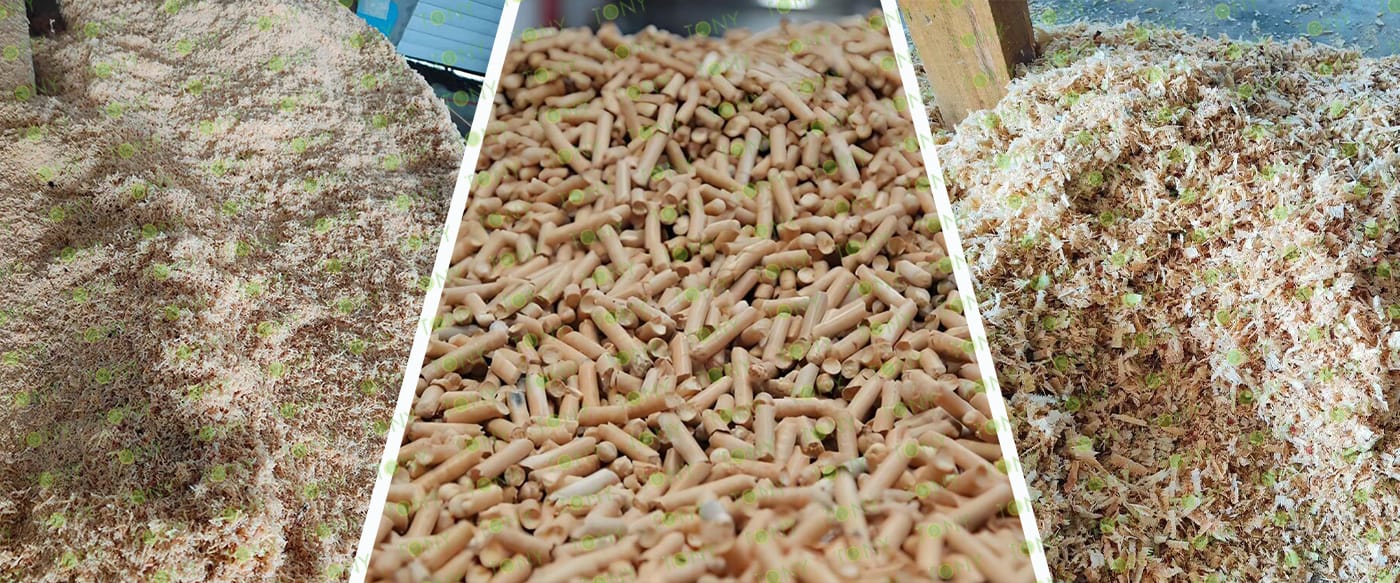
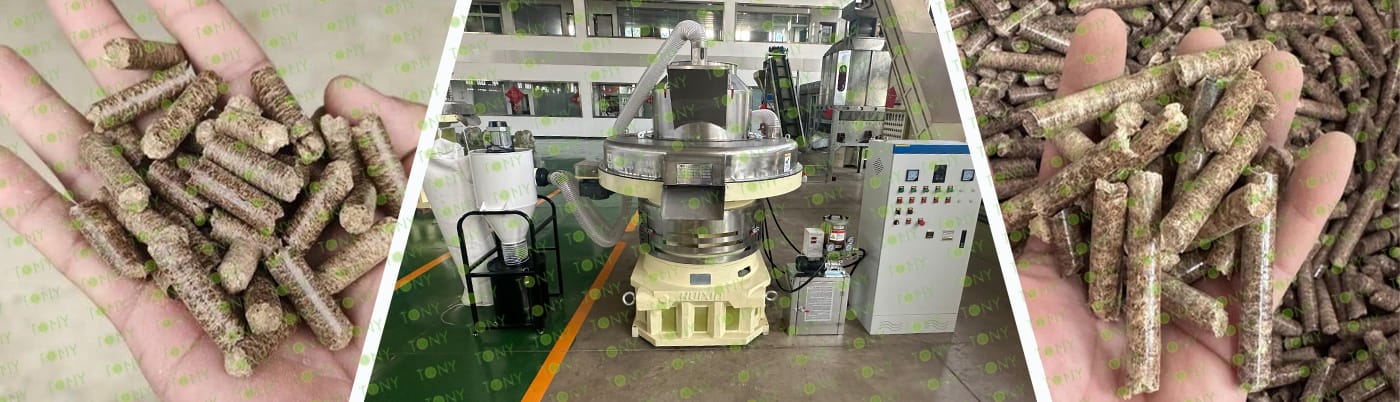
| Next, TONY Will Introduce To You All The Necessary Machinery That Will Be Used For The Whole Pellet Production Line. Some Machines Can Be Custom - Made By Customers According To Different Customers' Detailed Demands. Contact TONY For More Details, Including Quotation And Layout. | ||
 |
 |
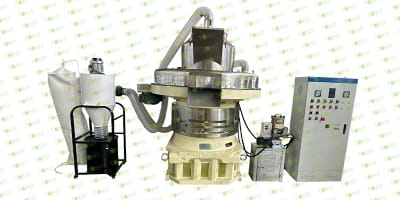 |
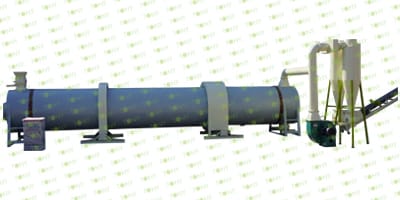
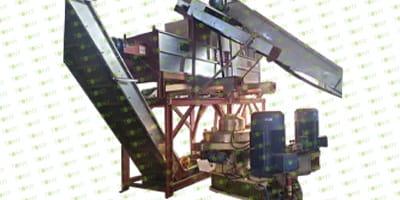
| Rotary Drum Dryer | Double Screw Cycling Silo | Vertical Ring Die Pellet Machine |
| 1.To Dry The 40% Sawdust Into 10-15% Sawdust. 2.Model: THGD3.2-24*4sets 3.Capacity:9-12Ton/Hour/Set |
1.To Stroage Sawdust Before Pellet Machine; Adjust The Speed Of Sawdust Entering The Pellet Machine 2.Model: TLC-15*3sets 3.Capacity:12-15Ton/Hour/Set |
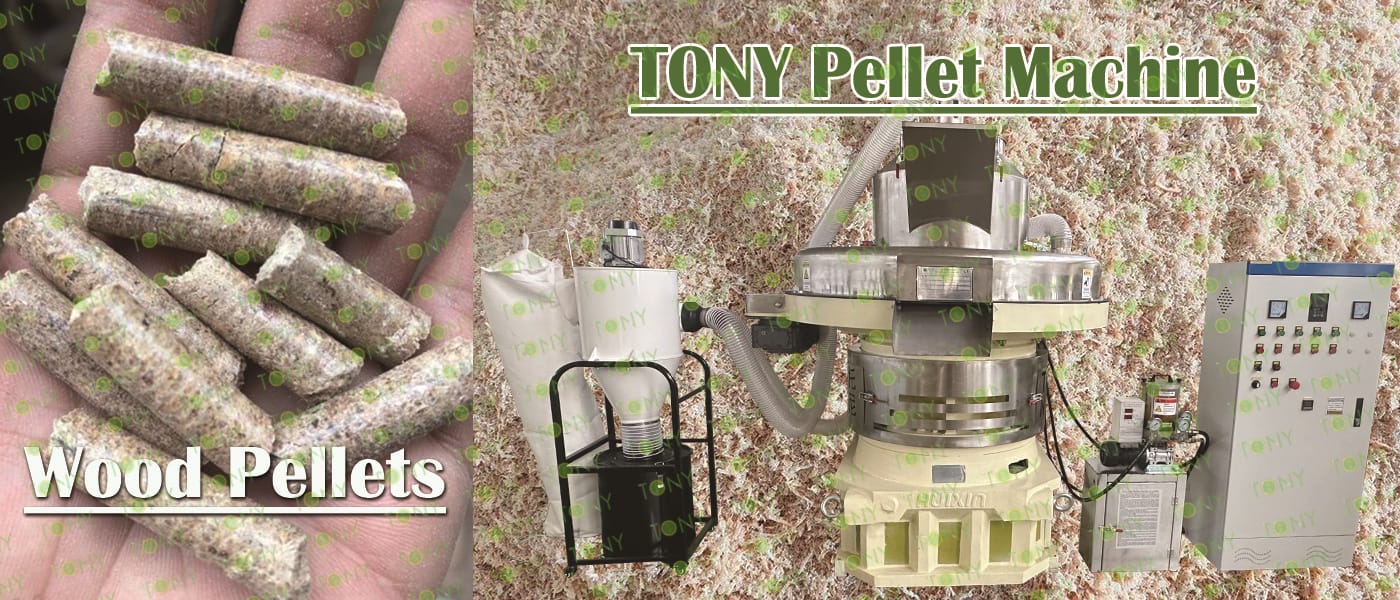
.To Press Dry Sawdust Into 6-8mm Biomass Pellets 2.Model: TYJ860-III-280KW*9sets 3.Capacity:4-5Ton/Hour/Set 4.New 304SS Type |
 |
 |
 |
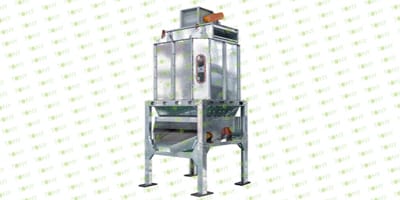
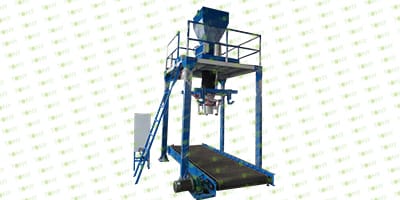
| Galvanized Pellets Cooler | Ton Packing Machine | Belt Conveyor |
| 1.To Cool Pellets From 80-90℃ Into 20-30℃ 2.Model: TCN-10*3sets 3.Capacity:36-45Ton/Hour |
1.To Pack Pellets Into 1Ton/Bags. 2.Model: TBD*3sets 3.Capacity:36-45Ton/Hour |
1.To Transport Sawdust,Pellets. 2.Width: 80cm*20sets 3.Capacity:Designed With The Whole Line |

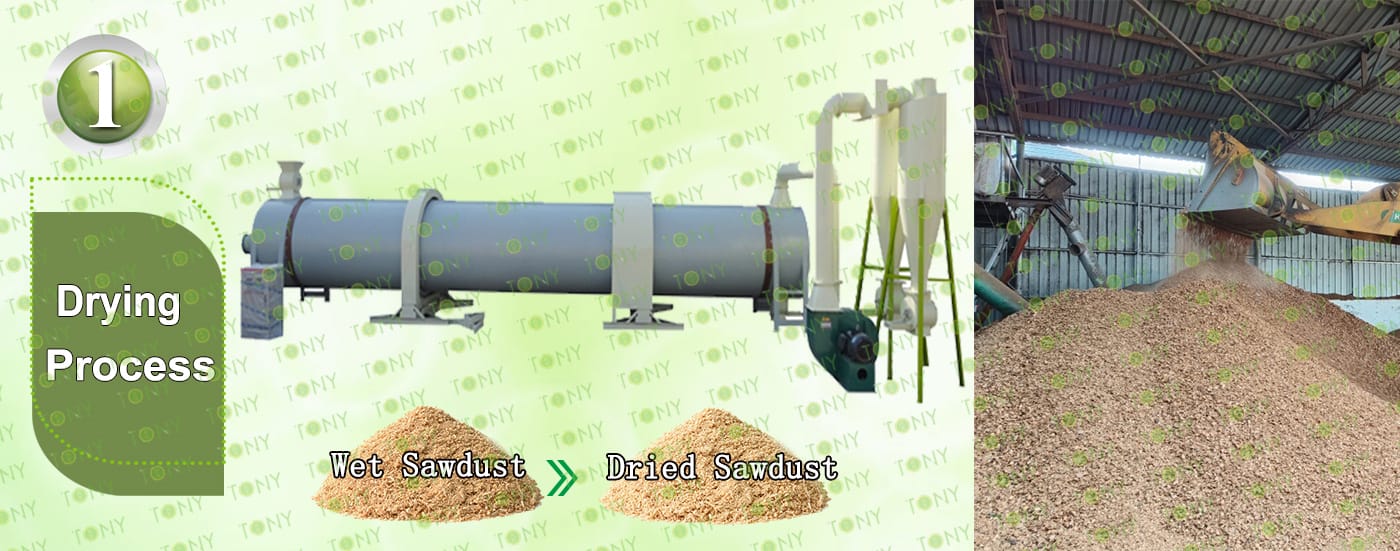
1.Sawdust Drying Process:
A.This process is mainly used to dry the sawdust from 40% to 10-15%.
B.Capacity:36-45Ton/Hour.
C.TONY use 4 sets of 3.2*24m rotary drum dryer for this process, TONY hot blast stove is made of firebrick pan, shell with H steel plate as the frame. There are 3 layers of fire blocking device inside, which can effectively prevent the fire from entering the tumble dryer.Customers can choose to use waste wood, biomass pellets, natural gas, etc. as fuel for the hot air furnace
TONY dryer use spiral tube material, and is not easy to deform.
Unlike other manufacturers with iron plate splicing welding, very easy to deformation.
Main Parts:
(1)TONY's Rotary Drum Dryer Main Body. (Reducers With Motors and Pips.)
(2)TONY's Hot Stove.
(3)Fan Blower+Cyclone With Airlock.
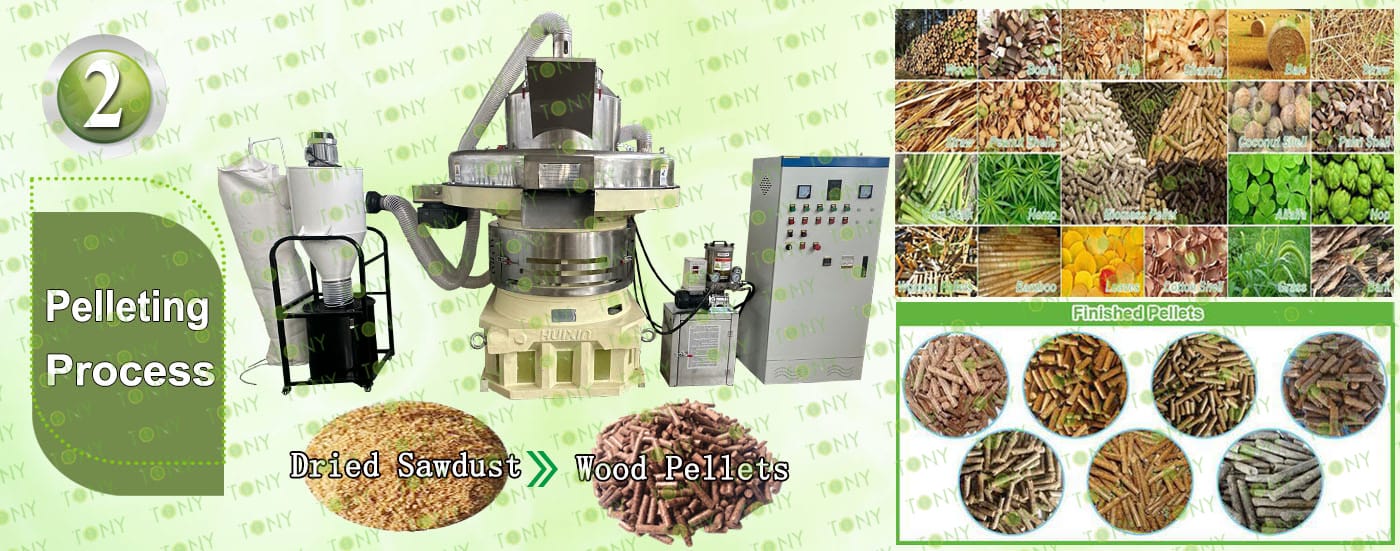
2.Pelletizing Process:
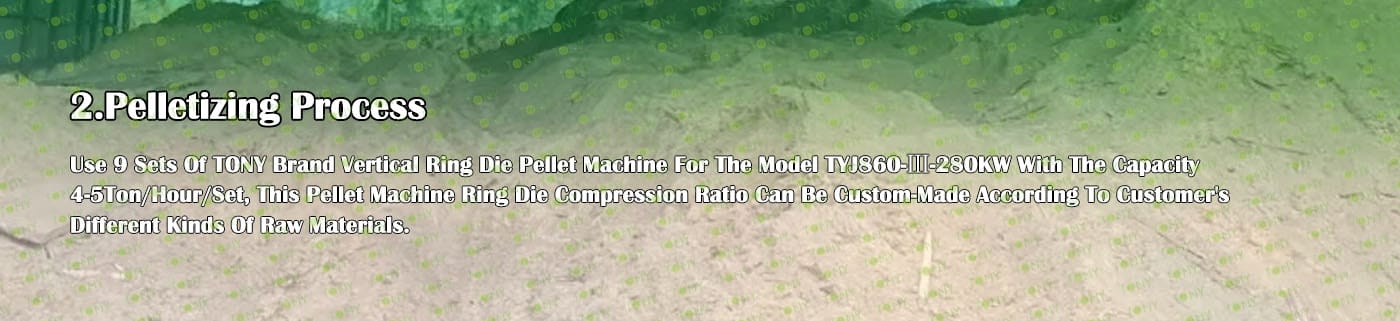
A.This process is mainly used to to product pellets into φ6-8mm.
B.Capacity:36-45Ton/Hour.
C.TONY brand vertical ring die pellet machine TYJ860-III-280KW*9sets
D.Double screw cycling silo is added above the pellet machine, which has the advantages of saving space, saving labor, intelligently controlling the feeding speed, not easy to block the material, and improving production efficiency.
Main Parts:
(1)TONY's New Vertical Ring Die Pellet Machine.
(2)Cyclone And Bags Dust Collectors.
(3)Automatic Lubrication System.
(4)Electrical Cabinets.
You can chose TONY new type SS304 pellet machine

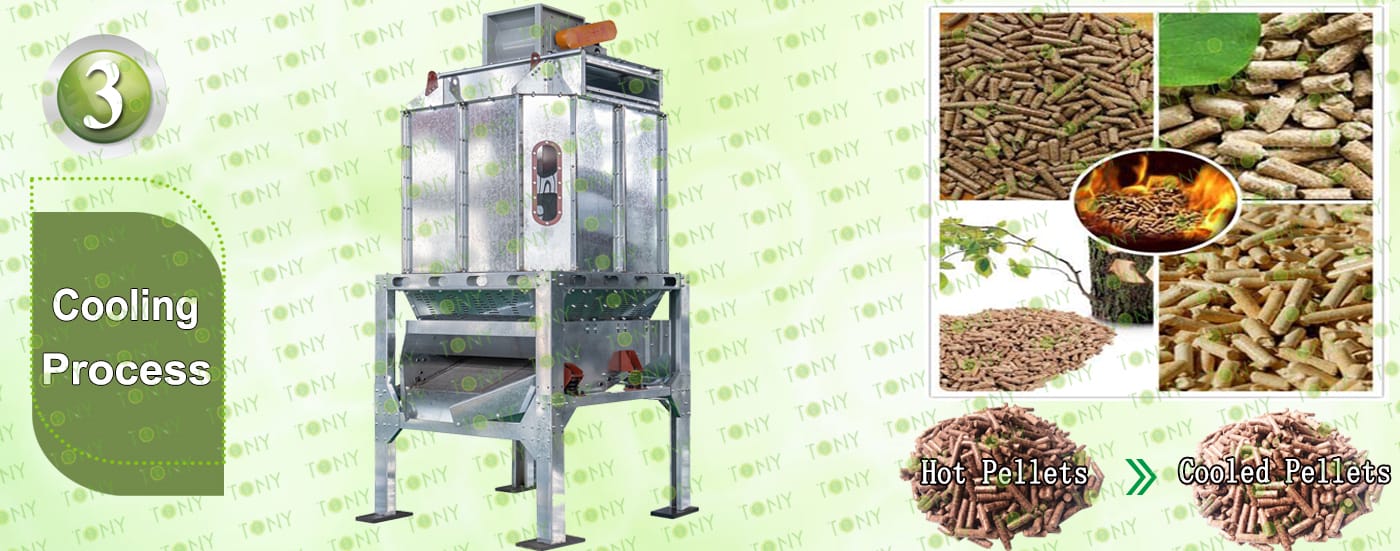
3.Cooling Process:
A.This process is mainly used to cool pellets from 80-90℃ to 20-30℃
B.Capacity:36-45Ton/Hour.
C.TONY brand galvanized pellets cooler *3sets
Main Parts:
(1)TONY's Galvanized Pellets Cooler With Vibrating Screen.
(2)Cyclone And Bags Dust Collectors.
(3)Fan Blower.
(4)Connect Pipes.

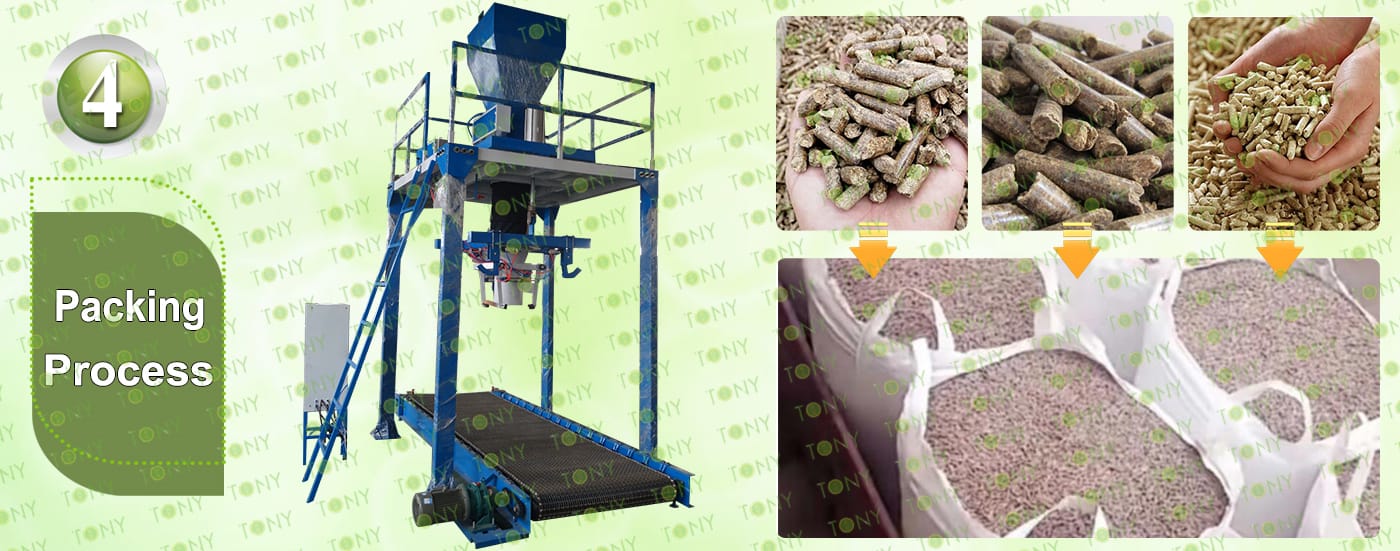
4.Packing Process:
A.This process is mainly used to pack pellets into 1Ton/Bags.
B.Capacity:36-45Ton/Hour.
C.TONY band ton packing machine*3sets
Main Parts:
(1)TONY Ton Packing Machine
(2)Electronic Platform Scale Metering System
(3)Automatic Tare, Zero, and Drop Correction Functions
(4)Feeding System Features Fast, Medium, and Slow Feeding Speeds to Ensure Measuring Accuracy

Project Advantages: Market competitiveness and environmental value
1.Excellent product characteristics and strong market competitiveness
Biomass pellets have many excellent characteristics. Their calorific value is high, generally 4200-4800 kcal/kg, close to medium-quality coal, and can provide sufficient heat; they have low ash content, and very little ash remains after combustion, reducing cleaning costs and environmental pollution; they have low emissions, extremely low sulfur content (usually <0.05%), and low nitrogen content. The pollutants such as SO₂ and NOₓ produced during combustion are much lower than those produced by burning coal, meeting strict environmental protection standards and are highly favored by customers with high environmental protection requirements. In addition, biomass pellets have a regular shape, mostly cylindrical pellets with a diameter of 6-12mm and a length of 20-50mm. The density can reach 0.8-1.2g/cm³, high hardness, not easy to break, and easy to store and transport, further enhancing the market competitiveness of the product.
2.Significant environmental benefits and high social value
The development of the biomass pellet industry is to "turn waste into treasure" for agricultural and forestry waste, realize the recycling of resources, and reduce the pollution of waste to the environment. At the same time, during the combustion process of biomass pellets, the carbon dioxide emissions are basically balanced with the carbon dioxide absorbed during plant growth, achieving "carbon neutrality", helping to alleviate the greenhouse effect and improve air quality. This not only complies with the national environmental protection policy, but also establishes a good corporate image for entrepreneurs, bringing high social reputation and potential business opportunities.
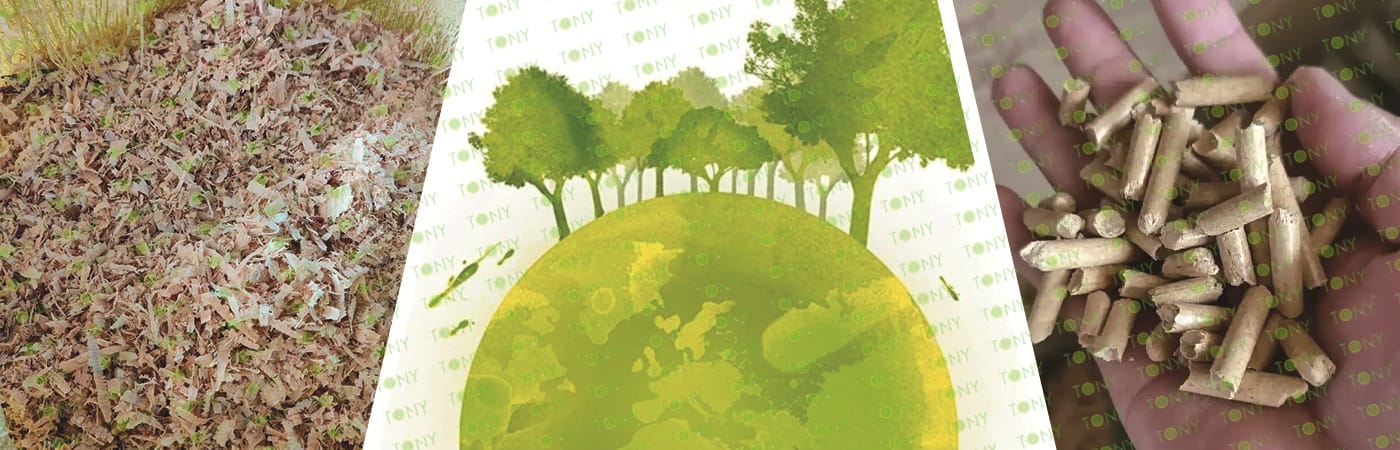
The environmental advantages of sawdust biomass pellets are their core competitive advantage, primarily reflected in their "low carbon footprint throughout their lifecycle" and "low pollution during combustion":
1.Low carbon and renewable, aligning with the "double carbon" goal:
Sawdust, derived from wood processing waste, is a "biomass resource." The CO₂ absorbed during its growth is essentially balanced by the CO₂ released during combustion, achieving "carbon neutrality." Compared to coal (a fossil energy source whose combustion releases ancient carbon), it can reduce net carbon emissions by over 90%, making it an ideal alternative fuel for achieving both peak and neutral carbon emissions.
2.Low combustion pollutants, reducing the environmental burden:
Combustion is almost sulfur-free (sulfur content ≤ 0.05%) and nitrogen-free (nitrogen content ≤ 0.5%), and does not produce large amounts of SO₂ and NOₓ (the main pollutants from traditional coal combustion), which can significantly reduce the risk of acid rain and haze. The ash content is extremely low (only 2%-5%, far lower than the 10%-20% of coal). The small amount of ash remaining after combustion can be used as organic fertilizer or auxiliary building materials, eliminating the problem of "secondary pollution of solid waste."
3.Non-spontaneous combustion and safe storage:
Pellets have a low moisture content but a dense structure, resulting in a small contact area with air. They won't spontaneously combust at room temperature (they require a high-temperature open flame to ignite). In contrast, pulverized coal and loose sawdust, due to their large surface area, are susceptible to spontaneous combustion due to oxidation and heat generation. Pellets also contain no volatile flammable gases, preventing explosions from leaks like liquefied petroleum gas.
4.No toxic gases are produced during combustion, ensuring safe use:
Pellets do not produce toxic gases such as carbon monoxide (CO) and formaldehyde (assuming complete combustion and suitable combustion equipment). Incomplete combustion of coal can easily produce CO, while firewood can easily produce smoke and tar. Pellets are more health-friendly and are particularly suitable for applications involving direct human or product contact, such as residential heating and food processing (such as drying tea leaves and medicinal herbs).




2025 Tony Machinery - All Rights Reserved. Map