





















As biomass energy equipment specifically designed to process rice husks, an agricultural waste product, the emergence and widespread adoption of rice husk pellet machine not only address the challenges of rice husk resource utilization but also have profoundly impacted the biomass energy industry from multiple perspectives, including raw material boundaries, technological innovation, energy structure, and industrial ecology. This impact is reflected in the expansion of waste-to-energy conversion pathways and the advancement of the industry towards more segmented, efficient, and more aligned with the agricultural economy.
Rice husk is a major byproduct of rice processing, with an annual global production exceeding 150 million tons. However, it has long been considered a burden due to its difficulty in utilization:
1. Rice husk is hard, has a low density (approximately 0.1 t/m³), and a medium calorific value (3000-3500 kcal/kg). Its direct combustion efficiency is only 10%-15%, and it easily causes slagging in the furnace.
2. Indiscriminate stacking breeds mold, while open-air burning releases large amounts of particulate matter and greenhouse gases, becoming a significant source of agricultural pollution.
The rice husk pellet machine utilizes targeted process innovations (such as crushing and grading in the pre-processing stage and high-temperature and high-pressure bonding during molding) to compress the previously loose and difficult-to-process rice husk into pellets with a density of 1.1-1.2 t/m³.
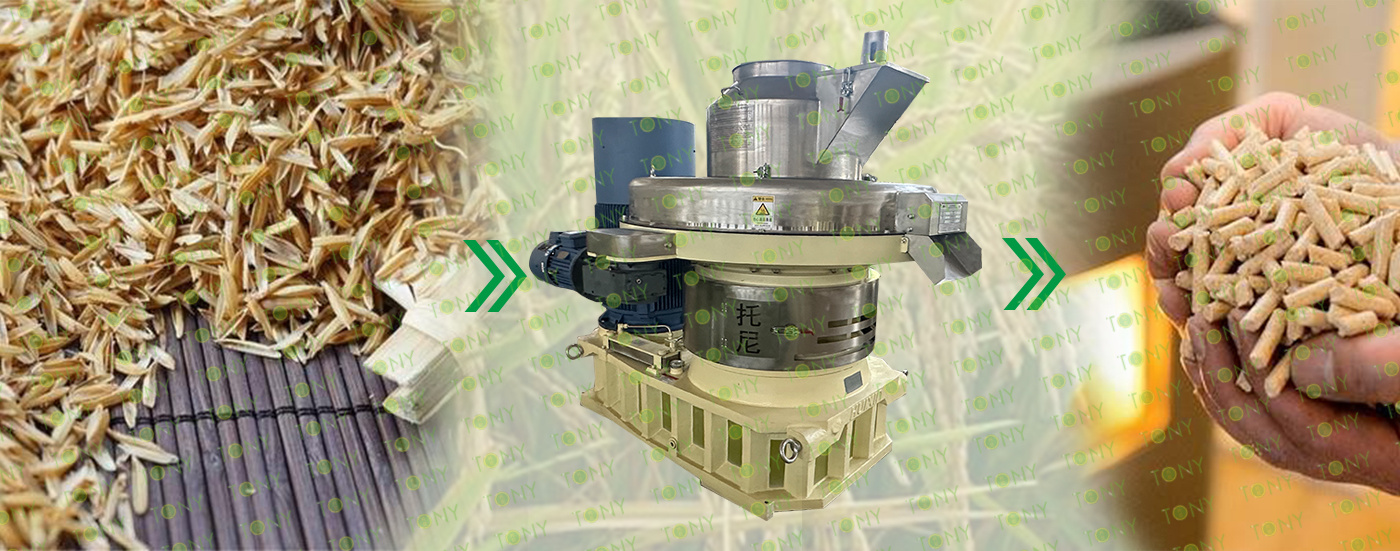
3. It solves the problems of high transportation costs and large storage space for rice husk (the pellets are only 1/10 the volume of the original husk);
4. It improves combustion efficiency to 80%. The rice husk pellet machine processes rice husks on a large scale, integrating them into the carbon cycle of "planting - processing - energy - replanting":
5. Coal Replacement: Burning 1 ton of rice husk pellets can replace 0.8 tons of standard coal, reducing CO₂ emissions by approximately 1.8 tons (the carbon emission coefficient of coal is 2.4tCO₂/t, while rice husk pellets have near-zero net carbon emissions due to their carbon cycle characteristics).
6. Pollution Reduction: Open-air burning of rice husks in my country generates approximately 120,000 tons of PM2.5 annually. By converting rice husks into clean fuel, the rice husk pellet machine can reduce this pollution by 120,000 tons. Over 80%.
This environmental value of "transforming waste into energy" has made carbon neutrality for biomass energy no longer just a theoretical concept, but a quantifiable and verifiable practice, enhancing the industry's competitiveness and strengthening policy support in the global energy transition.