





















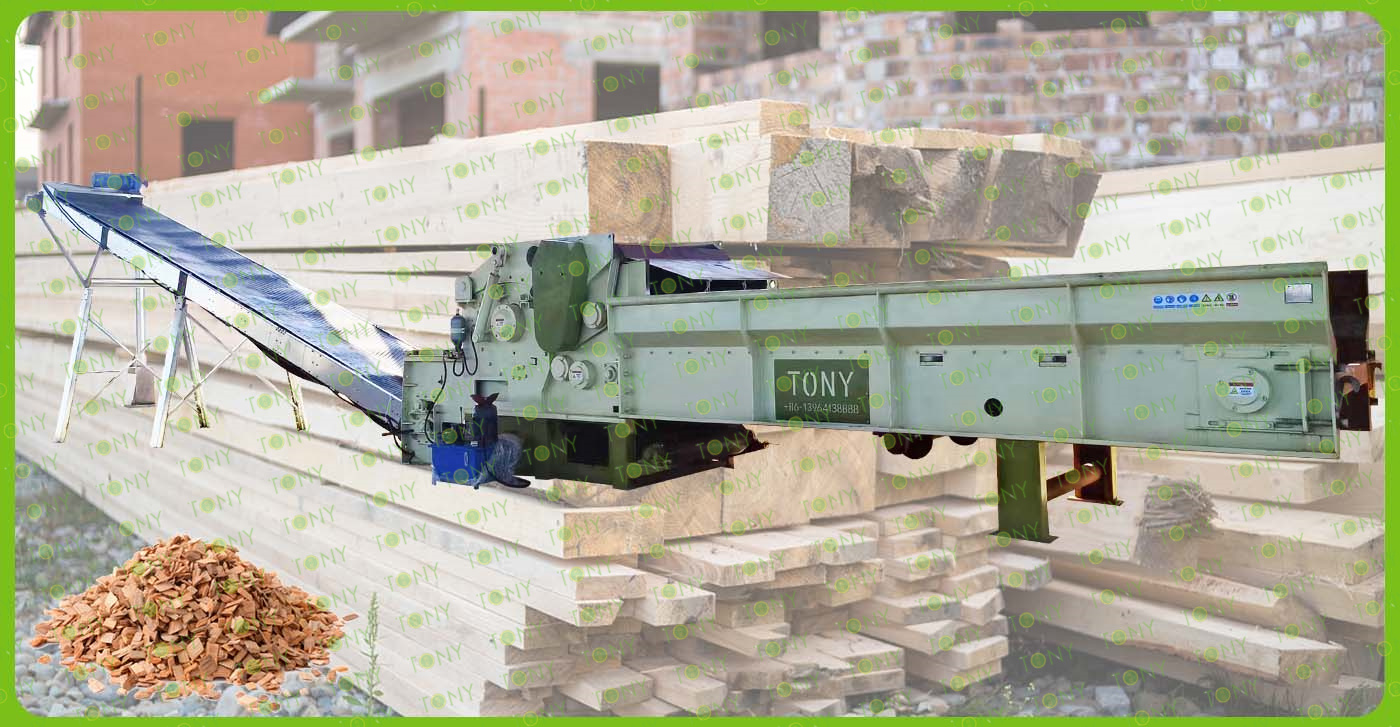
As a key piece of equipment in the pre-processing process for industries like biomass energy, wood-based panels, and papermaking, wood chippers focus on strengthening the foundation for downstream production through "pre-processing standardization." This standardization encompasses not only the uniformity of physical form but also encompasses the entire supply chain, encompassing raw material characteristics, production efficiency, and product quality. This standardization is specifically reflected in the following three dimensions:
1.Physical Form Standardization: Solving the Problem of "Disordered" Raw Materials
Biomass raw materials (such as wood, straw, and branches) are naturally characterized by a variety of shapes and sizes (ranging from a few centimeters to several meters in length and from a few millimeters to tens of centimeters in diameter). Directly feeding these raw materials into pelletizing and board-making processes can lead to fluctuating equipment loads and low processing efficiency.
Chippers precisely control cutting parameters (such as disc speed, blade spacing, and feed rate) to transform irregular raw materials into uniformly sized chips/debris (typically 15-50 mm in length, 3-10 mm in thickness, and no more than three times the thickness). The value of this standardized format lies in:
Reducing downstream equipment wear: This prevents blockage of large pieces of raw material or excessive accumulation of fine powder, minimizing wear on pelletizer rollers and dies, and reducing issues such as "localized overheating" during the papermaking process.
Improving material flowability: Uniformly sized wood chips are less likely to clump during conveying, drying, and mixing, ensuring stable feedstock on the production line and reducing the need for manual intervention.
Optimizing subsequent process efficiency: For example, standardized wood chips can reduce drying time by 20%-30% before pelleting, and moisture content can be more easily controlled within the ideal range of 15%-20%.
2.Homogenizing Raw Material Characteristics: Setting the Standard for Quality Stability
Raw materials of different types and parts (e.g., trunks and branches, new and old wood) vary in density, hardness, and fiber structure. Directly mixing and processing them can lead to quality fluctuations in downstream products (e.g., biomass pellets and fiberboard). Standardized pre-processing for wood chippers can achieve uniform raw material properties through "graded cutting + mixing and homogenization":
Differentiated cutting parameters are used for different raw materials, such as hardwood and softwood (e.g., increasing the cutter head speed for hardwood) to ensure consistent fiber morphology after chipping.
A conveying system allows for proportional mixing of different batches of raw materials, minimizing the impact of individual batch variations on the final product (for example, fluctuations in the calorific value of biomass pellets can be controlled within ±0.5 MJ/kg).
Standardization is the cornerstone of "cost reduction, efficiency improvement, and quality upgrade."
Standardized pre-processing for wood chippers may appear to be a simple "cutting process," but it actually involves precise control of raw material morphology and properties, providing downstream production with controllable, stable, and efficient raw materials. This standardization not only reduces equipment wear and improves production efficiency, but also ensures consistency in the end product from the source. It is a key step in the transition from "extensive production" to "precision manufacturing" in industries such as biomass energy and wood processing.