





















Pellet mill is core equipment in feed and biomass fuel production. Prolonged high-pressure friction operation easily leads to component wear, making the stock of commonly used spare parts crucial for ensuring continuous and stable equipment operation. Pellet mill spare parts are mainly divided into three categories: core forming wear parts, transmission and sealing components, and auxiliary protective components, suitable for various models such as ring dies and flat dies.
Core forming components are the most frequently worn and replaced spare parts, primarily ring dies, flat dies, and pressure roller shells. Ring dies and flat dies are key to material forming, compressing material through die holes to form pellets. Long-term operation can lead to die hole wear, blockage, and deformation, directly affecting pellet quality and output, requiring regular replacement. Pressure roller shells, which work in conjunction with the die to compress material, have a wear-resistant surface layer that is easily worn. Wear can result in insufficient extrusion pressure and loose output, making them essential spare parts. Additionally, alloy cutters are also core wear parts, responsible for cutting the formed pellets. Dull blades can cause pellets of inconsistent length, requiring timely replacement.
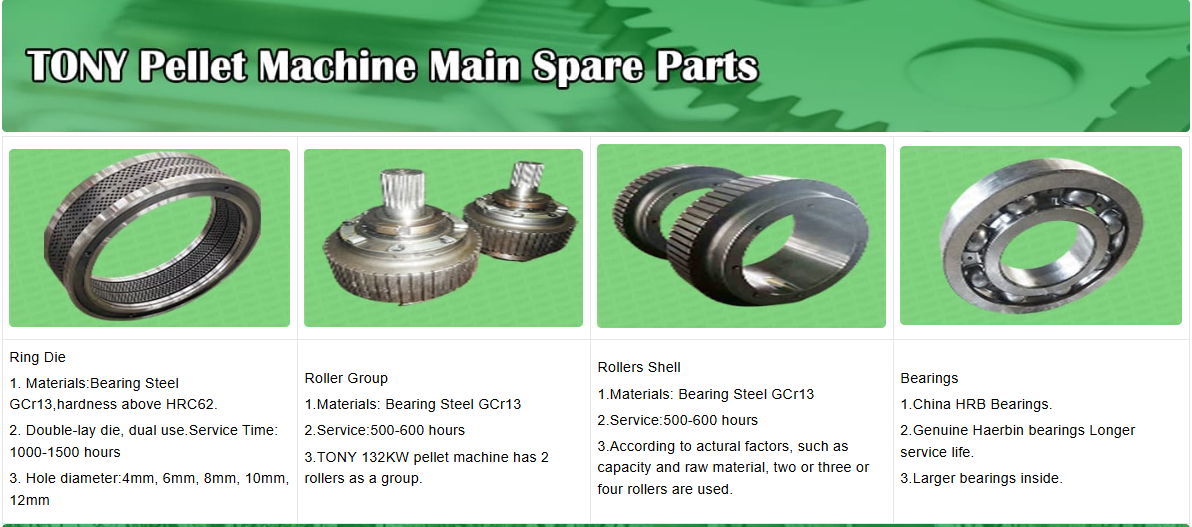
Transmission and sealing spare parts ensure the equipment's power transmission and operational tightness, including bearings, gaskets, belts, and chains. Bearings support the rotating shaft of the equipment; prolonged high-speed operation can easily lead to wear and jamming, causing abnormal noise and vibration. Sealing gaskets prevent material leakage and dust from entering the machine body; they must be replaced immediately after aging or damage. Belts and chains transmit power; prolonged stretching can cause them to loosen and break, making them frequently replaced parts during routine maintenance. Additionally, a sufficient stock of small transmission components such as main shafts, pins, and eccentric shafts is necessary to address wear and tear.
Although auxiliary protective spare parts wear out more slowly, they are crucial for safe equipment operation. Safety pins are core protective components; they automatically break to protect the machine body during overload and jamming, and must be readily available for replacement. Furthermore, components such as wear plates, screens, and agitator blades are subject to wear and deformation from prolonged material impact; advance stockpiling can effectively reduce downtime for maintenance and ensure production continuity.