





















Cracking, loosening, and flaking are extremely common problems in biomass pellet production. These issues not only reduce pellet yield and affect the finished product's appearance but also cause unstable calorific value, high transportation losses, and poor combustion efficiency. Pellet cracking is mostly not caused by a single equipment malfunction but primarily stems from four core factors: raw material moisture content, grinding fineness, compression pressure, and cooling process. Identifying the root cause is key to effective solutions.
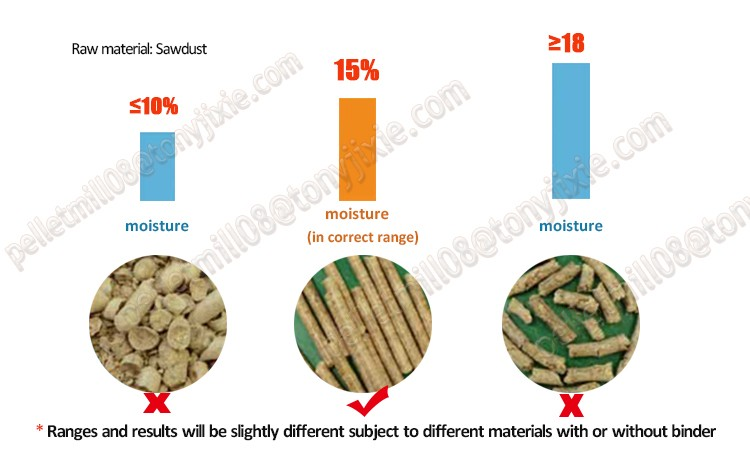
Imbalanced raw material moisture content is the primary cause of pellet cracking. Biomass pellet formation relies on the high-temperature softening and binding of lignin in the material. When the moisture content is too high, the internal water content of the pellet is large. After forming, continuous evaporation of internal moisture creates pores and gaps within the pellet, leading to shrinkage and cracking. Conversely, if the raw material is too dry, the lignin cannot soften sufficiently, resulting in insufficient material binding. After extrusion, the structure is loose, making it prone to longitudinal cracks, breakage, and flaking. In industry production, a raw material moisture content of 12%–18% is the optimal range for pellet formation.
Inadequate grinding fineness is also a key contributing factor to pellet cracking. Uneven raw material crushing and excessive large particles can lead to insufficient compaction during extrusion, resulting in large gaps between materials and uneven stress on the internal structure. The resulting pellets are loose, lack toughness, and are prone to surface cracking and overall breakage. Only uniformly finely crushed materials can ensure even extrusion, tight bonding, and compact, full pellets.
Improper equipment pressure and temperature settings directly affect the molding effect. Insufficient pelleting pressure or die compression ratio prevents sufficient extrusion and solidification, resulting in low pellet density, a loose structure, and susceptibility to cracking. Low temperatures lead to incomplete softening of lignin, loss of binding properties, and a significant decrease in pellet stability. Furthermore, inadequate cooling in the production line, where high-temperature pellets suddenly come into contact with room-temperature air, creates excessive temperature differences, generating thermal expansion and contraction stress and causing surface cracking.
In addition, improper raw material ratios, excessive impurities, and severe die wear can also damage the pellet structure and exacerbate cracking. Therefore, by precisely controlling the four key aspects of moisture, fineness, pressure, and cooling during production, and by standardizing the production process, the problem of pellet cracking can be completely solved, and high-density, crack-free, and durable biomass pellets can be produced.